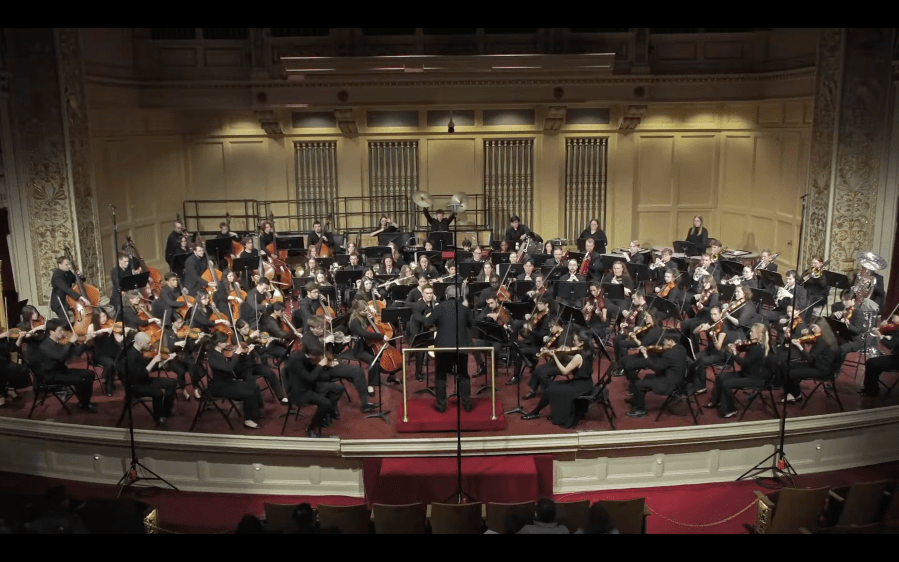
Gerard Schwarz guests conducts Carnegie Mellon Philharmonic

Carnegie Mellon Philharmonic
Carnegie Mellon Chorus
Gerard Schwarz, conductor
Thomas W. Douglas, chorus director

Carnegie Music Hall
Pittsburgh, PA
April 8, 2026

Hanson: Lament for Beowulf, Op. 25
Mahler: Symphony No. 1 in D major

In what must have been a remarkable opportunity for students at the Carnegie Mellon School of Music, distinguished conductor Gerard Schwarz led the university Philharmonic and Chorus in a compelling program. To reach those outside the Pittsburgh area, the performance was live-streamed (linked below). Schwarz currently serves as music director of the Palm Beach Symphony, but was most notable for a more than quarter-century tenure at the helm of the Seattle Symphony, doing much raise that ensemble’s prominence. He has also produced a vast discography, impressive not just for its scope, but for its inclusion of neglected and contemporary repertoire.

The evening began with Howard Hanson’s Lament for Beowulf, a work the conductor recorded at Seattle as part of his five-disc survey of the composer’s symphonies. Setting text extracted from the Anglo-Saxon epic, the work embodies Hanson’s neo-Romantic style, a language individual yet highly approachable. It was premiered by the Chicago Symphony in 1926, two years after Hanson took directorship of the Eastman School of Music, a position he would hold for forty years.

Ominous pulses began, answered by some craggy writing for brass. The choral layer brought to life this ancient text, swelling to great power in music that favored directness of expression instead of hidden layers of meaning. This performance made me keen to explore more of the American composer’s output.

Performing a Mahler symphony is a major achievement for a student orchestra, and the CMU musicians offered a remarkably polished reading of the First. The invocation of springtime at the beginning was particularly touching and certainly seasonally appropriate, and led to the opening movement’s radiant coda. Offstage brass gave an added aural dimension, resounding through the elegant Carnegie Music Hall.

The second movement was given with the infectious lilt of the ländler, and the klezmer sounds along with the double basses far up into their highest register made the Feierlich und gemessen all the more striking. A primal scream as only Mahler could do opened the finale. Wild and unsettled on the surface yet tautly controlled in this performance, it brought the work to a close in all its brassy brilliance.