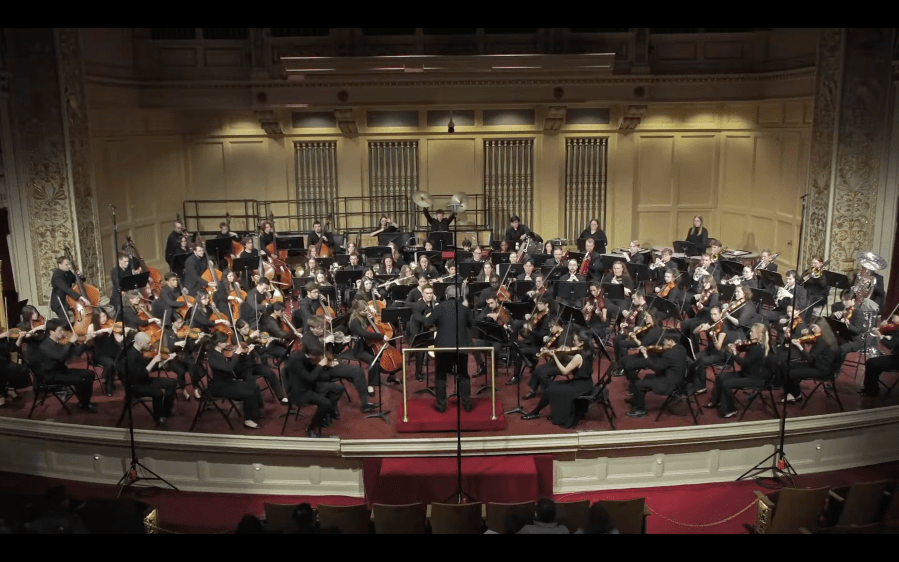
Gerard Schwarz guests conducts Carnegie Mellon Philharmonic

Carnegie Mellon Philharmonic
Carnegie Mellon Chorus
Gerard Schwarz, conductor
Thomas W. Douglas, chorus director

Carnegie Music Hall
Pittsburgh, PA
April 8, 2026

Hanson: Lament for Beowulf, Op. 25
Mahler: Symphony No. 1 in D major

In what must have been a remarkable opportunity for students at the Carnegie Mellon School of Music, distinguished conductor Gerard Schwarz led the university Philharmonic and Chorus in a compelling program. To reach those outside the Pittsburgh area, the performance was live-streamed (linked below). Schwarz currently serves as music director of the Palm Beach Symphony, but was most notable for a more than quarter-century tenure at the helm of the Seattle Symphony, doing much raise that ensemble’s prominence. He has also produced a vast discography, impressive not just for its scope, but for its inclusion of neglected and contemporary repertoire.
The evening began with Howard Hanson’s Lament for Beowulf, a work the conductor recorded at Seattle as part of his five-disc survey of the composer’s symphonies. Setting text extracted from the Anglo-Saxon epic, the work embodies Hanson’s neo-Romantic style, a language individual yet highly approachable. It was premiered by the Chicago Symphony in 1926, two years after Hanson took directorship of the Eastman School of Music, a position he would hold for forty years.

Ominous pulses began, answered by some craggy writing for brass. The choral layer brought to life this ancient text, swelling to great power in music that favored directness of expression instead of hidden layers of meaning. This performance made me keen to explore more of the American composer’s output.

Performing a Mahler symphony is a major achievement for a student orchestra, and the CMU musicians offered a remarkably polished reading of the First. The invocation of springtime at the beginning was particularly touching and certainly seasonally appropriate, and led to the opening movement’s radiant coda. Offstage brass gave an added aural dimension, resounding through the elegant Carnegie Music Hall.

The second movement was given with the infectious lilt of the ländler, and the klezmer sounds along with the double basses far up into their highest register made the Feierlich und gemessen all the more striking. A primal scream as only Mahler could do opened the finale. Wild and unsettled on the surface yet tautly controlled in this performance, it brought the work to a close in all its brassy brilliance.

Chamber Music Pittsburgh delights in Bach’s Brandenburgs

Members of the Pittsburgh Symphony Orchestra and Carnegie Mellon School of Music
Carnegie Music Hall
Pittsburgh, PA
November 24, 2025

Bach: Brandenburg Concerto No. 3 in G major, BWV 1048
Bach: Brandenburg Concerto No. 1 in F major, BWV 1046
Bach: Brandenburg Concerto No. 2 in F major, BWV 1047
Bach: Brandenburg Concerto No. 5 in D major, BWV 1050
Bach: Brandenburg Concerto No. 6 in B-flat major, BWV 1051
Bach: Brandenburg Concerto No. 4 in G major, BWV 1049

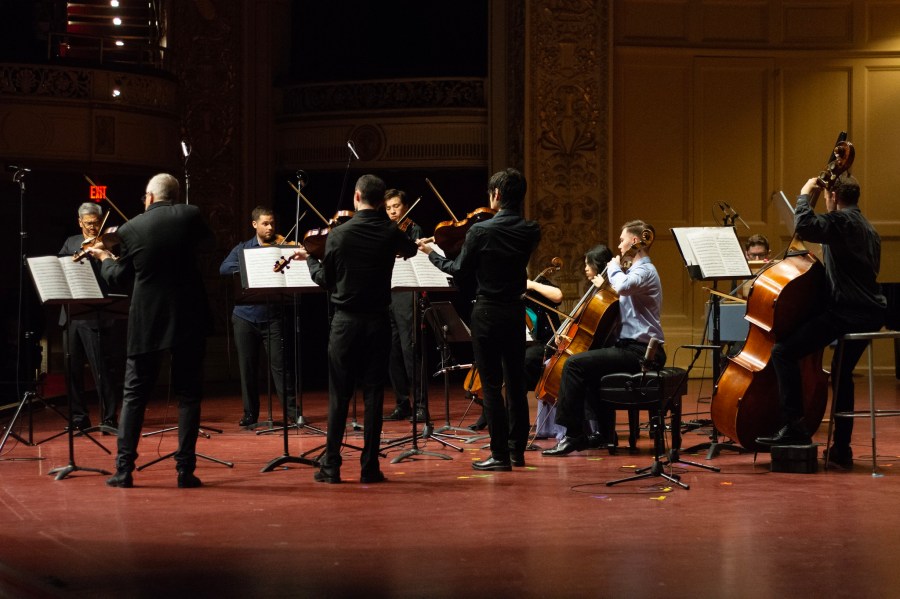
Bach’s six Brandenburg Concertos have nothing to do with the holidays, yet their cheery, celebratory spirit makes them a favorite this time year. A survey of the complete series made for a satisfying evening at Chamber Music Pittsburgh during the week of Thanksgiving. No two of these concertos are scored for the same instrumentation, and a wide panoply of performers were culled from the ranks of the Pittsburgh Symphony Orchestra and the Carnegie Mellon School of Music.

Brandenburg Concertos at Carnegie Music Hall, photos credit Michael Canton

No conductor was engaged (and nod to historical practice), and modern orchestral instruments were used (a nod to contemporary practice). And instead of proceeding in strictly numerical order, thoughtful contrasts and complements were suggested. The evening began with No. 3, a slighter work cast for strings alone, but charming and radiant nonetheless.

In No. 1, the strings were in mellifluous blend with the winds and brass (although the intonation of the horns left something to be desired). Under the astute leadership of violinist Callum Smart, the ensemble was in tight cohesion, culminating in the regal rhythms of the closing polonaise. Concerto No. 2 was marked by the resound of the clarion trumpet, in an impossibly high register.

No. 5 is a pianist’s dream with its outsized role for the keyboard. The remarkable Frederic Chiu was featured as soloist, playing on a modern Steinway rather than a harpsichord or fortepiano. He had a sparkling chemistry with the ensemble, with self-assured playing that rippled across the keyboard, and offered a mesmerizing take on the massive cadenza. No. 6 is perhaps the most intimate and understated of them all, and I liked the rich, husky tone the musicians conveyed. With a pair of flutes (used in place of recorders) and a complement of strings, the gentle and pastoral No. 4 drew the set to a spirited, heartfelt close.