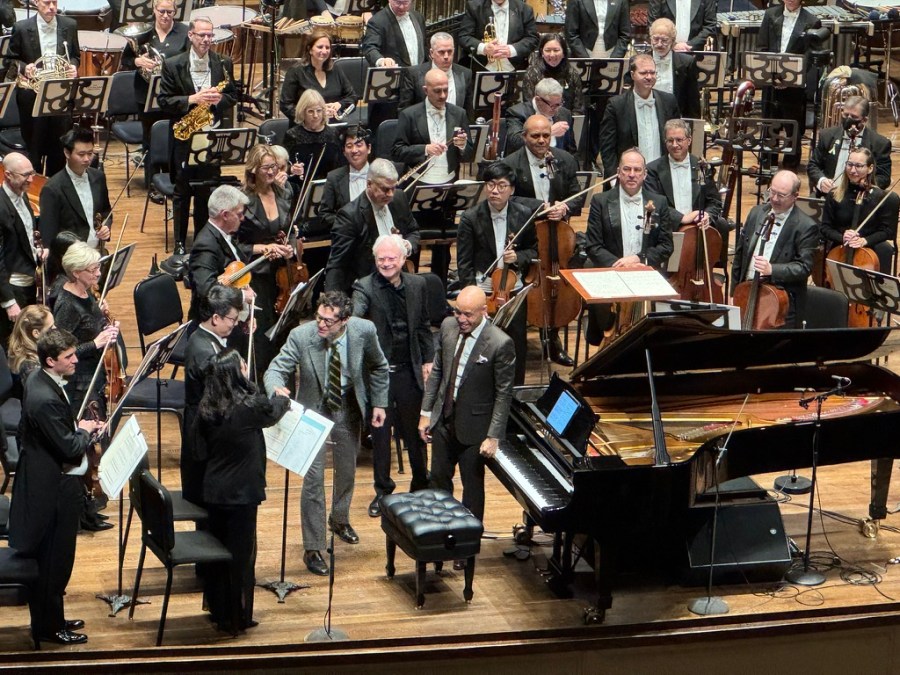
The Cleveland Orchestra John Adams, conductor Aaron Diehl, piano Mandel Concert Hall Severance Music Center Cleveland, OH February 19, 2026
Ives: From Greenland’s Icy Mountains (from Symphony No. 4) Andres: Made of Tunes Adams: Frenzy Piazzolla-Adams: Three Tangos
Following the previous week’s American program with Barbara Hannigan, The Cleveland Orchestra presented a second offering of American works with the doyen of living American composers himself at the podium, John Adams. Adams has a long, fruitful history with TCO and this years marks the 35th anniversary of his local debut.
ProMusica Chamber Orchestra David Danzmayr, conductor Katherine McLin, violin St. Mary Catholic Church Columbus, OH March 20, 2022
Vaughan Williams: Fantasia on a Theme by Thomas Tallis Piazzolla: The Four Seasons of Buenos Aires (arr. Desyatnikov)
Encore: Piazzolla: Adios Nonino
Nestled in the heart of German Village, Saint Mary Catholic Church – a structure that dates back to 1868 – recently underwent an extensive restoration, and proved to be a gorgeous setting for last weekend’s ProMusica performance. The program opened with Vaughan Williams’ Fantasia on a Theme by Thomas Tallis, and the plaintive theme reflected the solemnity of the setting in this glance backwards in English musical history. Though the heavy reverb in a church can create acoustical challenges, here the resonance seemed to further enhance the richness of the strings – and indeed, the work’s 1910 premiere occurred at Gloucester Cathedral. The work is scored for double string orchestra with string quartet, and one was struck by the clarity of the interplay between the various subsets of the ensemble.
ProMusica at St Mary, photo credit ProMusica
The remainder of the evening was devoted to Piazzolla, continuing the celebration of his centenary begun at last month’s chamber music concert. The Four Seasons of Buenos Aires, rendered in Spanish as Estaciones porteñas – porteño being the demonym for one from a port city, though it chiefly refers specifically to the Argentine capital – paints a colorful, vibrant portrait of the composer’s homeland. The work was presented in its arrangement by Leonid Desyatnikov, recast so as to highlight connections with its Vivaldian predecessor, including some direct quotations from Vivaldi, and scoring for string orchestra with violin soloist, a role undertaken with aplomb and verve by concertmaster Katherine McLin.
A sultry energy began the opening Otoño porteño, and a series of glissandos showed the composer to be a master of effect. A languid lyricism offered some pointed contrast. Invierno porteño was noted for its substantial passage for cello (Marc Moskovitz), thorny at first but melting into the songful. Given the concert’s coincidence with the vernal equinox, Primavera porteña was certainly the most topical – and perhaps the most ardently lyrical of the set, though not without some sprightly violin acrobatics. Verano porteño made for a vigorous finale with some particularly striking timbres achieved through sul ponticello playing from the soloist. Danzmayr and the orchestra offered a further Piazzolla work as an encore, Adios Nonino. Touchingly lyrical and with rich chromatic harmonies, it burgeoned into a big-boned, almost Hollywood-esque sumptuousness. The performance was billed as “a delightful evening” – a promise amply delivered upon.
Victoria Moreira, violin Joel Becktell, cello Renee Keller, marimba & percussion The Fives Columbus, OH February 18, 2022
Piazzolla: Fugata Piazzolla: Mumuki Barilari: The Mysteries Kodály: Duo for Violin and Cello, Op. 7 Diz: Poema Bachiano Granados: Danzas españolas, Op. 37 – No. 2 “Orientale” Bartók/arr. Kraeuter – Selected Hungarian Folk Melodies Piazzolla: Milonga del Angel Piazzolla: Lo que vendrá
Friday evening saw the first of a series of three chamber music performances featuring various combinations of players from ProMuscia. The venue of choice was The Fives, ProMusica’s home last season wherein they found a way to perform even in the midst of the pandemic. Friday brought forth Victoria Moreira, Joel Becktell, and Renee Keller in music for violin, cello, and marimba – an intriguing if unusual combination. There’s a paucity of repertoire for these forces as one might expect; most of the selections were thus presented in arrangements or adaptations to fit the ensemble at hand. The program was refreshingly offbeat, with the common thread being each composers’ engagement with the folk music traditions of their respective homelands. Additionally, there was acknowledgement of Astor Piazzolla’s centenary (last year) with two pairs of the Argentine’s works framing the recital.
L-R: Victoria Moreira, Renee Keller, and Joel Becktell, photo credit ProMusica
Piazzolla’s Fugata opened the program, its contrapuntal intricacies tinged with a distinctive Latin flavor. From the onset, we were introduced to the appealing sound of this novel instrumentation and the fluid chemistry of the three musicians on stage. Mumuki was touchingly lyrical, and the scoring put the often stratospherically high cello in the spotlight. A world premiere followed, namely a three movement suite titled The Mysteries by Uruguayan composer Elbio Barilari, currently on the faculty at the University of Illinois at Chicago. Barilari was on hand to introduce the work and noted his inspiration from ancient Greece, which he aptly called the “cradle of civilization.” The opening “Delphic Dance” featured an incessant, pulsating dance rhythm, and some passing references to Greek scales. “Adonic Dance” was marked by a busy part for the violin, while the closing “Eleusinian Dance” was grounded by the beating drum and pizzicato cello. I wasn’t convinced the work probed as deep as the title suggested, but the music was as good-natured as the composer himself.
The first half closed with the most substantial work on the program, Kodály’s Duo for Violin and Cello. Cast in three movements, the first was commanding and big-boned, making much of the resources of the duo. One was taken by the resonant cello in the middle movement, often blending with high register of the violin for striking combinations, and the rapid-fire finale showcased the consummate virtuosity of these two string players. The most interesting discovery of the evening to my ears opened the latter half: Poema Bachiano, a 2008 work by Argentine composer Ezequiel Diz. A duet for marimba and violin, the work alludes to Bach’s D minor keyboard concerto in gesture and inflection. The complexities of the work were delivered with aplomb in this compelling reimagining of its Bachian influences, and perhaps something of a response to Villa-Lobos’ Bachianas Brasileiras. A second work of the same title was composed in 2020, a piece I suspect would be worth exploring on a future chamber music program.
A series of short pieces by Granados and Bartók followed, presented in arrangements for cello and percussion – thereby exhausting all combinatorial possibilities of the instruments available. A pulsating accompaniment in the marimba made a touching backdrop for the wistful cello melody of Granados’ “Orientale.” The three Bartók arrangements employed the vibraphone as the percussion of choice – its metallic brilliance was quite striking, further encouraging a piquant, folksy charm. Two Piazzolla selections reunited all members of the trio and brought us back full circle. Milonga del Angel was dreamy and evocative, while Lo que vendrá (“What is to come,” suggesting a sense of possibility after the composer’s formative studies with Boulanger) made for a rousing finish.