Yuja Wang headlines Pittsburgh Symphony’s glittering gala

Pittsburgh Symphony Orchestra
Manfred Honeck, conductor
Yuja Wang, piano
David McCarroll, violin
Justine Campagna, violin
Heinz Hall
Pittsburgh, PA
September 20, 2025

López: “Techno” from Fiesta!
Strauss Jr: Éljen a Magyár!, Op. 332 (arr. Nischkauer)
Shostakovich: “Waltz II” from Suite for Variety Orchestra No. 1
Sarasate: Navarra
Mascagni: “Intermezzo” from Cavalleria rusticana
Mancini: Strings on Fire
Tchaikovsky: Piano Concerto No. 1 in B-flat minor, Op. 23

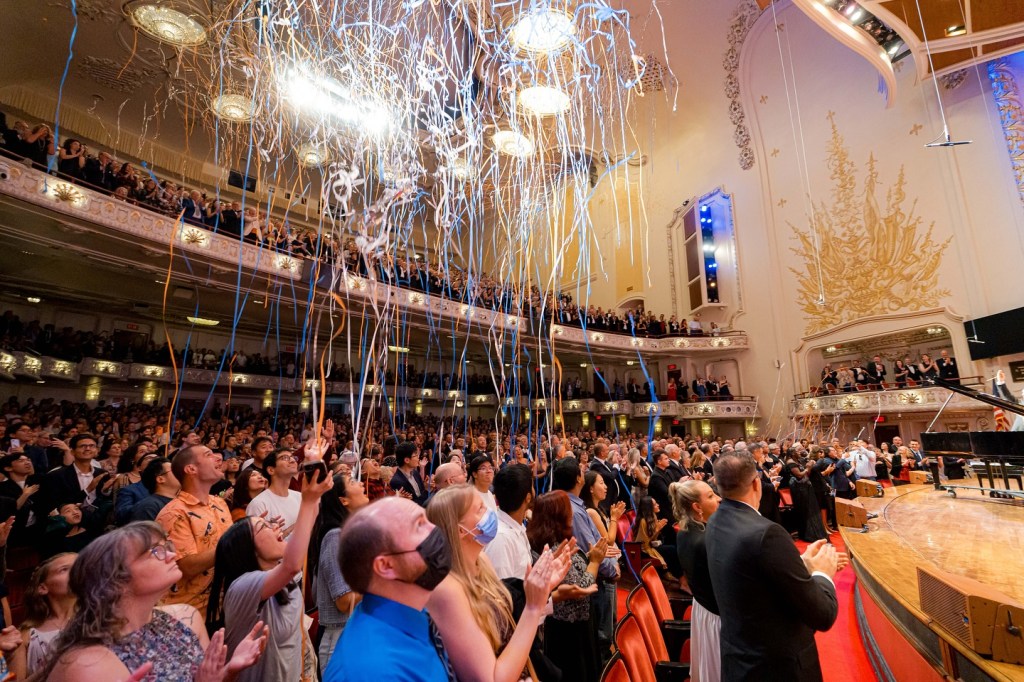
A celebratory gala concert marked the start of the Pittsburgh Symphony’s 2025-26 concert season, featuring a potpourri of appealing orchestral works guided by music director Manfred Honeck before star pianist Yuja Wang took the Heinz Hall stage. A major fundraising event for the organization as well, and a successful one — reportedly raising nearly $1 million.
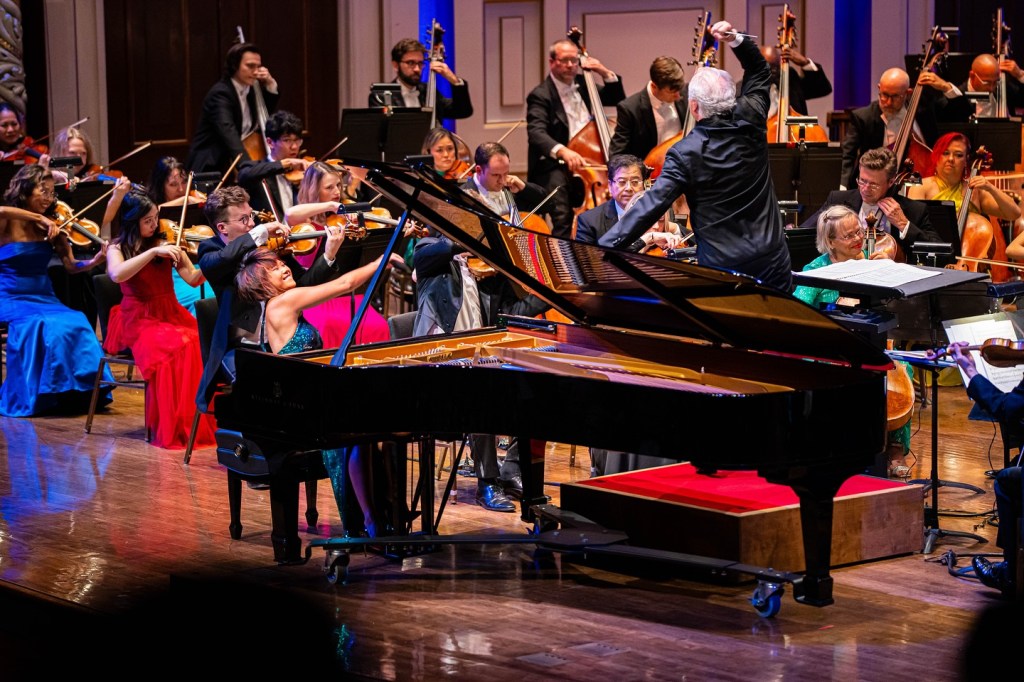
Yuja Wang with Manfred Honeck and the PSO, photos credit JMilteer Photography

Techno from the Fiesta! suite by Jimmy López certainly made for exciting first notes of the season with its driving kinetic energy, enhanced by an expanded percussion section. Strauss’ Éljen a Magyár! charmed in its infectiously lilting rhythms, and served as an acknowledgment of the composer’s 200th birthday.

Another anniversary was marked with Shostakovich, who we note died 50 years ago. A waltz from his Suite for Variety Orchestra No. 1 was nearly Chopinesque in its blending of elegance and melancholy. Sarasate’s Navarra featured dueling PSO violinists David McCaroll and Justine Campagna, playing the material with inimitable Spanish charm and coruscating virtuosity.

Mascagni’s indelible intermezzo from Cavalleria rusticana (which local audiences got to hear complete at Pittsburgh Opera last season) saw delicate strings blossom into the sumptuous. Finally, Henry Mancini’s (best remembered as composer of The Pink Panther and other films) Strings on Fire was just that — a sizzling, energetic workout.

I heard Yuja Wang play Tchaikovsky’s First Piano Concerto at The Cleveland Orchestra this past March, and was dazzled by her consummate virtuosity, command of the keyboard, and refined playing that revealed details I hadn’t heard before even in this overly familiar warhorse. There’s little else to say about it, but what a thrill it was to see her deliver such impassioned and assured playing with the Pittsburgh musicians, her first local appearance since 2013. Despite a thunderous ovation and numerous curtain calls, she didn’t indulge the capacity crowd with an encore, but perhaps it would have been all but gratuitous after such a satisfying take on Tchaikovsky.
Ólafsson and Wang dazzle in spectacular two piano recital

Yuja Wang, piano
Víkingur Ólafsson, piano
Mandel Concert Hall
Severance Music Center
Cleveland, OH
February 23, 2025

Berio: Wasserklavier (No. 3 from Six Encores)
Schubert: Fantasie in F minor, D940
Cage: Experiences No. 1
Nancarrow: Study No. 6 (arr. Adès)
Adams: Hallelujah Junction
Pärt: Hymn to a Great City
Rachmaninoff: Symphonic Dances, Op. 45

Encores:
Brahms: Waltz in A-flat major, Op. 39 No. 15
Dvořák: Slavonic Dance in E minor, Op. 72 No. 2
Brahms: Hungarian Dance No. 1 in G minor
Brahms: Waltz in E major, Op. 39 No. 2
Brahms: Waltz in G-sharp major, Op. 39 No. 3

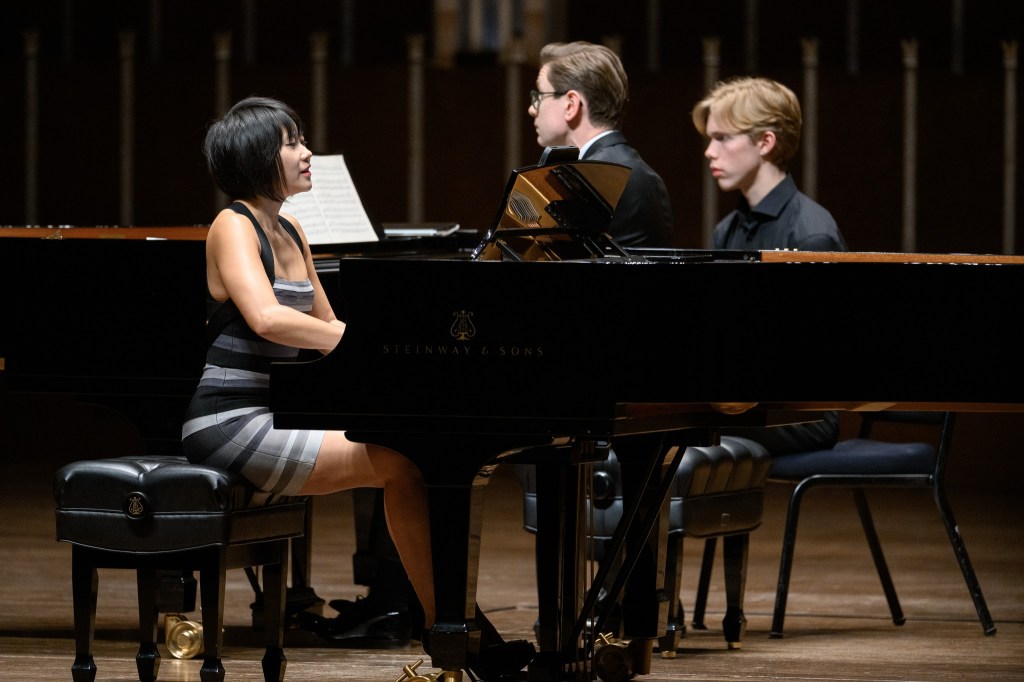
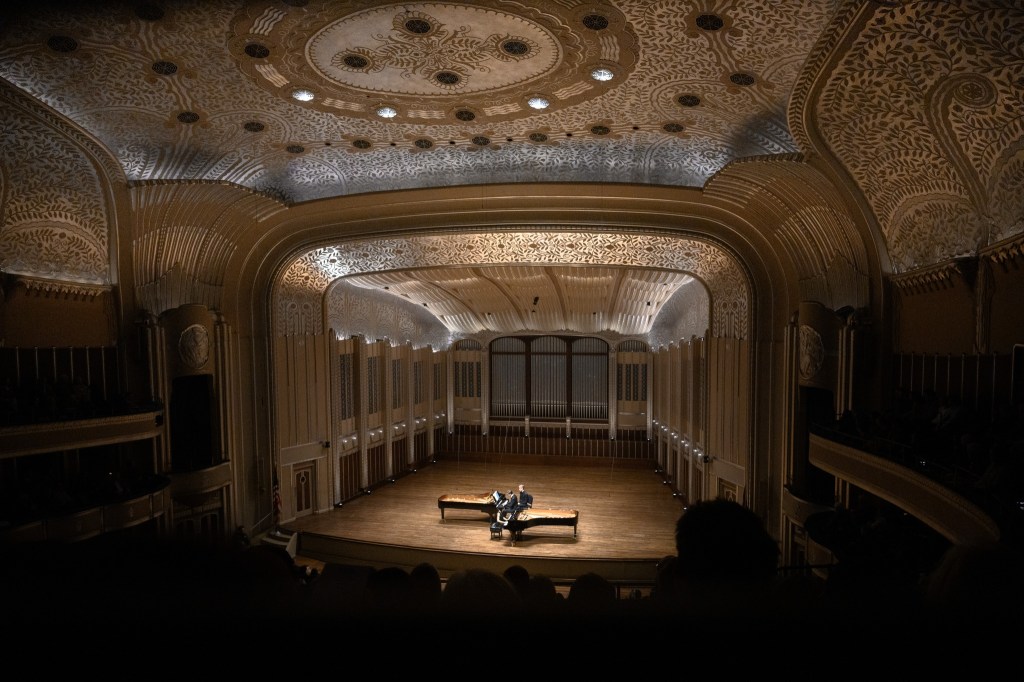
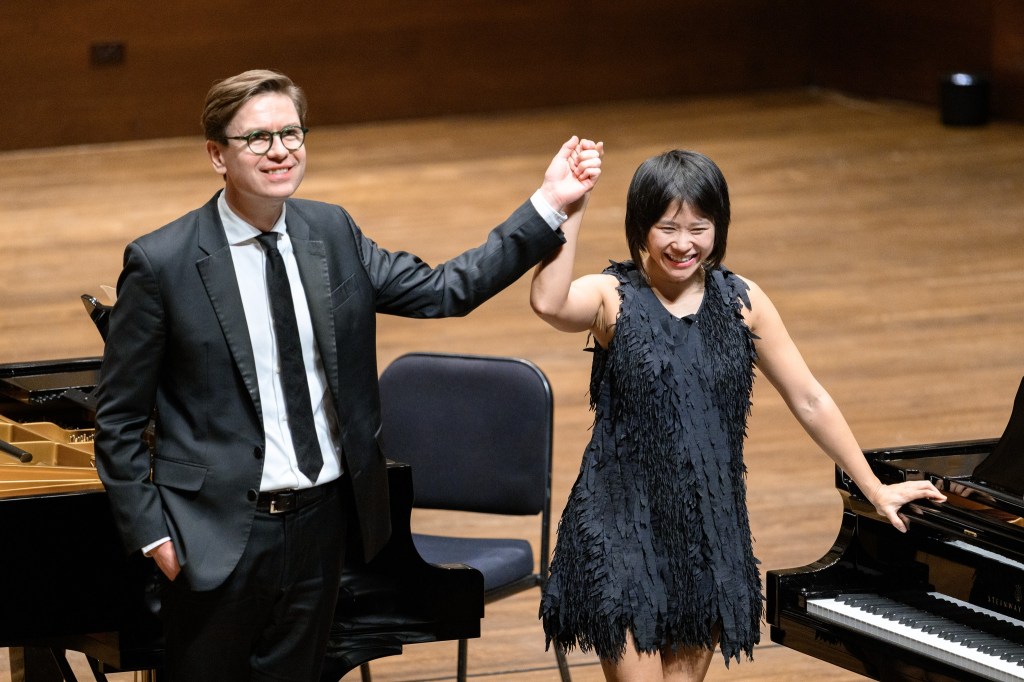
Sunday afternoon marked a remarkable high point in The Cleveland Orchestra’s immensely rewarding recital series, with pianists Yuja Wang and Víkingur Ólafsson joining forces in a stop at Severance Hall on a brief US tour. Both superstar soloists in their own right, it was truly electrifying seeing these two band together. Yet this was more than just a celebrity pairing calculated to maximize box office receipts: their artistic temperaments complemented each other well, showing the whole can be greater than the sum of its parts.

Víkingur Ólafsson and Yuja Wang at Severance Hall, photos credit Human Artist Photography + Cinema 

The program was ripe with discovery, skirting some of the more commonly played fare for two pianos. Luciano Berio’s Wasserklavier began, a meditative opening with liquescent textures freely flowing. The piece made subtle nods to Brahms and Schubert, and fittingly, the pianists artfully segued directly into the latter’s own Fantasie in F minor. Usually played four hands on a single piano, hearing it spread across two instruments gave the work a greater resonance and depth of sound.

Crisply articulated dotted rhythms began, plunging into penetrating drama — rarely will one hear Schubert played with such intensity. Dance-like sections contrasted, exuding joy with the twenty fingers at work, intricately choreographed. A fascinating selection of works from the late 20th-century followed, beginning with John Cage’s Experiences No. 1. The composer’s characteristic minimalist textures were piquantly harmonized, punctuated by silence.

The sixth of Conlon Nancarrow’s 49 studies for player piano followed, made humanly playable in its two-piano arrangement by Thomas Adès (who local concertgoers had the chance to see conduct a remarkable Cleveland Orchestra program just the night before). In this case, the two pianos seemed to be at odds with one another, yet the jagged rhythms fit together in interlocking fashion.

The first half closed with John Adams’ Hallelujah Junction, to my mind, the highlight of the program. Pulsating energy filled Severance Hall with pianistic brilliance. Music of almost perpetual motion — quite a contrast to the minimalism of Cage — gave a larger-than-life portrayal of the namesake town on the California-Nevada border, and demonstrated in no uncertain terms the electric chemistry between these two pianists. The more lyrical pulses of a downtempo section captivated in their rhythmic intricacies, only to build back up to a dazzling density of sound.

Arvo Pärt’s Hymn to a Great City was marked by Wang’s playing in the upper register that rang with the purity of bells, and some delicate filigree that decorated the otherwise barren textures. Rachmaninoff’s Symphonic Dances — his final work — closed the printed program. Hammering out the main theme with pile-driving intensity, an almost manic energy between the two created a rich orchestral sonority. Yet matters were still clear and articulate, with a contrasting theme of haunting lyrical beauty. Sultry waltz rhythms in the central dance were given with stylish playing, and the finale was bold and grandiose, with broad gestures cascading spectacularly.

No less than five encores followed, a delightful selection of dances by Brahms and Dvořák, performed on a single piano, four hands. A charming, convivial close to a memorable afternoon.

Viotti makes memorable Cleveland debut in Russo-French program

Cleveland Orchestra
Lorenzo Viotti, conductor
Yuja Wang, piano
Severance Hall
Cleveland, OH
November 29, 2019

Prokofiev: Suite from The Love for Three Oranges, Op. 33bis
Rachmaninov: Piano Concerto No. 4 in G minor, Op. 40
 Encore:
 Gluck-Sgambati: “Dance of the Blessed Spirits” from Orfeo ed Euridice
Poulenc: Sinfonietta, FP 141
Ravel: La valse

Over the Thanksgiving weekend, The Cleveland Orchestra dependably serves a musical feast, and this year was hardly an exception. Friday (coincidentally, the 150th birthday of the orchestra’s founder, Adella Prentiss Hughes) marked the local debut of 29-year-old conductor Lorenzo Viotti. Currently principal conductor of Portugal’s Gulbenkian Orchestra, and dubbed to assume the same role with the Netherlands Philharmonic Orchestra next season, Viotti is a conductor who Cleveland music director Franz Welser-Möst singled out as being especially promising during an interview previewing the current season. Viotti’s colorfully appealing program was bifurcated by nationality with a Russian first half preceding a French second.

900 Lorenzo-liggend (1)
Lorenzo Viotti, photo credit Desiré van den Berg

Prokofiev’s six-movement suite from The Love for Three Oranges opened with the composer’s characteristically vigorous orchestrations, bringing to life the opera’s colorful cast of characters with gentler, dancing winds contrasting. The following “Infernal Scene” was darkly surreal in its unusual timbres, while the “Marche” – the opera’s most indelible quantity – was given a crisply rhythmic and foot-tapping workout. “The Prince and the Princess” made for a lyrical interlude, the deeply touching language anticipating Romeo and Juliet. Viotti roused the requisite virtuosity for the roiling “Flight” that closed.

As central to repertoire as Rachmaninov’s works for piano and orchestra are, the Fourth Concerto has been relegated to periphery, not having been performed by this orchestra since 1996. An arsenal of energy opened, quickly paving the way for the full-bodied entry of the incomparable Yuja Wang. The fiendishly difficult piano writing was easily surmounted by her fleet fingerwork, and about two thirds of the way through the movement, matters burgeoned to a climax as grand and lush as anything Rachmaninov wrote. The solo introduction of the Largo was of deep melancholy, revealing Wang’s lyrical gifts, and in due course aided by burnished strings.

Textures grew impassioned and stormier, leading to the jarring transition to the closing Allegro vivace. Wang’s sleight-of-hand pianism negotiated the jazz-inflected rhythmic complexities, and chains of double octaves were effortlessly delivered with fire and panache. The orchestra supported Wang with a colorful accompaniment – Jeffrey Rathbun’s oboe a standout – culminating in a muscular conclusion. While ultimately perhaps not as memorable as the composer’s other works in the medium, it certainly merits hearings at more regular intervals! Although not indulging the Severance Hall audience in one of her encore marathons, Wang nonetheless responded to the hearty ovation with the wistful lyricism of a transcription from Gluck’s Orfeo ed Euridice.

The Cleveland Orchestra gave the US premiere of Poulenc’s Sinfonietta under George Szell in 1949, but remarkably hasn’t touched it since. Kudos then to Viotti for resurrecting this vintage gem, which despite its obscurity, local audiences had the chance to hear as recently as this past March on a CityMusic program. The opening movement brimmed with melodies of immediate appeal, piquant and bright, a sort of synthesis of 20th-century sensibilities within a classical economy, invoking comparison to Prokofiev’s Classical symphony. The inner movements were respectively joyfully light-hearted and sweetly songful, the latter with noteworthy solo passages from the trumpet and clarinet. Perhaps an expression of post-war bliss, the finale was utterly untroubled, and delectably so.

Continuing with French appropriations Germanic forms, matters turned to waltz in Ravel’s iconic La valse. Originally conceived for solo piano (heard just the previous weekend in Soyeon Kate Lee’s recital at the Cleveland Museum of Art), the orchestral version shows in no uncertain terms the composer’s stunning mastery of instrumentation. Beginning with barely audible rumbles, a sultry waltz theme took shape, with sumptuous harps adding to the dizzyingly rich tapestry: a glitteringly cataclysmic dissolution of the once venerable waltz.

Yuja-Wang-by-Norbert-Kniat-DG-11
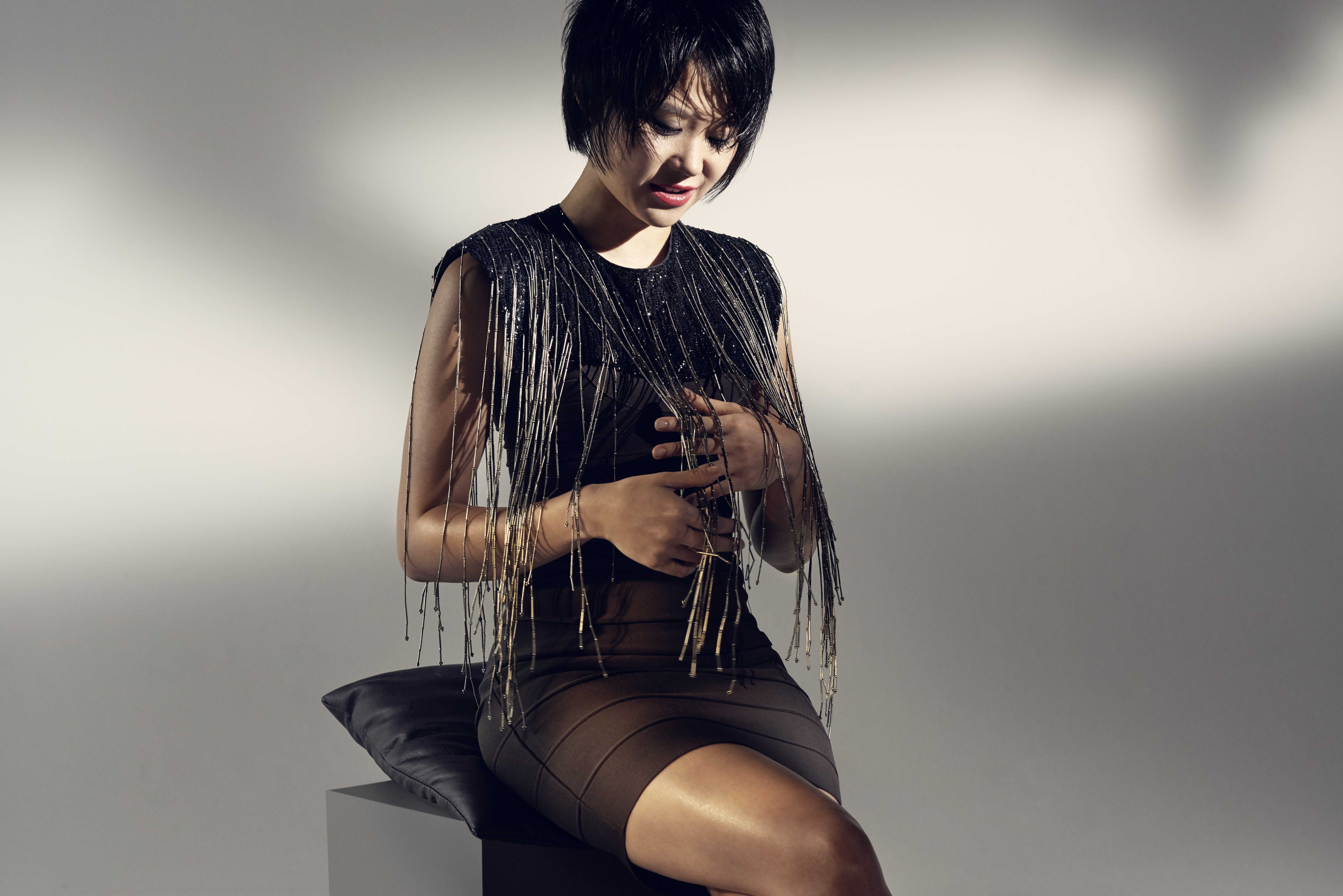
Yuja Wang, photo credit Norbert Kniat