VIVO closes festival in style with French repertoire, Choi premiere

Alicia Hui, violin †
Siwoo Kim, violin †‡
Henry Kramer, piano *‡
Jeffrey Myers, violin *
John Stulz, viola *†
Alice Yoo, cello *
Matthew Zalkind, cello †‡
Gabriel Campos Zamora, clarinet †

* Fauré / † Choi / ‡ Ravel

Southern Theatre
Columbus, OH
September 4, 2022

Fauré: Piano Quartet No. 1 in C minor, Op. 15
Choi: With Winds III
Ravel: Piano Trio

VIVO Music Festival closed the eighth edition of its annual chamber music celebration Sunday afternoon at the Southern Theatre, an event which also served to unofficially open Chamber Music Columbus’ banner 75th season. As with all of the elder organization’s upcoming concerts, Sunday’s included a newly commissioned work, as well as poem from the season’s poet laureate, Jennifer Hambrick – known to listeners of WOSU, as well as the host of VIVO’s “Beer & Beethoven” held a few nights prior. Hambrick’s entry “Stones to join the mountain with the rock” fit the spirit of the occasion, the joining of forces of two very fine chamber music organizations.

L-R: Jaehyuck Choi, Jeffrey Myers, John Stulz, Gabriel Campos Zamora, Alicia Hui, Alice Yoo, Siwoo Kim, Henry Kramer, Matthew Zalkind. Photo credit VIVO Music Festival

Fauré’s Piano Quartet No. 1 boasted dark-hued, dramatic beginnings, rather Brahmsian in persuasion, with the virtuosic piano writing and its tumultuous octaves (Henry Kramer) a standout. The scherzo was markedly more Gallic and of irresistible charm, while the Adagio was a gorgeous respite, with a particularly affecting and resonant cello line (Alice Yoo). The finale recalled the virtuosity of the beginning to bring the opening selection to an enthusiastic close.

South Korean composer Jaehyuck Choi was present to introduce his clarinet quintet With Winds III, the first of Chamber Music Columbus’ seven commissions to come to life. A taste of Choi’s work was sampled at the aforementioned Beer & Beethoven event in which violinist Alicia Hui performed his Self in Mind I. In addition to VIVO, violist John Stulz also counts himself a member of the Paris-based new music group Ensemble intercontemporain, and it was there he first became acquainted with Choi. Choi’s commission served as a tribute to CMC’s founder James N. Cain, and moreover, the clarinet quintet medium was apropos as one of the organization’s first performances featured the Walden Quartet with clarinetist Donald McGinnis. Choi spoke of finding influence from contrasting works of visual arts, a thread he discussed at length during my interview with him a few months prior.

Terse, rapid gestures in the strings opened, punctuated by a long-breathed tone in the clarinet (Gabriel Campos Zamora), emblematic of the work’s near obsession with pointed contrasts. The work’s dense textures made substantial use of extended techniques, pushing the capabilities of both the musicians and their instruments alike. A passage cast in the violin’s highest possible range was otherworldly in effect, while a mute in the clarinet provided yet another striking sonority in work’s final segment before matters evaporated into silence.

The afternoon closed with Ravel’s remarkable Piano Trio. The opening Modéré was dreamy and evocative, with the performers adroitly negotiating the 8/8 meter – suggestive of the Basque zortziko – complexities that felt all but effortless in this musical conversation amongst friends. What followed was a rare scherzo from Ravel, its gossamer textures almost like a work of Saint-Saëns. The Passacaille easily serves as the heart of the work, searching probing depths. A solemn statement, it was a juxtaposition of the austere and the deeply felt. Decorative filigree was abundant in the finale, given with meticulous attention to detail, and the self-assured piano in particular pointed towards a big-boned finish.

Cleveland Opera Theater presents an effective and affecting Butterfly

Cleveland Opera Theater
Maltz Performing Arts Center
Cleveland, OH
April 29, 2018

Puccini: Madama Butterfly

Dina Kuznetsova, Cio-Cio San
John Pickle, B.F. Pinkerton
Young Kwang Yoo, Sharpless
Sandra Ross, Suzuki
Mark James Eldred, Goro
Jason Budd, Il Bonzo

Domenico Boyagian, conductor
Scott Skiba, stage director
Matthew D. McCarren, scenographic design
Brittany Merenda, projection design

Make no mistake, opera is alive and well in Cleveland. In the last three weeks, Clevelanders were afforded the opportunity to see as many operas – Apollo’s Fire in L’Orfeo (arguably the first great opera ever written), the magnificent Tristan und Isolde from The Cleveland Orchestra (arguably the most groundbreaking opera ever written), and last but not least, Cleveland Opera Theater’s Madama Butterfly (arguably the most popular opera ever written). The venue of choice for Butterfly was the beautiful Maltz Performing Arts Center, a former synagogue now used as a performance venue by CWRU, and a space which lent itself well to opera.

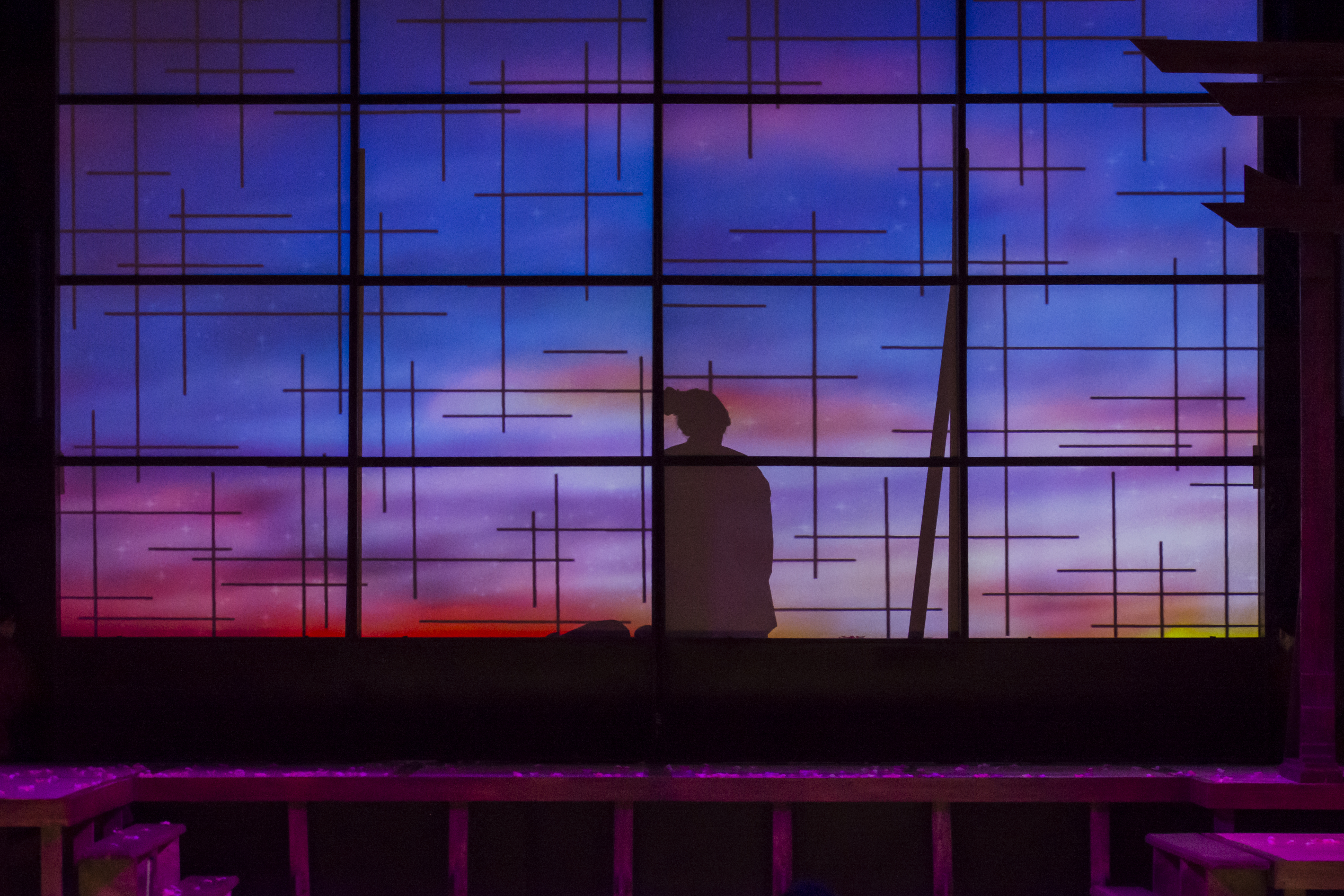
The work opened in faux-orientalism, evocative of its Japanese setting, and while the 30-piece orchestra sounded a bit thin for the lushness of Puccini, they generally exhibited a consummate level of playing and fine support for the vocalists under the baton of conductor Domenico Boyagian. (And amongst their ranks was concertmaster Aubrey Murphy who formerly held that title at the Sydney Opera House). The bulk of the scenery was comprised of a Japanese-style screen that stretched the length of the stage, often enhanced with lighting or projections – simple yet effective. When Pinkerton was introduced, a brass choir intoned The Star-Spangled Banner in stark contrast to the previously heard orientalism. John Pickle played a confident Pinkerton (substituting for an indisposed Timothy Culver), and was especially fine in the ensuing duet with Sharplessthe latter role given by the convincing Young Kwang Yoo – and both voices combined in a truly Puccinian sumptuousness.

In Cio-Cio San’s (i.e. Butterfly) first appearance, she was draped in a radiant pink, and the wedding which quickly followed was presented with ample pageantry. The Star-Spangled Banner was pitted atop the oriental pentatonicism, signifying the (tenuous) union of the two cultures. A booming Jason Budd appeared as Il Bonzo, admonishing and ultimately renouncing Butterfly, dramatically enhanced by the gong – as sure a sign as any that the bliss of the newlyweds would be short-lived. Dina Kuznetsova was memorable in the title role and had excellent chemistry with Pickle as evidenced by the gorgeous extended duet that closed the first act.

Three years separated the following act, and the set depicted an American flag Butterfly had hung as a beacon of sorts to her husband now an ocean apart – and in keeping with historical accuracy, a 45 star flag was special ordered for the performance. Kuznetsova shone in the opera’s most recognizable excerpt, Un bel dì vedremo – filled with longing and hoping, yet tempered by a more rational perspective, as if she had gained wisdom during the intervening years and knew that all could not be well. And this was indeed confirmed in her drawn out dialogue with Sharpless, in which the truth that Pinkerton married another all but unraveled. The act concluded with the “Humming Chorus”, here portrayed as a candlelight procession with the chorus dispersed throughout the sanctuary. Gentle touches in the harp added to the scene’s ethereal beauty, to my mind, the afternoon’s scenic and musical highlight.

Looming tragedy clouded the opening of Act III, yet there was striking contrast in the warmth of the sunrise. Pinkerton at long last returned (new wife in tow) – noticeably aged – and Pickle portrayed him as not incapable of remorse, having seemingly matured from the Don Juan of his younger days. Still, this did little to mitigate the tragic ending – with Butterfly’s child wrapped in the American flag to signify her loss of custody, she had little recourse but to take her own life to avert the shame she would otherwise undergo. Pinkerton cried out for her, but by then it was too late, and an iridescent butterfly was projected onto the screen – a final image of heartbreaking power.

DSC_0188
Set design of COT’s Madama Butterfly, all photos credit Noah Listgarten