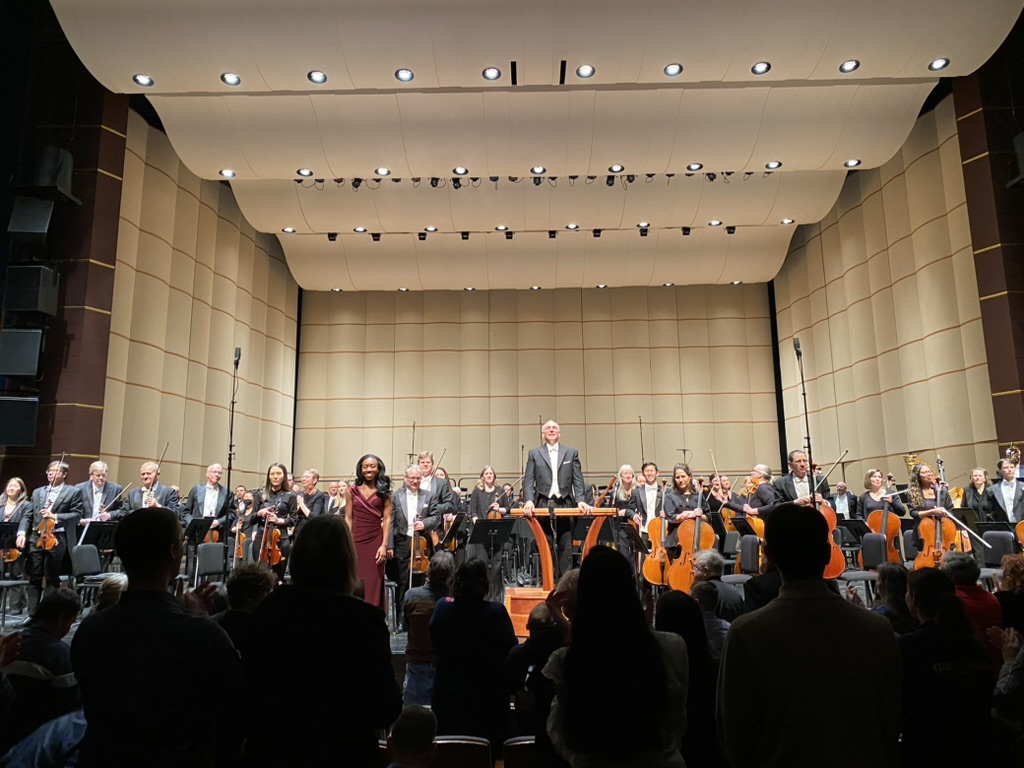
Renée Fleming brings The Brightness of Light to Cincinnati May Festival

Cincinnati Symphony Orchestra
Robert Moody, conductor
Renée Fleming, soprano
Rod Gilfry, baritone

May Festival Chorus
Matthew Swanson, director

Springer Auditorium
Music Hall
Cincinnati, OH
May 22, 2025

Vaughan Williams: Serenade to Music
Stravinsky: Symphony of Psalms
Puts: The Brightness of Light

This year’s edition of the Cincinnati May Festival featured the incomparable Renée Fleming as Festival Director, affording her the opportunity to curate a diverse selection of repertoire across the festival’s eight-day span. The penultimate program was anchored by Kevin Puts’ ambitious 2019 work The Brightness of Light, starring Fleming alongside baritone Rod Gilfry.
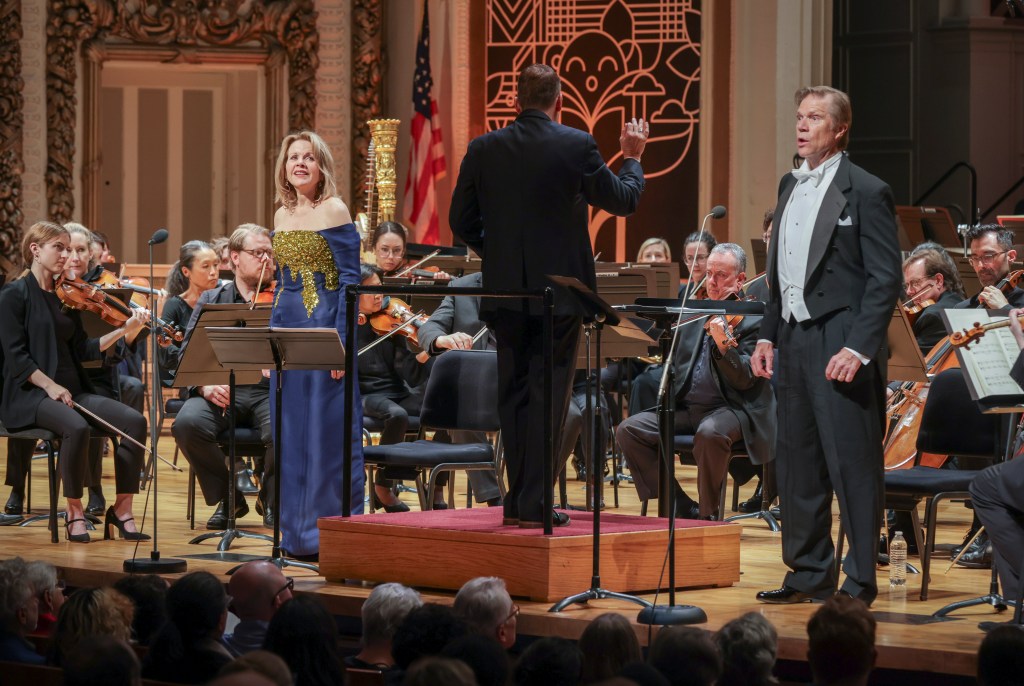
Renée Fleming, Robert Moody, Rod Gilfry and the Cincinnati Symphony perform The Brightness of Light, all photos credit Mark Lyons

The 45-minute conception chronicles the relationship of Georgia O’Keefe and Alfred Stieglitz — from agent to lovers to married couple, closing at O’Keefe’s final years as a widower in the solitude of the American Southwest. Giving the performance a multimedia dimension, projections by Wendall Harrington featured O’Keefe’s art alongside photographs of the couple through the years. The texts were extracted from the vast trove of letters they exchanged, beginning as professional correspondence that quickly turned to love letters.

Therein lies the fundamental challenge with the work, however, as texts of letters rarely provide the best material for vocalists. Poetic as they sometimes were, matters often veered more discursive and verbose. Nonetheless, Fleming and Gilfry captured the essence of their respective characters, painting a largely sympathetic portrait of these enigmatic figures via this epistolary drama. Puts’ musical language isn’t particularly groundbreaking, but remains appealing and approachable, somewhat reminiscent of the mid-century American composers — and thus stylistically contemporary with the two protagonists. Puts called for a large orchestra, and the Cincinnati Symphony supported the singers with aplomb. The composer exploited the orchestra’s colorful potential, as if expressing the colors of an O’Keefe painting in musical terms. Marshaling these forces was conductor Robert Moody, gracefully stepping in as a last-minute substitute for Juanjo Mena.

O’Keefe was quoted in saying that her first memory “is of the brightness of light, light all around,” hence the work’s title and the text with which it began, tenderly intoned by Fleming. The beginning of their correspondence was of playful, innocent humor, but the tone shifted in “A Soul Like Yours,” wherein gentle touches in the piano and violin gave to way to some deeply impassioned singing from Gilfry. Orchestral interludes served as key inflection points, underscoring the importance of the orchestra to the piece despite the top-billing of the two operatic legends — and I wonder if there’s the potential to extract a standalone orchestral suite.

I particularly liked the twang of the violin to mark the transition to the Southwest, and exploring the ups and downs of this relationship yielded musical variety. Matters culminated with the fittingly valedictory “Sunset,” pensive and reflective, a touchingly beautiful use of Fleming’s voice. Despite the work’s sincerity and the strength of this performance, ultimately I left Music Hall with mixed impressions, but much credit nonetheless to the ambition of the performers and creative team.

The first half was comprised of two shorter works that featured the May Festival Chorus, beginning with Vaughan Williams’ Serenade to Music. Luminous sounds blanketed the hall with the beauty of the harp and strings, and the tender voices of the chorus were a meditation on music itself. Serene and with arching lyricism, it made for the loveliest of openers.

Written in 1930 on a Koussevitsky commission for the fiftieth anniversary of the Boston Symphony, the bristling neoclassicism of Stravinsky’s Symphony of Psalms sharply contrasted. The work sets a trio of psalms against a strikingly idiosyncratic orchestration that even called upon not one but two pianos. In his spoken remarks, Moody noted how it would later influence Orff’s Carmina Burana and Bernstein’s Chichester Psalms. Conducting without baton, Moody perhaps channeled his inner Pierre Boulez (who made a benchmark recording of the work with Berlin), imbuing each gesture with clarity and a strict sense of place.

Following a brassy close of the first psalm, the central selection began with a searching oboe solo, drawing richly contrapuntal textures given with severity and exactitude. Longer than the first two combined, the closing entry was a larger-scale conception with disparate elements seamlessly woven together, in due course arriving at a peaceful resolution.
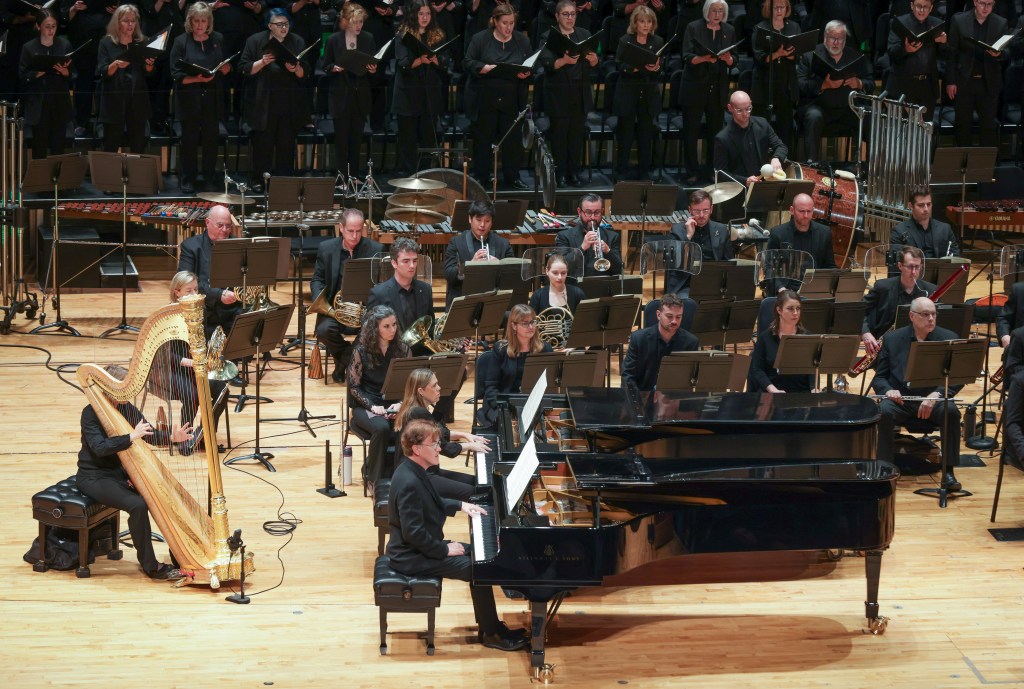
Cincinnati Symphony and May Festival Chorus in Stravinsky’s Symphony of Psalms

Elder leads Pittsburgh Symphony in brooding Sibelius, Shostakovich – and an interlude in the English countryside

Pittsburgh Symphony Orchestra
Sir Mark Elder, conductor
Cynthia Koledo DeAlmeida, oboe
Heinz Hall
Pittsburgh, PA
January 31, 2025

Sibelius: Pohjola’s Daughter, Op. 49
Vaughan Williams: Concerto in A minor for Oboe and Strings
Shostakovich: Symphony No. 15 in A major, Op. 141

Sir Mark Elder is certainly a conductor with a knack for devising intriguing and offbeat programs, and his Friday night appearance with the Pittsburgh Symphony was no exception. Sibelius’ tone poem Pohjola’s Daughter opened, beginning with darkly brooding material from the cellos. Vigorous brass joined in the lush orchestration, though any glimmers of hope in this grisly tale from the Kalevala were duly snuffed out for its quiet, somber ending. On either side of the stage, plot events from the source material were projected in sync with the music — though Sibelius’ writing is so detailed, one hardly needed it.

Sir Mark Elder, Cynthia Koledo DeAlmeida, and the Pittsburgh Symphony, photo credit Josh Milteer

Vaughan Williams’ 1944 Oboe Concerto followed, featuring PSO principal Cynthia Koledo DeAlmeida. This is a work the PSO has performed only once before, and nearly 30 years ago. DeAlmeida served as soloist in that performance as well, and in prerecorded remarks, she reflected on playing it as a relatively new addition to the PSO’s ranks, to now revisiting it decades later as a seasoned member.

Because the oboe doesn’t project particularly well, Vaughan Williams reduced the orchestral accompaniment to strings alone. The concerto serves as a companion piece to the composer’s Fifth Symphony (the “Pastoral”): it, too, purveys a ponderous pastoralism, and the concerto’s finale came from sketches originally intended for the symphony. DeAlmeida offered a lyrical, songful tone, keenly phrased and in delicate balance with her stringed colleagues. Cadenzas at various intervals showed her limber and dexterous.

The central movement took its cue from English country dances, sprightly and charming. The closing scherzo traversed the oboe’s range, and saw the soloist in fleet interplay with the orchestra. A closing section returned to the tender and reflective, and theme that perhaps interpolates The Last Rose of Summer in quintessential English fashion.

Shostakovich’s Fifteenth and final symphony occupied the latter half. Quite unlike any of the composer’s previous groundbreaking works in the form — or any symphony that came before or after, for that matter — it reflects on a lifetime of turmoil and triumphant in idiosyncratic fashion. Pings in the glockenspiel began, answered by a silvery flute — flippant and unsettled as only Shostakovich could do. Themes from William Tell and other works were seamlessly woven in, an eerie soundscape with the composer in a dreamlike trance of music by others that resonated with him.

A low brass chorale opened the lugubrious slow movement, highlighted by a devastatingly austere cello solo (Anne Martindale Williams). Angular material in the clarinet marked the Allegretto, along with a fine solo from concertmaster David McCarroll. Echoes of Wagner and many others were heard in the eclectic finale, as if Shostakovich wanted to use the final movement of his final symphony to comprehensively reflect on all that inspired him. The ticking of clocks, achieved through woodblocks (a device previously used in his iconoclastic Fourth Symphony), made for an ending as extraordinary as it was enigmatic.

Dayton Philharmonic offers moving meditation on war and peace

Dayton Philharmonic Orchestra
Neal Gittleman, conductor

Sheridan K. Currie, viola
Jonathan Lee, cello
Kenneth Shaw, baritone
Kayla Oderah, soprano

Dayton Philharmonic Chorus
Steven Hankle, chorus director

Mead Theatre
Schuster Performing Arts Center
Dayton, OH
March 11, 2023

Boulanger: Pour les funérailles d’un soldat
Schelle: Resilience
Vaughan Williams: Symphony No. 3, Pastoral

Last weekend’s Dayton Philharmonic program was commendable for its organization around a common theme – reflections of war and aspirations for peace – as well selections that lie well outside the standard repertoire, likely unfamiliar quantities even to seasoned concertgoers. Lili Boulanger is one of the most tragic figures of 20th-century music, dying far too soon at age 24. Her work Pour les funérailles d’un soldat, written when she was 19, provided a captivating introduction to her compositional potential.

Kayla Oderah and Neal Gittleman with the Dayton Philharmonic and Chorus

Music director Neal Gittleman – one of the last Americans to study with the composer’s better-known older sister, Nadia – fittingly described the work as a “mini-requiem,” scored for orchestra with choir and baritone soloist. Rumbling timpani opened, soon to be joined by funereal brass. The choir joined in with French text of a poem by Alfred de Musset; on cue with the line “Qu’on dise devant nous la prière des morts” (“Let the prayer of the dead be said before us”), the Dies irae appeared hauntingly in the strings. Kenneth Shaw delivered a powerful baritone, imposing in its solemnity, and the work faded away with the beating pulse of the timpani. A composer with the prodigious gifts of a Mendelssohn, writing fully polished works as a mere teenager.

Michael Schelle’s 2014 work Resilience was written to commemorate the 70th anniversary of World War II, of which his father was a veteran and his mother a nurse. A double concerto for viola and cello, it featured DPO principals Sheridan Currie and Jonathan Lee. Cast in three movements, the first concerns the European theater, the second the Pacific, and the last amounts to a prayer for peace. As the title suggests, the work takes inspiration from resilience in the face of adversity.

Percussive beginnings opened the work in shocking intensity in the first movement “Dachaulieder.” Dense textures pervaded, and the soloists entered with an eloquent invocation of a theme from Mendelssohn’s String Quartet No. 2. A further musical allusion came in the shape of quite literally a song from Dachau – namely, a melody found carved into the prison walls. As with the Mendelssohn, it celebrated the voices of Jewish composers which the Nazi regime attempted to silence. The soloists played with committed intensity and fervor, bringing clarity to chaos. A mournful clarinet passage, later answered by the duo, was another striking moment.

Double concertos for violin and cello are somewhat common (think Brahms), but turning things a notch lower by way of the viola here fittingly gave the music a more somber tone. The central “Rising Sun, Falling Sky” opened in stillness. Sighing gestures took form, with pizzicato passages angular and uneasy. A large metal spring – one of Schelle’s signature musical effects – made for striking sounds from the percussion section, but this was a movement generally inward and introspective. The clash of the beginning resurfaced in the closing “Blast of Silence”, in due course arriving at a serene lyricism with particularly lovely and intimate material from the duo, and the work faded away in hopeful resolution.

If there’s one composer who wrote a substantial body of symphonies that tend to be overlooked, surely it would be Ralph Vaughan Williams with nine major entries to his name. In his 150th anniversary year, I’ve enjoyed turning attention to them (and have particularly fond memories of hearing the Sixth in Cincinnati). This weekend the DPO offered the Third, known as the Pastoral. The composer was deeply moved by the startling emptiness of the English countryside following the mass casualties of the First World War; hardly a bucolic affair, the symphony captures those emotions. Pastoral-sounding winds opened – though I found Gittleman’s tempo choice a bit fast – introducing a striking, coloristic chord progression. Concertmaster Aurelian Oprea articulated a theme with fragile lyricism.

A forlorn horn solo opened the Lento moderato, and the strings meandered into mournful depths. An extended passage for solo trumpet – intentionally meant to sound out of tune to mimic an amateur military bugler – resounded to desolate effect. Though functioning as the scherzo and the most extrovert of the four movements, the Moderato pesante was hardly festive, lumbrous and weighed down, even including a thorny fugue. The closing Lento opened with a haunting wordless vocal from offstage, given with feeling by soprano Kayla Oderah. As one final elegiac paragraph, the movement was further highlighted by a touching flute solo, and Oderah was given the last word before music drifted to silence.

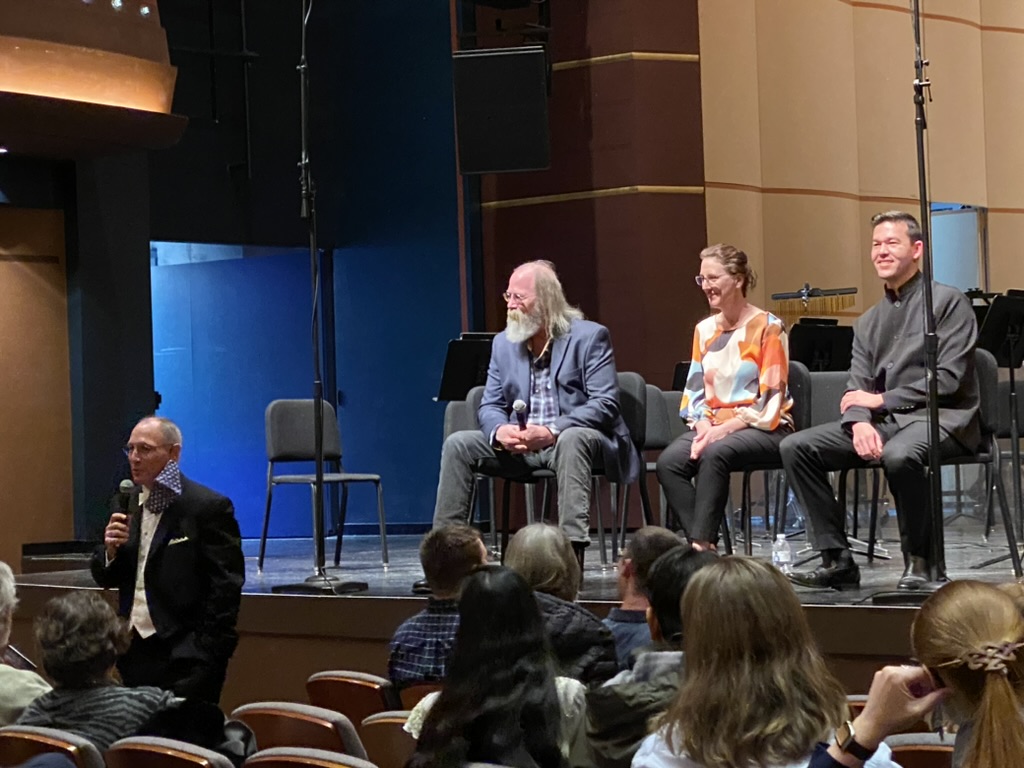
Neal Gittleman, Michael Schelle, Sheridan K. Currie, and Jonathan Lee during the post-concert discussion

ProMusica brings lush Vaughan Williams and vibrant Piazzolla to St Mary

ProMusica Chamber Orchestra
David Danzmayr, conductor
Katherine McLin, violin
St. Mary Catholic Church
Columbus, OH
March 20, 2022

Vaughan Williams: Fantasia on a Theme by Thomas Tallis
Piazzolla: The Four Seasons of Buenos Aires (arr. Desyatnikov)

Encore:
Piazzolla: Adios Nonino

Nestled in the heart of German Village, Saint Mary Catholic Church – a structure that dates back to 1868 – recently underwent an extensive restoration, and proved to be a gorgeous setting for last weekend’s ProMusica performance. The program opened with Vaughan Williams’ Fantasia on a Theme by Thomas Tallis, and the plaintive theme reflected the solemnity of the setting in this glance backwards in English musical history. Though the heavy reverb in a church can create acoustical challenges, here the resonance seemed to further enhance the richness of the strings – and indeed, the work’s 1910 premiere occurred at Gloucester Cathedral. The work is scored for double string orchestra with string quartet, and one was struck by the clarity of the interplay between the various subsets of the ensemble.

ProMusica at St Mary, photo credit ProMusica

The remainder of the evening was devoted to Piazzolla, continuing the celebration of his centenary begun at last month’s chamber music concert. The Four Seasons of Buenos Aires, rendered in Spanish as Estaciones porteñasporteño being the demonym for one from a port city, though it chiefly refers specifically to the Argentine capital – paints a colorful, vibrant portrait of the composer’s homeland. The work was presented in its arrangement by Leonid Desyatnikov, recast so as to highlight connections with its Vivaldian predecessor, including some direct quotations from Vivaldi, and scoring for string orchestra with violin soloist, a role undertaken with aplomb and verve by concertmaster Katherine McLin.

A sultry energy began the opening Otoño porteño, and a series of glissandos showed the composer to be a master of effect. A languid lyricism offered some pointed contrast. Invierno porteño was noted for its substantial passage for cello (Marc Moskovitz), thorny at first but melting into the songful. Given the concert’s coincidence with the vernal equinox, Primavera porteña was certainly the most topical – and perhaps the most ardently lyrical of the set, though not without some sprightly violin acrobatics. Verano porteño made for a vigorous finale with some particularly striking timbres achieved through sul ponticello playing from the soloist. Danzmayr and the orchestra offered a further Piazzolla work as an encore, Adios Nonino. Touchingly lyrical and with rich chromatic harmonies, it burgeoned into a big-boned, almost Hollywood-esque sumptuousness. The performance was billed as “a delightful evening” – a promise amply delivered upon.