Angelic Mahler – and an unexpected debut – at the Pittsburgh Symphony

Pittsburgh Symphony Orchestra
Manfred Honeck, conductor
Bruce Liu, piano
Lilit Davtyan, soprano
Heinz Hall
Pittsburgh, PA
June 6, 2025

Vali: The Camel Bell
Beethoven: Piano Concerto No. 3 in C minor, Op. 37
 Encore:
 Chopin: Fantasie-Impromptu in C-sharp minor, Op. 66
Mahler: Symphony No. 4 in G major

Both of the Pittsburgh Symphony’s final two subscription programs of the season are scheduled to open with a world premiere, the first of which saw Reza Vali’s The Camel Bell come into being. Born in Iran, Vali is a composer with strong connections to Pittsburgh, having completed his PhD in composition at Pitt and subsequently teaching for many years at Carnegie Mellon. Additionally, this counts as his fourth PSO commission — the first three of which have been recorded on a recent Naxos release.
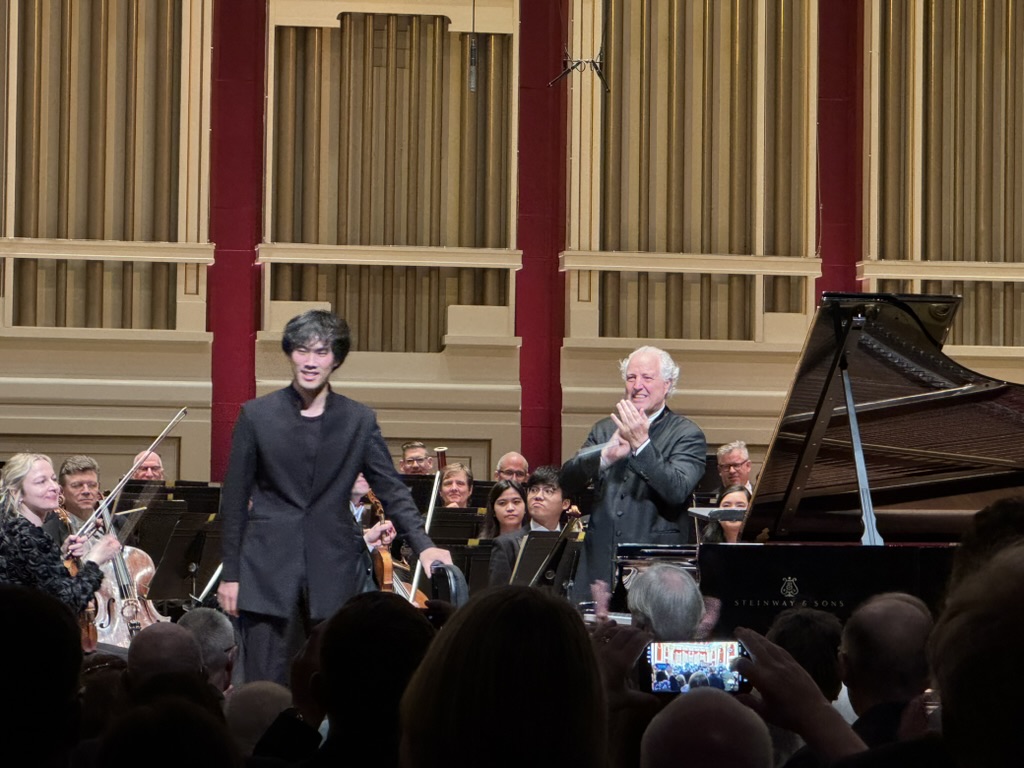
Bruce Liu with Manfred Honeck and the PSO

In his prefatory remarks, Vali likened the work to a “dialogue between great musical civilizations,” specifically noting it weaves together European, American, and Persian influences. A burst of energy began, and work explored the sounds of quarter tones – somewhat jarring to the Western ear, but a striking effect. Inflections even of jazz surfaced in this kaleidoscopic confluence of musical cultures, and I enjoyed the dueling solos between violinists David McCarroll and Jeremy Black. A tour de force closed one of the most impressive new pieces the PSO has introduced this season.

Pianist Alice Sara Ott was regrettably obliged to bow out of this weekend’s appearances due to acute tendinitis — much admiration to Bruce Liu for stepping in on short notice (as well as for the PSO360 recital situated between the two performances of this program). Liu has come to prominence after capturing first prize in the 2021 International Chopin Piano Competition, so a PSO debut from him was a welcome surprise.

Crisply articulated, the orchestral introduction to Beethoven’s Piano Concerto No. 3 introduced the C minor tonality, replete with requisite tension. Liu entered the fold by way of a fiery flourish on the keyboard, while nonetheless purveying a tone elegant and rippling, and the cadenza was given with dramatic flair. The unaccompanied piano opened the central Largo, prayer-like, and probing its great expressive potential. I was struck by Liu’s limber, flexible fingerwork in the stylishly elegant finale, ending in the brightness of C major. As an encore, Liu offered a marvelous account of Chopin’s impassioned Fantasie-Impromptu.

Mahler’s Fourth Symphony is a different animal than the composer’s other symphonies, slimmer and rather classically proportioned, yet still unmistakably Mahlerian. Music director Manfred Honeck drew the orchestral fabric with clarity and transparency, and a classical economy that brought out its details and nuances — and not without an infectious lilt. In the second movement, concertmaster McCarroll played a de-tuned violin, purveying a coarse, rustic quality further enhanced by a shrill clarinet.

In the sprawling Ruhevoll we were given the first glimpse of heaven, plaintive and serene, seemingly at peace — but still not without a certain strife with which to contend. The finale began with an innocent purity, free from world-weary concerns. Soprano Lilit Davtyan perhaps could have benefitted from clearer diction, but I was mostly taken by the angelic quality of her voice, and the way the orchestra deftly matched it.

Carpe Diem offers a heartfelt afternoon of string quartets

Carpe Diem String Quartet
First Unitarian Universalist Church
Columbus, OH
November 5, 2023

Gabriella Smith: Carrot Revolution
Mayer: String Quartet in G minor, Op. 14
Vali: CHAS
Shostakovich: String Quartet No. 9 in E-flat major, Op. 117

Last weekend marked the opening of the Carpe Diem String Quartet’s first season with violinist Sam Weiser. The varied program was a a sign of good things to come, balancing contemporary works with earlier ones – one of which has been long forgotten. A wonderfully energetic and exciting opener was had in Gabriella Smith’s Carrot Revolution, a 2015 work written for the Aizuri Quartet. Rarely does a string quartet sound so percussive! The body of the cello was repurposed as a percussion instrument, and guttural sounds from the second violin did much to explore a vast range of textures, given with an unwavering rhythmic intensity.

With a life spanning 1812-1883, Emilie Mayer was an exact contemporary of Wagner and Liszt. Her String Quartet in G minor was an intriguing discovery, evidencing Mayer to be a highly accomplished and skilled musical voice. Marked by a recurrent sighing gesture, the first movement was sweeping and passionate. A slow movement was quite touching, the dotted rhythms of its main melody elegantly articulated. Despite ending firmly in the minor, the finale was largely and a warm and genial affair. Carpe Diem’s committed advocacy has piqued my interest in exploring more of Mayer’s body of work.

The second half opened with the premiere of CHAS, a moving work by Reza Vali written in memory of Charles Weatherbee. Vali has had a long relationship with Carpe Diem – violist Korine Fujiwara spoke fondly of a 2012 festival of Persian music in which quartet and composer first collaborated; several recordings of his works have followed. The letters of CHAS were spelled out in music (using the German nomenclature), as individual entities and then layered on top of each other, creating an aura of inward contemplation. A viola melody perhaps evidenced the composer’s Persian roots in its inflections, and another statement of the titular theme in the quartet’s highest register was of striking effect in its otherworldly harmonics.

Shostakovich was another composer who employed the spelling of his name (DSCH) as a musical theme, and it was his Ninth Quartet which closed the program. The 1964 work was cast in five movements, alternating fast and slow, almost in the manner of a Baroque suite. Carpe Diem gave it a poignant reading, evident from the searching, wandering theme which opened. The second movement Adagio was particularly mournful, while the following Allegretto was Shostakovich at his blistering, sardonic best. The finale spanned more than twice as much time as any of the preceding movements, a quantity which cellist Ariana Nelson introduced as a “200 bar crescendo”, and indeed, it brought the recital to a bold, uncompromising finish.

ProMusica opens season with the brilliance of cellist Kian Soltani

ProMusica Chamber Orchestra
David Danzmayr, conductor
Kian Soltani, cello
Southern Theatre
Columbus, OH
October 8, 2022

Kernis: Musica Celestis
Haydn: Cello Concerto No. 1 in C major, Hob. VIIb:1
Vali: “The Girl from Shiraz” from Persian Folk Songs
Beethoven: Symphony No. 5 in C minor, Op. 67

ProMusica’s 2022-23 season opener was particularly auspicious in that it served as a platform for the local debut of Kian Soltani, a rapidly rising star in the cello world. The program began with the 1990 work for string orchestra Musica Celestis by American composer Aaron Jay Kernis. At the time of composition, the composer had been immersed in the work of Hildegard von Bingen, and the spirit of her work was woven into Kernis’ idiosyncratic texture. The piece unfolded glacially, with soaring passagework for both concertmasters. It reached celestial heights, ultimately arriving at peaceful resolution.

Kian Soltani, David Danzmayr, and ProMusica, photo credit ProMusica

A crisp, rhythmically punctuated introduction opened Haydn’s Cello Concerto No. 1. Soltani entered with a richly burnished tone, brimming with Viennese elegance, effortlessly fluent. Matters weren’t all pearly, however, with appropriate vigor given to the stormier sections. The cellist boasted a long-bowed, graceful melody in the central Adagio, and the finale rounded things off in the highest of spirits, with blistering virtuosity and vivacity.

Born in Austria of Iranian parentage, it was only fitting for Soltani to follow the Haydn with a work by Iranian composer Reza Vali – and Vali had in fact went to school with the cellist’s father in Iran. “The Girl from Shiraz,” a selection from the composer’s Persian Folk Songs – a work that just received its premiere earlier this year – made for an enticing contrast to the Haydn. A languid, winding melody in the cello introduced the titular melody, and the percussion scoring gave the work a decidedly non-Western feel. The latter section, known as “Love Drunk,” was a rambunctious and boisterous foil, pointing to a thunderous closing gesture.

Following the brilliance and intriguing programming choices of the first half, the balance of the program was rather more prosaic in Beethoven’s Fifth Symphony which nonetheless served as an exciting work with which to open the season. Danzmayr led a taut and focused performance, bringing out the work’s essential dramatic qualities.