
Dover Quartet
PNC Theatre
Pittsburgh Playhouse
Pittsburgh, PA
April 21, 2025
Montgomery: Strum
Fé: Rattle Songs (arr. Tate)
Tate: Woodland Songs
Dvořák: String Quartet No. 12 in F major, Op. 96, American
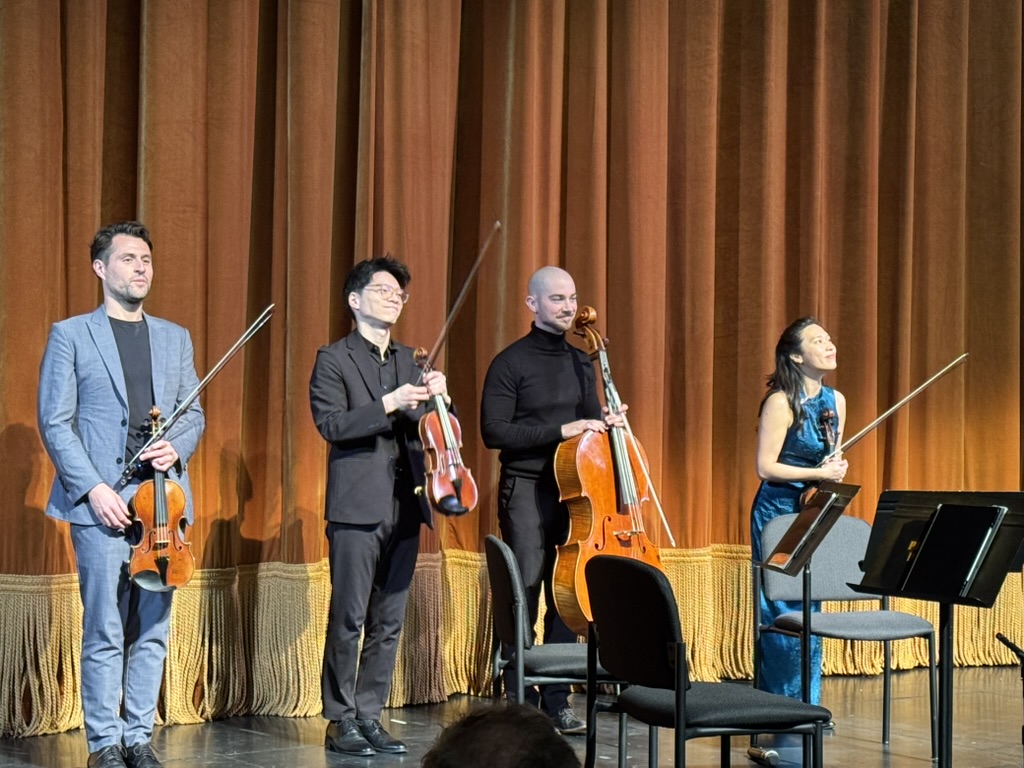
Closing Chamber Music Pittsburgh’s 64th season was the dynamic Dover Quartet. Challenging the Euro-centric associations one may have with the string quartet medium, the Dovers offered a thoughtful program of bona fide Americana, with a first half devoted to Black and Indigenous voices. Anchored by Dvořák’s American quartet (which one member described as his “gateway drug into string quartet playing”), the Dovers sought to explore the influences absorbed in Dvořák’s piece — an initiative that will also be captured on an upcoming recording.
Jessie Montgomery’s Strum has found a prominent place in the repertoire, and for good reason given its warm appeal. The viola was strummed like a guitar at the opening, and there was colorful interplay between bowed and plucked textures.
Camden Shaw, the Dover’s cellist, found himself quite taken by the album Mahk Jchi (“Our Hearts”) from the Native American a cappella group Ulali. The album features Native songs in a strikingly modernist bent, and includes the Rattle Songs by Ulali member Pura Fé. Shaw engaged Chickasaw composer Jerod Impichchaachaaha’ Tate to arrange the songs for string quartet. Seven brief pieces were conceived as a single entity, and the folk themes were artfully woven into the fabric of the sting quartet.
Generally lyrical works, the third piece stuck out as being gritty and percussive, bringing to life the titular rattles. “Women’s Shuffle” was somewhat bluesy, and the rapid repetitions in the closing “Great Grandpah’s Banjo” were an invigorating invocation of the instrument. It speaks to Tate’s skill as a composer and understanding of the repertoire for indigenous music to be so seamlessly transformed for string quartet.
Next, we got to hear a piece from Tate himself, written on commission for the Dovers in 2024. Woodland Songs paints a portrait of five woodland animals which also have a namesake Chickasaw clan. “Squirrel” opened vigorously — and not without a certain mischief. “Woodpecker” demanded great virtuosity from the quartet, countered by the quiet majesty of “Deer.” In “Fish,” one heard a lovely pizzicato line in the high register of the cello, set amidst swells of strings. The closing “Raccoon” — the clan to which the composer belongs — capped off the work with an autobiographical statement. For those interested in hearing more of Tate’s music, the Carnegie Mellon Philharmonic will be performing his Fire and Light this Sunday (April 27) at Heinz Hall.
Completing the program was a refreshing and energetic reading of Dvořák’s American. The genial main theme first surfaced in the viola, and Dover’s light and lithe textures painted the work as a lovely paean to the Czech composer’s adopted country. Still, there was ample drama and contrasts to capture one’s attention. The Lento was delicate and deeply felt, while the Scherzo radiated insouciant charm, an ethos that continued into the finale that closed in the highest of spirits.
One might also be reminded of Chamber Music Pittsburgh’s previous concert with PUBLIQuartet which featured improvisations on this quartet. Being the season finale, the upcoming 2025-26 was revealed, which most notably, will feature a return to the Carnegie Music Hall.
 quasi-faust