
Takács Quartet
Cultural Arts Center
Disciples Church
Cleveland Heights, OH
November 11, 2025
Haydn: String Quartet in G minor, Op. 74, No. 3, Hob. III:74, Rider
Bartók: String Quartet No. 3
Dvořák: String Quartet No. 13 in G major, Op. 106
Encore:
Debussy: String Quartet in G minor – 2nd mvt.
Founded in 1975 while students at the Liszt Academy in Budapest, half a century later the Takács Quartet continues to offer a gold standard of string quartet playing — and remarkably, still counts one original member in its ranks (cellist András Fejér). Tuesday night marked a welcome return to the Cleveland Chamber Music Society (which celebrated its own 75th anniversary last season) where they have long been regular guests — in recent years, performing with Marc-André Hamelin and in a memorable Grieg/Shostakovich program.
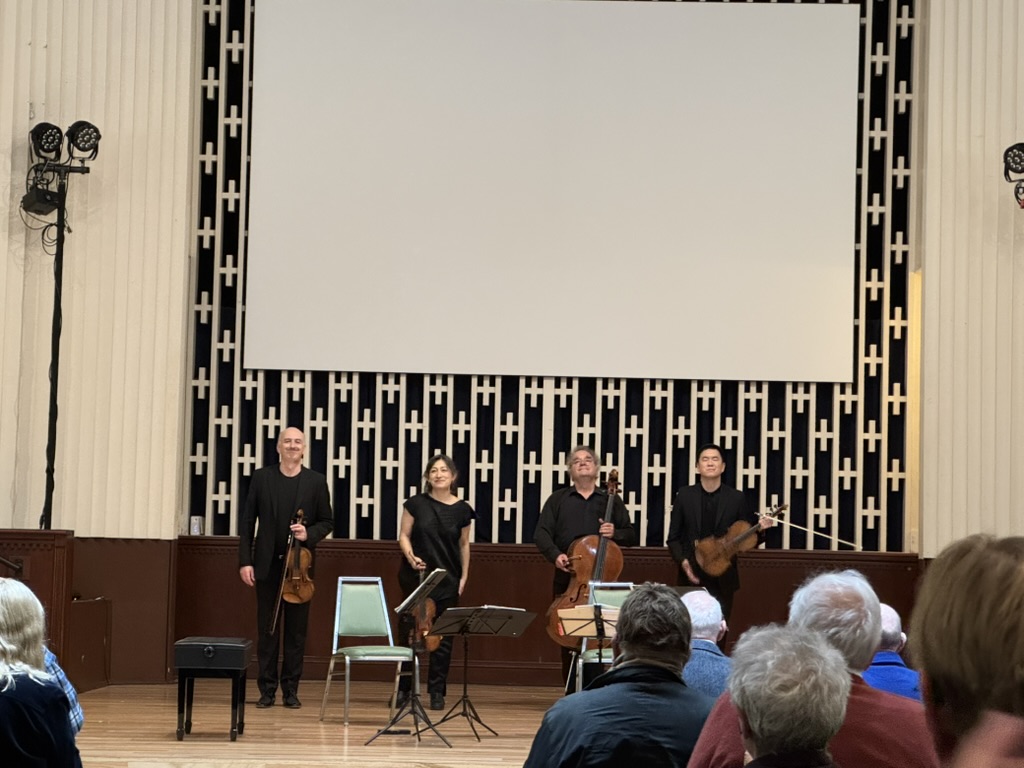
The so-called father of the string quartet, Haydn is always a rewarding composer with which to begin a string quartet recital. Tuesday’s selection was the Rider quartet in its bristling G minor. It opened in quintessential Haydnesque fashion with its delicate ornamentations and sudden pauses. This genteel material was given with tight cohesion, carefully conveying its layered textures with clarity. Some striking modulations were heard in the slow movement before an elegant minuet countered by a rather stormy trio (usually it’s the trio that’s the calmer one). The fiery, galloping finale is what gave this work its epithet, and Haydn had the last laugh with its humorously deceptive close.
Of Bartók’s six iconoclastic quartets, the Third is the shortest but also the most concentrated. It’s quite unusual in form, too, with two contrasting parts subsequently repeated in a loose mirror of their initial presentation. Protean strands began, organically growing in weight and intensity — preconcert lecturer Kevin McLaughlin aptly compared this soundscape to Stravinsky’s Rite of Spring. A panoply of extended techniques were deployed, yielding an array of captivating sounds. Melodically, harmonically, and rhythmically intricate, the second part was blistering in its driving appropriation of folk song. The so-called Ricapitulazione of first part surfaced like a distant dream of the opening before the work’s uncompromising close.
It was lovely to hear Dvořák on a string quartet program in a piece that isn’t the justly famous American quartet. The Takács instead offered the Bohemian composer’s penultimate work in the genre: no. 13 in G major, Op. 106 (I was also reminded the Apollon Musagète Quartet presenting Dvořák’s final quartet on a CCMS program in February 2020, just ahead of the covid shutdown). In these last two works in the form, Dvořák sailed to new heights, only to then turn his attention away from chamber music and to opera and the tone poem.
Gentle gestures opened to set an intoxicatingly bucolic mood, only to grow in dramatic tension and orchestral heft. First violinist Edward Dusinberre had a soaring melodic line, and the broad first moment movement drew to particularly robust coda. Rich textures were layered on top of each in the angelic slow movement, somewhat reminiscent of Beethoven’s Heiliger Dankgesang. At its conclusion, some earthy pentatonicism reminded us this came from the same pen as the man wrote the New World symphony.
Even more quintessential Dvořák came in the following, wherein the composer proudly displayed his Czech origin in the shape of a spunky furiant. I was struck by the Takács intense physicality here, playing with their whole bodies. The bold, wide-ranging finale was given with unified direction for a powerful close.
As an encore, the quartet turned to the second movement of Debussy’s sole work in the medium in a show of their versatility, equally adept in the Frenchman’s impressionist enigma.
 quasi-faust