Yuja Wang headlines Pittsburgh Symphony’s glittering gala

Pittsburgh Symphony Orchestra
Manfred Honeck, conductor
Yuja Wang, piano
David McCarroll, violin
Justine Campagna, violin
Heinz Hall
Pittsburgh, PA
September 20, 2025

López: “Techno” from Fiesta!
Strauss Jr: Éljen a Magyár!, Op. 332 (arr. Nischkauer)
Shostakovich: “Waltz II” from Suite for Variety Orchestra No. 1
Sarasate: Navarra
Mascagni: “Intermezzo” from Cavalleria rusticana
Mancini: Strings on Fire
Tchaikovsky: Piano Concerto No. 1 in B-flat minor, Op. 23

A celebratory gala concert marked the start of the Pittsburgh Symphony’s 2025-26 concert season, featuring a potpourri of appealing orchestral works guided by music director Manfred Honeck before star pianist Yuja Wang took the Heinz Hall stage. A major fundraising event for the organization as well, and a successful one — reportedly raising nearly $1 million.
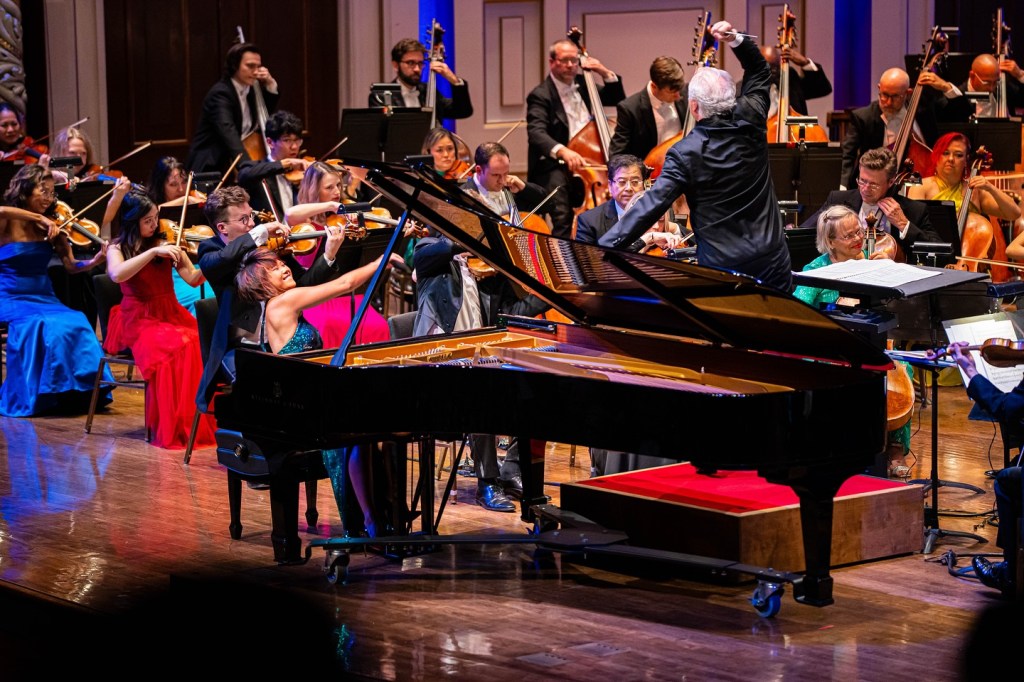
Yuja Wang with Manfred Honeck and the PSO, photos credit JMilteer Photography

Techno from the Fiesta! suite by Jimmy López certainly made for exciting first notes of the season with its driving kinetic energy, enhanced by an expanded percussion section. Strauss’ Éljen a Magyár! charmed in its infectiously lilting rhythms, and served as an acknowledgment of the composer’s 200th birthday.

Another anniversary was marked with Shostakovich, who we note died 50 years ago. A waltz from his Suite for Variety Orchestra No. 1 was nearly Chopinesque in its blending of elegance and melancholy. Sarasate’s Navarra featured dueling PSO violinists David McCaroll and Justine Campagna, playing the material with inimitable Spanish charm and coruscating virtuosity.

Mascagni’s indelible intermezzo from Cavalleria rusticana (which local audiences got to hear complete at Pittsburgh Opera last season) saw delicate strings blossom into the sumptuous. Finally, Henry Mancini’s (best remembered as composer of The Pink Panther and other films) Strings on Fire was just that — a sizzling, energetic workout.

I heard Yuja Wang play Tchaikovsky’s First Piano Concerto at The Cleveland Orchestra this past March, and was dazzled by her consummate virtuosity, command of the keyboard, and refined playing that revealed details I hadn’t heard before even in this overly familiar warhorse. There’s little else to say about it, but what a thrill it was to see her deliver such impassioned and assured playing with the Pittsburgh musicians, her first local appearance since 2013. Despite a thunderous ovation and numerous curtain calls, she didn’t indulge the capacity crowd with an encore, but perhaps it would have been all but gratuitous after such a satisfying take on Tchaikovsky.
Honeck and Pittsburgh Symphony offer delectable potpourri in Thanksgiving program

Pittsburgh Symphony Orchestra
Manfred Honeck, conductor
Steven Banks, saxophone
Heinz Hall
Pittsburgh, PA
December 1, 2024

Weber: Overture to Der Freischütz
Tomasi: Concerto for Alto Saxophone
Strauss II: Overture to Die Fledermaus
Strauss II: Éljen a Magyar!, Op. 332
Puccini: Intermezzo from Act III of Manon Lescaut
Strauss II: Leichtes Blut, Op. 319
Banks: Strength of My Life from Come As You Are (arr. Corey Dundee)
Strauss II: Kaiser-Walzer, Op. 437
Strauss II: Auf der Jagd, Op. 373

Encores:
Josef Strauss: Feurfest!, Op. 269
Strauss Sr.: Radetzky-Marsch, Op. 228

In a standing tradition, the Pittsburgh Symphony presented a populist Thanksgiving program highlighted by a brimming selection of waltzes, polkas, and marches from the Strauss family. The first half began on a rather more serious note, however, opening with the overture to Weber’s landmark opera Der Freischütz.

Steven Banks, Manfred Honeck, and the PSO. Photo credit Manfred Honeck on Facebook

A long-bowed melody in the arching strings was tempered by warm chorales from the Pittsburgh brass. With vigor, darker material took over in full-fledged operatic drama, though in the end the triumphant conclusion won the day.

A rarity followed in the 1949 Alto Saxophone Concerto by Henri Tomasi, a quantity for the PSO debut of Steven Banks. A modernist soundscape was drawn from its piquant bitonalities, and the lyrical potential of the saxophone was exploited to remarkable effect — a markedly distinct style from the jazz sound one is more accustomed to. The Allegro section that followed the concerto’s introductory remarks was of a coloristic mid-century aesthetic, with a lively orchestration to boot, and Banks traversed a wide array of tone and timbre.

The closing Giration-Final saw the soloist dazzle in rapid fingerwork, and the movement’s dance inflections added to its excitement. As an encore, Banks offered The Lord’s Prayer, a slow and lyrical paragraph that showed yet another side of his instrument — and the power it has to resound unaccompanied.

The Strauss-heavy latter half was very much in the spirit of a Vienna Philharmonic New Year’s Concert, as if Heinz Hall was momentarily morphed into the golden Musikverein (and one should also be reminded that an authentic Austrian-style Christmas market lies a few blocks away at Market Square). One could have hardly asked for a more informed interpreter than Austrian native Manfred Honeck.

Lithe and elegant, the overture to the operetta Die Fledermaus fizzed with vigor and flamboyance. Hungarian folk melodies — including echoes of the indelible Rákóczi March — were woven in the exuberant Éljen a Magyar! Rather different but equally appealing was an intermezzo from Puccini’s Manon Lescaut, lush and filled with longing. Harps swelled for a sumptuous texture, further encouraged by fine playing from the solo cello.

Banks returned to showcase his own composition entitled Come As You Are. Originally scored for tenor saxophone and piano, the suite is a lovely tribute to his faith and family. On offer was an arrangement for tenor sax and strings of the third movement “Strength of My Life.” Touchingly reflective, it was well-suited to the rich, mellow sound of the tenor.

Back to Strauss. The Emperor Waltzes were fittingly regal, and Auf der Jagd concluded the printed program complete with some humorous theatrics. Honeck and the PSO indulged the audience with a pair of encores beginning with Feuerfest! from the pen of Johann Jr’s brother Josef. Brought to life by use of the anvil, it was only outdone by the rambunctious Radetzky March.

In a post-concert performance, the Pittsburgh Cello Quartet (comprised of four PSO cellists) offered a brief selection of mostly holiday fare. More memorable was a transcription of Poulenc’s pensive O magnum mysterium.