Pittsburgh Symphony Orchestra Juraj Valčuha, conductor Pablo Ferrández, cello Heinz Hall Pittsburgh, PA November 14, 2025
Wolfe: Liberty Bell Saint-Saëns: Cello Concerto No. 1 in A minor, Op. 33 Encore: Bach: Sarabande from Cello Suite No. 3 in C major, BWV 1009 Strauss: Ein Heldenleben, Op. 40
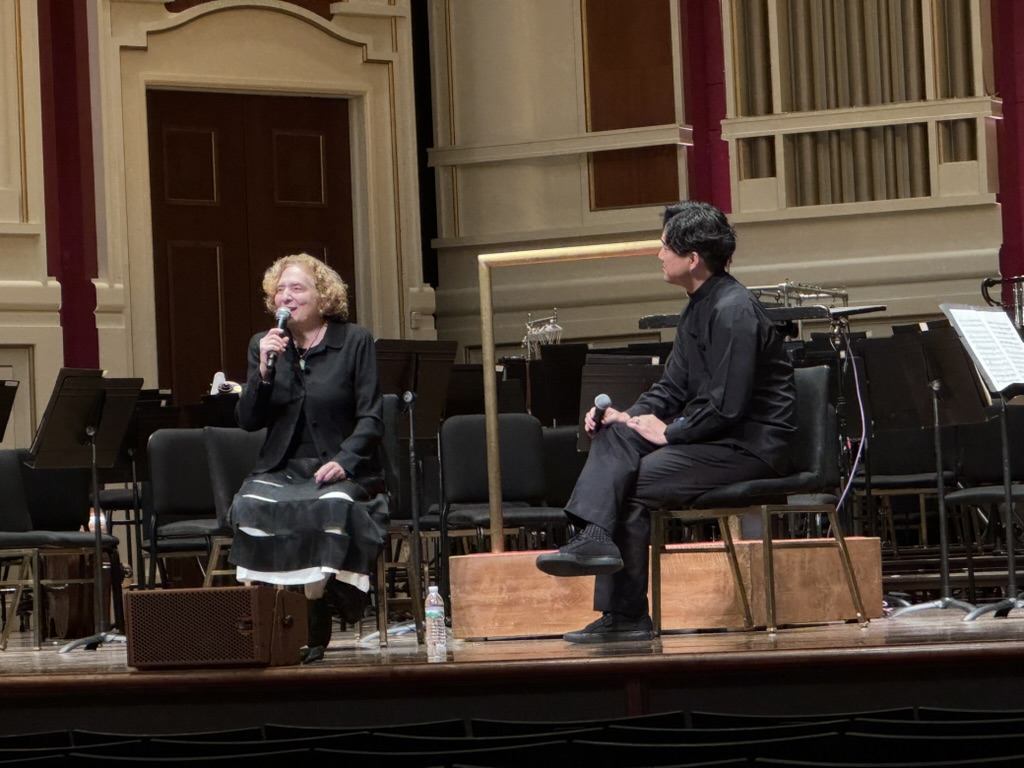
Featuring a return to the Heinz Hall podium of Juraj Valčuha, this weekend’s PSO program opened with another entry in this season’s survey of American orchestral works. Receiving just its second performance was Julia Wolfe’s Liberty Bell, premiered in September at the Houston Symphony where Valčuha serves as music director. Based in the titular bell’s home of Philadelphia, Wolfe was on hand to introduce the piece in person (I liked how she described Philly and Pittsburgh as “the two pillars of Pennsylvania”).
Preconcert interview with Julia Wolfe and assistant conductor Moon Doh
The 10 minute work opened with the clangor of vigorously tolling bells. Perhaps suggested the Liberty Bell’s iconic crack, the jagged, interlocking rhythms conveyed a fractured texture. The orchestration was brilliantly colored, celebratory yet conscious of the struggle to arrive there. At moments, matters paused as if to provide moments of reflection. Drawing on a diversity of traditions, there was even a raucous rock and roll beat, leading to a bold climax splashed with the resonance of the bell.
Saint-Saëns’ Cello Concerto No. 1 in A minor saw the return of Spanish cellist Pablo Ferrández (who will also be featured in this season’s first PSO360 performance). Cast in three compact, interconnected movements, the cellist opened with a lyrical, burnished tone, achieving long-bowed, artful phrasing. The orchestra supported him with a supple, sympathetic accompaniment. The central slow movement opened with a hushed passage in the strings, and Ferrández joined in an intimate dialogue with the orchestra. The robust finale was filled with technical fireworks, yet still lyrical at heart. As an encore, Ferrández offered a Bach sarabande, stately and pure.
Strauss’ great orchestral showpiece Ein Heldenleben opened the second half with bold and heroic beginnings. Yet the conductor thoughtfully didn’t begin too loud, allowing ample room for the muscular brass to grow. “The Hero’s Adversaries” which follows depicts the cranky music critics that bedeviled Strauss — listening to this from the vantage point of being a critic is always a delightfully uncomfortable experience. “The Hero’s Companion” was a passionate and affecting portrait of the composer’s wife, the singer Pauline de Ahna. It featured an extensive and demanding passage for solo violin, played by concertmaster David McCarroll with wide-ranging emotion and variegated color.
A battle was heralded by offstage brass in the fourth section, music that really gets one’s blood flowing before devolving into utter cacophony. The final two sections were rather more restrained, in the twilight of the hero’s life, a retrospective on a life’s work. The music faded into graceful triumph, but not without revisiting the iconic opening of Also sprach Zarathustra.
Pittsburgh Symphony Orchestra Manfred Honeck, conductor Sheku Kanneh-Mason, cello Heinz Hall Pittsburgh, PA March 21, 2025
Shekhar: Lumina Shostakovich: Cello Concerto No. 1 in E-flat major, Op. 107 Encore: I Say a Little Prayer Strauss: Don Juan, Op. 20 Strauss: Symphonic Fantasy from Arabella, Op. 79 (arr. Honeck/Ille)
The Pittsburgh Symphony is to be commended for its advocacy of contemporary music, with many of this season’s programs introducing a recent work by a living composer. This week’s program began with the 2020 work Lumina by Nina Shekhar. Shekhar is currently a doctoral student in music composition at Princeton (presumably classmates with Hannah Ishizaki, featured on a PSO program a month ago). The composer also draws from an engineering background, evident in the present work that concerns the spectrum of light.
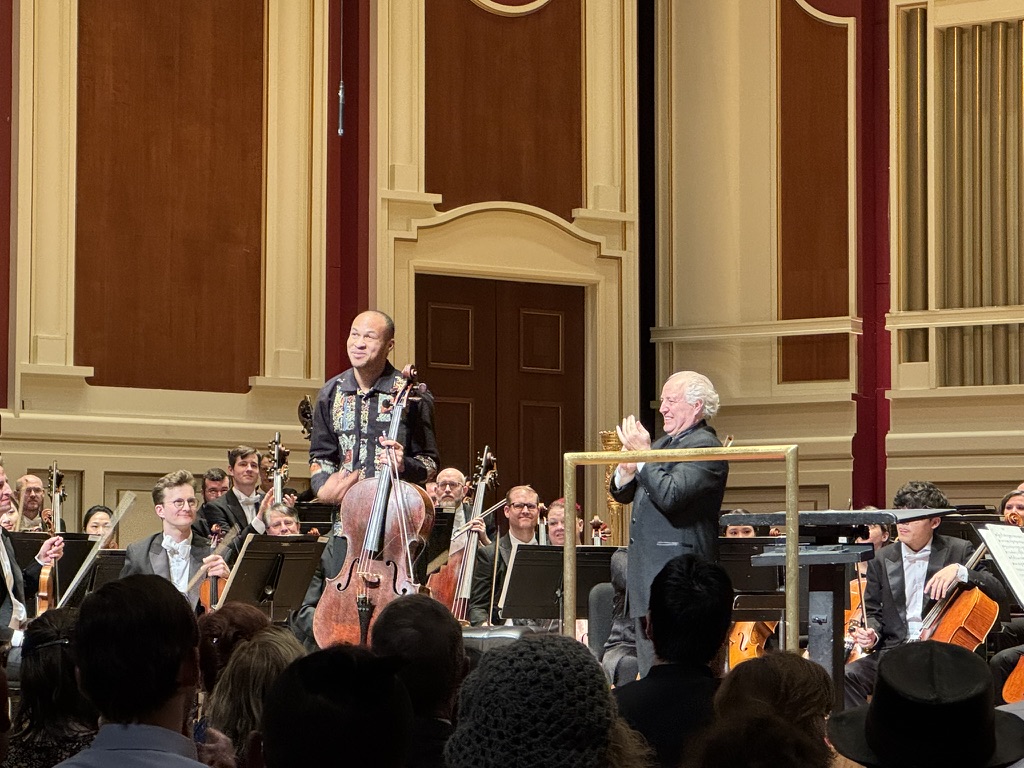
Sheku Kanneh-Mason with Manfred Honeck and the Pittsburgh Symphony
It’s a work that demands attention from both performers and audience. Silence is just as important as sound, and effects are achieved through subtle, nearly imperceptible gestures: microtones, harmonics, bowing of the vibraphone. A soft-spoken essay, it occasionally burgeoned into strident climaxes. I’m not sure this is a piece that fully earned the attention it required, yet I appreciate the PSO’s attention to a rising composer.
The main draw of the evening was the Pittsburgh debut of cellist Sheku Kanneh-Mason in the Cello Concerto No. 1 of Shostakovich. Kanneh-Mason drew a fittingly gritty tone out of his Matteo Goffriller instrument that dates from 1700, delivering a variation on the composer’s musical signature with a caustic bite. The cellist was flexible and limber, imbuing the score with character and color. Manfred Honeck and the PSO supported the soloist with piquant accompaniment. Unusually for Shostakovich, the horn is the only brass instrument used — a tip of the hat to William Caballero for single-handedly serving as the brass section. The Moderato was of desolate, pained lyricism, reduced to a skeletal orchestration.
Like the composer’s First Violin Concerto, an extended cadenza served as effectively a standalone movement in the heart of the work. One was struck by Kanneh-Mason’s expressive range — and while not an overtly virtuosic affair, the cellist showed a deep command of his instrument. The finale was quintessential Shostakovich in both its urgency and coloristic writing, up to the blistering end. As an encore, Kanneh-Mason offered a transcription I Say a Little Prayer, the Burt Bacharach song made famous by both Dionne Warwick and Aretha Franklin — a lovely piece in its jazzy pizzicato (for a recording, see Kanneh-Mason’s warmly recommend album Song).
The second half was devoted to Richard Strauss, beginning with his iconic tone poem Don Juan. Its opening was akin to drinking from a firehose, with blazing virtuosity and brassy splendor. The music crested to searing passions, highlighted by a long and languid oboe solo from Cynthia Koledo DeAlmeida. By the coda, matters came crashing down for a tragic, somber end.
Closing the program was an appealing alternative to the more well-worn tone poems, in the world premiere of a suite based on Strauss’ opera Arabella. Conceived by Manfred Honeck and arranged by Tomáš Ille (a team that has previously devised suites based on Elektra and Janáček’s Jenůfa), it captured the essence of the opera in a span of eighteen minutes. A bold, dense opening was arresting in its rich chromaticism. A lilting waltz — in a similar spirit to Rosenkavalier — contrasted, and the PSO’s superb playing brought out a gorgeous lyricism, leading to a brilliant close.
Columbus Symphony Orchestra Rossen Milanov, conductor Natasha Paremski, piano Ohio Theatre Columbus, OH May 3, 2024
Lutosławski: Symphony No. 1 Rachmaninoff: Rhapsody on a Theme of Paganini, Op. 43 Clyne: This Moment Strauss: Suite from Der Rosenkavalier, Op. 59
Last weekend’s Columbus Symphony program was of particularly inspired and enterprising programming, traversing three works from various points of the 20th-century, and a fourth work composed just last year. Witold Lutosławski was at the vanguard of midcentury modernism, and like Shostakovich and Prokofiev, saw his works heavily repressed by the communist authorities. Such was certainly the case for his First Symphony, composed 1941-47 – during and in the immediate aftermath of WWII – which was suppressed for a decade after its first performance.
Natasha Paremski, Rossen Milanov, and the Columbus Symphony
It’s a landmark work, to be sure, brimming with the composer’s individual voice but readily accessible, and kudos to Milanov for giving the first Columbus hearing. In his spoken introduction, the conductor reminisced about meeting Lutosławski while a student in Pittsburgh. Cataclysmic beginnings were to be had in the work, uncompromisingly expressing the bleak spirit of the times – much to the chagrin of the Soviet apparatchiks. The brass provided a certain sheen of brightness, and piano and harp further added to the colorful scoring.
An extended slow movement saw low strings underpinning a horn solo, giving some semblance of peace after the cacophony of the preceding, but not without a certain unease with its pained lyricism. A flowing solo passage from concertmaster Joanna Frankel ranged from the subdued to the impassioned. The Allegretto misterioso was eerie and mysterious, and its fleeting quality reminded me of the Schattenhaft from Mahler’s Seventh. A shimmering interlude near the movement’s close was quite striking before the finale returned to the vigor of the opening. Hats off to the CSO for a blistering performance of a complex score.
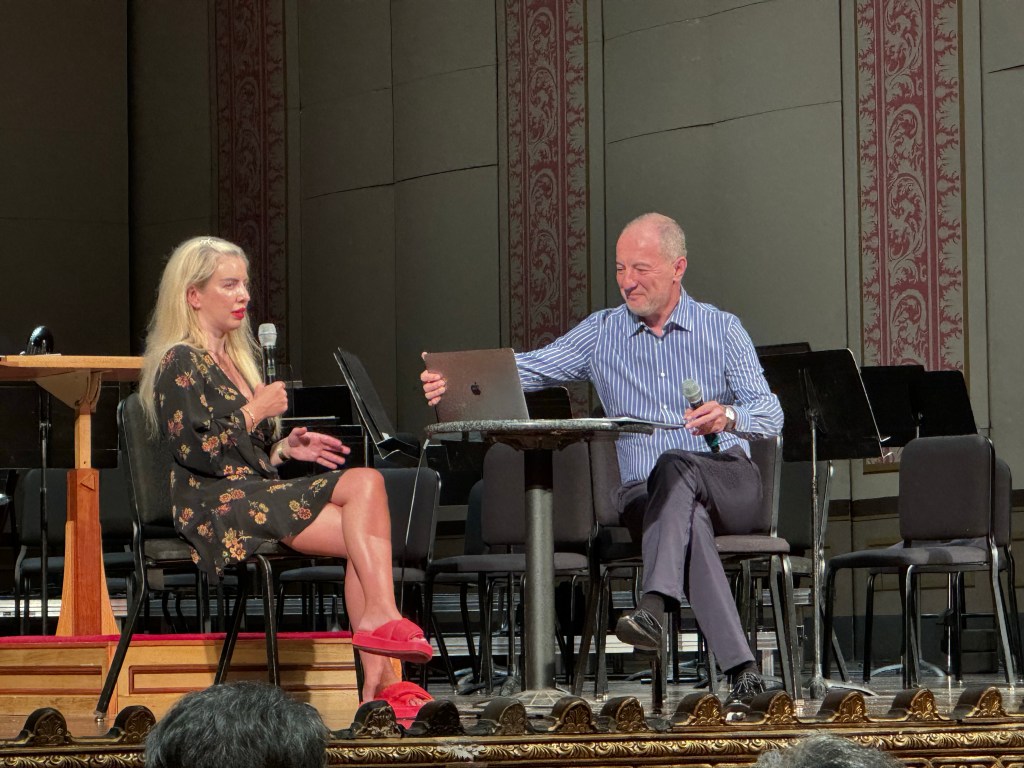
Rachmaninoff’s Rhapsody on a Theme of Paganini was certainly more familiar territory, and brought forth Natasha Paremski as soloist. Paremski was further on hand for a preconcert interview with Milanov (as a sidebar: could Milanov please let his guests speak uninterrupted?). Matters began with a thundering articulation of the skeleton of the ubiquitous theme, and Paremski took things at a rapid, unsentimental tempo, supported by her impressive fingerwork. Variation 7 introduced the Dies irae theme in a meditative manner before building to crashing double octaves. Variation 18 was suitably sumptuous while skirting the saccharine, and Paremski had no shortage of pianistic fireworks in the final variations before the flippant closing gesture.
Anna Clyne’s This Moment came about on commission from the League of American Orchestras, as part of an initiative to proliferate music by women composers. The title alludes to a quote from Buddhist monk Thich Nhat Hanh: “this moment is full of wonders.” The work further invokes quotes from the Kyrie and Lacrimosa of Mozart’s Requiem, which Milanov helpfully had orchestra members demonstrate (and in the present context, perhaps also offered a thematic connection to the Dies irae from the Rachmaninoff). Meditative stillness seemingly stretched the moment, building to more strident material. It’s an appealing piece, but ultimately its six-minute duration didn’t make the strongest impression as a standalone work.
A suite from Strauss’ opera Der Rosenkavalier closed the evening. From bar one, the Ohio Theatre was enveloped in its lush, honeyed, excess. I was struck by the richness of the strings, as well as fine playing from the winds with a standout oboe solo. The Ochs-Waltzes were elegant, stylish, and echt-Viennese, and the suite crested to searing passion.
ProMusica Chamber Orchestra David Danzmayr, conductor Ellen Connors, bassoon St Mary Catholic Church Columbus, OH March 19, 2023
Strauss: Serenade in E-flat major, Op. 7 Villa-Lobos: Ciranda das sete notas, W325 Tauský: Coventry: Meditation for Strings Mozart: Symphony No. 38 in D major, K504, Prague
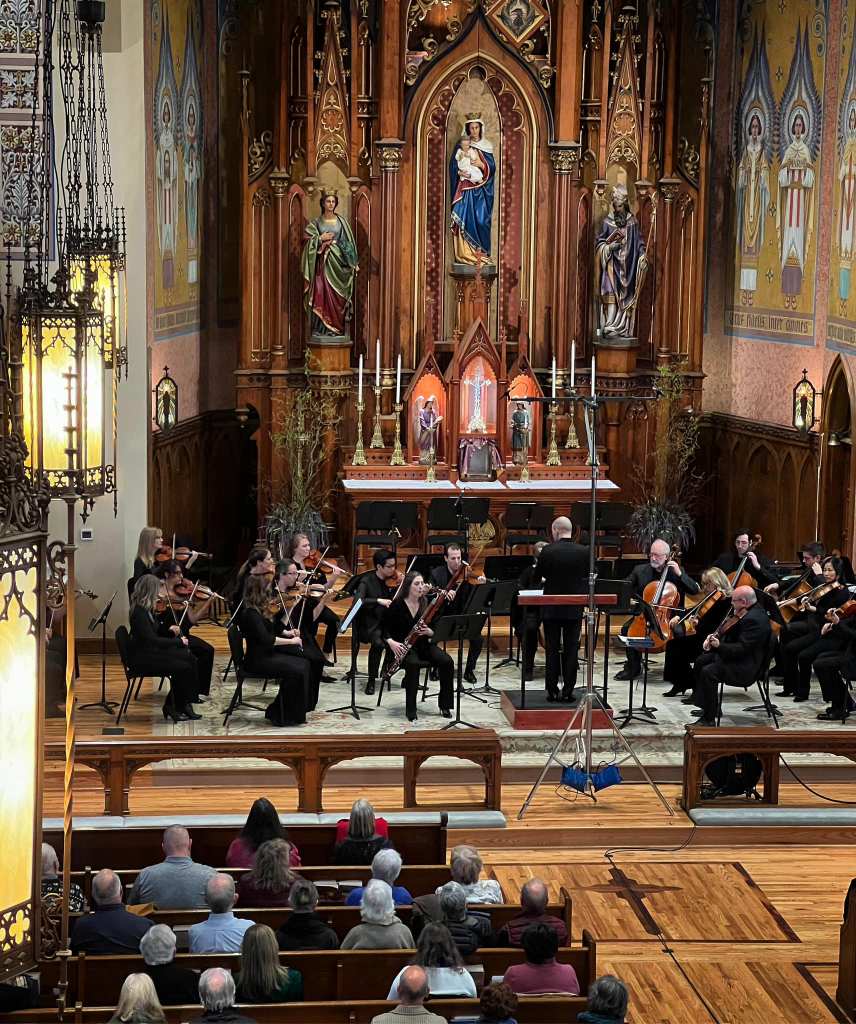
In a continued effort to reach wider audiences, ProMusica presents a “neighborhood series,” leaving their usual home at the Southern Theatre in favor of various locations throughout Columbus. I caught Sunday afternoon’s performance at the beautiful St Mary Church in German Village. A youthful Serenade by Richard Strauss opened. The winds and brass for which it was scored were warm and mellifluous in this classically-proportioned work, hardly foreshadowing the extravagant use of those instruments in the mighty tone poems that would follow. The ensemble filled the church almost like an organ; such a venue can suffer from excessive reverberation, though apparent, conductor David Danzmayr did much to adapt to the space.
Ellen Connors with David Danzmayr and ProMusica at St Mary, photo credit ProMusica
Villa-Lobos’ single movement Ciranda das sete notas (“Round Dance of Seven Notes”) brought forth ProMusica’s principal bassoon Ellen Connors. There was a wonderful energy present from the onset, and the richly harmonized material captured one’s attention. Connors offered a clear tone with playing surprisingly limber for such a lumbering instrument. The work demanded a substantial range and speed, with barely a moment for the soloist the breathe even in the slower central section. The meditative final moments were especially lovely.
A work for strings from the Czech composer Vilém Tauský followed. A Jew, he was forced to flee in homeland in 1939, settling in England where he remained until his death in 2004. Coventry, written in 1979, reflects with raw emotion on the trauma of war. One was struck by the resonance of low strings that opened, soon to be joined by the violins. Lyrical at heart but peppered with dissonances pained and poignant, it was a piece of solemn intensity that painted a forlorn picture.
Mozart’s Prague symphony was a markedly cheerier affair. Only a small handful of the composer’s 41 symphonies begin with a slow introduction; the Prague has the most substantial, stately and weighty beginnings before one of Mozart’s most delightful themes took shape. Danzmayr opted for a brisk tempo choice, but clarity was maintained even during the bracing development. A graceful and measured slow movement served as a moment of repose before the whirlwind finale, wherein the ProMusica woodwinds were in especially fine form.
Columbus Symphony Orchestra Rossen Milanov, conductor Brian Mangrum, horn
Women of the Columbus Symphony Chorus Ronald J. Jenkins, chorus director
Ohio Theatre Columbus, OH March 18, 2022
Britten: Four Sea Interludes from Peter Grimes, Op. 33a Strauss: Horn Concerto No. 1 in E flat major, Op. 11 Liszt: Dante Symphony, S109
Though Franz Liszt is rightly remembered as chiefly a composer for the piano, he produced a vast body of orchestral works – including virtually inventing the tone poem – that should not be overlooked. In some particularly ambitious programming, the Columbus Symphony offered the first local performances of the Dante Symphony, an orchestral portrait of The Divine Comedy. An informative pre-concert conversation between music director Rossen Milanov and Jonathan Combs-Schilling from Ohio State’s Italian department gave thoughtful insight into both the music and its literary inspiration. A visual element was added with Gustave Doré‘s iconic illustrations to accompany the text – produced in 1857, the same year as the symphony – projected along with the music. Though an intriguing idea, the stage lights largely diluted the projections, rendering them more a distraction than an enhancement.
Gustave Doré’s illustration to Dante’s Inferno. Plate VIII: Canto III: The gate of Hell. “Abandon all hope ye who enter here”, photo credit Wikimedia Commons
The first movement Inferno began with an imposing descent to the hell in the low brass – trombones in particular have long been associated with depictions of the underworld, dating back to Monteverdi’s Orfeo. A wound-up tension was purveyed in music that was unrelenting, often overwhelming in ferocity, but Milanov had a thorough grasp of the large-scale form, serving as an incisive guide. Secondary material depicted the doomed love affair of Francesca and Paolo, a languid contrast. A skeletal recitative-like passage in the bass clarinet was quite striking, and Liszt made use of richly chromatic, Wagernian harmonies, sounding at times like a page out of Tristan. Milanov rightly reined in the bombast during the coda, but still yielded a close that was powerfully unforgiving.
The second movement Purgatorio provided some much needed peace after the preceding, with some especially touching scoring for the harp and oboe. This was fittingly music of stasis, held in contemplative limbo, although a triumphant passage and a thorny fugue gave matters both variety and perhaps a glimmer of hope. Liszt had originally envisioned concluding the work with a Paradiso movement, mirroring the source material, but conceded that depicting heaven would be all but impossible. Instead, he provided a lovely Magnificat as something of a pendant to previous movement. It’s a hymn of sorts wherein we manage just a glimpse of the entrance to paradise. It was a magical moment when the women of the Columbus Symphony Chorus appeared practically out of the ether, offering an angelic vision of what lies beyond in the most deeply moving music of the work. The performance was a laudable achievement, and I hope Milanov and the CSO will continue to explore Liszt’s lesser-known orchestral pieces.
The program began with Britten’s Four Sea Interludes from Peter Grimes, a quantity which amazingly hasn’t appeared on a CSO program since 1979. High strings opened with an almost mystical evocation of dawn, though the intonation left something to be desired. “Sunday Morning” saw a brassy awakening, replete with tolling church bells. “Moonlight” was tranquil though not without foreboding as matters took a darker turn in the closing “Storm.”
The ensemble afforded the spotlight to one of its own in Strauss’ Horn Concerto No. 1 in bringing Brian Mangrum front and center, the CSO’s principal horn since 2018. Written when the composer was a precocious 18 year old, the regal E flat major tonality set the stage for a decisive solo entrance, and Mangrum offered a warm, rich tone. A lyrical slow movement saw the horn in dialogue with a rising gesture in the strings, a moment of repose before the jaunty and limber finale.
Rossen Milanov, Brian Mangrum, and the Columbus Symphony. Photo credit Columbus Symphony
Boston Symphony Orchestra Andris Nelsons, conductor Lisa Batiashvili, violin Symphony Hall Boston, MA October 14, 2021
Still: Threnody (In Memory of Jan Sibelius) Strauss: Symphonic Fantasy on Die Frau ohne Schatten Sibelius: Violin Concerto in D minor, Op. 47
Encore: Machavariani: Doluri
The Boston Symphony and music director Andris Nelsons offered a program that not only boasted very fine playing, but presented three selections that while outwardly diverse, revealed fascinating connections. The evening opened with music of William Grant Still, namely his 1965 Threnody, written to elegize Jean Sibelius. Sibelius was familiar with Still’s scores, and had nothing but high praise for the American. The Threnody was brief but of powerful impact. An arresting beginning gave way to a melancholic, Sibelius-like melody. The work proceeded in the manner of a doleful funeral march, punctuated by tolling bells – a touching tribute from one great composer to another.
Andris Nelsons and Lisa Batiashvili, photo credit Aram Boghosian
Continuing last weekend’s exploration of Strauss, the ensemble next turned to the Symphonic Fantasy on Die Frau ohne Schatten in its first BSO performance (as with the Still). Strauss returned to his 1919 opera near the end of his life, completing the present fantasy in 1947, in twenty or so minutes capturing the essence of the opera – much like Liszt did for piano in his major operatic fantasies. A cataclysmic opening statement pointed towards a lush, coloristic workout for the orchestra, seamlessly blending together the opera’s themes in a vibrant tapestry. The low brass were a particular standout as the music surged and swelled in this powerful performance, one that surely made the case for including this all too often overlooked work alongside the composer’s best-known tone poems.
Sibelius’ incomparable Violin Concerto occupied the entire second half, tying the program together: after the opening selection, it was only fitting to include a work by Sibelius himself, and moreover, the concerto’s 1905 premiere in its now standard revised version had no less than Strauss at the podium. Lisa Batiashvili proved to be a choice soloist right from the opening bars. Imbued with a stylistically appropriate Nordic chill, her deeply burnished tone resounded with searing passion, and I was especially struck by her complete control as the music soared far into the violin’s highest register. The massive cadenza, a structural underpinning of the opening movement, further put Batiashvili’s stunning virtuosity on display. After the fire and passion, the central Adagio di molto countered with a muted lyricism. Both soloist and orchestra alike deftly brought out the music’s subtleties while the dance rhythms of the work’s finale were delivered with a singular intensity. As a well-deserved encore, the soloist offered Alexi Machavariani’s Doluri, a jaw-dropping study in double stops and perpetual motion.
Cleveland Orchestra
Franz Welser-Möst, conductor
Simon Keenlyside, baritone
Severance Hall
Cleveland, OH
May 23, 2019
Grieg: Morning Mood, The Death of Åse, and At the Wedding from Peer Gynt, Op. 23
Sibelius: Kaiutar, No. 4 from Six Songs, Op. 72
Sibelius: Illale, No. 6 from Seven Songs, Op. 17
Sibelius: Aus banger Brust, No. 4 from Six Songs, Op. 50
Sibelius: Svarta rosor, No. 1 from Six Songs, Op. 36
Sibelius: Kom nu hit, död!, No. 1 from Two Songs for Shakespeare’s The Twelfth Night, Op. 60
Sibelius: Im Feld ein Mädchen singt, No. 3 from Six Songs, Op. 50
Sibelius: Die stille Stadt, No. 5 from Six Songs, Op. 50
Sibelius: Var det en dröm?, No. 4 from Five Songs, Op. 37
Strauss: Aus Italien, Op. 16
Franz Welser-Möst and The Cleveland Orchestra closed the 2018-19 season in an alluring program, with all selections stemming from the late 19th-century (and in to the early 20th), connected by Romantic fascinations from awe-inspiring destinations to drama and poetry. Beginning the evening were selections from Grieg’s incidental music to Peer Gynt. Welser-Möst culled his own suite of three excerpts rather than opting for either of the two suites the composer later produced. The selections were performed in reverse order of appearance in the source material, opening with the familiar Morning Mood (which serves as the prelude to Act 4). Silvery flutes beckoned the morning, with the songful theme passed around the woodwinds before appearing in the strings. Welser-Möst’s brisk tempo ensured matters were never sentimentalized. Lush and mournful strings made The Death of Åse the emotional crux, easily a precursor to Barber’s Adagio. At the Wedding (which opens the complete work) was given with vigor and joyous abandon. A more languorous theme was very finely played in turn by the principal winds while Wesley Collins’ offstage viola radiated folksy charm.
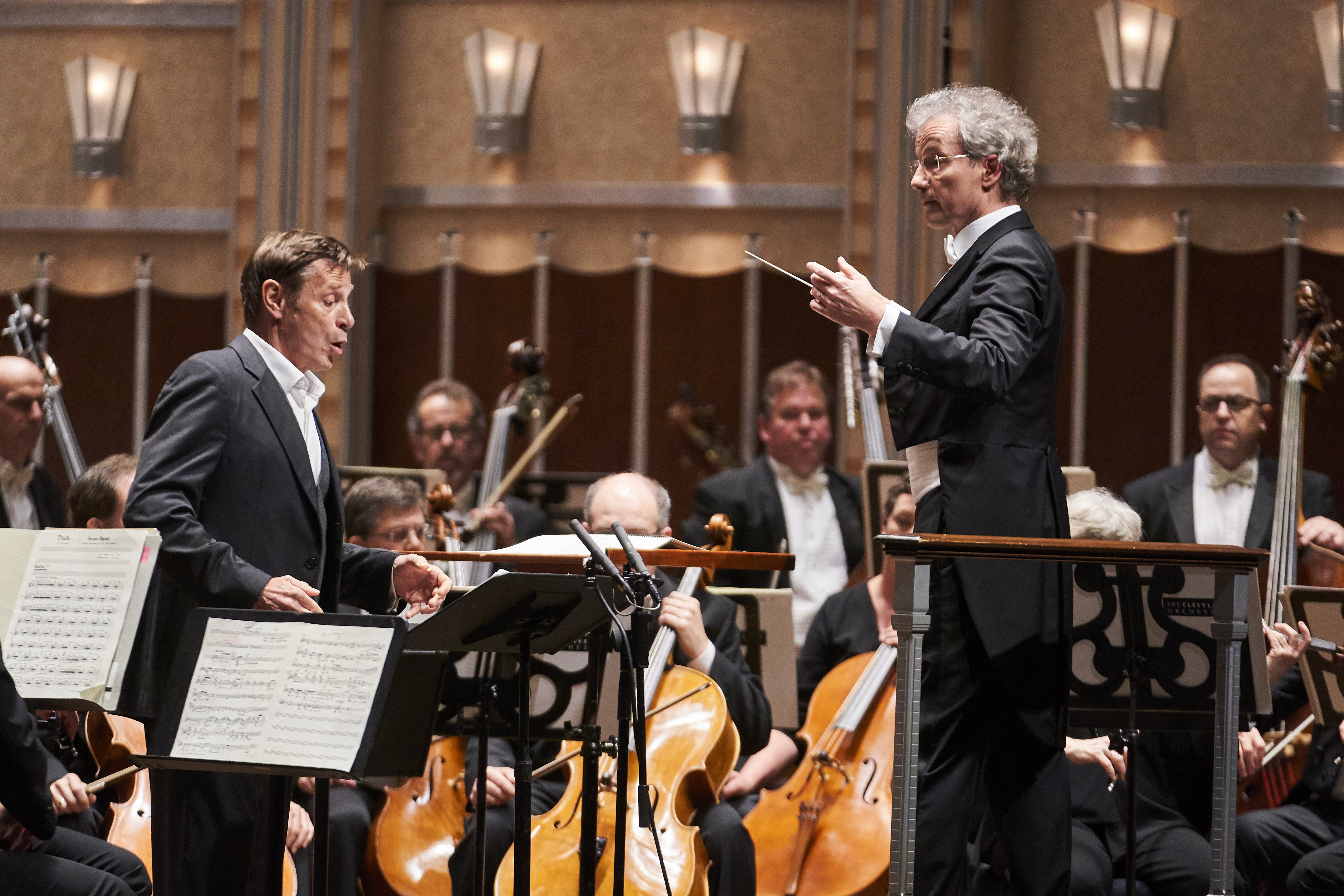
Simon Keenlyside and Franz Welser-Möst, photos credit Roger Mastroianni, Courtesy of The Cleveland Orchestra
On the heels of his lieder recital a few days prior, Simon Keenlyside returned for the evening’s centerpiece and highpoint – a helping of eight of the seldom-performed songs of Sibelius. The songs at hand were variously in Finnish, Swedish, or German, and in some cases orchestrated by Sibelius himself, others by contemporaries. Keenlyside brought out the lyrical qualities of the Swedish language in Kaiutar, with an orchestration that encouraged its fantastical, fairy-tale atmosphere. Crepuscular strings made Illale a true gem, and the next selection turned to German in a setting of Richard Dehmel’s Aus banger Brust. Dehmel’s poetry served as text for the likes of Strauss and Schoenberg, and Sibelius proved no less adept with the work’s acerbic dissonances and moving solo passages from concertmaster Peter Otto in faithful service of the text. Svarta rosor, a comparatively better-known quantity, was of robust lyricism and grand emotions, nearly operatic with an unforgiving close to boot.
Unlike the others all originally scored for voice and piano, Kom nu hit, död! came from a set of two Swedish settings of Shakespeare’s The Twelfth Night for voice and guitar, given a rather gloomy reading at present. The richness of Im Feld ein Mädchen singt could easily have been mistaken for Strauss, while Die stille Stadt – another Dehmel setting – maintained a remarkably surreal atmosphere, enhanced by ethereal sounds from the glockenspiel, harp, and high strings. The last selection, Var det en dröm?, displayed again Keenlyside’s keen ability to seamlessly switch languages, and brought matters to a passionate, satisfying close, feeling almost as if these eight otherwise disparate songs were conceived as a unified cycle.
Strauss’ Aus Italien drew inspiration from an Italian journey undertaken by the composer as an impressionable youth, and became the first entry in his great series of tone poems. It’s an immature work to be sure, yet many Straussian hallmarks are already firmly in place, setting the stage for the musical revolutions that would soon be flowing from his pen. This was certainly apparent in the opening Auf der Campagne which could only have been written by Strauss, with elemental beginnings burgeoning into material larger than life. Brassy passages were of arresting vigor, although otherwise matters in performance weren’t entirely polished, sounding as if some extra rehearsal time was needed – no doubt, I suspect, ironed out by the Saturday performance.
Rather than the single-movement architecture of the successive tone poems, Aus Italien was conceived far less cohesively as four distinct portraits. In Roms Ruinen followed suit, generally lighter fare of Italianate charm interspersed with more solemn moments in awe of the eponymous ruins. Strauss’ idiomatic orchestral effects certainly began to crystallize in Am Strande von Sorrent, a coloristic painting of the sun-drenched coast of Sorrento. The closing Neapolitanisches Volksleben marked the work as a foreigner’s less than reliable view of Italy in that Strauss mistook a popular tune of the day for bone fide Neapolitan folk music (I was somewhat reminded of the All’Italiana movement from the Busoni piano concerto heard earlier this season – though there the composer was no foreigner, it too juxtaposed Italianate folk melodies in the context of an otherwise very Teutonic musical language). In any case, matters were nonetheless of an infectious joie de vivre, banal yet so colorfully orchestrated. The orchestra’s committed playing heightened one’s interest: ultimately the rewards were mixed, though the players on stage made as strong a case as they could in this vintage work displaying the budding composer’s incipient genius.
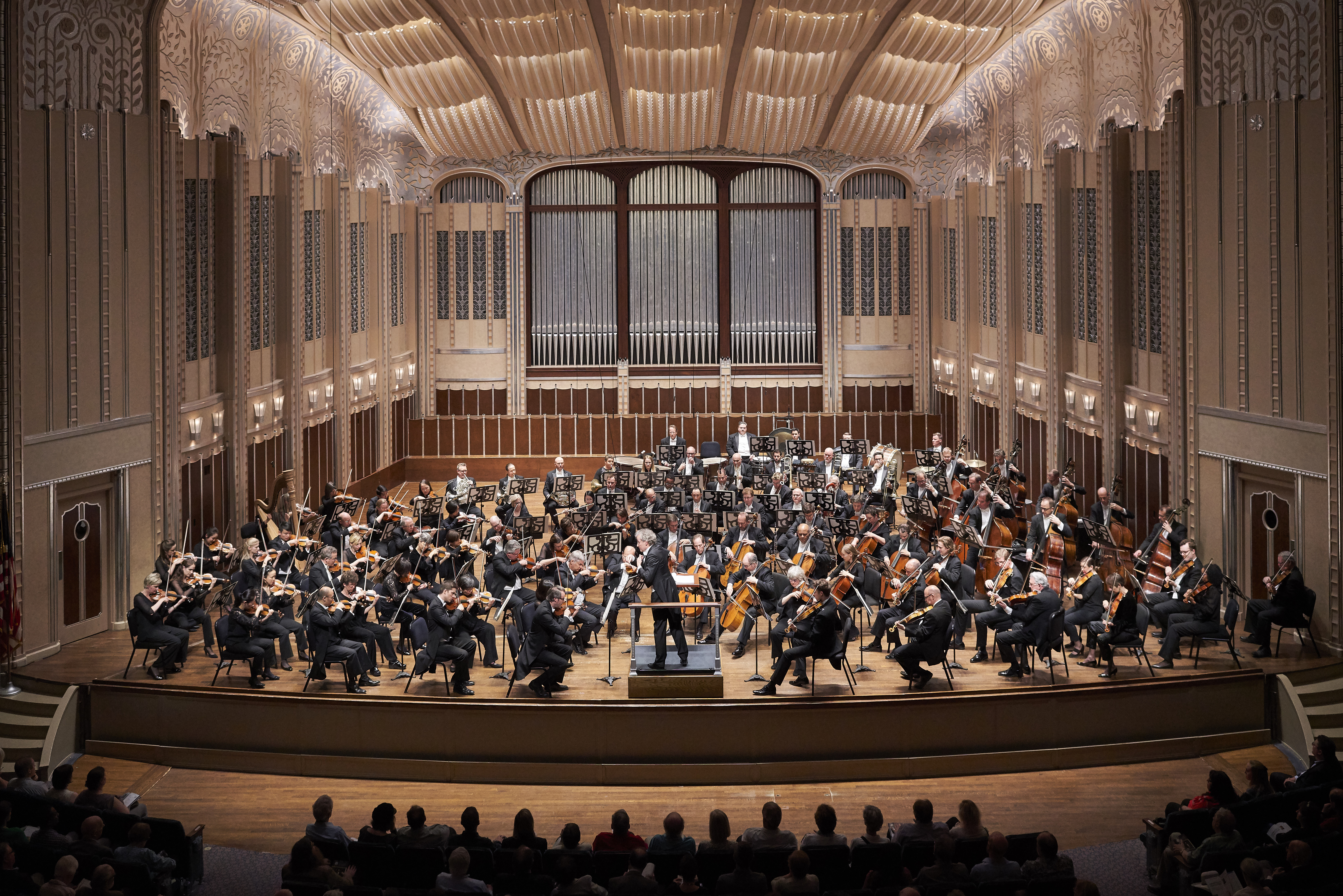
Franz Welser-Möst and The Cleveland Orchestra in Aus Italien
Cleveland Orchestra
Franz Welser-Möst, conductor
Severance Hall
Cleveland, OH
January 13, 2019
Strauss: Ariadne auf Naxos, Op. 60
Tamara Wilson, soprano (Ariadne/Diva)
Andreas Schager, tenor (Bacchus/Tenor)
Daniela Fally, soprano (Zerbinetta)
Kate Lindsey, mezzo-soprano (Composer)
Wolfgang Brendel, speaking role (Major-Domo)
Hanno Müller-Brachmann, baritone (Music Master)
Jonas Hacker, tenor (Dance Master)
Julie Mathevet, soprano (Naiad)
Daryl Freedman, mezzo-soprano (Dryad)
Ying Fang, soprano (Echo)
Ludwig Mittelhammer, baritone (Harlequin)
James Kryshak, tenor (Scaramuccio)
Anthony Schneider, bass (Trufffaldino)
Miles Mykkanen, tenor (Brighella)
Frederic Wake-Walker, director
Alexander V. Nichols, lighting, projection, and set design
Dominic Robertson & Lottie Bowater, collage, animation, and video content design
Jason Southgate, costume design
Mallory Pace, hair and makeup design
In what has become an essential part of The Cleveland Orchestra’s Severance Hall season, music director Franz Welser-Möst led his ensemble in a staged opera production, this season turning attention towards Richard Strauss in Ariadne auf Naxos. A wholly unique work in the operatic canon, Ariadne is preceded by a prologue wherein a cast of characters plan and prepare an evening’s musical program, debating whether it should be serious art or comedic entertainment, and what follows is the resultant product – effectively, an opera with an opera. The new production was designed by Frederic Wake-Walker, who made much of Severance’s small stage and deftly incorporated motifs of the hall into his design.
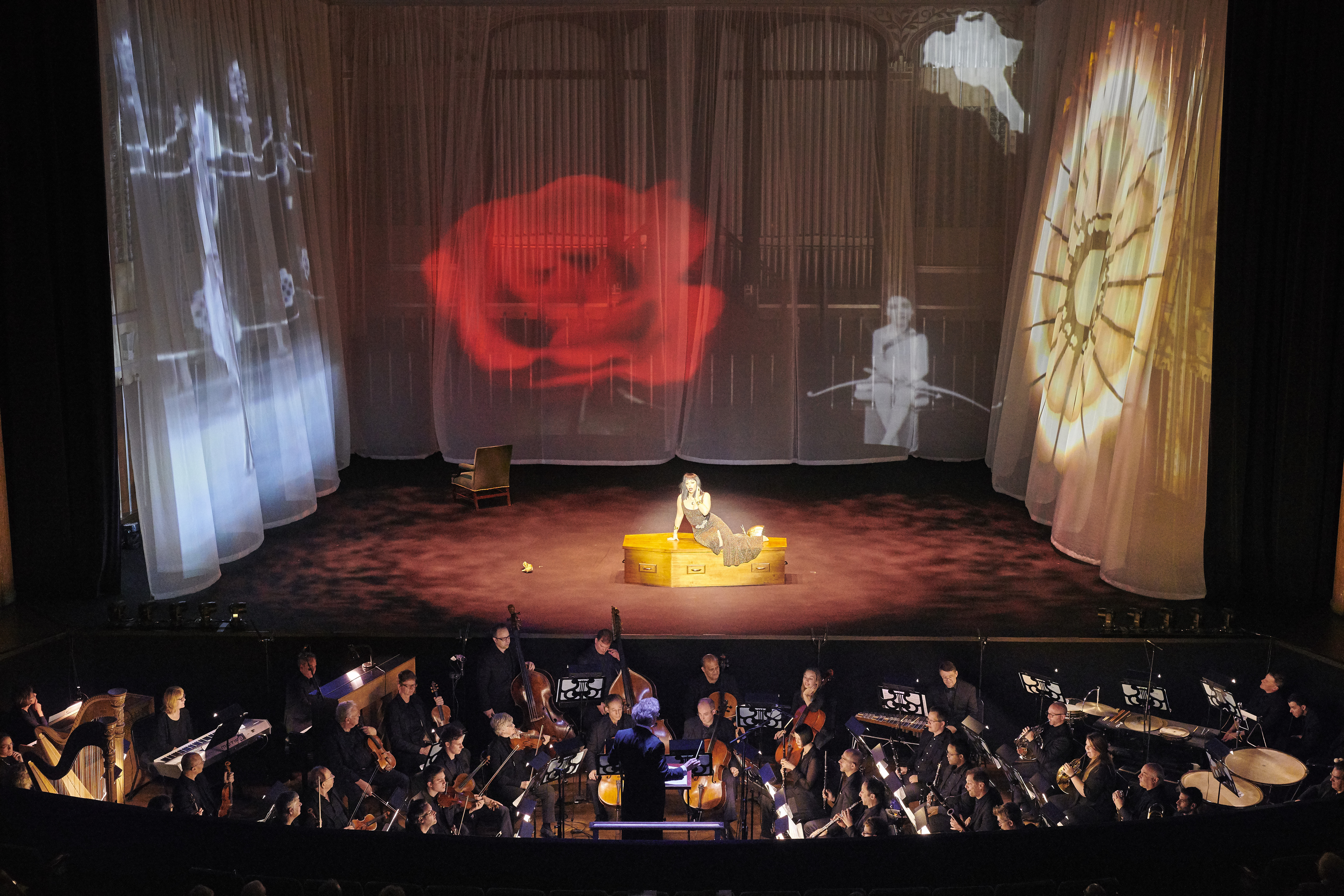
The ensemble of Ariadne auf Naxos at Severance Hall, with The Cleveland Orchestra led by Music Director Franz Welser-Möst. Photo by Roger Mastroianni.
Welser-Möst eschewed the usual conductor entrance, with the prologue opening practically in medias res with conductor and orchestra in casual dress as perhaps in the middle of a rehearsal: the musicians thus became characters themselves. The instrumental introduction evidenced the finely-tuned Strauss playing of this ensemble. Strauss scored it for the rather modest force of about 35, although owing to the composer’s mastery of orchestration it often sounded as much more. While the scoring was thinner in the winds – particularly given what one might expect for Strauss – it was fleshed out by three keyboard instruments (piano, harmonium, celeste), and the clear textures allowed for the solos of the Cleveland principals to be rendered in sharper focus – notable were passages from the flute, clarinet, oboe, cello, and concertmaster Peter Otto.
As the Major Domo, Wolfgang Brendel was both imposing and avuncular in his spoken role (the character purportedly being tone deaf), explaining to the Composer that the latter’s opera would coincide with a performance by a comedy troupe, setting up the prologue’s central conflict. Dressed in the glam of a rock star, Kate Lindsey brought enormous vigor and defiance to the firebrand Composer, scored for mezzo to portray his youth, which involved an artistic idealism he hardly wanted to yield to comedians. As the Prima Donna (and slated to play title role in the Composer’s opera), soprano Tamara Wilson captured the essence of the stereotypical diva (and incidentally, Wilson is to reprise the role with Welser-Möst at La Scala later this season). When it was announced an inflexibly scheduled fireworks display would necessitate the opera and the comedy to be performed simultaneously, the singers and the comics exchanged ideas in a humorous mashup of the comical and the serious.
After the prologue’s minimalist staging, Severance Hall underwent a miraculous transformation to host the opera proper. The orchestra was lowered down to the pit, and a curtain draped around the stage’s perimeter served as a canvas for a nearly continuous stream of video projection. In adoration of the production’s venue, patterns reflective of the Severance ceiling were displayed on the curtain, and Ariadne’s dress would invoke the same pattern. While I was impressed with the production being truly made for Cleveland, perhaps the sight lines of the hall could have further been considered during design – particularly in the prologue, some of the action was obscured from my vantage point on the side of the balcony.
Daniela Fally (Zerbinetta) in Ariadne auf Naxos at Severance Hall, with The Cleveland Orchestra led by Music Director Franz Welser-Möst. Photo by Roger Mastroianni.
Following another finely-played orchestral prelude, the celestial voices of the three nymphs were heard from above, reaching out to Wilson now refashioned as Ariadne. In a nod towards (somewhat) contemporaneous comedy, the comedians were costumed as the four Marx Brothers (is there any evidence that Strauss ever saw a Marx Brothers film?!). Additionally, clips from various comedies were projected, including scenes of Charlie Chaplin during the Harlequin’s aria, Lieben, Hassen, Hoffen, Zagen. Ludwig Mittelhammer gave a deeply lyrical and affecting reading of the Harlequin, and during his excellent pre-concert lecture, Prof. Bryan Gilliam observed that the aria in question bears a more than passing resemblance to the first movement theme from Mozart’s piano sonata K331 – a composer who Strauss profoundly admired.
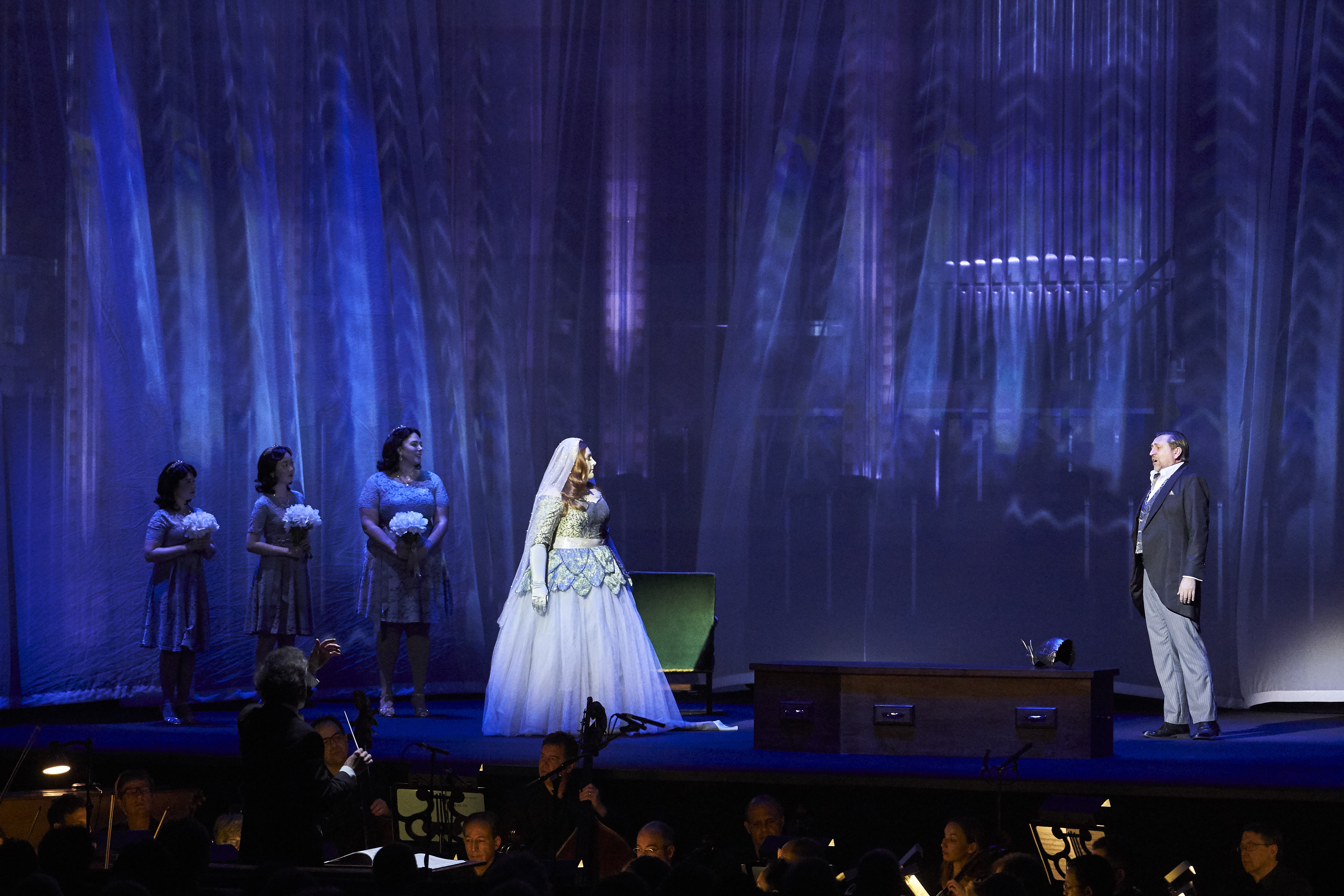
The second half’s centerpiece, Zerbinetta’s extensive Großmächtige Prinzessin, saw Daniela Fally – donning a flapper dress – shining brilliantly in this coloratura tour de force. The ensemble piece Töne, töne, süße Stimme, given by the nymphs in concert with Ariadne, was of sublime beauty as well as another musical homage – in this case, to Schubert (the Wiegenlied, D498). Tenor Andreas Schager entered as Bacchus, stretching to the extremities of his vocal range with great power but always lyrical first and foremost. A transcendent transformation occurred on stage with the darkened hall becoming filled with light as Ariadne gave thought to life with Bacchus outside her cave on the titular Naxos, perhaps alluding to the quest for enlightenment in Plato’s allegory of the cave. Bacchus and Ariadne closed with a duet of luscious lyricism: in the wake of the earlier debates of high art vs. populism, the sublime firmly had the final word.
Tamara Wilson (Ariadne) and Andreas Schager (Bacchus) in Ariadne auf Naxos at Severance Hall, with The Cleveland Orchestra led by Music Director Franz Welser-Möst. Photo by Roger Mastroianni.






 quasi-faust