In style and spirit, Noseda offers a Brahmsian evening at the National Symphony

National Symphony Orchestra
Gianandrea Noseda, conductor
Ying Fu, violin
Raymond Tsai, cello
Concert Hall
Kennedy Center
Washington, DC
March 14, 2026

Schumann: Overture to Manfred, Op. 115
Simon: Double Concerto Suite
Brahms: Symphony No. 3 in F major, Op. 90

Under the helm of music director Gianandrea Noseda, the weekend’s program at the National Symphony Orchestra traced the spirit of Brahms with works that influenced and were influenced by him, culminating in a symphony by the German composer himself. As per official decree from the current administration, all NSO concerts now begin with a rendition of the national anthem (led by the concertmaster, without the conductor present).
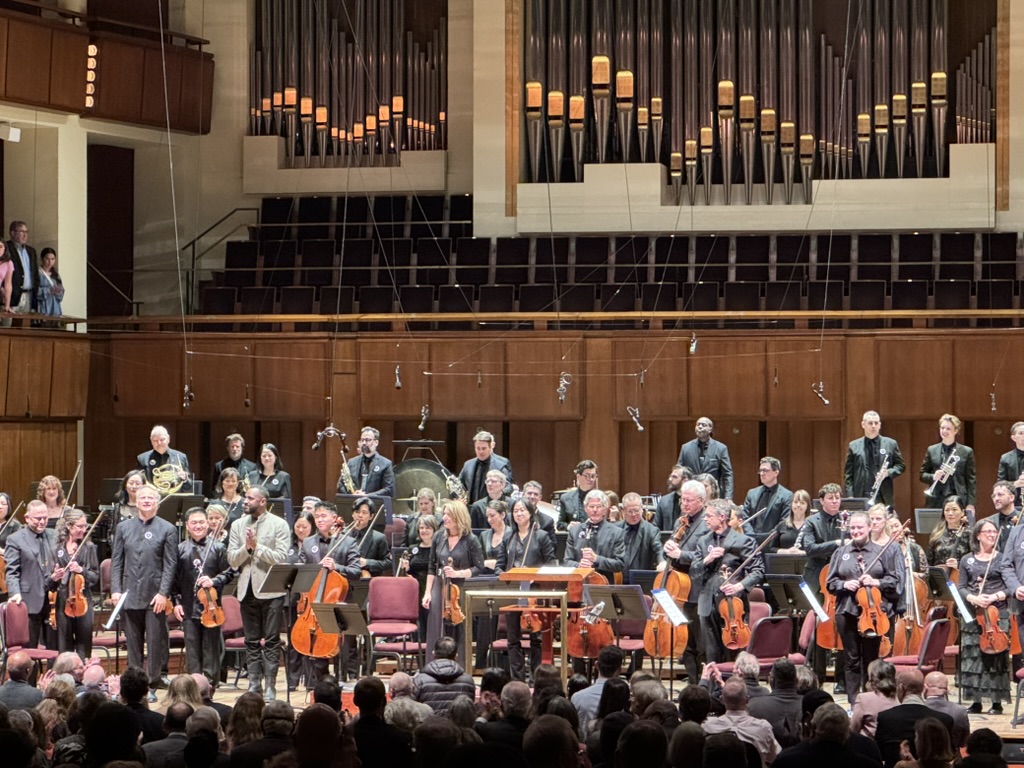
Gianandrea Noseda, Ying Fu, Carlos Simon, and Raymond Tsai with National Symphony Orchestra

Robert Schumann shaped Brahms’ musical language perhaps more than any other. A late work from the elder composer opened in the overture to the incidental music to Manfred. The complete work is rarely heard, but the overture functions well as a standalone piece. A bold opening was dialed back to the poignantly ponderous, gradually building again to intense, riveting drama. An especially sturdy brass section portrayed the brooding titular figure, only to arrive at a somber close.

A native of Washington, Carlos Simon has been serving as the NSO’s composer-in-residence since 2021. The present performances featured the world premiere of his Double Concerto Suite, with solo parts for violin and cello – a nod to Brahms’ own double concerto. Unlike most of Simon’s works, this music was purely abstract without an explicit program or inspiration. “Suite” is a key word in the title; its five movements were rather disparate and lacked the cohesion of a singular concerto. The soloists were drawn from the ranks of the NSO principals, Ying Fu (violin) and Raymond Tsai (cello) after Hilary Hahn and Seth Parker Woods withdrew in protest.

The work is substantial in scope at over thirty minutes. Energetic, colorful orchestration began, propelled by driving rhythms. Fu and Tsai were in a harmoniously blended dialogue with one another. The second movement featured lyrical playing from the cello with some touching double stops and a substantial solo passage for flute. A playful, good-natured movement followed, ahead of material that invoked the Delta Blues. The finale was a bit thornier, with frenetically interlocking material for a high-octane coda. While much of it was pleasing to the ears, I didn’t find it to be a work that made a lasting impression – and I was left wondering what Hilary Hahn might have managed with it.

The program concluded with Brahms’ autumnal Third Symphony in the strongest playing of the evening. Stormy beginnings belied its gentle core. Noseda’s baton gently floated, suspended, drawing out the bucolic textures, and under his pacing, matters were never stodgy as Brahms can be under lesser hands. The Saturday night audience had a tendency to applaud between movements; in the symphony Noseda seemed to consciously fight against it by leaving little space between.

Mellifluous winds opened the Andante, a tranquil essay capped off by the amber glow of the striking chord progression which closed. There was a gentle lilt to the Poco allegretto, and most of the dramatic tension was saved for the finale with its brassy splendor, though it found its way to a reflective close at peace with world.

ProMusica opens 45th season with burnished Bruch and bold Beethoven

ProMusica Chamber Orchestra
David Danzmayr, conductor
Simone Porter, violin
Southern Theatre
Columbus, OH
October 7, 2023

Simon: Fate Now Conquers
Bruch: Violin Concerto No. 1 in G minor, Op. 26
Beethoven: Symphony No. 2 in D major, Op. 36

ProMusica Columbus opened its 45th season with what they do best: a work by a contemporary composer, a concerto with a star soloist, and a cornerstone symphony. Beginning the evening was Carlos Simon’s 2020 piece Fate Now Conquers. Since being premiered by the Philadelphia Orchestra, it’s a work that has quickly made rounds from ensembles across the country (I caught a performance in Indianapolis just about a year ago). The work is an homage to Beethoven, suggesting the harmonies of the Seventh Symphony’s Allegretto, and moreover, its title alludes to a passage from Homer’s Iliad which Beethoven had quoted in his diary.

Simone Porter and David Danzmayr with ProMusica, photo credit ProMusica

Terse, motivic gestures in lieu of singable melody marked the piece, very much à la Beethoven. There was a singular rhythmic drive that purveyed a Beethovenian fury, briefly countered by a lyrical cello before its forceful end – certainly packing a punch in a mere 5-minute duration. Bruch’s evergreen Violin Concerto No. 1 in G minor was vividly brought to life by the talents of Simone Porter. A plaintive, longing orchestral passage set the stage for the violin’s entrance; one was struck by Porter’s burnished tone from the onset, articulate and projected with assuredness. In the stately Vorspiel with which the concerto began, Porter made the technical demands look all but effortless, and conductor David Danzmayr offered an orchestral accompaniment that had just the right spark.

This opening prelude served as preparation for the heart of the work, a lyrical and languid Adagio – one hardly wanted this moment of serenity to end. The sprightly finale resided at the other end of the spectrum, however, given with verve and vivacity, and its Hungarian inflections recalled the finale of Brahms’ violin concerto – heard at ProMusica last season.

In his prefatory remarks, Danzmayr suggested a possible thematic connection between Simon’s Fate Now Conquers and Beethoven’s Second Symphony in that the latter was composed at a time when Beethoven was profoundly grappling with fate, as documented in the heart-wrenching Heiligenstadt Testament. In any case, this early entry in Beethoven’s symphonic corpus was marked by a broad introduction that gave way to buoyant theme – airy and joyous, but not without without an underlying sense of drama not far beneath the surface. Though his maturity as a symphonist began with the Eroica, the present work’s expansive and exploratory development made the case that it can’t be dismissed as merely imitative.

A graceful and delicate Larghetto countered, a finely detailed – a few brass flubs notwithstanding. The witty scherzo showed a certain indebtedness to Haydn, though I found Danzmayr’s tempo a bit brisk; I suspect a bit more breathing room wouldn’t have diminished the drama. The finale was as playful and high spirited as anything Beethoven wrote: it was mentioned that ProMusica recently acquired a new set of timpani modeled after those used in Beethoven’s time, and here they resounded to great effect.

Columbus Symphony celebrates American music with standout guest conductor and soloist

Columbus Symphony Orchestra
David Alan Miller, conductor
Aubree Oliverson, violin
Ohio Theatre
Columbus, OH
February 3, 2023

Simon: This Land
Barber: Violin Concerto
 Encore:
 Puts: Arches
Dvořák: Symphony No. 9 in E minor, Op. 95, From the New World

Under guest conductor David Alan Miller, the Columbus Symphony presented an exuberant program of American music – the first half comprised of American composers, the latter the view of a foreigner looking in. As music director of the Albany Symphony Orchestra, Miller has developed a reputation for his commitment to contemporary music, and began the CSO program with a 2019 work of Carlos Simon. This Land is a musical depiction of the Statue of Liberty, and in particular, the Emma Lazarus poem at its base. It began introspectively with earthy harmonies, as a mediation on the poem and monument, and perhaps the less than promised realization of those ideals. A patchwork tapestry of various national anthems took shape, and the brief work closed as pensively as it began.

Aubree Oliverson, David Alan Miller, and the Columbus Symphony, photo credit Corinne Mares

Barber’s Violin Concerto put the considerable talents of soloist Aubree Oliverson in the spotlight. Eschewing introductory material, the music got right down to business with a rich lyricism from bar one, heightened by Oliverson’s warm, amber tone – self-assured, and articulately projecting over the orchestra. The movement was not without moments of tension, but never wandered far from its lyrical heart. A mournful oboe marked the central Andante, music clearly from the same pen as the Adagio for Strings, and the solo writing reached high into the range of Oliverson’s instrument. A breathless moto perpetuo – and the most harmonically adventurous of the movements – made for an exciting, energetic close. Certainly one of the finest concertos to come from this country, and on a personal note, I have fond memories of hearing the work here back in March 2010 – the very first time I attended the Columbus Symphony.

As a well-deserved encore, Oliverson selected another American composer in Kevin Puts, a name which has gotten much attention as of late following the premiere of his opera The Hours at the Met this past November. Arches proved to be a real treat for the audience: the violinist selected the final caprice wherein she drew out the titular arches without respite, increasingly wide and to mesmerizing effect – a jaw-droopingly virtuosic response to the Barber finale.

The evening closed with Dvořák’s “New World” symphony, the crowning product of his American sojourn. Some local concertgoers may have heard the symphony just the night before, concluding the Lviv National Philharmonic’s performance at Denison University. A passionate and brooding opening purveyed drama without bombast, while a stirring chorale began the Largo, setting the stage for the memorable English horn solo. In the scherzo, Dvořák found a way to remind us of his Czech origins in its flavor, seamlessly blended with the “American” material, and the lilting trio was especially delightful. The finale was dramatic to the finish of this polished performance, evidencing Miller’s fine chemistry with this orchestra.