Elder leads Pittsburgh Symphony in brooding Sibelius, Shostakovich – and an interlude in the English countryside

Pittsburgh Symphony Orchestra
Sir Mark Elder, conductor
Cynthia Koledo DeAlmeida, oboe
Heinz Hall
Pittsburgh, PA
January 31, 2025

Sibelius: Pohjola’s Daughter, Op. 49
Vaughan Williams: Concerto in A minor for Oboe and Strings
Shostakovich: Symphony No. 15 in A major, Op. 141

Sir Mark Elder is certainly a conductor with a knack for devising intriguing and offbeat programs, and his Friday night appearance with the Pittsburgh Symphony was no exception. Sibelius’ tone poem Pohjola’s Daughter opened, beginning with darkly brooding material from the cellos. Vigorous brass joined in the lush orchestration, though any glimmers of hope in this grisly tale from the Kalevala were duly snuffed out for its quiet, somber ending. On either side of the stage, plot events from the source material were projected in sync with the music — though Sibelius’ writing is so detailed, one hardly needed it.

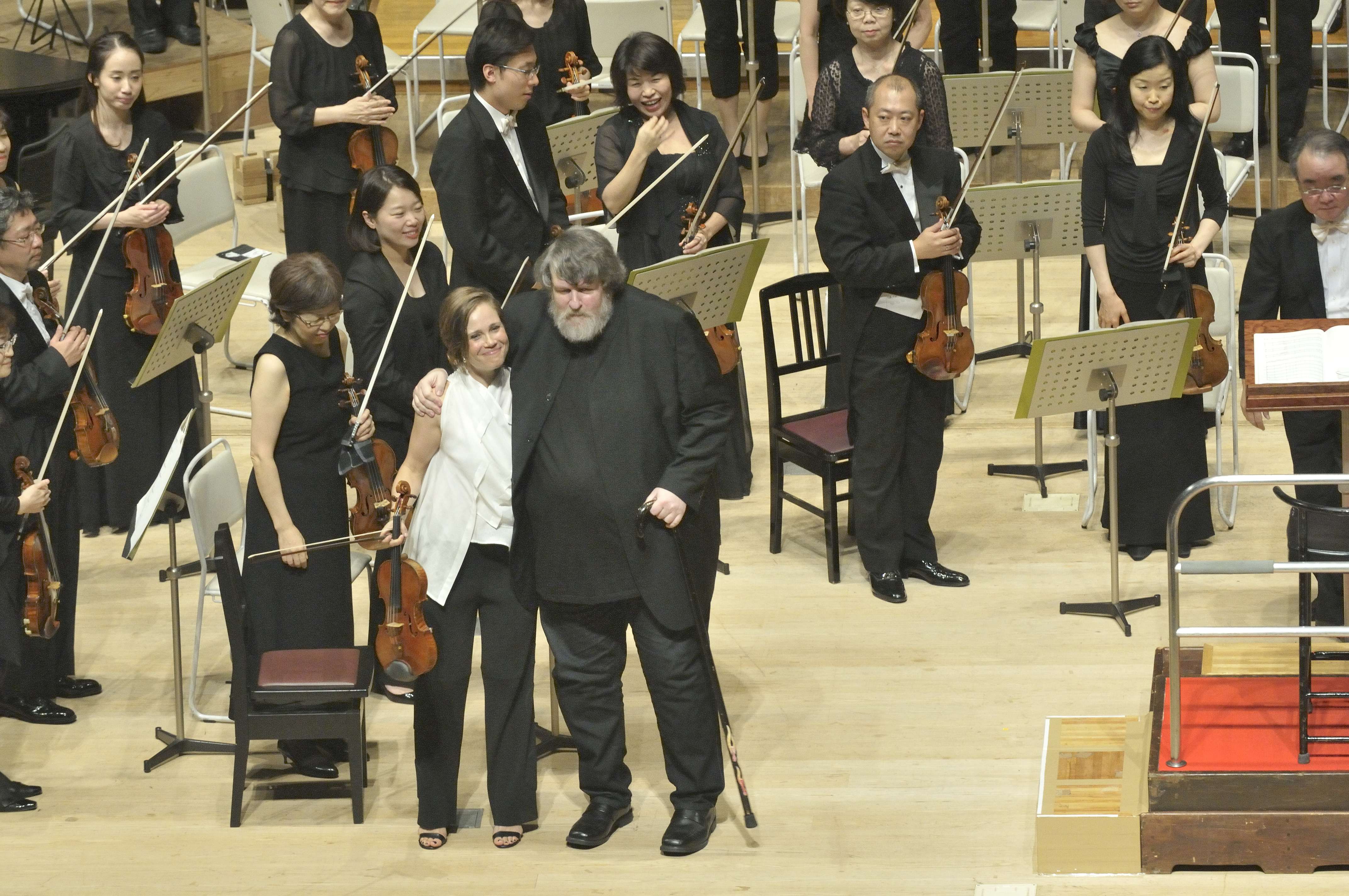
Sir Mark Elder, Cynthia Koledo DeAlmeida, and the Pittsburgh Symphony, photo credit Josh Milteer

Vaughan Williams’ 1944 Oboe Concerto followed, featuring PSO principal Cynthia Koledo DeAlmeida. This is a work the PSO has performed only once before, and nearly 30 years ago. DeAlmeida served as soloist in that performance as well, and in prerecorded remarks, she reflected on playing it as a relatively new addition to the PSO’s ranks, to now revisiting it decades later as a seasoned member.

Because the oboe doesn’t project particularly well, Vaughan Williams reduced the orchestral accompaniment to strings alone. The concerto serves as a companion piece to the composer’s Fifth Symphony (the “Pastoral”): it, too, purveys a ponderous pastoralism, and the concerto’s finale came from sketches originally intended for the symphony. DeAlmeida offered a lyrical, songful tone, keenly phrased and in delicate balance with her stringed colleagues. Cadenzas at various intervals showed her limber and dexterous.

The central movement took its cue from English country dances, sprightly and charming. The closing scherzo traversed the oboe’s range, and saw the soloist in fleet interplay with the orchestra. A closing section returned to the tender and reflective, and theme that perhaps interpolates The Last Rose of Summer in quintessential English fashion.

Shostakovich’s Fifteenth and final symphony occupied the latter half. Quite unlike any of the composer’s previous groundbreaking works in the form — or any symphony that came before or after, for that matter — it reflects on a lifetime of turmoil and triumphant in idiosyncratic fashion. Pings in the glockenspiel began, answered by a silvery flute — flippant and unsettled as only Shostakovich could do. Themes from William Tell and other works were seamlessly woven in, an eerie soundscape with the composer in a dreamlike trance of music by others that resonated with him.

A low brass chorale opened the lugubrious slow movement, highlighted by a devastatingly austere cello solo (Anne Martindale Williams). Angular material in the clarinet marked the Allegretto, along with a fine solo from concertmaster David McCarroll. Echoes of Wagner and many others were heard in the eclectic finale, as if Shostakovich wanted to use the final movement of his final symphony to comprehensively reflect on all that inspired him. The ticking of clocks, achieved through woodblocks (a device previously used in his iconoclastic Fourth Symphony), made for an ending as extraordinary as it was enigmatic.

Rare Rachmaninoff anchors Columbus Symphony’s decidedly D minor program

Columbus Symphony Orchestra
Rossen Milanov, conductor
Elina Vähälä, violin
Ohio Theatre
Columbus, OH
March 22, 2024

Mozart: Overture to Don Giovanni, K527
Sibelius: Violin Concerto in D minor, Op. 47
Rachmaninoff: Symphony No. 1 in D minor, Op. 13

All three works on last night’s Columbus Symphony program were cast in the stormy key of D minor, a programming choice that seemingly mirrored the gloomy, rainy conditions outside the Ohio Theatre (Beethoven also chose that key for his Tempest sonata). The overture to Mozart’s great opera Don Giovanni is always an effective and attention-grabbing curtain-raiser. Beginning unequivocally bold and tragic, contrasting material was given briskly and with crisp articulation.

Preconcert conversation with Elina Vähälä and Rossen Milanov

Jean Sibelius’s Violin Concerto brought forth soloist Elina Vähälä who shares the composer’s Finnish heritage (though she spent the first part of her childhood in Iowa). Hesitant tremolos in the orchestra opened, with Vähälä’s lyrical, dark-hued solo line taking shape. She delivered with a passion that was fiery yet never showy, not the least in the extended cadenza. A slow movement followed in songful fashion, growing in intensity with a series of searing, rising trills. The foot-tapping rhythmic vitality of the finale left one in good spirits after the Nordic chill of the preceding.

The premiere of Rachmaninoff’s First Symphony is one of music history’s greatest disasters. The most ambitious work to date from the composer then in his early twenties, the first performance of the complex score suffered from inadequate rehearsal time and a purportedly inebriated Alexander Glazunov at the podium. The symphony – despite showing enormous promise – was all but forgotten until after the composer’s death, and Rachmaninoff fell into a deep depression that impeded his ability to write for the next few years. Friday night marked its very belated Columbus premiere, and credit to Milanov and the CSO for shedding light on an unjustly neglected work.

A triplet motif opens all four movements; in the first, it signaled a plunge into darkness. Despite being a youthful work, so many of the hallmarks one associates with Rachmaninoff are already very much apparent: sweeping melodies, colorful orchestrations, folk-inflected themes, and use of the plainchant Dies irae. This is in fact the composer’s first appropriation of Dies irae, a theme that would virtually become his calling card, wandering through so much of his output – and here it was given a particularly scintillating treatment about halfway through the opening movement.

The lilting Allegro animato was a bit gentler, though not immune from the somber Dies irae which acted as a binding agent throughout the work. A Larghetto was a calming interlude, if not quite reaching the heartwrenching heights of the slow movements the composer would become famous for, though an extended clarinet solo seemed to predict that of the Second Symphony. Delicate dialogue between concertmaster Joanna Frankel and principal cello Luis Biava was a further highpoint. A swashbuckling march theme opened the finale, swelling to searing melody in true Rachmaninoff-ian fashion. In the closing moments, the tempo slowed considerably for a coda with gravitas – and at long last, a brief glimpse of D major.

Mäkelä returns to Cleveland with stunning Shostakovich

Cleveland Orchestra
Klaus Mäkelä, conductor
Nikolaj Szeps-Znaider, violin
Mandel Concert Hall
Severance Music Center
Cleveland, OH
April 23, 2022

Sibelius: Violin Concerto in D minor, Op. 47
 Encore:
 Bach: Partita No. 2 in D minor, BWV 1004 – Sarabande
Shostakovich: Symphony No. 10 in E minor, Op. 93

Following one of the most memorable debuts in recent seasons, the amazingly youthful Finnish conductor Klaus Mäkelä made a much-anticipated return to Cleveland in a meaty program of Sibelius and Shostakovich. Sibelius was represented by way of his towering Violin Concerto, a work first performed in Cleveland in 1922 by Ferenc Vecsey, the concerto’s dedicatee. The work opened shrouded in mysterious tremolos, with soloist Nikolaj Szeps-Znaider pointing the way with resonant lyricism. Thornier material swiftly multiplied virtuoso demands, played with aplomb and searing passion – and the energetic orchestral accompaniment evidenced Mäkelä’s innate understanding of his fellow Finn.

Nikolaj Szeps-Znaider, Klaus Mäkelä, and The Cleveland Orchestra, photo credit Roger Mastroianni, courtesy of The Cleveland Orchestra

Szeps-Znaider’s command of his instrument was on full display in the extended cadenza, intriguingly placed in the center of the movement in emphasis of its structural significance. Much-need repose was to be had in the central Adagio di molto, noted for its wonderfully long-breathed melody. Contrast was once again found in the finale with its foot-tapping polonaise rhythms. As an encore, the violinist offered a deeply poignant Bach sarabande which he noted to be his token of gratitude for being back in Cleveland for the first time post-pandemic.

Quiet rumblings began Shostakovich’s mighty Tenth Symphony, reaching towards ponderous depths. A forlorn clarinet solo – which has been astutely compared to Mahler’s Urlicht – was profoundly moving, and the climaxes scaled cataclysmic heights – a pacing that benefitted from the conductor’s singular sense of architecture. An unexpected physical manifestation of the intensity with which he conducted came when he inadvertently knocked over the concertmaster’s music stand! The brief Allegro, often thought to be a portrait of Stalin, was unrelenting and uncompromising, not in the least during the machine gun fire of the percussion.

Rather flippant by comparison, the Allegretto introduced the DSCH motive, with the politically engaged composer ever keen to willingly inject himself into the commentary. The gleaming Elmira motive in the horn further solidified the composer’s personal connection to the work. A slow introduction – the closest thing to a proper slow movement in this symphony – opened the finale, as if the composer was gathering together his final thoughts. The DSCH returned in incessant prominence, hammered home for a powerhouse conclusion. Just a stunning performance from this dynamic podium presence.

Sumptuous Sibelius anchors Boston Symphony’s diverse program

Boston Symphony Orchestra
Andris Nelsons, conductor
Lisa Batiashvili, violin
Symphony Hall
Boston, MA
October 14, 2021

Still: Threnody (In Memory of Jan Sibelius)
Strauss: Symphonic Fantasy on Die Frau ohne Schatten
Sibelius: Violin Concerto in D minor, Op. 47

Encore:
Machavariani: Doluri

The Boston Symphony and music director Andris Nelsons offered a program that not only boasted very fine playing, but presented three selections that while outwardly diverse, revealed fascinating connections. The evening opened with music of William Grant Still, namely his 1965 Threnody, written to elegize Jean Sibelius. Sibelius was familiar with Still’s scores, and had nothing but high praise for the American. The Threnody was brief but of powerful impact. An arresting beginning gave way to a melancholic, Sibelius-like melody. The work proceeded in the manner of a doleful funeral march, punctuated by tolling bells – a touching tribute from one great composer to another.

Andris Nelsons and Lisa Batiashvili, photo credit Aram Boghosian

Continuing last weekend’s exploration of Strauss, the ensemble next turned to the Symphonic Fantasy on Die Frau ohne Schatten in its first BSO performance (as with the Still). Strauss returned to his 1919 opera near the end of his life, completing the present fantasy in 1947, in twenty or so minutes capturing the essence of the opera – much like Liszt did for piano in his major operatic fantasies. A cataclysmic opening statement pointed towards a lush, coloristic workout for the orchestra, seamlessly blending together the opera’s themes in a vibrant tapestry. The low brass were a particular standout as the music surged and swelled in this powerful performance, one that surely made the case for including this all too often overlooked work alongside the composer’s best-known tone poems.

Sibelius’ incomparable Violin Concerto occupied the entire second half, tying the program together: after the opening selection, it was only fitting to include a work by Sibelius himself, and moreover, the concerto’s 1905 premiere in its now standard revised version had no less than Strauss at the podium. Lisa Batiashvili proved to be a choice soloist right from the opening bars. Imbued with a stylistically appropriate Nordic chill, her deeply burnished tone resounded with searing passion, and I was especially struck by her complete control as the music soared far into the violin’s highest register. The massive cadenza, a structural underpinning of the opening movement, further put Batiashvili’s stunning virtuosity on display. After the fire and passion, the central Adagio di molto countered with a muted lyricism. Both soloist and orchestra alike deftly brought out the music’s subtleties while the dance rhythms of the work’s finale were delivered with a singular intensity. As a well-deserved encore, the soloist offered Alexi Machavariani’s Doluri, a jaw-dropping study in double stops and perpetual motion.

Mälkki and Josefowicz champion Sibelius, Knussen with The Cleveland Orchestra

Cleveland Orchestra
Susanna Mälkki, conductor
Leila Josefowicz, violin
Severance Hall
Cleveland, OH
February 6, 2020

Sibelius: En saga, Op. 9
Knussen: Violin Concerto, Op. 30
Sibelius: Symphony No. 1 in E minor, Op. 39

Ever the dynamic podium presence, Susanna Mälkki brought to The Cleveland Orchestra a pair of imposing yet less-trodden Sibelius scores, bookending a seminal 21st-centruy concerto from the late Oliver Knussen. Sibelius’ early tone poem En saga is the work of a confident young composer self-assuredly finding his voice, not heard at Severance Hall since a 1965 performance under George Szell. Undulating strings gave this single-movement essay an epic sense of scale, countered by thornier winds with the composer masterfully spinning a tale worthy its saga designation. A particularly memorable theme was articulated through the burnished, musky warmth of the violas and cellos, while a solo from clarinetist Daniel McKelway pointed towards a somber end: a mere whisper in the strings, fading away with remarkable control at the ppp dynamic level.

DSC_0072_nolamp-1024x683
Susanna Mälkki, photo credit Jiyang Chen

Knussen is a man who had a wonderfully fruitful relationship with TCO up to his untimely passing in 2018, both as composer and conductor. His 2002 violin concerto received its second Cleveland hearing, this time with champion of the contemporary violin repertoire Leila Josefowicz. Orchestral bells opened the work in striking fashion, with rapid runs high in the violin’s stratosphere. Despite the modernist dissonances, Josefowicz delivered with a luminous clarity. In many regards, this is a Romantic work at heart, a persuasion most pronounced in the resonant lyricism of the central Aria. The closing Gigue thrilled in its intricate web of rhythmic intricacies, negotiated with aplomb and finesse by all.

While the influences of the late Romantic milieu abound in Sibelius’ First Symphony, its opening of a solo clarinet – gorgeously played by Afendi Yusuf – over a rumbling timpani is pure Sibelius, unmistakably the composer’s own rarefied language, even in this inaugural symphonic effort. The strings entered in their celestial radiance for the movement proper with the music lush and rewarding. A dose of Nordic chill was introduced in the development, and perhaps it was Mälkki’s shared heritage with the composer that gave her such innate Sibelian fluency in this thoroughly convincing performance.

The endless melody of the Andante could easily be mistaken for a Tchaikovsky slow movement: he we saw not the forward-thinking Sibelius we would later come to know, but one firmly – and comfortably – rooted in the 19th-century. The scherzo was in turn a nod to Bruckner, and the orchestra remained in tight cohesion even at vigorous speed. A slow, measured introduction to the finale was seeped in melancholy and tragedy, yet in due course gave way to a boisterous, unrelenting affair, occasionally contrasted by a rich melody that resided deep in the strings. The brash coda proceeded with confident swagger, only to turn inward at the last moment to close in unexpected anticlimax.

20150924_C000231cRikimaru_Hotta
Leila Josefowicz with Oliver Knussen in 2015, photo credit Rikimaru Hotta

From Scandinavia to Italy, Cleveland Orchestra closes season in colorful travelogue

Cleveland Orchestra
Franz Welser-Möst, conductor
Simon Keenlyside, baritone
Severance Hall
Cleveland, OH
May 23, 2019

Grieg: Morning Mood, The Death of Åse, and At the Wedding from Peer Gynt, Op. 23
Sibelius: Kaiutar, No. 4 from Six Songs, Op. 72
Sibelius: Illale, No. 6 from Seven Songs, Op. 17
Sibelius: Aus banger Brust, No. 4 from Six Songs, Op. 50
Sibelius: Svarta rosor, No. 1 from Six Songs, Op. 36
Sibelius: Kom nu hit, död!, No. 1 from Two Songs for Shakespeare’s The Twelfth Night, Op. 60
Sibelius: Im Feld ein Mädchen singt, No. 3 from Six Songs, Op. 50
Sibelius: Die stille Stadt, No. 5 from Six Songs, Op. 50
Sibelius: Var det en dröm?, No. 4 from Five Songs, Op. 37
Strauss: Aus Italien, Op. 16

Franz Welser-Möst and The Cleveland Orchestra closed the 2018-19 season in an alluring program, with all selections stemming from the late 19th-century (and in to the early 20th), connected by Romantic fascinations from awe-inspiring destinations to drama and poetry. Beginning the evening were selections from Grieg’s incidental music to Peer Gynt. Welser-Möst culled his own suite of three excerpts rather than opting for either of the two suites the composer later produced. The selections were performed in reverse order of appearance in the source material, opening with the familiar Morning Mood (which serves as the prelude to Act 4). Silvery flutes beckoned the morning, with the songful theme passed around the woodwinds before appearing in the strings. Welser-Möst’s brisk tempo ensured matters were never sentimentalized. Lush and mournful strings made The Death of Åse the emotional crux, easily a precursor to Barber’s Adagio. At the Wedding (which opens the complete work) was given with vigor and joyous abandon. A more languorous theme was very finely played in turn by the principal winds while Wesley Collins’ offstage viola radiated folksy charm.

CLO052319__197_select
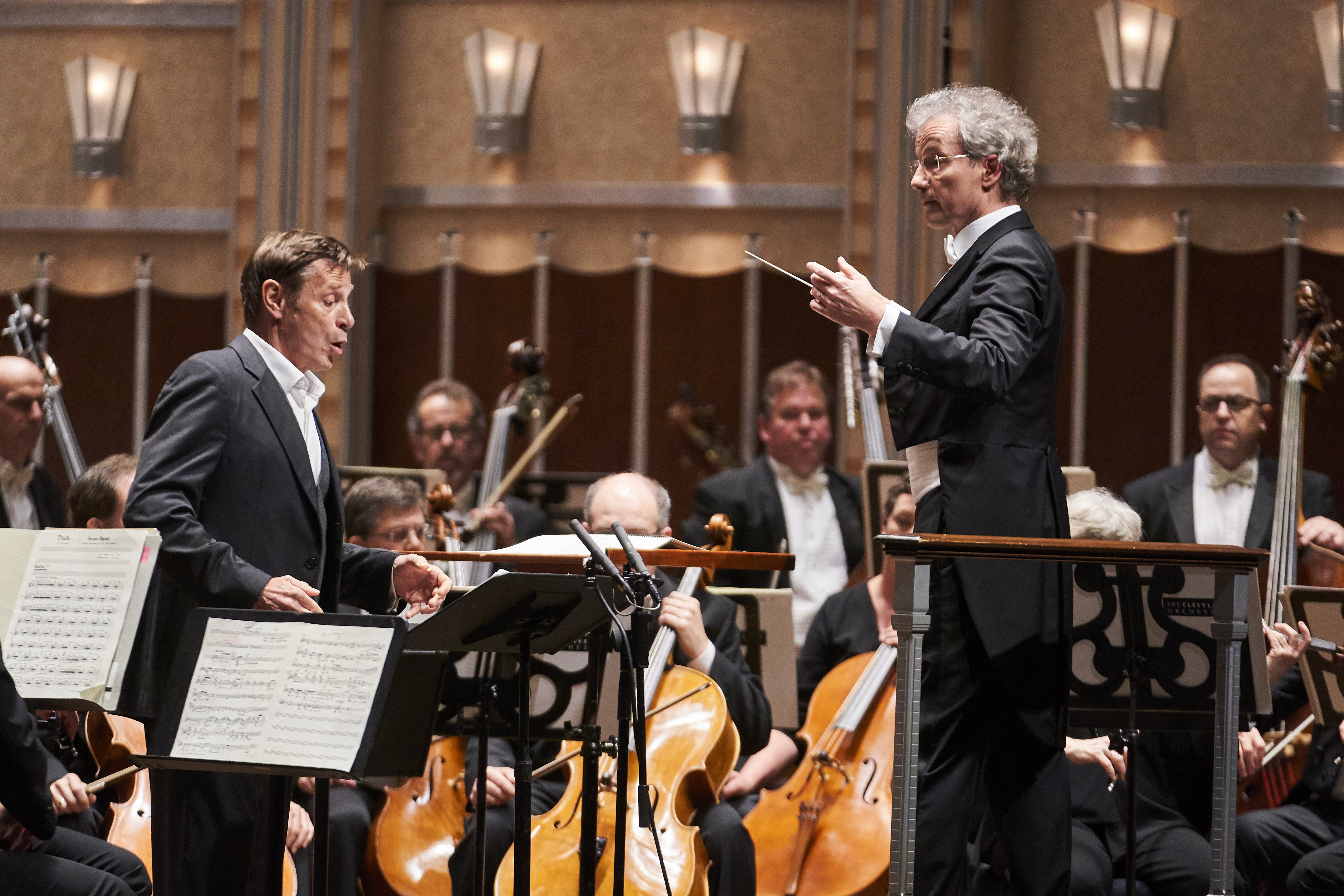
Simon Keenlyside and Franz Welser-Möst, photos credit Roger Mastroianni, Courtesy of The Cleveland Orchestra

On the heels of his lieder recital a few days prior, Simon Keenlyside returned for the evening’s centerpiece and highpoint – a helping of eight of the seldom-performed songs of Sibelius. The songs at hand were variously in Finnish, Swedish, or German, and in some cases orchestrated by Sibelius himself, others by contemporaries. Keenlyside brought out the lyrical qualities of the Swedish language in Kaiutar, with an orchestration that encouraged its fantastical, fairy-tale atmosphere. Crepuscular strings made Illale a true gem, and the next selection turned to German in a setting of Richard Dehmel’s Aus banger Brust. Dehmel’s poetry served as text for the likes of Strauss and Schoenberg, and Sibelius proved no less adept with the work’s acerbic dissonances and moving solo passages from concertmaster Peter Otto in faithful service of the text. Svarta rosor, a comparatively better-known quantity, was of robust lyricism and grand emotions, nearly operatic with an unforgiving close to boot.

Unlike the others all originally scored for voice and piano, Kom nu hit, död! came from a set of two Swedish settings of Shakespeare’s The Twelfth Night for voice and guitar, given a rather gloomy reading at present. The richness of Im Feld ein Mädchen singt could easily have been mistaken for Strauss, while Die stille Stadt – another Dehmel setting – maintained a remarkably surreal atmosphere, enhanced by ethereal sounds from the glockenspiel, harp, and high strings. The last selection, Var det en dröm?, displayed again Keenlyside’s keen ability to seamlessly switch languages, and brought matters to a passionate, satisfying close, feeling almost as if these eight otherwise disparate songs were conceived as a unified cycle.

Strauss’ Aus Italien drew inspiration from an Italian journey undertaken by the composer as an impressionable youth, and became the first entry in his great series of tone poems. It’s an immature work to be sure, yet many Straussian hallmarks are already firmly in place, setting the stage for the musical revolutions that would soon be flowing from his pen. This was certainly apparent in the opening Auf der Campagne which could only have been written by Strauss, with elemental beginnings burgeoning into material larger than life. Brassy passages were of arresting vigor, although otherwise matters in performance weren’t entirely polished, sounding as if some extra rehearsal time was needed – no doubt, I suspect, ironed out by the Saturday performance.

Rather than the single-movement architecture of the successive tone poems, Aus Italien was conceived far less cohesively as four distinct portraits. In Roms Ruinen followed suit, generally lighter fare of Italianate charm interspersed with more solemn moments in awe of the eponymous ruins. Strauss’ idiomatic orchestral effects certainly began to crystallize in Am Strande von Sorrent, a coloristic painting of the sun-drenched coast of Sorrento. The closing Neapolitanisches Volksleben marked the work as a foreigner’s less than reliable view of Italy in that Strauss mistook a popular tune of the day for bone fide Neapolitan folk music (I was somewhat reminded of the All’Italiana movement from the Busoni piano concerto heard earlier this season – though there the composer was no foreigner, it too juxtaposed Italianate folk melodies in the context of an otherwise very Teutonic musical language). In any case, matters were nonetheless of an infectious joie de vivre, banal yet so colorfully orchestrated. The orchestra’s committed playing heightened one’s interest: ultimately the rewards were mixed, though the players on stage made as strong a case as they could in this vintage work displaying the budding composer’s incipient genius.

CLO052319__039_select
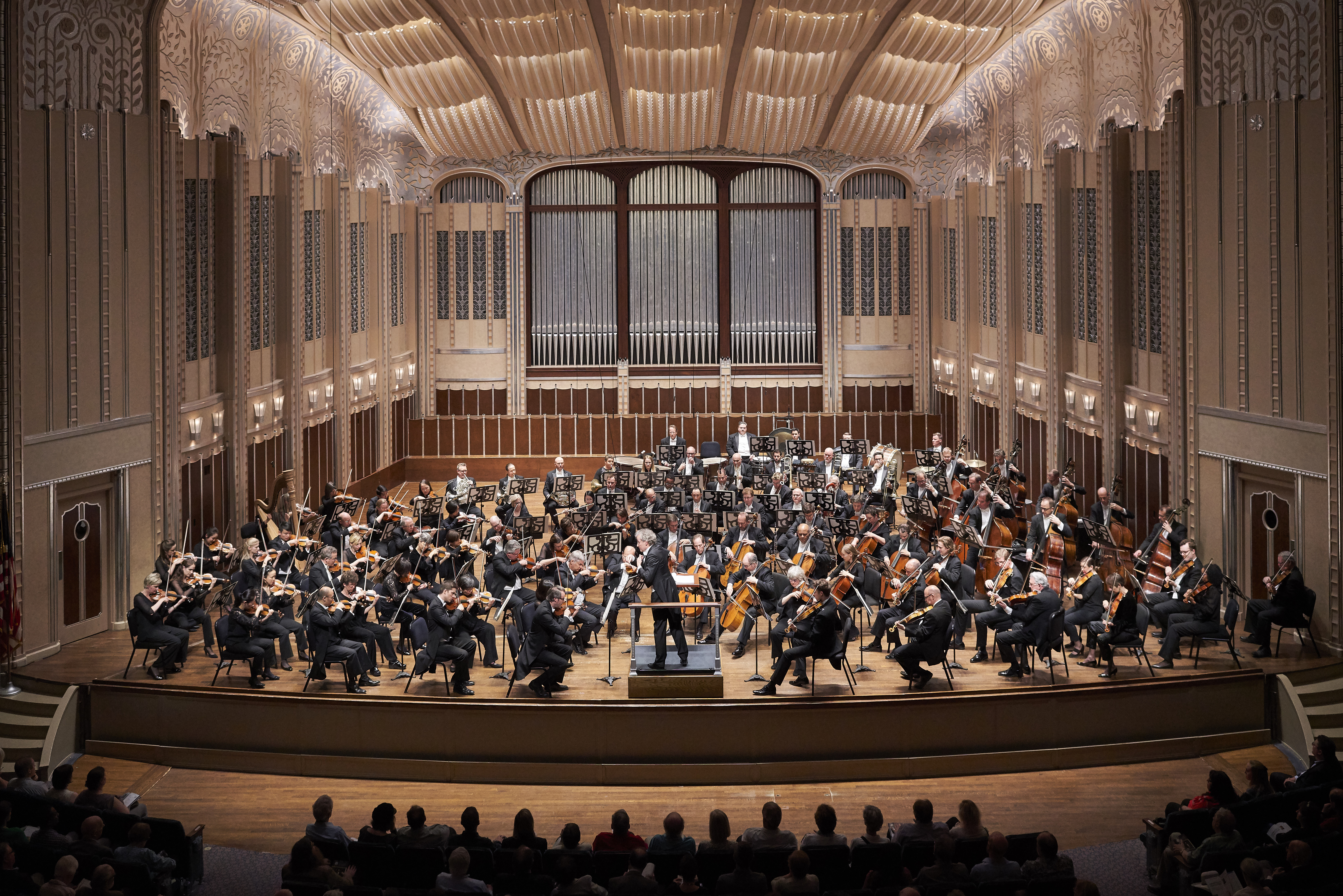
Franz Welser-Möst and The Cleveland Orchestra in Aus Italien