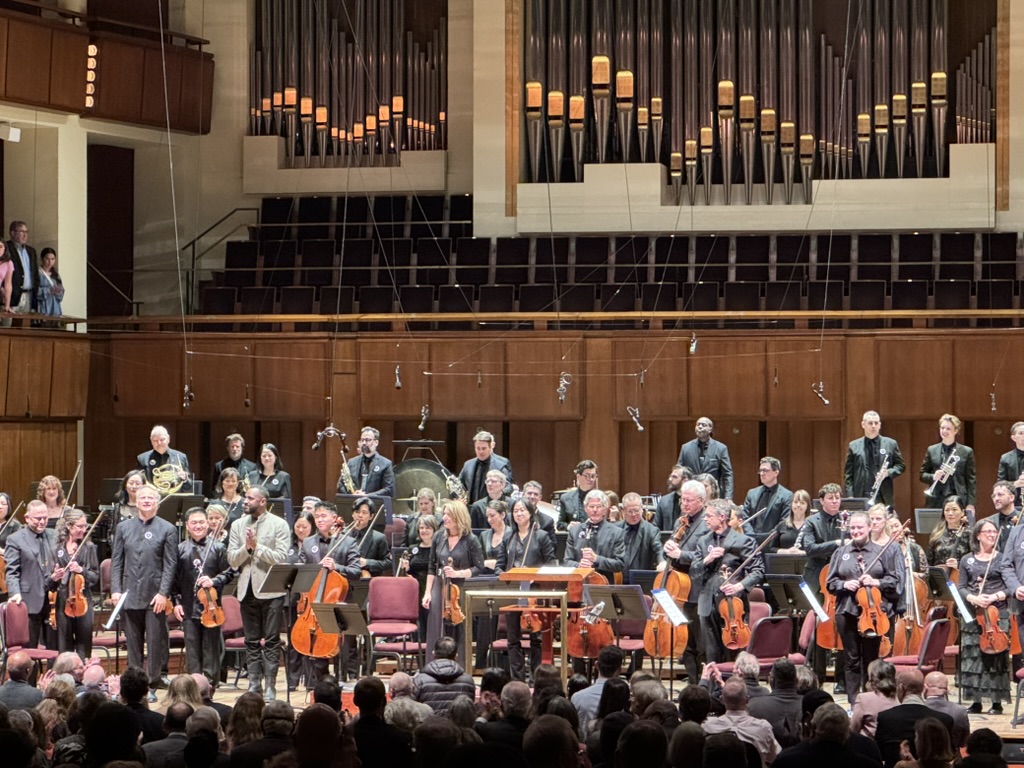
National Symphony Orchestra Gianandrea Noseda, conductor Ying Fu, violin Raymond Tsai, cello Concert Hall Kennedy Center Washington, DC March 14, 2026
Schumann: Overture to Manfred, Op. 115 Simon: Double Concerto Suite Brahms: Symphony No. 3 in F major, Op. 90
Under the helm of music director Gianandrea Noseda, the weekend’s program at the National Symphony Orchestra traced the spirit of Brahms with works that influenced and were influenced by him, culminating in a symphony by the German composer himself. As per official decree from the current administration, all NSO concerts now begin with a rendition of the national anthem (led by the concertmaster, without the conductor present).
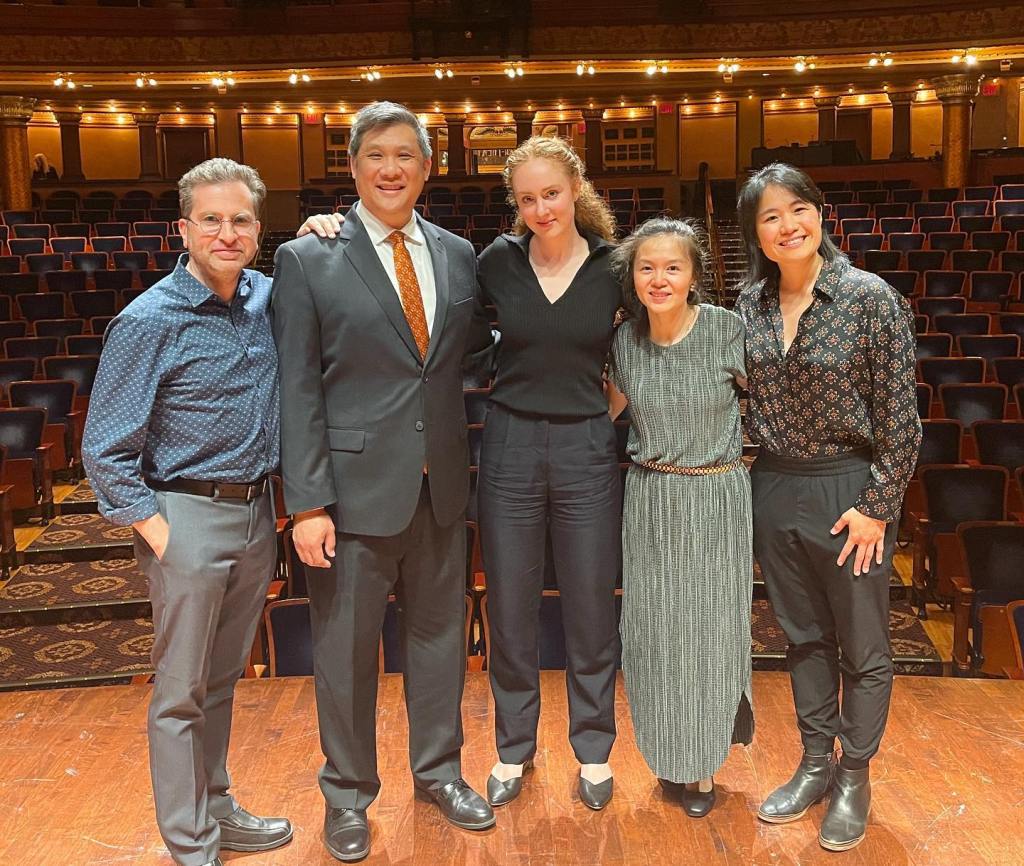
Gianandrea Noseda, Ying Fu, Carlos Simon, and Raymond Tsai with National Symphony Orchestra
Robert Schumann shaped Brahms’ musical language perhaps more than any other. A late work from the elder composer opened in the overture to the incidental music to Manfred. The complete work is rarely heard, but the overture functions well as a standalone piece. A bold opening was dialed back to the poignantly ponderous, gradually building again to intense, riveting drama. An especially sturdy brass section portrayed the brooding titular figure, only to arrive at a somber close.
A native of Washington, Carlos Simon has been serving as the NSO’s composer-in-residence since 2021. The present performances featured the world premiere of his Double Concerto Suite, with solo parts for violin and cello – a nod to Brahms’ own double concerto. Unlike most of Simon’s works, this music was purely abstract without an explicit program or inspiration. “Suite” is a key word in the title; its five movements were rather disparate and lacked the cohesion of a singular concerto. The soloists were drawn from the ranks of the NSO principals, Ying Fu (violin) and Raymond Tsai (cello) after Hilary Hahn and Seth Parker Woods withdrew in protest.
The work is substantial in scope at over thirty minutes. Energetic, colorful orchestration began, propelled by driving rhythms. Fu and Tsai were in a harmoniously blended dialogue with one another. The second movement featured lyrical playing from the cello with some touching double stops and a substantial solo passage for flute. A playful, good-natured movement followed, ahead of material that invoked the Delta Blues. The finale was a bit thornier, with frenetically interlocking material for a high-octane coda. While much of it was pleasing to the ears, I didn’t find it to be a work that made a lasting impression – and I was left wondering what Hilary Hahn might have managed with it.
The program concluded with Brahms’ autumnal Third Symphony in the strongest playing of the evening. Stormy beginnings belied its gentle core. Noseda’s baton gently floated, suspended, drawing out the bucolic textures, and under his pacing, matters were never stodgy as Brahms can be under lesser hands. The Saturday night audience had a tendency to applaud between movements; in the symphony Noseda seemed to consciously fight against it by leaving little space between.
Mellifluous winds opened the Andante, a tranquil essay capped off by the amber glow of the striking chord progression which closed. There was a gentle lilt to the Poco allegretto, and most of the dramatic tension was saved for the finale with its brassy splendor, though it found its way to a reflective close at peace with world.
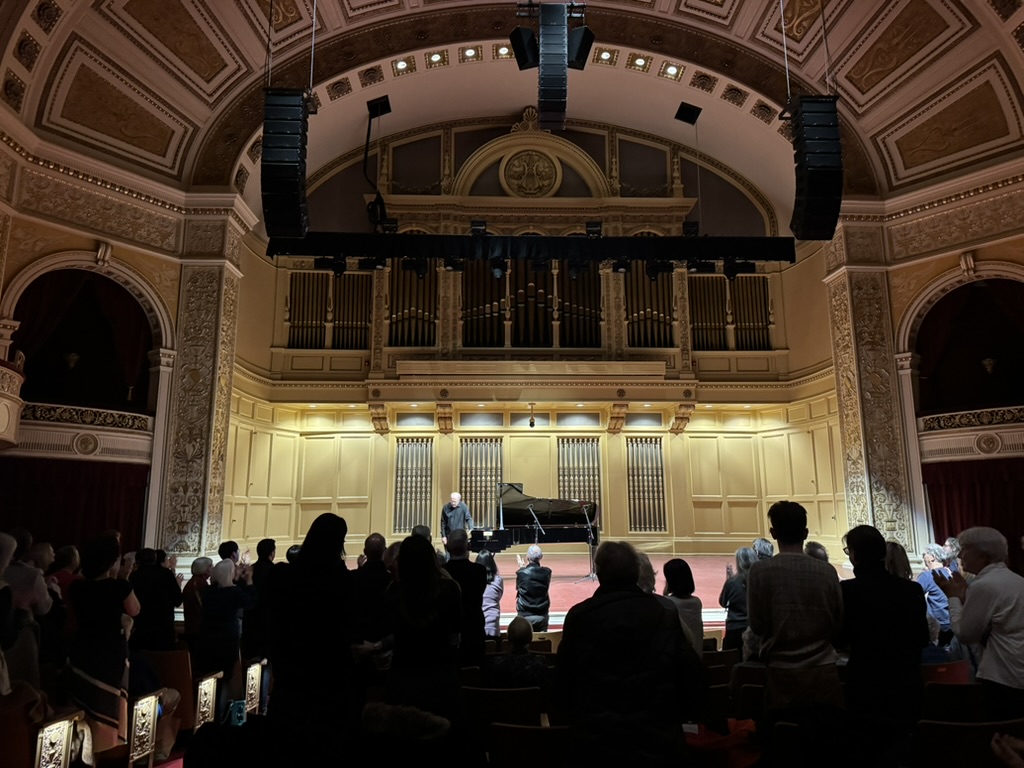
Marc-André Hamelin, piano Carnegie Music Hall Pittsburgh, PA January 12, 2026
Ives: Piano Sonata No. 2, Concord, Mass., 1840–60 Schumann: Waldszenen, Op. 82 Ravel: Gaspard de la nuit
Encores: Ravel: Jeux d’eau Rachmaninoff: Étude-tableau in E-flat minor, Op. 39 No. 5 Hamelin: Music Box, no. 5 from Con intimissimo sentimento
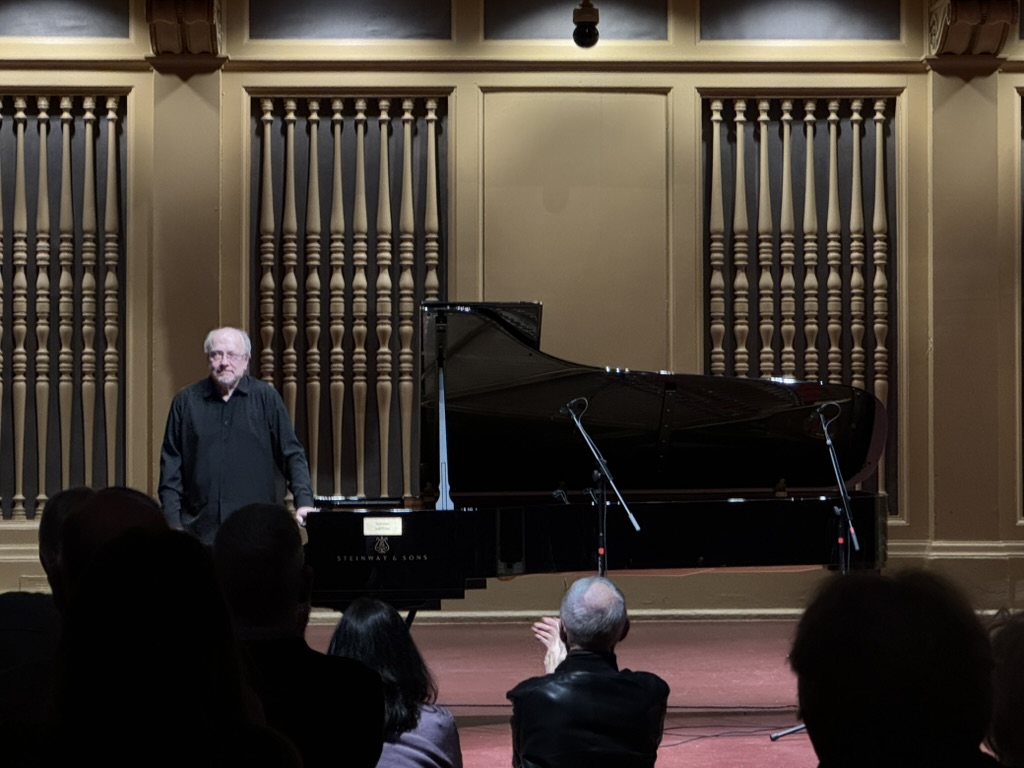
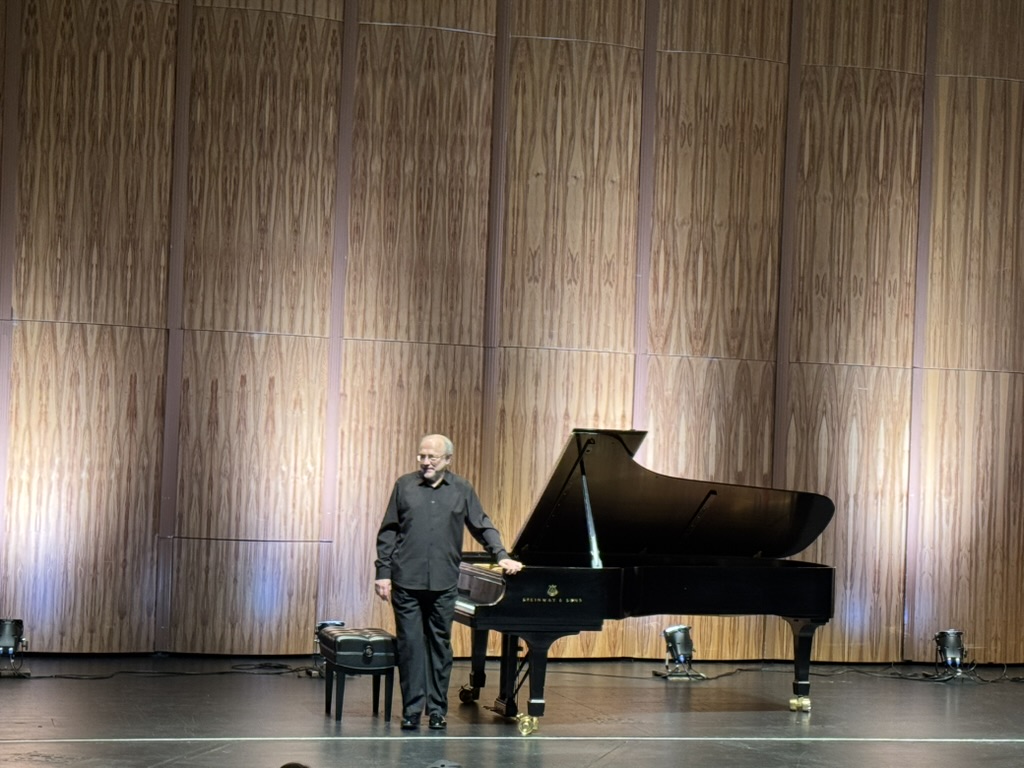
Opening 2026 at Chamber Music Pittsburgh – and the first major event of the local classical music calendar this year – was a much-anticipated solo recital from pianist Marc-André Hamelin. A piano on loan from Carnegie Mellon University had an imposing presence on the Carnegie Music Hall stage. Hamelin is among today’s most intrepid explorers of the instrument, never shying away from a work no matter how little known or technically demanding. This was amply apparent in the first half, which opened in uncompromising form by of Charles Ives’ Concord Sonata.
Marc-André Hamelin at Carnegie Music Hall
A mainstay of Hamelin’s repertoire for decades, there is no better champion of the massive work: virtually no one has more experience and expertise on it. Its four movements depict the 19th-century New England writers centered in Concord, Massachusetts. Emerson had bracing beginnings, with torrents of rich, muscular sound. It oscillated between gripping intensity and a dreamy evocation. Powerful bass lines drew out the three shorts notes followed by a long motif familiar from Beethoven’s Fifth, a gesture that serves as a binding element throughout the thorny sonata.
Hawthorne was mercurial and fantastical, filled with massive tone clusters and frenetic syncopations. Contrasting was the brief Alcotts, a respite from the dizzying complexities of the surrounding, radiant and direct in expression. In the closing Thoreau, the long journey arrived at a wistful reflection; one imagines the writer in quiet contemplation at shore of Walden Pond.
The latter half paired Schumann’s Waldszenen with Ravel’s Gaspard de la nuit – works I just saw him perform in October at Akron’s Tuesday Musical, but a welcome opportunity to revisit. The Schumann opened in a warm embrace, a beckoning welcome to the forest – and most captivating was the mystical Vogel als Prophet. The Ravel is a virtuosic tour de force – a bold choice to include on a program that opened with the Concord Sonata! From the shimmering Ondine to the funereal tolling of Le Gibet, matters concluded in thrilling fashion with the technical wizardry of Scarbo.
Hamelin generously offered three encores, beginning with more Ravel. Jeux d’eau made a fitting complement to Ondine, another mesmerizing impressionist evocation of water. An Etude-Tableau from Rachmaninoff filled the hall with its dense, robust chordal textures. And finally, a work by Hamelin himself: Music Box, an all too brief piece of insouciant charm.
Marc-André Hamelin, piano EJ Thomas Hall Akron, OH October 21, 2025
Beethoven: Piano Sonata No. 29 in B-flat major, Op. 106, Hammerklavier Schumann: Waldszenen, Op. 82 Ravel: Gaspard de la nuit
Encore: Debussy: Reflets dans l’eau (No. 1 from Images, Book 1)
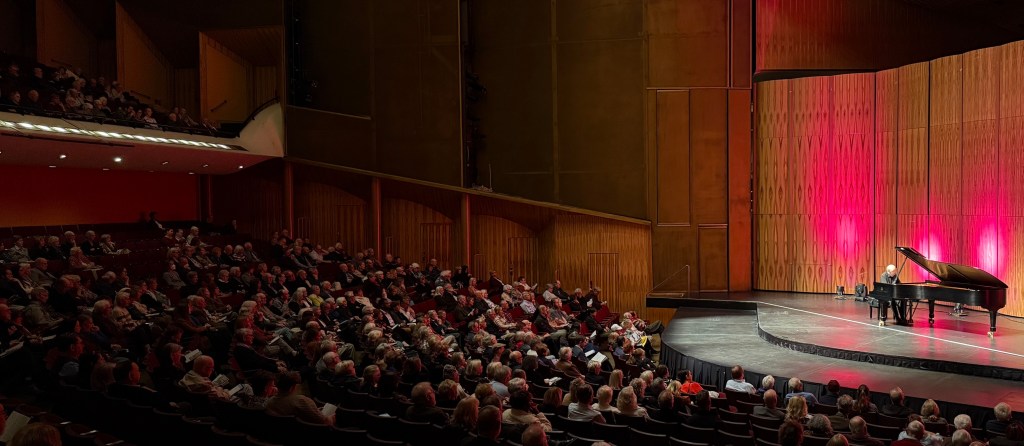
No part of Marc-André Hamelin’s recital at Akron’s Tuesday Musical was for the faint of heart. The repertoire spanned a mammoth Beethoven sonata, the rewarding Romanticism of Schumann, and Ravel at his most mercurial and ferocious. Opening night of Tuesday Musical’s 138th(!) season, Hamelin served as the annual Margaret Baxtresser Pianist, in which capacity he led a masterclass at Kent State the following day. Additionally, the evening performance began with a rippling account of Liszt’s La leggierezza by local high school student Saya Uejima.
Marc-André Hamelin at EJ Thomas Hall, photo credit Tuesday Musical
Along with the Diabelli Variations, the Hammerklavier is Beethoven’s largest and most demanding work for solo piano. A granite monument of the piano literature, Hamelin has recently recorded it to acclaim. As if totally unfazed by its technical demands, it comprised merely the first half of Tuesday’s recital. The bold Allegro movement made for a commanding beginning. Hamelin opted to strike the opening bass note with the right hand rather than the left for added power. Textures were crisp and brisk, with deft voicing of its intricacies, balancing the exuberant with more graceful material. The development saw some spiky contrapuntal passages, a preview of sorts for what was to come, before the movement’s blistering, uncompromising coda.
Though short in length, the scherzo that followed was hardly a trifle. Hamelin conjured a tempest, though an impulse towards restraint here kept the otherwise tumultuous writing in check. What followed was the work’s magnificent slow movement. Drawing on deep reserves of emotion, Hamelin sustained a spellbinding atmosphere over its nearly twenty-minute duration. Worlds apart from the robustness of the outer movements, here Hamelin purveyed a velvety touch to striking effect, landing on the profound sequence of chords that closed, beautifully voiced. With meditative, improvisatory beginnings, the massive fugue that concluded the sonata saw Hamelin at his best — a dazzling technique used in service of the music.
Schumann’s Waldszenen (Forest Scenes) made for a genial opening to the second half. Eintritt (Arrival) extended a warm and gracious entry into the forest, played with rippling lyricism. Hunting songs came second and second-to-last in this nine-part suite, in both cases given with vigorous flexibility. I was touched by the delicate nostalgia of Einsame Blumen (Lonely Flowers) and the uber-Romantic lushness of Herberge (Wayside Inn). The closing Abschied (Farewell) bid adieu with the same warmth with which it began.
The evening concluded with another work famous for its extraordinary technical demands in Ravel’s Gaspard de la nuit. Though a mainstay of Hamelin’s recital programs for years, it’s the only work of the present selection he has not yet recorded. The work brings to life in musical terms poems by Aloysious Bertrand, all of which deal with fantastical, rather demonic figures — a seasonally appropriate selection for late October! Ondine positively shimmered in this remarkable soundworld of the titular water nymph, building to an ecstatic climax. Le Gibet was a striking contrast in its funereal stasis ahead of Scarbo, closing with a spattering of iridescent colors and ferocious virtuosity.
Hamelin offered just a single encore in Debussy’s Reflets dans l’eau, which like Ondine, paints a mesmerizingly impressionist aquatic scene. A clip of Hamelin discussing the work can be viewed here.
Two years ago, I saw Hamelin play a very similar program in Cleveland with another massive piano sonata — Charles Ives’ Concord — in place of the Hammerklavier. See review here. Lastly, Hamelin was on hand ahead of his Akron recital for a brief but affable interview with WCLV’s Jacqueline Gerber, available for listening here.
Simone Dinnerstein, piano Stetson Chapel Kalamazoo College Kalamazoo, MI May 7, 2024
Couperin: Les barricades mystérieuses, from Pièces de clavecin Schumann: Arabeske, Op. 18 Satie: Gnossienne No. 3 Glass: Mad Rush Schumann: Kreisleriana, Op. 16
Encore: Couperin: Les barricades mystérieuses, from Pièces de clavecin
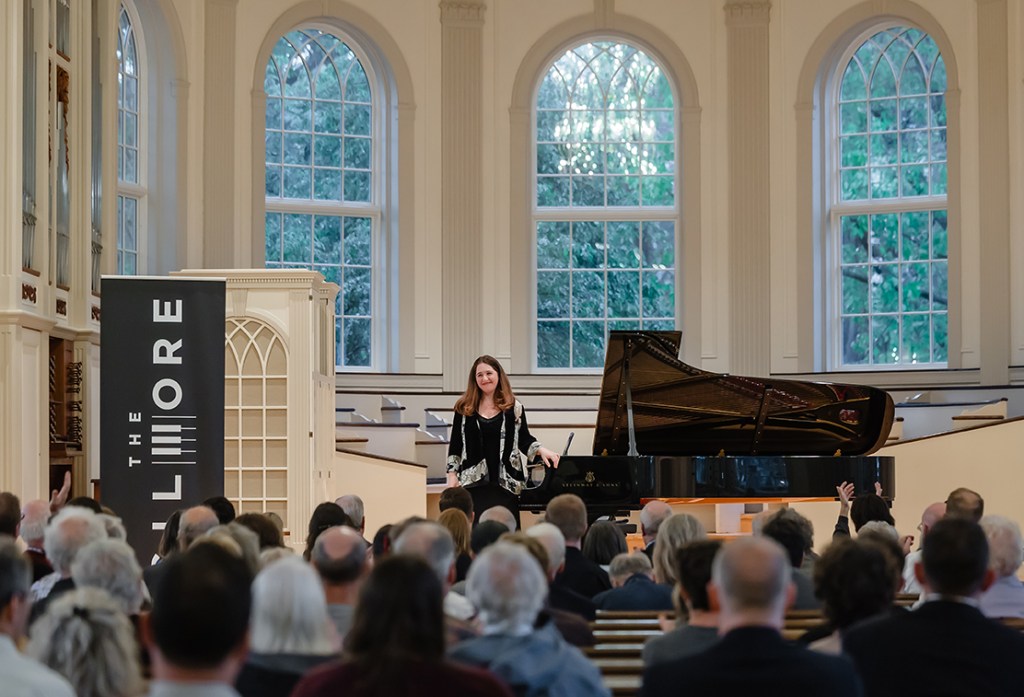
There’s a first time for everything, and I can safely say that Tuesday evening at the Gilmore Festival was the first concert I’ve attended in which the audience was asked to shelter in the venue’s basement for 45 minutes due to uncomfortably close tornados raging nearby. A hearty crowd of committed pianophiles stuck it out, however, and were amply rewarded with an artfully crafted recital from Simone Dinnerstein.
This was essentially a live performance of her Undersong album, the last of a trilogy of projects she recorded during the pandemic. The title, an archaic word for chorus or refrain, refers to the idea of return, revisiting places after the passage of time. All of the diverse body of music programmed engaged with the theme in a different way, but in each case, a melody presented resurfaced in some context later on. The delayed evening began with Couperin’s gem of a piece Les barricades mystérieuses, quite literally the calm after the storm. Elegantly ornamented, Dinnerstein drew from the piano a rich, reflective tone.
Schumann’s Arabeske saw the composer at his most Schubertian with its lyrical, rippling figures, arriving at a point of return following some contrasting episodes, and its gentle coda amounts to one of Schumann’s loveliest inspirations. Philip Glass’ Mad Rush continued the theme into the late 20th-century. Undulating figures changed subtly, almost imperceptibly, growing in intensity as Dinnerstein filled the Stetson Chapel with waves of sound. She has a close affinity for the music of Glass, with the composer having written his Third Piano Concerto with her in mind.
The third of Satie’s Gnossiennes evoked the French composer’s rarefied, idiosyncratic language, distilled of any excess and expressive in its barrenness. Recurrence is a key element of the eight vignettes that comprise Schumann’s Kreisleriana. Fleet and mercurial, the opening was given an impassioned workout. The most extended selection of the suite followed, with contrasting themes bound together by its common thread. Nearly manic, the penultimate episode introduced contrapuntal textures in homage to Bach, played with incisive clarity, and the final piece was stately and sensitive, the culmination of a long trajectory.
Dinnerstein’s lone encore embodied the undersong theme in returning to the Couperin with which the recital began. What a lovely gesture it was to close the program full-circle.
In the this season’s final installment of Severance Music Center’s admirable recital series, two artists who exemplify their instruments came together for an intimate lieder recital: baritone Matthias Goerne and pianist Evgeny Kissin. On a side note, it’s lovely to see Kissin become a more regular presence in Cleveland following his return after a long absence – and he is on tap for next season’s recital series as well.
Evgeny Kissin and Matthias Goerne at Severance Music Center
The first half was devoted to Schumann’s epochal song cycle Dichterliebe. Sixteen songs go by in a flash as quicksilver vignettes, each occupying a rarefied state that we only get to visit for a fleeting moment. Goerne’s vocal command showed this to be a work firmly in his repertoire, and Kissin responded in kind with probing accompaniment. Though a month premature, the opening Im wunderschönen Monat Mai began matters gentle and longing, only to be upended by the subsequent Aus meinen Tränen sprießen which contrasted in its melancholy. The thunderous Im Rhein, im heiligen Strome was a standout, answered by the familiar Ich grolle nicht, given an exultant and impassioned reading, anchored by the pianist’s bass octaves. As the most extended song of the set, the closing Die alten, bösen Liederwas powerful and bracing, only to close with pensive postlude for piano alone.
The latter half gave Kissin a moment in the spotlight, opening with Brahms’ four Ballades for solo piano – and for this listener, the highlight of the afternoon. The first, nicknamed Edward after the eponymous Scottish poem, was a stately, almost royal, processional, building to a powerful climax – especially so for such a brief work. In the chordal passages, Kissin’s nuanced voicing yielded a wondrous effect. The second followed a similar trajectory, with gentle beginnings giving way an animated, march-like central section. The following ballade was rather more animated, inflected by Hungarian rhythms (a Brahms favorite), while the final piece was Schumannesque in its poetry, languorous and lyrical, rapturously beautiful under Kissin’s hands.
Lieder by Brahms filled out the balance of the program, a composer whose path used Schumann’s influence as a signpost to discover his own individual voice. Four settings of Heinrich Heine (the poet of Dichterliebe) were culled from opp. 85 and 96. The pair captured the sultry atmosphere of Sommerabend; the closing line “Schimmern in dem Mondenscheine” made for a seamless segue to Mondenschein wherein the luminous moonlight dispelled the darkness. Meerfahrt, by comparison, was a stormier affair.
The nine Lieder und Gesänge of opus 32 were given a deeply expressive reading, evident from the opening Wie rafft’ ich mich auf in der Nacht, further conveyed by the substantial piano accompaniment. Two distinct poets were traversed across the set (August von Platen and Georg Friedrich Daumer), making it not quite as cyclical and coherent as Dichterliebe, but arguably a work which probed greater range and variety. Wehe, so willst du mich wieder made for an emphatic midpoint ahead of the sorrowful Du sprichst, daß ich mich täuschte. Peace was found, however, in the closing Wie bist du, meine Königin, arriving at a blissful state not unlike where the recital began with Im wunderschönen Monat Mai.
The duo returned full circle to Schumann for the lone encore of the late song Mein Wagen rollet langsam, wherein gently flowing textures were countered by more urgent martial material.
Gabriela Montero, piano Reinberger Chamber Hall Severance Music Center Cleveland, OH July 9, 2023
Chopin: Polonaise-fantaisie, Op. 61 Schumann: Carnaval, Op. 9 Stravinsky: Piano Sonata Montero: Improvisations on themes by Beethoven, Gershwin, and Piaf
As part of the Cleveland International Piano Competition and Institute for Young Artists, Venezuelan pianist Gabriela Montero presented a wide-ranging recital at Severance’s Reinberger Chamber Hall. Two pinnacles of the Romantic repertoire occupied the first half – both works which often feature on contestant programs in Piano Cleveland’s adult counterpart of the youth competition, to be held next in 2024. Chopin’s Polonaise-fantaisie was given an introspective, spacious opening, more fantasy than polonaise before the dance meter took shape.
Gabriela Montero at Reinberger Chamber Hall
Montero purveyed remarkably clear voicing through Chopin’s densely-textured writing, crisply punctuating the polonaise rhythms. A chorale section was of lyrical contrast, its delicate cantilena suggesting an Italianate bel canto, in due course giving way to an energetic coda. Schumann’s Carnaval provided a wonderfully picturesque series of vignettes from the titular festival, arrestingly brought to life by Montero. An opening preamble was colorful and exuberant, almost orchestral in force.
Each subsequent scene was shaped with distinct character: the coquettishness of “Arlequin”, the darkly passionate “Chiarina” – emphasizing the dotted rhythms, Montero sculpted a fervent climax. “Chopin” was rapturously lyrical, a fitting tribute to the Pole – and in the present recital, a callback to the previous selection – while “Paganini” was a sprightly affair with Montero traversing the keyboard in leaps and bounds. The buoyant march which closed the work did much to heighten its drama.
I first encountered Stravinsky’s brief piano sonata on a warmly recommended album from Earl Wild. Despite being a pianist himself, Stravinsky’s output for the instrument tends to get overlooked, and the sonata made for an intriguing opening to the latter half. Crisp and detached, it epitomized the composer’s neoclassical period, though a melody of surprising sweetness took shape. The central movement served as an interlude replete with piquant dissonances and intricate ornamentations. The finale recalled the measure of the opening, though its imitative textures suggested a two-part invention.
The balance of the evening was devoted to Montero’s signature improvisations, wherein she requests a theme from the audience and proceeds to develop a five-minute or so improvisation based on that theme. It’s a rare thing to experience in a classical piano recital, and a remarkable gift to witness. In her spoken remarks, Montero noted that improvisation is “the way I communicate through sound”; indeed, what followed flowed just as natural conversation, improvising on Beethoven’s Für Elise, Gershwin’s Rhapsody in Blue, Piaf’s La Vie en rose, and Beethoven again in the opening theme of the Fifth Symphony.
Merz Trio Southern Theatre Columbus, OH May 6, 2023
Hu: An Eternal Hope Rachmaninov: Trio élégiaque No. 1 in G minor Al-Zand: Lines in Motion Shostakovich: Piano Trio No. 1 in C minor, Op. 8 Schumann: Piano Trio No. 2 in F major, Op. 80
Encore: Piaf: La Vie en rose
Chamber Music Columbus’ 75th season has now come to a close, and what a celebration it has been. Seven momentous concerts, each featuring a newly commissioned work, and the season finale from the Merz Trio certainly closed matters on a high note. A particularly lush program, leaning heavily into the Romantic repertoire, it was an evening of energetic and virtuosic performance.
Merz Trio with Karim Al-Zand and Ching-chu Hu, photo credit Merz Trio
Ching-Chu Hu is certainly a familiar presence at the Southern Theatre by now, and the Merz Trio presented the final piece of his season-long fanfare, titled An Eternal Hope. In his spoken remarks, Hu noted the work conveys a hope for growth, beautifully timed with the advent of spring here in early May. A busy piano part made this rather more extrovert than some of the previous installments. It evoked a certain radiance and built to a bold finish. The trio has recently undergone a changing of the guard with a new pianist; one would never have guessed she was new to ensemble given how seamlessly she gelled with her string colleagues.
Rachmaninov’s first Trio élégiaque opened with a soft, undulating gesture in the strings, setting up a distinctly Russian melody in the piano. Though the composer was a mere 18 year old when writing the work, its sumptuous melody and surging passions left little doubt as to who the composer was, with the work fulfilling the promise of its title in leading to a somber, funereal close. Another early work from a major Russian composer followed in a C minor trio from the pen of a 16 year old Shostakovich. Though there were hints of his idiosyncratic wit and sarcasm, it was largely a Romantic work, with meditative beginnings and particularly lovely passage in thirds on the piano.
Sandwiched between the Russian works was Lines in Motion, a commission from Karim Al-Zand, first performed this past January at Chamber Music Houston, where the composer is based. A he discussed in our interview, Al-Zand has a particular affinity for extramusical inspirations. Lines in Motion was no exception, with the composer pointing to selected black and white woodcut illustrations (helpfully reproduced in the program books), corresponding to each of the three movements. As the title suggests, each of prints in question striking use geometric lines to convey a sense of motion on the printed page.
The opening On the Big Sea took inspiration from René Quillivic’s En pleine mar. Roiling piano figurations were answered by calming lines in the strings, and I heard shades of French Impressionism which often used water and the sea as subject material. Angular gestures and bright, brilliant textures dominated In the Big City, capturing the busy skyscraper scene of Frans Masereel’s America. At the Spirit Dance (a nod to Rhythms by Wharton Esherick) was of energetic, driving dance rhythms for a rollicking close. This is a work I certainly look forward to hearing again.
The latter half was devoted to Schumann’s F major piano trio, a work uncharacteristically cheery and optimistic for the often depressive composer. The ensemble purveyed an attractive, singing tone in articulating the bounty of beautiful melody the composer provided. Sophisticated contrapuntal passages provided some textural contrast, delivered with nuanced clarity. The second movement bears the marking Mit innigem Ausdruck (“with innermost expression”), and it was indeed a look inward, lovingly conveyed.
The following movement was marked by a loose suggestion of a waltz figure, while the finale excited in its further use of counterpoint, giving each individual voice of the trio the space to shine. An well-deserved encore was offered, namely, an arrangement of Edith Piaf’s song La Vie en rose, wistful and nostaglic. A memorable close to a memorable season!
Musicians from the Cincinnati Symphony Orchestra* Wilks Studio Music Hall Cincinnati, OH October 28, 2022
Gounod: Petite symphonie Schumann: Piano Quartet in E-flat major, Op. 47 Beethoven: String Quintet in C major, Op. 29
The evening prior to a particularly memorable Cincinnati Symphony program, one had the distinct pleasure of hearing select CSO musicians band together for a varied selection of chamber music. Held in the Wilks Studio – a rather more intimate space than the Springer Auditorium – the trio of works presented spanned the nineteenth-century, traversing configurations as diverse as wind nonet, piano quartet, and string quintet.
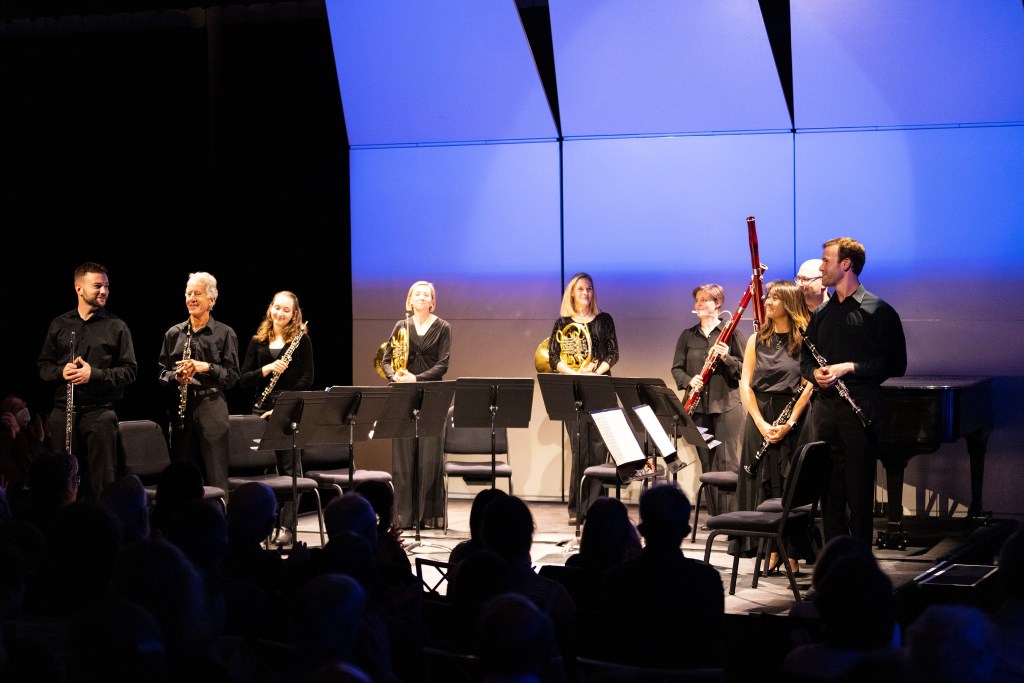
Gounod’s Petite symphonieBeethoven’s String QuintetSchumann’s Piano QuartetPhotos credit Tyler Secor
Going in reverse chronological order, the program opened with Gounod’s delightful Petite symphonie, scored for nine winds – a work which flautist Henrik Heide aptly introduced as one of the “pearls of the wind chamber music repertoire.” A stately, classical introduction initiated, an enticing set up for the movement proper’s pure joie de vivre, its Gallic lightness a sparkling contrast to the weightier Germanic works that would follow. A limpid, singing flute line highlighted the Andante cantabile, while the scherzo saw its march-like material regally announced by the horns. The finale rounded matters off with insouciant charm.
Schumann’s Piano Quartet occupied a vastly different soundworld – and also makes for an interesting contrast to the composer’s more frequently heard but contemporaneous Piano Quintet, also in E-flat major: though not without ample drama, the Quartet tends to be more restrained and intimate. Introductory material functioned a bit like a rhapsodic warmup, and a richly flowing melody built to fervent passions, encouraged by the powerful pianism of Dror Biran. Schumann took a cue from Beethoven in placing the scherzo second, a movement played by this group of musicians seamlessly even at breakneck speed. The slow movement that followed was truly gorgeous, with especially generous material from the cello (Daniel Culnan) and a searching line in the violin (Charles Morey), and the melody was increasingly decorated – very much in the spirit of the lieder pouring from the composer’s pen at the time. An energetic affair, the finale was especially striking in its fugato passage, expertly and crisply articulated.
Beethoven’s String Quintet in C major is, perhaps surprisingly, his only work in the medium, save for some adaptations of other pieces. The work opened graceful and genial, varied by sprightly filigree, occasionally leading to stormier sections – especially in the development. A slow movement was sweetly lyrical by contrast, while the scherzo saw a tenuous balance of drama and buoyancy – although a handful of passages could have been served by better intonation. As Beethoven was oft to do in closing movements, the final Presto was replete with contrapuntal textures, though it was the more playful material that was given the last word.
* Gounod: Henrik Heide, flute Lon Bussell, oboe Emily Beare, oboe Christopher Pell, clarinet Ixi Chen, clarinet Martin Garcia, bassoon Jennifer Monroe, bassoon Elizabeth Freimuth, horn Lisa Conway, horn
Schumann: Charles Morey, violin Christopher Fischer, viola Daniel Culnan, cello Dror Biran, piano
Gartner Auditorium Cleveland Museum of Art Cleveland, OH July 29 – August 1, 2021
Inevitably postponed last summer due to the pandemic, the Cleveland International Piano Competition has made a remarkable comeback here in 2021, a wonderfully exciting return to in-person performances. An initial pool of over 250 applicants from more than 40 countries was pared down to 26 contestants, all of whom performed in the Competition’s first two rounds. Owing to the travel and health restrictions that still persist, these rounds were conducted virtually, filmed at venues across the world – and available for free viewing on YouTube. Eight outstanding semi-finalists were selected to proceed onsite in Cleveland, a cohort to be further narrowed down to four finalists who will perform a chamber music round with the Escher Quartet and a concerto round with The Cleveland Orchestra under the baton of Jahja Ling.
Gartner Auditorium before Session 1 of the Semi-Final Round
Compared to the relative brevity of the first two rounds, the semi-finals offer an even more in-depth portrait of each artist, performing a recital of approximately 40 minutes. A few new and welcome additions for this year’s edition: each semi-finalist included in their program a popular song transcription commissioned from composer Alexey Kurbatov. Four selections were available, namely “America” from Bernstein’s West Side Story, Queen’s “Bohemian Rhapsody”, themes from Mission Impossible, and John Williams’ Olympic Fanfare. Regrettably, none of the eight selected the Williams piece, but perhaps a recording can be posted in due course. I also hope publication of these scores is imminent as they undoubtedly can serve as particularly enjoyable encore pieces.
Also for the first time was the inclusion of piano duets – the two performers from each session teamed up following their solo material for either the Fantasie in F minor by Schubert or Mozart’s Sonata for Two Pianos in D major. A lovely addendum that not only tested the contestants’ ability to collaborate with another pianist, but encouraged a spirit of camaraderie. Finally, excellent program notes for every piece performed – from the first round to the finals – were provided by Marissa Glynias Moore, Anna M. O’Connell, and Marco Ladd. Indispensable reading for attendees and a veritable crash course in piano literature. Below are some brief impressions I had of each semi-finalist.
Session 1 July 29, 2021
Ying Li Mozart: Piano Sonata No. 13 in B-flat Major, K. 333 Grainger: “Ramble on Love” from Der Rosenkavalier Bartók: Piano Sonata, Sz. 80 Schifrin: Themes from Mission Impossible (arr. Kurbatov)
Honggi Kim Schifrin: Themes from Mission Impossible (arr. Kurbatov) Chopin: Twelve Etudes, Op. 25
Schubert: Fantasie in F Minor, D. 940
Ying Li (China) opened the semi-final round with a Mozart sonata, delicate and balanced, exuding the pearly classical style. I found her pacing of the slow movement a bit hard to follow but was quite taken by the sprightly finale. Grainger’s so-called Ramble on Love, paraphrasing themes from Strauss’ Rosenkavalier, gave sumptuous treatment to the source material’s lush and languid melody. Bartók’s Piano Sonata was for me the highlight of her performance, opening with a manic energy – and the live video screens did much to enhance the audience experience, offering close-ups of the intricate hand-crossings.
Honggi Kim (South Korea) opened with the same piece with which Li closed, namely the Kurbatov Mission Impossible transcription. Kim was perhaps a bit more percussive than Li; both displayed how the composer brilliantly interpolated the familiar themes. All contestants are required to present a Chopin etude in the first two rounds – here in the semi-finals, Kim offered all twelve etudes from Op. 25. An ambitious undertaking to be sure, though I found his playing fitfully uneven. No. 2, for instance, would have benefitted from greater clarity, although I did like the way he brought out melodic material in the left hand. In No. 5, one wanted more accentuated contrast between the dissonant sections and the lyrical. The rapid double thirds of No. 6 were quite impressive, however. Op. 25 is certainly an end-weighted set, and perhaps one’s performance should be judged primarily on the final three which concluded on a high note: the rapid octaves of No. 10, a chillingly dramatic “Winter Wind”, and a rather marvelous finish in the intense depths of the “Ocean” etude.
Li and Kim were impressive four-hands partners in the Schubert Fantasie, bringing out contrasts from the brooding to the dancing.
Session 2 July 30, 2021
Jiarui Cheng Scarlatti: Sonata in B Minor, K. 87 Chopin: Barcarolle in F-sharp Major, Op. 60 Rachmaninov: Variations on a Theme of Corelli, Op. 42 Bernstein: “America” from West Side Story (arr. Kurbatov)
Yedam Kim Chopin: Polonaise-Fantaisie in A-flat Major, Op. 61 Prokofiev: Sonata No. 4 in C Minor, Op. 29 Mercury: Bohemian Rhapsody (arr. Kurbatov)
Mozart: Sonata for Two Pianos in D Major, K. 448
Jiarui Cheng (China) selected one of the more introspective of the Scarlatti sonatas, emphasizing its lyrical quality. Continuing the thread, he did much to bring out the wistful melancholy in Chopin’s late gem, the Barcarolle. In Rachmaninov’s Corelli Variations, Cheng sculpted an individual character in each variation – an excellent performance. Kurbatov’s transcription of Bernstein’s “America” ended matters on a jovial note.
Yedam Kim (South Korea) opened with a mesmerizing account of Chopin’s Polonaise-Fantaisie – contemporaneous with the previously-heard Barcarolle – the composer’s crowning achievement in the polonaise form. A commanding performance of Prokofiev’s Fourth Sonata followed, with searching, unsettling material leading to a bright and brilliant finale. In the Queen original, “Bohemian Rhapsody” is something of a mini tone poem with its wealth of thematic material and operatic narrative and dramatic flow – qualities very much brought out in Kim’s performance, perhaps the most impressive of the Kurbatov transcriptions.
Session 3 July 31, 2021
Rafael Skorka Bernstein: “America” from West Side Story (arr. Kurbatov) Leighton: Fantasia Contrappuntistica, Op. 24 (“Homage to Bach”) (1956) Brahms: Sieben Fantasien, Op. 116
Martín García García Schubert: Wanderer-Fantasie in C Major, D. 760 Liszt: “Les cloches de Genève (Nocturne)” from Années de Pèlerinage I, S. 160 Liszt: Étude de Concert, S. 145, No. 2 (“Gnomenreigen”) Liszt: Transcendental Etude, S. 139, No. 10 Mercury: Bohemian Rhapsody (arr. Kurbatov)
Schubert: Fantasie in F Minor, D. 940
Rafael Skorka (Israel) had confident beginnings with a memorable account of Bernstein’s “America”. The most intriguing discovery during the semi-final round came in the shape of Kenneth Leighton’s Fantasia Contrappuntistica, a 1956 homage to Bach (and to Busoni, given the elder composer’s monumental work of the same title). A virtuosic opening gave way to a pensive chorale and a pair of fugues rounded off the work. Skorka deftly negotiated the contrapuntal intricacies to bring matters to a vigorous close. The pianist continued to make a strong showing in Brahms’ Fantasies, Op. 116, just as convincing in the lyrical selections (nos. 2, 4, and the touching chorale of no. 6) as the more extrovert ones, giving the first piece an energetic workout and reserving the most overt virtuosity for the seventh and final fantasy.
Martín García García (Spain) offered an arresting account of Schubert’s ingenious Wanderer-Fantasie. While his tone at times veered a bit too percussive for my taste, he did much to bring out a wide dynamic and dramatic contrast and a keen sense of the work’s large-scale architecture. An interesting selection of three Liszt pieces followed. Deft use of the pedal did much to bring out the sonorities of the titular bells in Les cloches de Genève while García conveyed much charm in the impish legerdemain of Gnomenreigen. The Transcendental Etude No. 10 was technically impressive, although I found myself longing for even more firepower.
Session 4 August 1, 2021
Byeol Kim C. Schumann: Notturno in F Major, Op. 6, No. 2 Schumann: Arabeske in C Major, Op. 18 Mendelssohn: Fantasie in F-sharp Minor, Op. 28 Mercury: Bohemian Rhapsody (arr. Kurbatov) Jalbert: Toccata (2001) Gottschalk: The Union, Op. 48
Lovre Marušić Scarlatti: Sonata in E Major, K. 380 Schumann: Kreisleriana, Op. 16 Mercury: Bohemian Rhapsody (arr. Kurbatov)
Mozart: Sonata for Two Pianos in D Major, K. 448
Byeol Kim (South Korea) assembled the most diverse and wide-ranging semi-final program, beginning with music from both the Schumanns. Clara’s Notturno boasted a haunting, Chopinesque melody, a performance which should put Kim in the running for the Female Composer Prize, one of over a dozen special prizes being offered. A limpid account of Robert’s Arabeske followed, and Mendelssohn’s Fantasie in F sharp minor was given a passionate and dramatic performance. I really enjoyed the way Kim brought out the sweeping lyrical main theme in her take on the “Bohemian Rhapsody” transcription. Jalbert’s Toccata was a breathless study in perpetual motion, and Gottschalk’s Union, a wonderfully inventive cornucopia of Americana, put Kim’s searing virtuosity and vast dynamic range on full display. A clear audience favorite, she was the only one of the eight to receive a standing ovation.
Lovre Marušić (Croatia) began with a stately account of Scarlatti’s K380 sonata. Schumann’s extensive Kreisleriana followed. I felt Marušić’s reading would have been even more engaging with sharper contrasts between the wide range of expressions the work explores, but I certainly sensed the pianist becoming increasingly self-assured as the work progressed. Sunday’s session was a high note on which to conclude the semi-finals as we await the jury’s announcement of the four finalists, and the fine level of pianism we can expect from them in the subsequent chamber and concerto rounds.
St. Paschal Baylon Highland Heights, OH April 27, 2021
Bach: Sonata for Violin and Keyboard No. 3 in E major, BWV 1016 Strozzi: L’Eraclito amoroso – No. 14 from Cantate, ariette e duetti, Op. 2 (arr. Kenney) Messiaen: Thème et variations Kurtág: Hommage à J.S.B., from Signs, Games and Messages Messiaen: Louange à l’Immortalité de Jésus, from Quatuor pour la fin du temps Schumann: Fantasiestücke, Op. 73 Mozart: Violin Sonata No. 35 in A major, K526
Encore: Paradis: Sicilienne
In a sure sign of light at the end of the tunnel, the Cleveland Chamber Music Society returned to live, in person performances Tuesday evening. Instead of the usual venue at Plymouth Church, an alternative was to be found in the bright and airy St. Paschal Baylon in Highland Heights, a space rather more conducive to the requisite social distancing (the remaining two performances on the calendar will take place here as well). Violinist Alexi Kenney and pianist Renana Gutman offered a thoughtfully-curated recital, generously filled with curiosities and discoveries.
Alexi Kenney, photo credit alexikenney.com
Renana Gutman, photo credit Carlos Andrés Dueñas
Bach is always a fine choice with which to begin a recital, and the Sonata for Violin and Keyboard No. 3 was indeed such a selection. The bright E major tonality made for a stately opening, and the lively Allegro that followed purveyed seamless blending of violin and piano: these duo sonatas were pivotal amongst the composer’s output insofar as they gave both instruments roughly equal prominence. A passacaglia movement served as the emotional core of the work, given a heartfelt reading, while the finale was as uplifting as anything Bach wrote. Barbara Strozzi’s brief song L’Eraclito amoroso was presented in a transcription by Kenney. Long-breathed playing drew out a beguiling melody, delicately ornamented.
Following Baroque beginnings, the balance of the first half was rounded out by works from the 20th century. Messiaen’s Thème et variations is an early work, dating from 1932. Even in this early incarnation, the rich chromaticism made its composer unmistakably recognizable, with splashes of color hinting at all that was to come. Despite its the work’s brevity in five variations,Messiaen nonetheless found the space and time for matters to crest to a searing passion. Kurtág’s Hommage à J.S.B. (J.S. Bach, that is) made for a thoughtful connection to the program’s opening. A monologue for violin, the textures obliquely hinted at Baroque dance rhythms. (Local audiences might recall Isabelle Faust memorably presenting a Kurtág piece from the same collection during a Cleveland Orchestra performance a few seasons ago).
The duo revisited Messiaen once more in Louange à l’Immortalité de Jésus, the final movement from Quatuor pour la fin du temps. Though written for clarinet, violin, cello, and piano (the instruments available to him composing while imprisoned in a German POW camp), most movements are scored for various subsets of the quartet, with the closing movement distilled to violin and piano. This performance had an otherworldly effect. The music proceeded at a wondrously glacial pace, ending high in the stratosphere.
The latter half retreated to rather more familiar territory, but hardly less insightful. The first of Schumann’s three Fantasiestücke was brooding and passionate in its flights of fancy, while the middle piece made for a playful, light-hearted foil before the blistering finale. Mozart’s Violin Sonata in A major, K526 was his last of a long series of violin sonatas (notwithstanding the very brief K547), and served as a substantive conclusion. Sparkling, pearly playing in the opening Molto allegro was further encouraged by Gutman’s stylish accompaniment. There was a nuanced beauty of tone in the lyrical slow movement, always tinged with an ineffable melancholy. The closing Presto was a high-octane affair, though its vigor was deftly interlaced with more lyrical material. As an encore, the duo offered the Sicilienne by Maria Theresia von Paradis (purported dedicatee of Mozart’s Piano Concerto No. 18): a beautiful pendant to a wonderful program.



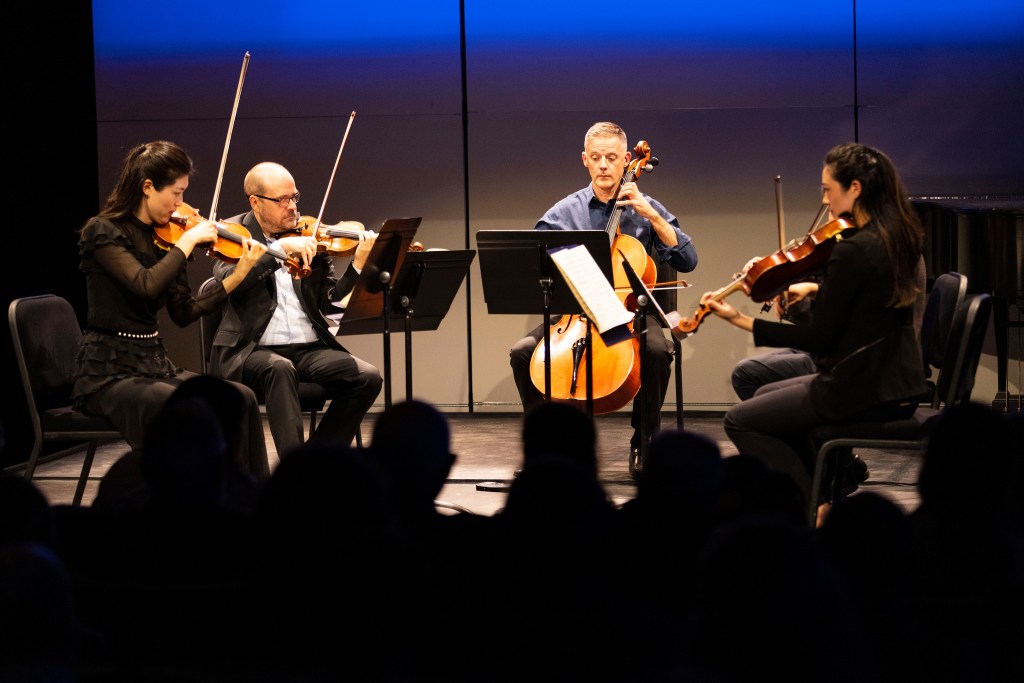
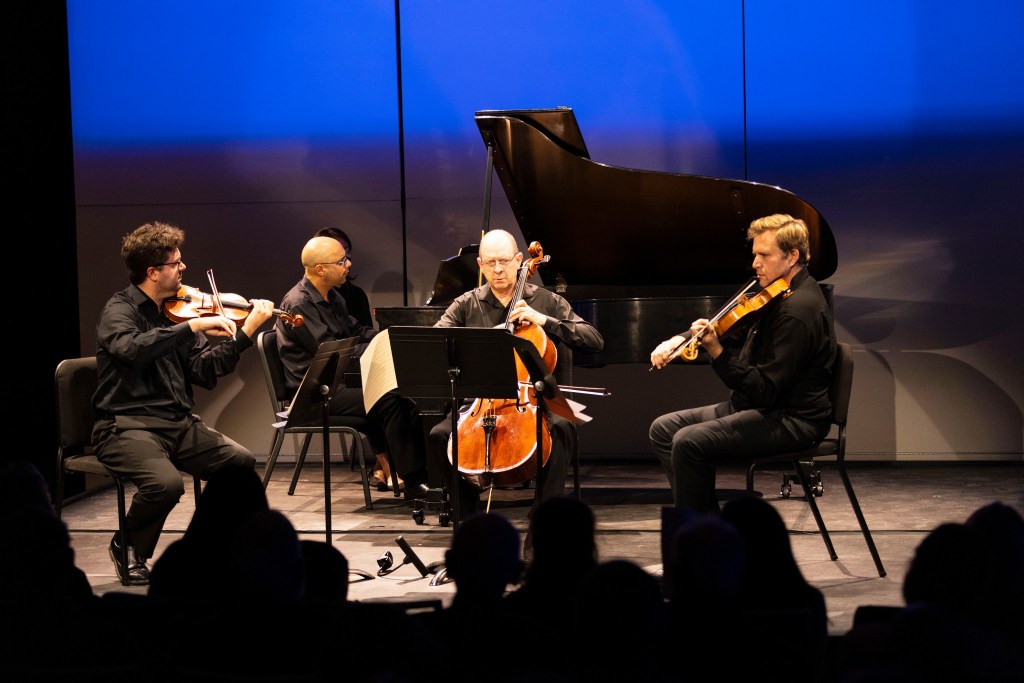


 quasi-faust