Pittsburgh Symphony Orchestra Manfred Honeck, conductor Francesco Piemontesi, piano Heinz Hall Pittsburgh, PA March 30, 2025
Eisendle: heliosis Liszt: Piano Concerto No. 2 in A major, S125 Encore: Schubert: Impromptu in G-flat major, Op. 90 No. 3 Habibi: Jeder Baum spricht Beethoven: Symphony No. 6 in F major, Op. 68, Pastoral
Over the closing weekend of March, Manfred Honeck and the Pittsburgh Symphony offered a program anchored by Beethoven’s Pastoral symphony, certainly an apt way to mark the arrival of spring (and I’m happy to report I spotted some cherry blossoms on the way to Heinz Hall!). In the graceful material that opened the symphony, the PSO radiated a joyous exuberance from the stage.
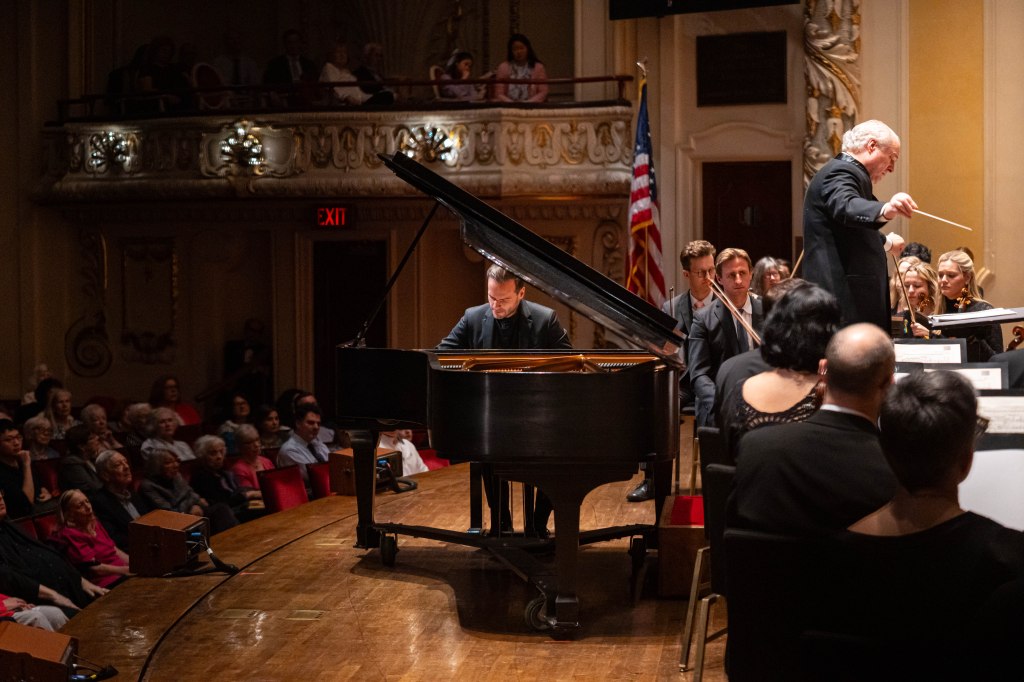
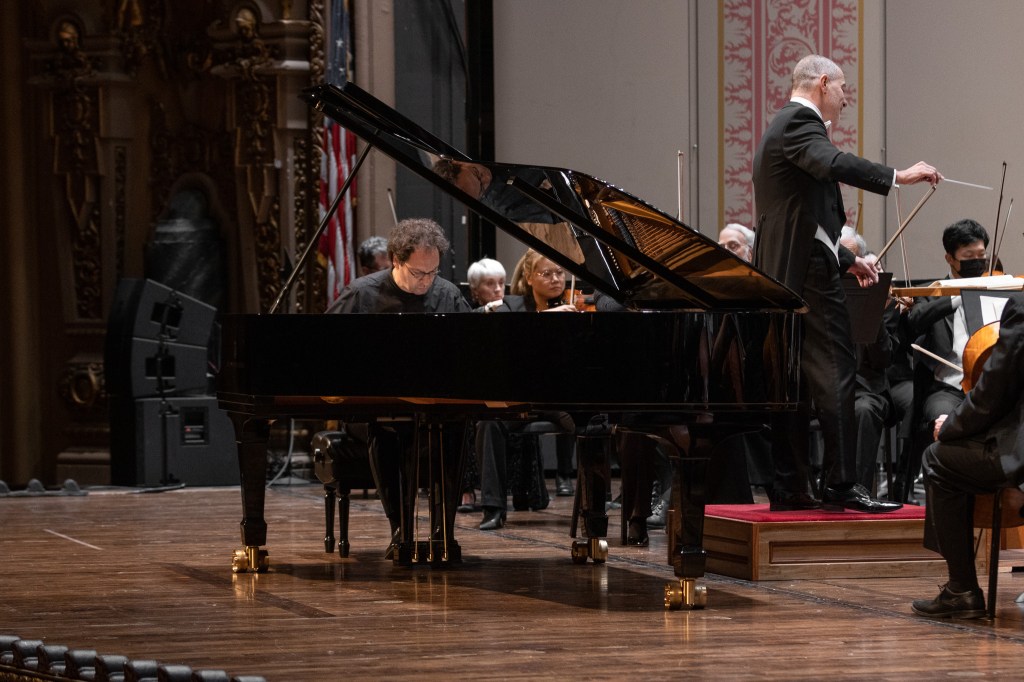
Francesco Piemontesi, Manfred Honeck, and the PSO, photo credit JMilteer Photography
I was particularly touched by the warmth of the clarinet in the gentle slow movement, hardly portending the storm that lay ahead. The PSO romped through the minuet that followed, with Honeck inviting the musicians to stomp their feet, perhaps giving the authentic air of a country dance. Ample drama painted the ensuing storm in vivid realism, making the closing Shepherd’s Song all the more rewarding.
Prefacing the Beethoven was the 2019 work Jeder Baum spricht (“Every Tree Speaks”) by Iranian composer Iman Habibi. Written for the Philadelphia Orchestra’s celebration of Beethoven’s 250th anniversary, it was explicitly conceived to precede the Fifth and Sixth symphonies, and makes numerous if somewhat veiled references to both. The title comes from Beethoven’s diaries, and in his prerecorded video remarks, Habibi noted a further resonance to the current climate crisis. An invocation of the fate motif from the Fifth opened, and a panoply of nature sounds abounded in this brief, five-minute prelude.
Opening the program was another contemporary work, a 2021 piece by Austrian composer Hannah Eisendle entitled heliosis (a medical term for sunstroke). Following an attention-grabbing opening, there was a retreat to a desolate, sun-drenched soundscape. The scoring emphasized the percussion, and its driving rhythms to my ears echoed Stravinsky’s Rite of Spring.
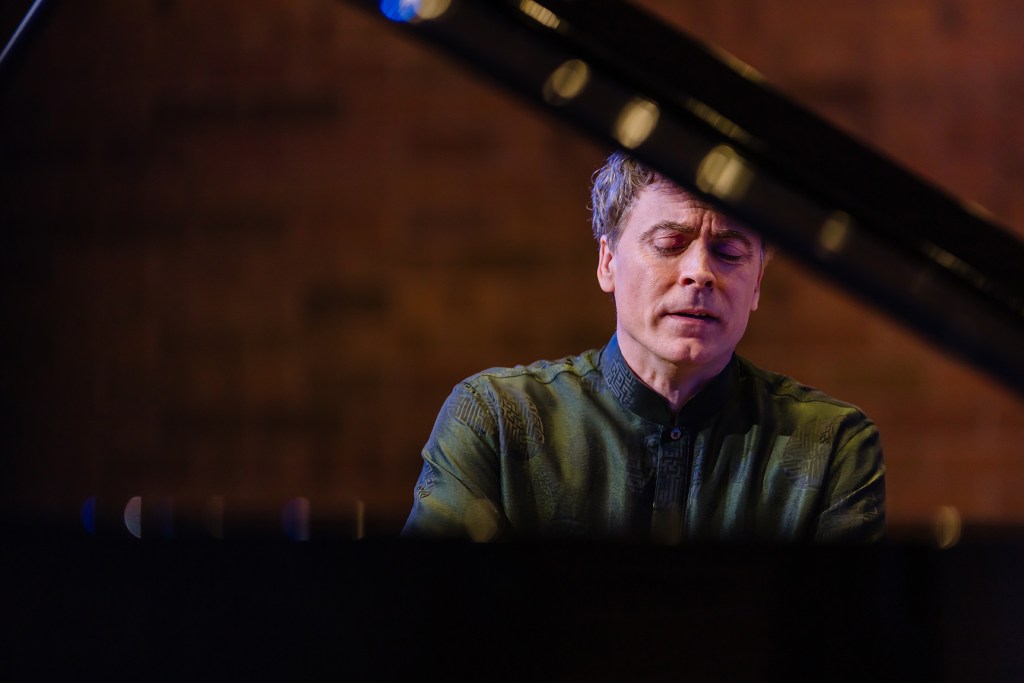
The program further featured pianist Francesco Piemontesi in Liszt’s Second Piano Concerto (a work I also heard him play at the Chicago Symphony just a few months earlier). Gentle winds began, answered by rolling arpeggios across the piano, as if gingerly exploring the potential of the instrument. Virtuosity was quickly ramped up, however, with the theme being transformed into an energetic march. In a more serene moment, the piano was in a richly lyrical duet with the cello (Anne Martindale Williams), a moment of respite before the fiery end. As an encore, the pianist selected Schubert’s G-flat impromptu — lovely and lyrical, and also a favorite of Piemontesi’s mentor Alfred Brendel.
Yuja Wang, piano Víkingur Ólafsson, piano Mandel Concert Hall Severance Music Center Cleveland, OH February 23, 2025
Berio: Wasserklavier (No. 3 from Six Encores) Schubert: Fantasie in F minor, D940 Cage: Experiences No. 1 Nancarrow: Study No. 6 (arr. Adès) Adams: Hallelujah Junction Pärt: Hymn to a Great City Rachmaninoff: Symphonic Dances, Op. 45
Encores: Brahms: Waltz in A-flat major, Op. 39 No. 15 Dvořák: Slavonic Dance in E minor, Op. 72 No. 2 Brahms: Hungarian Dance No. 1 in G minor Brahms: Waltz in E major, Op. 39 No. 2 Brahms: Waltz in G-sharp major, Op. 39 No. 3
Sunday afternoon marked a remarkable high point in The Cleveland Orchestra’s immensely rewarding recital series, with pianists Yuja Wang and Víkingur Ólafsson joining forces in a stop at Severance Hall on a brief US tour. Both superstar soloists in their own right, it was truly electrifying seeing these two band together. Yet this was more than just a celebrity pairing calculated to maximize box office receipts: their artistic temperaments complemented each other well, showing the whole can be greater than the sum of its parts.
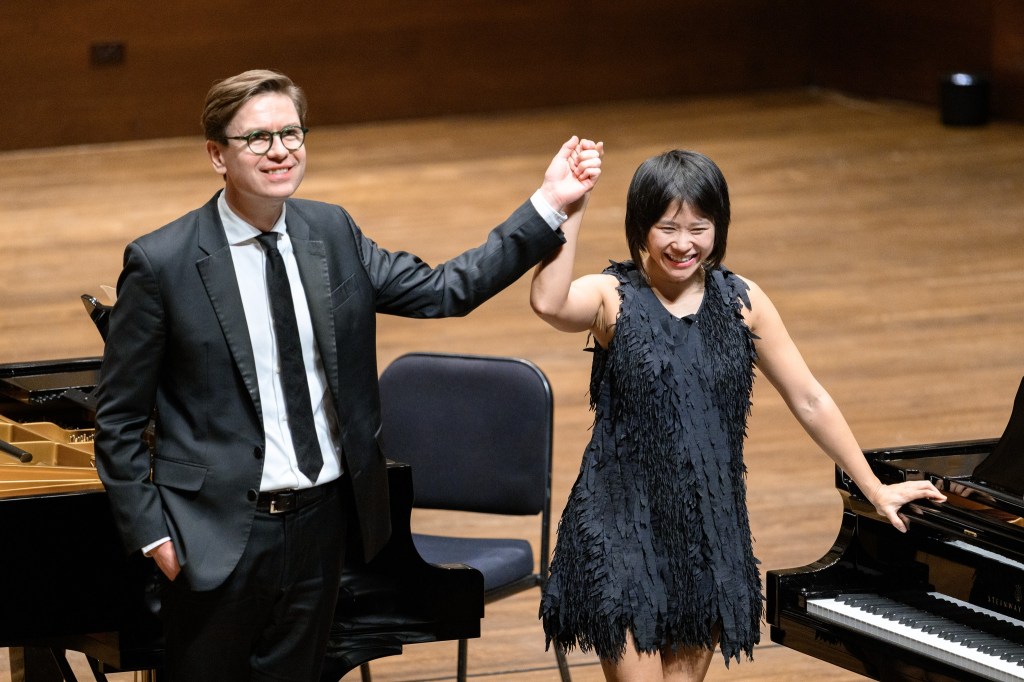
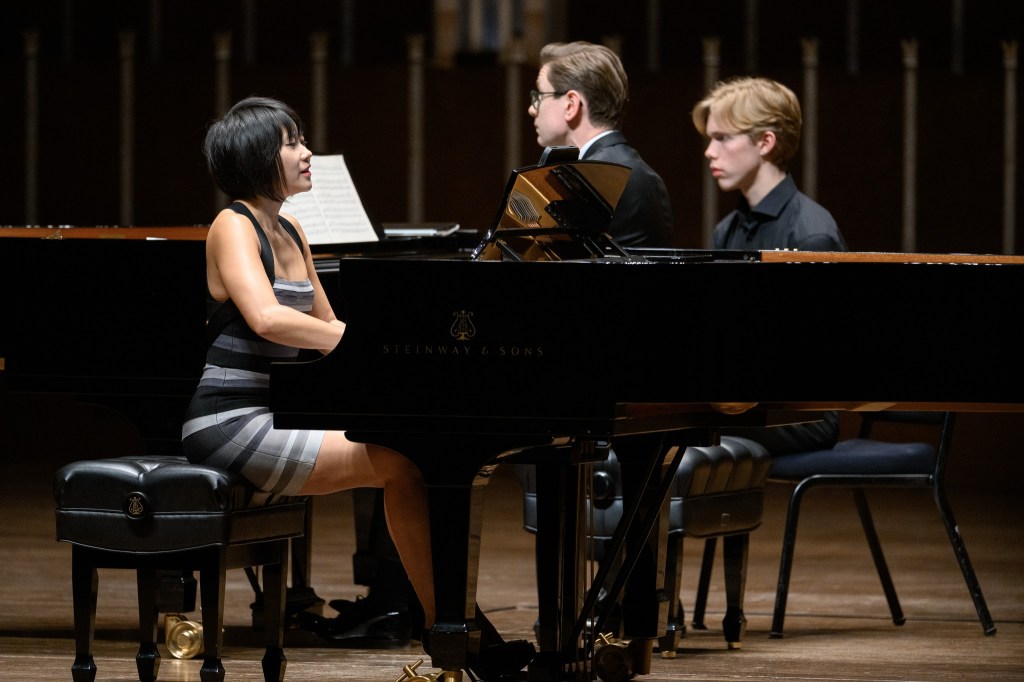
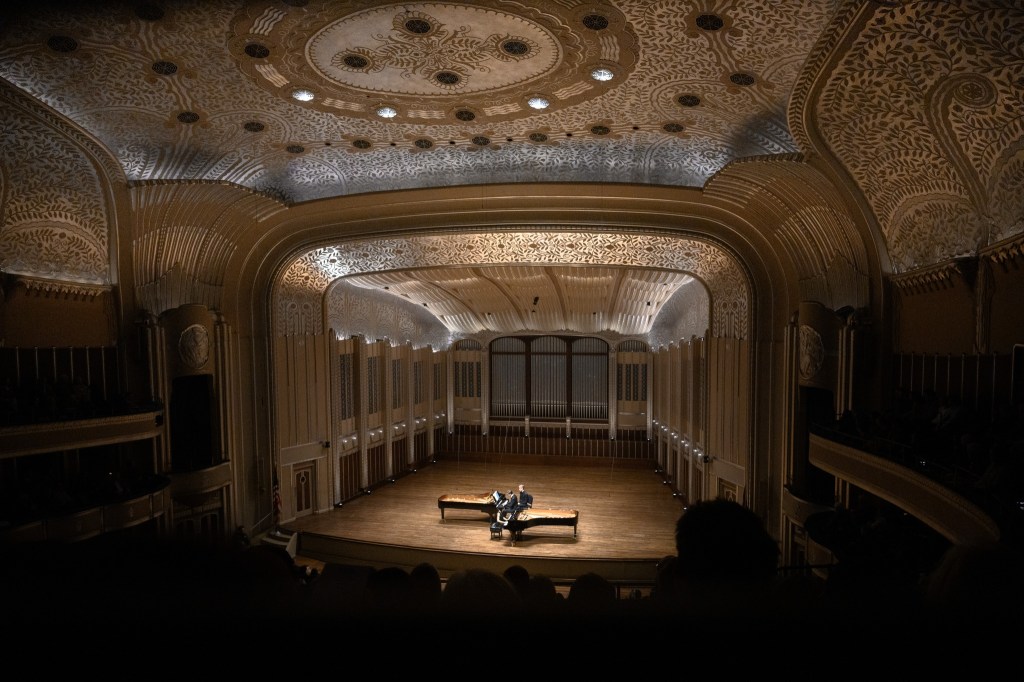
Víkingur Ólafsson and Yuja Wang at Severance Hall, photos credit Human Artist Photography + Cinema
The program was ripe with discovery, skirting some of the more commonly played fare for two pianos. Luciano Berio’s Wasserklavier began, a meditative opening with liquescent textures freely flowing. The piece made subtle nods to Brahms and Schubert, and fittingly, the pianists artfully segued directly into the latter’s own Fantasie in F minor. Usually played four hands on a single piano, hearing it spread across two instruments gave the work a greater resonance and depth of sound.
Crisply articulated dotted rhythms began, plunging into penetrating drama — rarely will one hear Schubert played with such intensity. Dance-like sections contrasted, exuding joy with the twenty fingers at work, intricately choreographed. A fascinating selection of works from the late 20th-century followed, beginning with John Cage’s Experiences No. 1. The composer’s characteristic minimalist textures were piquantly harmonized, punctuated by silence.
The sixth of Conlon Nancarrow’s 49 studies for player piano followed, made humanly playable in its two-piano arrangement by Thomas Adès (who local concertgoers had the chance to see conduct a remarkable Cleveland Orchestra program just the night before). In this case, the two pianos seemed to be at odds with one another, yet the jagged rhythms fit together in interlocking fashion.
The first half closed with John Adams’ Hallelujah Junction, to my mind, the highlight of the program. Pulsating energy filled Severance Hall with pianistic brilliance. Music of almost perpetual motion — quite a contrast to the minimalism of Cage — gave a larger-than-life portrayal of the namesake town on the California-Nevada border, and demonstrated in no uncertain terms the electric chemistry between these two pianists. The more lyrical pulses of a downtempo section captivated in their rhythmic intricacies, only to build back up to a dazzling density of sound.
Arvo Pärt’s Hymn to a Great City was marked by Wang’s playing in the upper register that rang with the purity of bells, and some delicate filigree that decorated the otherwise barren textures. Rachmaninoff’s Symphonic Dances — his final work — closed the printed program. Hammering out the main theme with pile-driving intensity, an almost manic energy between the two created a rich orchestral sonority. Yet matters were still clear and articulate, with a contrasting theme of haunting lyrical beauty. Sultry waltz rhythms in the central dance were given with stylish playing, and the finale was bold and grandiose, with broad gestures cascading spectacularly.
No less than five encores followed, a delightful selection of dances by Brahms and Dvořák, performed on a single piano, four hands. A charming, convivial close to a memorable afternoon.
Paul Lewis, piano Dalton Center Recital Hall Western Michigan University Kalamazoo, MI May 6, 2024
Schubert: Piano Sonata No. 19 in C minor, D958 Schubert: Piano Sonata No. 20 in A major, D959 Schubert: Piano Sonata No. 21 in B-flat major, D960
I am deeply grateful to Paul Lewis for introducing me to remarkable piano music of Schubert, a composer who can be unjustly overlooked in the wake of Beethoven and other contemporaries. I still have fond memories of a revelatory Schubert cycle he presented at Chicago’s Symphony Center, traversing all of the composer’s late piano works over the course of five recitals, a multi-season exploration that began back in February 2011. The 2024 Gilmore Festival saw Lewis in a similar undertaking, in this case, focusing on the piano sonatas over a quartet of recitals in the space of a single week. I was only fortunate enough to catch the final entry, consisting of the last three sonatas – one of those holy grail piano programs, on par with the final Beethoven sonatas or the Goldberg Variations.
The opening of the C minor sonata was given with ample weight and drama, only to be contrasted by lighter, buoyant material, with the quick-shifting moods akin to flickering candlelight. Lewis was fully enraptured and played with unwavering commitment; the intervening decade since I last saw him play Schubert has certainly brought even closer to the core of this music. In the slow movement, Lewis delicately voiced the chordal passages, with a nuanced shading given to each gesture. A rollicking triple meter marked the finale, one of the composer’s most thrilling creations.
Spacious, majestic beginnings were had in the A major sonata, answered by rippling triplets, and Lewis played with a distinct gracefulness, a particular joy to watch during the passages for crossed hands. In the tragic slow movement, the brightness of A major faded to a bleak F-sharp minor, and the primal agony of the central section was of startling ferocity. And then – a theme familiar from the G-flat impromptu surfaced, like sunlight shining through dark clouds for a wondrous calming effect. The sprightly scherzo was no trifle, packing in ample drama. The rondo finale was lyrical at heart, interspersed with themes that contrasted, and the closing figure was strikingly in mirror of the sonata’s opening where the long journey had begun.
The incomparable final sonata rightfully occupied the entire second half. The valedictory work opened in contemplative stillness, punctuated by silence (a theme that connected to Mark Nepo’s moving talk at the Kalamazoo Public Library earlier in the day, a further event hosted by the Gilmore). Rumbles in the bass undulated as tolling bells, and the development built to coruscating tension. A dotted rhythm underpinned the Andante sostenuto, giving way to an urgent lyricism that was simply heavenly. The scherzo marked a sudden shift to the jovial, given with carefree abandon, an ethos that continued into the good-natured finale that amounted to a satisfying, all-encompassing close. Still, Lewis found great variety, employing something of a chiaroscuro effect as shadows emerged in sharp relief, in due course bringing the sonata – and Lewis’ cycle as a whole – to a bold close.
Notice the tablet displaying the Andantino from D959!
Springfield Symphony Orchestra Peter Stafford Wilson, conductor Sarah Chang, violin Kuss Auditorium Clark State Performing Arts Center Springfield, OH January 27, 2024
Martinů: Overture for Orchestra, H345 Bruch: Violin Concerto No. 1 in G minor, Op. 26 Schubert: Symphony No. 4 in C minor, D417, Tragic
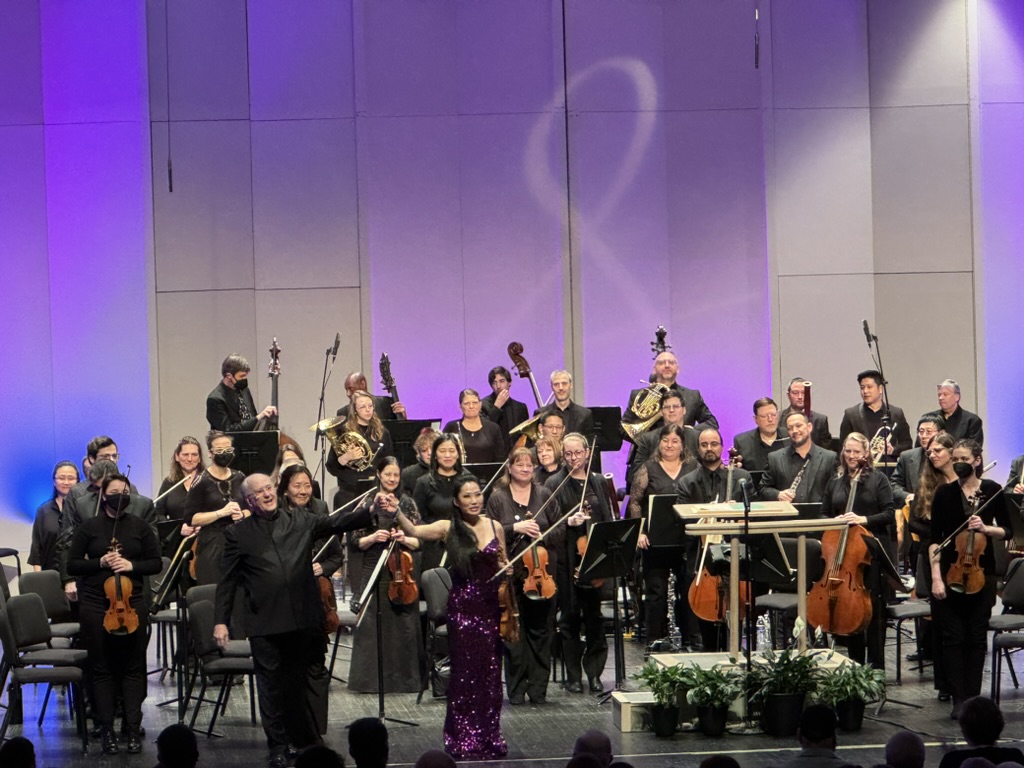
Saturday evening’s Springfield Symphony performance was highlighted by a concerto appearance from star violinist Sarah Chang. Before Chang took to the stage, the SSO offered a rather less-familiar score in Bohuslav Martinů’s Overture for Orchestra. An ebullient and effective opener, its festive nature was conceived in celebration of the Mannes College of Music where the composer had taught some years prior. Martinů favored chamber-like subsets of the full orchestra, invoking the Baroque concerto grosso. Concertmaster Sujean Kim offered some fine solo passages, and a serene central section contrasted the overture’s outward ebullience.
Peter Stafford Wilson, Sarah Chang, and the Springfield Symphony Orchestra
Chang came to Springfield armed with Bruch’s Violin Concerto No. 1, a work which she notably recorded with the great Kurt Masur. She opened with a melodic line articulate and emotive, and one was taken by the supreme purity of her tone, utterly controlled. A long-breathed melody marked the central slow movement, richly resonant and almost without break for the soloist, save for a swelling orchestral interlude; here and elsewhere the SSO generally supported their distinguished colleague with fine accompaniment.
The jocular acrobatics of the finale were exciting to watch but never just for show, and with the music being all but second-nature to Chang, it flowed organically from her bow. In a fascinating tidbit, music director Peter Stafford Wilson mentioned that Isaac Stern once played this same concerto with the SSO – and likely on the very same instrument heard Saturday, now in Chang’s possession.
The program concluded with Schubert’s Fourth Symphony. Its thunderous opening gave way to a measured introduction, and movement’s main theme was given with crisp articulation – though one wanted perhaps a bit more tension and cleaner intonation. The Andante served as a lyrical moment of repose, elegantly played, before the sprightly minuet and energetic finale – ending, like Beethoven’s C minor symphony before him, triumphantly in the major.
ProMusica Chamber Orchestra David Danzmayr, conductor Andy Akiho, steel pan Southern Theatre Columbus, OH November 11, 2023
Akiho: Beneath Lighted Coffers Encore: Akiho: Murasaki Schubert: Symphony No. 9 in C major, D944, Great
Last weekend’s ProMusica performances offered a further installment in their admirable and illuminating Composer/Performer project, in which they shine light on that special breed of musicians who balance careers in both disciplines. Featured on the present program was composer and steel pannist Andy Akiho – who just the day before received no less than 3 Grammy nominations!
Andy Akiho and ProMusica, photos credit ProMusica
The work he offered ProMusica was a concerto for steel pan and orchestra entitled Beneath Lighted Coffers, written in 2015 on commission from the National Symphony Orchestra. The piece was inspired by time the composer spent in Rome, and in particular, the Pantheon with each of its five movements exploring a feature of the awe-inspiring edifice. Cascades in the pan alone started the opening “Portico” movement, and one was struck by Akiho’s thorough command of his instrument. Despite being essentially a foreign entity in the context of the Western classical orchestra, the pan naturally blended with the others under the composer’s skillful writing.
“Twenty-Eight” alluded to the Pantheon’s trapezoidal coffers, with strident, angular writing building these architectural elements in musical terms. Striking the edge of the pan, Akiho yielded a wide variety of timbre and color from the instrument. “Oculus” proceeded as meditative paean, and “Corelli” was a tribute to Baroque master buried at the Pantheon on an instrument the elder composer could scarcely have imagined. The composer’s adroitness at writing for orchestra was perhaps most convincing in the closing “Permanence” – a tuneful final statement abundant with virtuosic flourishes. Perhaps not the most profound score ProMusica has embraced, but a thoroughly enjoyable listen.
As an encore, Akiho offered his piece Murasaki, putting the capabilities and variety of the pan into focus – I was especially taken by the wide dynamic range. During the post-concert conversation, Akiho mentioned the inspiration came in the wee hours of the morning following a late shift at his father’s sushi restaurant – and a nod to reggae and Bob Marley.
Schubert’s final completed symphony was a weighty end to the evening. The broad stroked introduction evidenced the heft and proportion of the work (which Schumann would famously dub “heavenly length”), although here I prefer a bit more indulgent tempo and spacing than what Danzmayr offered. The first movement proper was given an energetic, vivacious workout, a spirited and life-affirming statement, and the trombone – novel in the symphony during Schubert’s time – provided a muscular backbone. The solo oboe of the slow movement proceeded as a gorgeous song without words, answered by a prayer-like passage in the strings.
The scherzo that followed was certainly no trifle, just as long as any of the other movements. It had a driving energy, and a recurrent tension between the fiery and the lyrical, contrasted by the loveliest of trios. Danzmayr and ProMusica romped through the vivacious finale with joy and abandon.
Maria João Pires, piano Mandel Concert Hall Severance Music Center Cleveland, OH May 3, 2023
Schubert: Piano Sonata No. 13 in A major, D664 Debussy: Suite bergamasque, L75 Schubert: Piano Sonata No. 21 in B-flat major, D960
Encore: Debussy: No.1 from Deux arabesques, L66
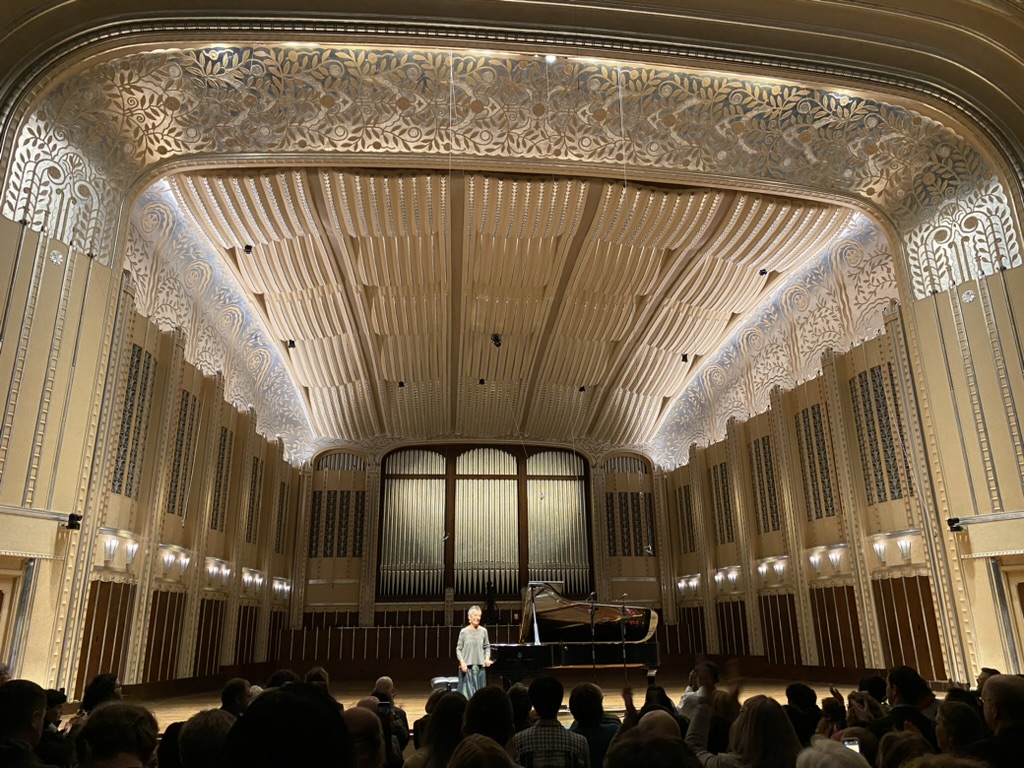
The Cleveland Orchestra’s inaugural recital series came to a divinely inspired close Wednesday evening, with Maria João Pires showing herself a true poet of the piano in works of Schubert and Debussy. Pires officially retired from the concert stage in 2017 – I sorely regretted missing her Cleveland appearance the previous year upon hearing that news – making the present recital all the more wonderful of an occasion, evidenced by the sizable and enthusiastic audience.
Maria João Pires at Severance Hall
Pires began with Schubert’s Piano Sonata No. 13 – middle period Schubert, still very much in the classical style insofar as it predated the sublime late sonatas, but not without the composer’s individual hallmark markedly apparent. Matters opened gracious and gentle, but colored by passing shadows in quintessentially Schubertian effect. Pires deftly shaped the phrasing and melody; stormier material in the development offered contrast but only for a fleeting moment before we returned to sunny A major. The Andante showed the pianist’s detailed voicing and nuance; the finale’s sprightly fingerwork playfully contrasted.
Debussy’s Suite bergamasque followed. The opening Prélude was given confident, self-assured beginnings, but not without an essential lyricism. Distinctive dance rhythms marked the Menuet, burgeoning to more impassioned material. Though Clair de lune is often presented as a standalone piece, it was quite intriguing hearing it in the context of the whole suite. Familiar a work as it may be, Pires’ lovely reading was anything but routine. A foil to its shimmering stasis came in the Passepied, an essay of near perpetual motion.
Schubert’s transcendent final piano sonata occupied the second half, and it truly was nothing short of a spiritual experience. An elegantly sculpted melodic line wondrously took shape, punctuated by profound silence after its first statement. Pires was particularly remarkable in the way she varied bringing out the inner voices, never content to merely repeat a phrase in the same way twice, and her keen attention to balance and coloring kept one in rapturous attention. The pianist took the long repeat of the first movement exposition, offering its dramatic first ending that would otherwise have been jettisoned. Distant keys were explored in the development before the movement’s serene close.
Pires opted for minimal pedaling in the Andante sostenuto, allowing the dotted rhythmic gesture to be strikingly detached, seemingly making the sumptuously gorgeous central section resound all the more lyrical. The scintillating scherzo was wonderfully charming, and the myriad guises in which the main theme recurred in the closing rondo oscillated between the insouciant and the dramatic.
For a lone encore, Pires returned to Debussy in the first of the Arabesques, an account limpid and lithe. Certainly a high bar on which to conclude the recital series, and kudos to the Cleveland Orchestra administration for such a successful endeavor. Next season’s offerings provide much to look forward to with solo recitals or chamber collaborations from Marc-André Hamelin, Emanuel Ax, Yefim Bronfman, and Evgeny Kissin.
Columbus Symphony Orchestra Rossen Milanov, conductor David Thomas, clarinet Ohio Theatre Columbus, OH February 18, 2023
Price: Andante ma non troppo from Symphony No. 3 in C minor Berio/Brahms: Op. 120 No. 1 Schubert: Symphony No. 4 in C minor, D417, Tragic
It has been deeply gratifying to see renewed attention given to the formidable work of Florence Price in the past few years. Last year’s Grammy for best orchestral performance went to the Philadelphia Orchestra’s warmly recommended recording of her First and Third symphonies under Yannick Nézet-Séguin – an ensemble of which Rossen Milanov served as assistant conductor for almost a dozen years before coming to Columbus. Last weekend’s Columbus Symphony program opened with the slow movement of the Third Symphony.
David Thomas, photo credit Columbus Symphony
A plaintive choir of winds began, with a tuneful melody gently unfolding. Like Dvorák before her (as in the New World symphony, heard here two weeks prior), Price purveyed a language steeped in folk tradition without making use of specific quotations. A passage for brass chorale was particularly affecting and distinctly American in character before the movement reached a serene ending, aided by a touch of harp. It certainly whetted one’s appetite for more, and I hope the complete symphony can be programmed in an upcoming season.
Though at the forefront of the avant-garde, Luciano Berio had a knack for faithfully transcribing other composers’ works for various media (including a particularly delightful selection of Beatles songs). A 1986 commission from the Los Angeles Philharmonic saw him transcribe Brahms’ late Clarinet Sonata in F minor, Op. 120 No. 1 for soloist and orchestra. Championing the work was David Thomas, serving as the CSO’s principal clarinet since 1989.
Passionate, brooding beginnings were had, with Berio’s orchestration inimitably Brahmsian as he left his iconoclastic proclivities far behind – the work sounded almost as the clarinet concerto Brahms never wrote. Thomas’ rich tone was well-suited to this autumnal work, finely balanced with the larger ensemble, and conveying a natural chemistry with his orchestral colleagues. The slow movement proceeded as a long-breathed song without words – really gorgeous – while an Allegretto grazioso charmed with its inflections of the ländler in both rhythm and spirit. A repeated motif marked the closing Vivace, a finale of appropriate vigor.
Another C minor symphony closed the program, namely Schubert’s Tragic. Weighty introductory material announced the minor tonality in no uncertain terms; the movement proper brimmed with Sturm und Drang in this early expression of Romanticism. The primary theme was deftly articulated in the strings, and a development section traversed distant keys before the movement landed – quite surprisingly – in the major.
The Andante boasted one of Schubert’s loveliest melodies, first presented in the strings with a touching countermelody in the oboe, searching for peace amidst the tumult of the rest of the work. The minor key shading gave the minuet added vigor, a contrast heightened by the lilting trio. Milanov leapt right in the to the finale – perhaps in reaction to some of the audience’s insistence on applauding after every movement. Matters felt a tad rushed, but this was an energetic outing nonetheless, leading to a dramatic finish.
Columbus Symphony Orchestra Rossen Milanov, conductor Shai Wosner, piano Ohio Theatre Columbus, OH November 5, 2022
Montgomery: Starburst Brahms: Piano Concerto No. 2 in B-flat major, Op. 83 Encore: Schubert: Hungarian Melody, D817 Dvořák: Symphony No. 6 in D major, Op. 60
Jessie Montgomery is a contemporary composer that has rightfully garnered much attention in recent years, and the Columbus Symphony opened their program with her 2012 work Starburst – a welcome further foray into her work after their inclusion of Bannerlast season (a program which in fact paired Montgomery with the same composers here). Starburst quite literally bursted with infectious, sparkling energy. One only wished this was sustained longer than its 5-minute duration, and I hope Montgomery is a composer the CSO continues to visit.
Shai Wosner with Rossen Milanov and the Columbus Symphony, photo creditt Corinne Mares
Brahms’ vast Second Piano Concerto made for a heavier contrast, and featured Israeli pianist Shai Wosner. A mellow horn call from principal Brian Mangrum made for a majestic opening to the weighty first movement. Wosner performed with intense, singular focus, though I felt his playing veered a bit too cautious and restrained. Although his technique wasn’t flawless, it nonetheless served well the daunting demands of the work. Both pianist and conductor Rossen Milanov seemed aligned in their conception of the grand, sweeping arc of the movement.
The scherzo that followed was hardly a trifle, still bearing much of the weight of the preceding, but sprightlier material contrasted. A deeply lyrical cello solo (Luis Biava) opened the Andante, and the piano entered with a gentle, song-like touch. The payoff came in the finale with its folk-inflected abandon, though hardly short on drama. As an encore, Wosner offered a lovely account of Schubert’s Hungarian Melody.
Dvořák’s Sixth Symphony was a milestone for the composer in that it was the first to published, and shows him blossoming into a mature symphonist. The spacious, expansive Allegro non tanto opened with a gentle, bucolic theme over pulsating accompaniment. It was certainly apposite to precede the symphony with Brahms as it bears the elder composer’s influence (particularly from Brahms’ own D major symphony), yet not without Dvořák’s individual hallmarks.
A touching moment of repose was to be had in the Adagio, its thematic material charmingly introduced in the winds. The composer unmistakably revealed in his Czech origins in the lively furiant that followed, and the orchestra deftly negotiated the ever-changing meters, an energetic warmup of sorts for the jubilant finale.
Columbus Symphony Orchestra Carolyn Kuan, conductor Vijay Venkatesh, piano Ohio Theatre Columbus, OH March 26, 2022
James Lee III: Towards a Greater Light Saint-Saëns: Piano Concerto No. 2 in G minor, Op. 22 Encore: Schubert-Liszt: Ständchen, S560/7 Schubert: Symphony No. 9 in C major, D944
Currently music director of the Hartford Symphony Orchestra, conductor Carolyn Kuan made a welcome debut with the Columbus Symphony in the final performance for March. The program opened with the brief 2017 work Towards a Greater Light by American composer James Lee III, meant to mark the 500th anniversary of the Protestant Reformation. Scored for strings alone, matters were often in a meditative stasis, saying much in its five-minute duration.
Carolyn Kuan, Vinjay Venkatesh, and the Columbus Symphony, photo credit Columbus Symphony
The young soloist Vijay Venkatesh was brought forth for Saint-Saëns’ Piano Concerto No. 2. The commanding, improvisatory-like opening for the soloist alone pointed towards the passionate primary theme. Venkatesh displayed a formidable technique, from delicate filigree to fiery double octaves. The central Allegro scherzando was gossamer – and rather Mendelssohnian – in texture. Though an impressive finish, it felt clarity was sacrificed for speed in the breakneck finale. Venkatesh returned for an encore in the Schubert-Liszt Ständchen transcription, showing a haunting, lyrical side of the pianist not revealed in the ebullient concerto.
An apt choice of encore given that the rest of the evening was devoted to Schubert in the towering Ninth Symphony. Kuan allowed for the solo horn call which opened to be played freely, though it perhaps could have benefitted from her conducting to initiate things with more focused direction. Matters gradually amassed, leading the grandiose movement proper. The trombones were especially striking, forming the spine of the work, and the busy orchestra harmoniously blended together. A limber oboe passage in the Andante con moto was a quintessentially Schubertian melody, and gorgeous strings were a turn inwards in a work that otherwise shows the composer at his most exuberant. The third movement’s vigor spoke to an affinity with dance, though never without a certain Viennese charm and grace, and the high-spirited energy was sustained through the vivacious finale. A strong showing from Kuan – let’s hope she’s invited back to the CSO podium soon.
Gartner Auditorium Cleveland Museum of Art Cleveland, OH July 29 – August 1, 2021
Inevitably postponed last summer due to the pandemic, the Cleveland International Piano Competition has made a remarkable comeback here in 2021, a wonderfully exciting return to in-person performances. An initial pool of over 250 applicants from more than 40 countries was pared down to 26 contestants, all of whom performed in the Competition’s first two rounds. Owing to the travel and health restrictions that still persist, these rounds were conducted virtually, filmed at venues across the world – and available for free viewing on YouTube. Eight outstanding semi-finalists were selected to proceed onsite in Cleveland, a cohort to be further narrowed down to four finalists who will perform a chamber music round with the Escher Quartet and a concerto round with The Cleveland Orchestra under the baton of Jahja Ling.
Gartner Auditorium before Session 1 of the Semi-Final Round
Compared to the relative brevity of the first two rounds, the semi-finals offer an even more in-depth portrait of each artist, performing a recital of approximately 40 minutes. A few new and welcome additions for this year’s edition: each semi-finalist included in their program a popular song transcription commissioned from composer Alexey Kurbatov. Four selections were available, namely “America” from Bernstein’s West Side Story, Queen’s “Bohemian Rhapsody”, themes from Mission Impossible, and John Williams’ Olympic Fanfare. Regrettably, none of the eight selected the Williams piece, but perhaps a recording can be posted in due course. I also hope publication of these scores is imminent as they undoubtedly can serve as particularly enjoyable encore pieces.
Also for the first time was the inclusion of piano duets – the two performers from each session teamed up following their solo material for either the Fantasie in F minor by Schubert or Mozart’s Sonata for Two Pianos in D major. A lovely addendum that not only tested the contestants’ ability to collaborate with another pianist, but encouraged a spirit of camaraderie. Finally, excellent program notes for every piece performed – from the first round to the finals – were provided by Marissa Glynias Moore, Anna M. O’Connell, and Marco Ladd. Indispensable reading for attendees and a veritable crash course in piano literature. Below are some brief impressions I had of each semi-finalist.
Session 1 July 29, 2021
Ying Li Mozart: Piano Sonata No. 13 in B-flat Major, K. 333 Grainger: “Ramble on Love” from Der Rosenkavalier Bartók: Piano Sonata, Sz. 80 Schifrin: Themes from Mission Impossible (arr. Kurbatov)
Honggi Kim Schifrin: Themes from Mission Impossible (arr. Kurbatov) Chopin: Twelve Etudes, Op. 25
Schubert: Fantasie in F Minor, D. 940
Ying Li (China) opened the semi-final round with a Mozart sonata, delicate and balanced, exuding the pearly classical style. I found her pacing of the slow movement a bit hard to follow but was quite taken by the sprightly finale. Grainger’s so-called Ramble on Love, paraphrasing themes from Strauss’ Rosenkavalier, gave sumptuous treatment to the source material’s lush and languid melody. Bartók’s Piano Sonata was for me the highlight of her performance, opening with a manic energy – and the live video screens did much to enhance the audience experience, offering close-ups of the intricate hand-crossings.
Honggi Kim (South Korea) opened with the same piece with which Li closed, namely the Kurbatov Mission Impossible transcription. Kim was perhaps a bit more percussive than Li; both displayed how the composer brilliantly interpolated the familiar themes. All contestants are required to present a Chopin etude in the first two rounds – here in the semi-finals, Kim offered all twelve etudes from Op. 25. An ambitious undertaking to be sure, though I found his playing fitfully uneven. No. 2, for instance, would have benefitted from greater clarity, although I did like the way he brought out melodic material in the left hand. In No. 5, one wanted more accentuated contrast between the dissonant sections and the lyrical. The rapid double thirds of No. 6 were quite impressive, however. Op. 25 is certainly an end-weighted set, and perhaps one’s performance should be judged primarily on the final three which concluded on a high note: the rapid octaves of No. 10, a chillingly dramatic “Winter Wind”, and a rather marvelous finish in the intense depths of the “Ocean” etude.
Li and Kim were impressive four-hands partners in the Schubert Fantasie, bringing out contrasts from the brooding to the dancing.
Session 2 July 30, 2021
Jiarui Cheng Scarlatti: Sonata in B Minor, K. 87 Chopin: Barcarolle in F-sharp Major, Op. 60 Rachmaninov: Variations on a Theme of Corelli, Op. 42 Bernstein: “America” from West Side Story (arr. Kurbatov)
Yedam Kim Chopin: Polonaise-Fantaisie in A-flat Major, Op. 61 Prokofiev: Sonata No. 4 in C Minor, Op. 29 Mercury: Bohemian Rhapsody (arr. Kurbatov)
Mozart: Sonata for Two Pianos in D Major, K. 448
Jiarui Cheng (China) selected one of the more introspective of the Scarlatti sonatas, emphasizing its lyrical quality. Continuing the thread, he did much to bring out the wistful melancholy in Chopin’s late gem, the Barcarolle. In Rachmaninov’s Corelli Variations, Cheng sculpted an individual character in each variation – an excellent performance. Kurbatov’s transcription of Bernstein’s “America” ended matters on a jovial note.
Yedam Kim (South Korea) opened with a mesmerizing account of Chopin’s Polonaise-Fantaisie – contemporaneous with the previously-heard Barcarolle – the composer’s crowning achievement in the polonaise form. A commanding performance of Prokofiev’s Fourth Sonata followed, with searching, unsettling material leading to a bright and brilliant finale. In the Queen original, “Bohemian Rhapsody” is something of a mini tone poem with its wealth of thematic material and operatic narrative and dramatic flow – qualities very much brought out in Kim’s performance, perhaps the most impressive of the Kurbatov transcriptions.
Session 3 July 31, 2021
Rafael Skorka Bernstein: “America” from West Side Story (arr. Kurbatov) Leighton: Fantasia Contrappuntistica, Op. 24 (“Homage to Bach”) (1956) Brahms: Sieben Fantasien, Op. 116
Martín García García Schubert: Wanderer-Fantasie in C Major, D. 760 Liszt: “Les cloches de Genève (Nocturne)” from Années de Pèlerinage I, S. 160 Liszt: Étude de Concert, S. 145, No. 2 (“Gnomenreigen”) Liszt: Transcendental Etude, S. 139, No. 10 Mercury: Bohemian Rhapsody (arr. Kurbatov)
Schubert: Fantasie in F Minor, D. 940
Rafael Skorka (Israel) had confident beginnings with a memorable account of Bernstein’s “America”. The most intriguing discovery during the semi-final round came in the shape of Kenneth Leighton’s Fantasia Contrappuntistica, a 1956 homage to Bach (and to Busoni, given the elder composer’s monumental work of the same title). A virtuosic opening gave way to a pensive chorale and a pair of fugues rounded off the work. Skorka deftly negotiated the contrapuntal intricacies to bring matters to a vigorous close. The pianist continued to make a strong showing in Brahms’ Fantasies, Op. 116, just as convincing in the lyrical selections (nos. 2, 4, and the touching chorale of no. 6) as the more extrovert ones, giving the first piece an energetic workout and reserving the most overt virtuosity for the seventh and final fantasy.
Martín García García (Spain) offered an arresting account of Schubert’s ingenious Wanderer-Fantasie. While his tone at times veered a bit too percussive for my taste, he did much to bring out a wide dynamic and dramatic contrast and a keen sense of the work’s large-scale architecture. An interesting selection of three Liszt pieces followed. Deft use of the pedal did much to bring out the sonorities of the titular bells in Les cloches de Genève while García conveyed much charm in the impish legerdemain of Gnomenreigen. The Transcendental Etude No. 10 was technically impressive, although I found myself longing for even more firepower.
Session 4 August 1, 2021
Byeol Kim C. Schumann: Notturno in F Major, Op. 6, No. 2 Schumann: Arabeske in C Major, Op. 18 Mendelssohn: Fantasie in F-sharp Minor, Op. 28 Mercury: Bohemian Rhapsody (arr. Kurbatov) Jalbert: Toccata (2001) Gottschalk: The Union, Op. 48
Lovre Marušić Scarlatti: Sonata in E Major, K. 380 Schumann: Kreisleriana, Op. 16 Mercury: Bohemian Rhapsody (arr. Kurbatov)
Mozart: Sonata for Two Pianos in D Major, K. 448
Byeol Kim (South Korea) assembled the most diverse and wide-ranging semi-final program, beginning with music from both the Schumanns. Clara’s Notturno boasted a haunting, Chopinesque melody, a performance which should put Kim in the running for the Female Composer Prize, one of over a dozen special prizes being offered. A limpid account of Robert’s Arabeske followed, and Mendelssohn’s Fantasie in F sharp minor was given a passionate and dramatic performance. I really enjoyed the way Kim brought out the sweeping lyrical main theme in her take on the “Bohemian Rhapsody” transcription. Jalbert’s Toccata was a breathless study in perpetual motion, and Gottschalk’s Union, a wonderfully inventive cornucopia of Americana, put Kim’s searing virtuosity and vast dynamic range on full display. A clear audience favorite, she was the only one of the eight to receive a standing ovation.
Lovre Marušić (Croatia) began with a stately account of Scarlatti’s K380 sonata. Schumann’s extensive Kreisleriana followed. I felt Marušić’s reading would have been even more engaging with sharper contrasts between the wide range of expressions the work explores, but I certainly sensed the pianist becoming increasingly self-assured as the work progressed. Sunday’s session was a high note on which to conclude the semi-finals as we await the jury’s announcement of the four finalists, and the fine level of pianism we can expect from them in the subsequent chamber and concerto rounds.







 quasi-faust