Classical symphonies bookend wunderkind violinist at ProMusica

ProMusica Chamber Orchestra
David Danzmayr, conductor
Fiona Khuong-Huu, violin
Southern Theatre
Columbus, OH
January 28, 2024

Prokofiev: Symphony No. 1 in D major, Op. 25, Classical
Saint-Saëns: Introduction et Rondo capriccioso, Op. 28
Ravel: Tzigane
Haydn: Symphony No. 104 in D major, Hob. I:104, London

Last weekend’s ProMusica performances introduced Columbus audiences to the remarkable – and remarkably young – violinist Fiona Khuong-Huu. Just 16 years old, she has already scored a New York Philharmonic debut and is currently a student in Juilliard’s pre-college division. Additionally, she is recipient of the Fomin Scholarship Fund from the Chicago-area North Shore Chamber Festival, an organization helmed by ProMusica’s creative partner Vadim Gluzman.

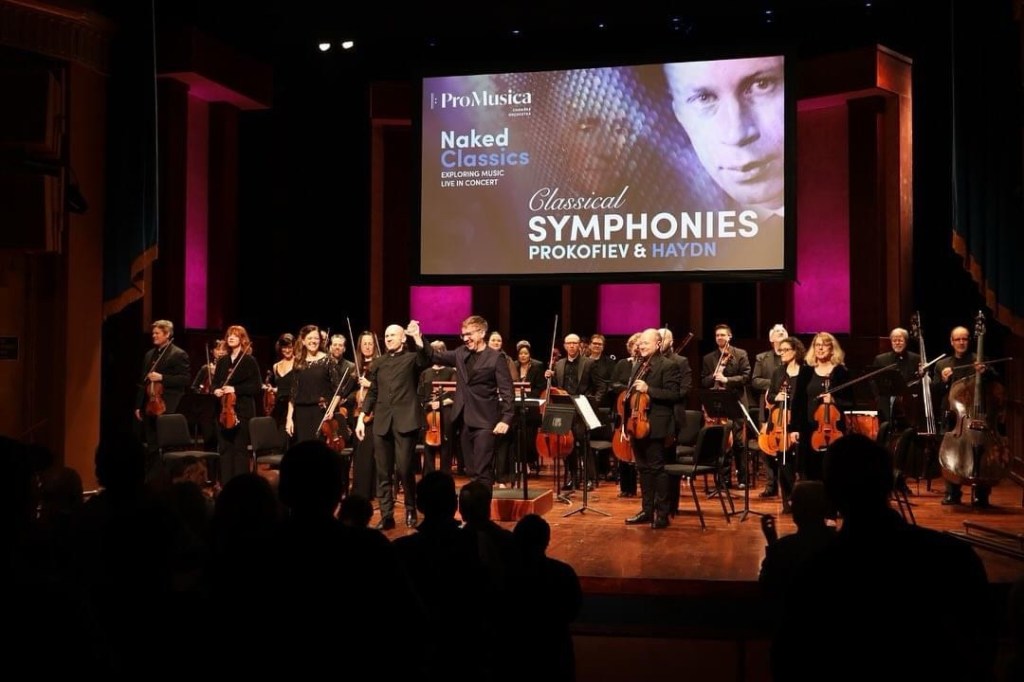
Fiona Khuong-Huu, David Danzmayr, and ProMusica, photos credit ProMusica

Khuong-Huu offered two 10-minute or so virtuoso showpieces, beginning with Saint-Saëns’ Introduction and Rondo capriccioso. A long-bowed melody marked the introductory material, and the violinist played with a rich tone and a maturity beyond her years. The Rondo was elegantly ornamented, with Khuong-Huu self-assured across the range of her instrument. In a particularly striking moment, the soloist played a series of rapid, wide-ranging arpeggios as the theme surfaced in the winds.

Ravel’s Tzigane opened with a monologue for violin alone, replete with modal inflections in invocation of Romani music. It’s a work that made substantial technical demands, surmounted by the soloist with seeming effortlessness. It’s also a piece filled with novel timbres, from the rapid pizzicato passages to a substantial part for harp (Jeanne Norton). Khuong-Huu certainly has a bright future ahead of her, and a career I look forward to watching.

The evening began and ended with “classical” symphonies of various flavors – Prokofiev’s First, which consciously sought to emulate and imitate his symphonic forbears, and Haydn’s last, a veritable archetype of the form. The fizzy opening of the Prokofiev was further buttressed by a buoyant contrasting theme, almost weightless, though vigor was amassed as much was made from efficient use of the chamber-sized orchestra. The delicate inner voices were intricately brought out in the Larghetto, and the piquant dissonances of the haughty gavotte were given a stylish reading. The effervescence of the whirlwind finale was a worthy rival to Haydn himself.

A broad-stroked introduction began Haydn’s London symphony at the other end of the program, pointing towards an essay in equal parts energetic and elegant, epitomizing classical symmetry and balance. The irregularly dispersed accents and pauses of the minuet were of charming effect, as was the finale, derived from a Croatian folk song that sounded almost indistinguishable from a bona fide Haydn theme.

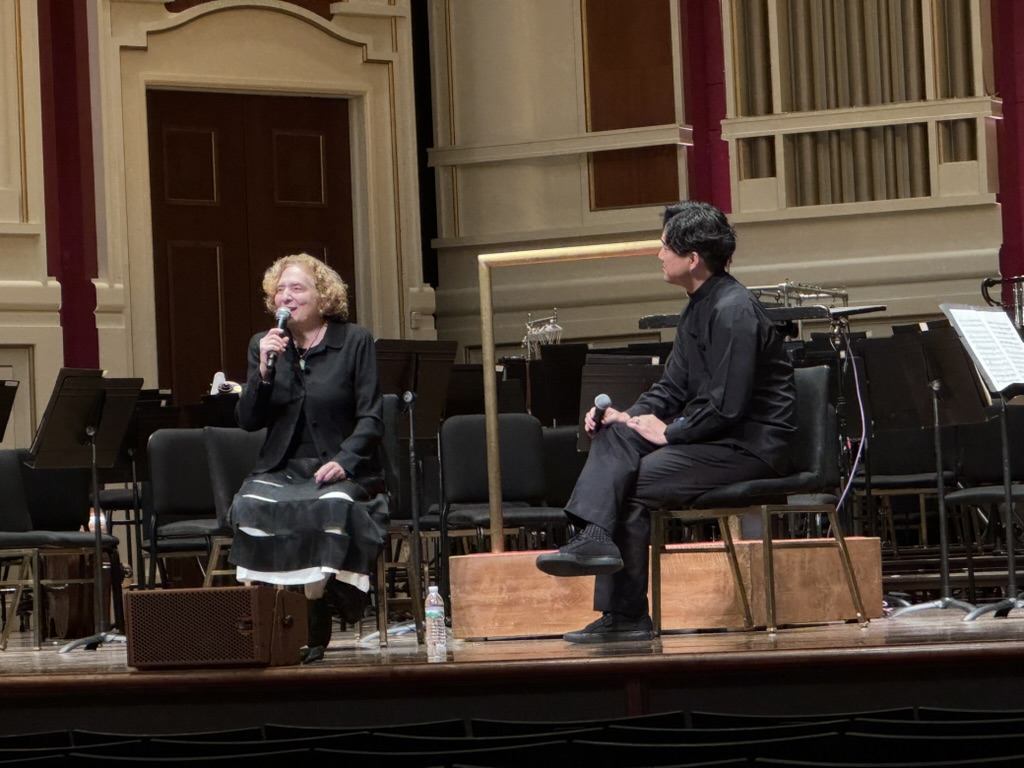
The preceding Friday night saw a further installment of Naked Classics, hosted by the ebullient and informed Paul Rissmann. Parallels and contrasts between the Haydn and Prokofiev symphonies were illuminated, culminating in a performance of both works. Here, the two symphonies were intertwined, with a movement of Prokofiev alternating with a movement of Haydn, an approach which may have helped illustrate comparisons but ultimately made for a disjointed listen.

Paul Rissmann with David Danzmayr and ProMusica

Kibbey and Kenney delight in harp and violin duos at Chamber Music Columbus

Bridget Kibbey, harp
Alexi Kenney, violin
Southern Theatre
Columbus, OH
November 5, 2022

Saint-Saëns: Fantaisie in A major, Op. 124
Hu: Chamber Music Columbus Fanfare
CPE Bach: Sonata in G Minor, H 542.5
Bartók: Romanian Folk Dances
Larsen: Sun Strider
Biber: Mystery Sonata No. 1 (“Annunciation”)
Messiaen: Vocalise-étude
Dowland: Flow my Teares
Rodrigo: Madrigales amatorios
Falla: Siete canciones populares españolas
Currier: Night Time

Appealing as the combination may seem, music for harp and violin duo is an uncommon occurrence. Leave it Bridget Kibbey and Alexi Kenney to make a strong case for the medium in lovely program of duets at Chamber Music Columbus. Most of the selections performed were by necessity arrangements of other works, but the duo highlighted a few pieces written expressly for this combination, including a world premiere from Libby Larsen.

Alexi Kenney and Bridget Kibbey, photo credit Chamber Music Columbus

One such work with this instrumentation in mind was Saint-Saëns’ Fantaisie in A major. Graciously lyrical, the musical synergy between Kibbey and Kenney was apparent from the first bars. Impressive virtuosity served well the fantasy, improvisatory-like elements of the piece. Following was Ching-chu Hu’s Fanfare, a mainstay of all Chamber Music Columbus performances this season. After previously hearing it cast for brass quintet, it was quite fascinating to hear it undertaken by such vastly different forces.

A transcription of a sonata by CPE Bach opened with extravagant material for harp alone, and the violin later joined in imitation. A long-bowed violin melody over harp filigree made a touching Adagio, and the rapid finale was given with seamless cohesion. In place of the Clara Schumann Romances, Op. 22 listed on the program, the duo opted for the livelier Romanian Folk Dances of Bartók, a series of six miniatures (originally for piano, Sz. 56) boasting a folksy flair.

A co-commission from Chamber Music Columbus and the Schubert Club of Saint Paul, Minnesota (an ever older organization than CMC – celebrating 140 years this season!), Libby Larsen’s Sun Strider opened the second half. Matters gradually amassed, gathering energy, and the different characteristics of the strings of each instrument were exploited for contrast (a subject Larsen discussed during my interview with her). Novel sounds were drawn from the harp, taking full advantage of Kibbey’s peerless technique, and the work was at heart deeply lyrical – and generously so. The title evokes the sun’s journey across the sky; when sunset arrived, the music faded away, leaving only the vibrations of the strings.

A varied selection of shorter works followed, beginning with the first of Biber’s mystical Mystery Sonatas. Though separated by a few centuries. Messiaen’s Vocalise-étude occupied a similar sense of religious wonderment. For a Spanish sojourn, Rodrigo’s Madrigales amatorios were interwoven with selections from Falla’s Siete canciones populares españolas, works by turn feisty and jaunty or sultry and seductive.

Sebastian Currier’s 1998 work Night Time closed the recital – along with the Saint-Saëns and the new Hu and Larsen pieces, the only other work on the program conceived originally for harp and violin. Depicting the enigma of the night, its striking musical language seemed to be Currier’s response to Bartók’s “night music.” The second movement “Sleepless” was appropriately filled with jarringly irregular accents, though calm arrived in the concluding “Starlight” wherein matters drifted off into the depths of night.

Conductor Carolyn Kuan makes notable Columbus Symphony debut

Columbus Symphony Orchestra
Carolyn Kuan, conductor
Vijay Venkatesh, piano
Ohio Theatre
Columbus, OH
March 26, 2022

James Lee III: Towards a Greater Light
Saint-Saëns: Piano Concerto No. 2 in G minor, Op. 22
 Encore:
 Schubert-Liszt: Ständchen, S560/7
Schubert: Symphony No. 9 in C major, D944

Currently music director of the Hartford Symphony Orchestra, conductor Carolyn Kuan made a welcome debut with the Columbus Symphony in the final performance for March. The program opened with the brief 2017 work Towards a Greater Light by American composer James Lee III, meant to mark the 500th anniversary of the Protestant Reformation. Scored for strings alone, matters were often in a meditative stasis, saying much in its five-minute duration.

Carolyn Kuan, Vinjay Venkatesh, and the Columbus Symphony, photo credit Columbus Symphony

The young soloist Vijay Venkatesh was brought forth for Saint-Saëns’ Piano Concerto No. 2. The commanding, improvisatory-like opening for the soloist alone pointed towards the passionate primary theme. Venkatesh displayed a formidable technique, from delicate filigree to fiery double octaves. The central Allegro scherzando was gossamer – and rather Mendelssohnian – in texture. Though an impressive finish, it felt clarity was sacrificed for speed in the breakneck finale. Venkatesh returned for an encore in the Schubert-Liszt Ständchen transcription, showing a haunting, lyrical side of the pianist not revealed in the ebullient concerto.

An apt choice of encore given that the rest of the evening was devoted to Schubert in the towering Ninth Symphony. Kuan allowed for the solo horn call which opened to be played freely, though it perhaps could have benefitted from her conducting to initiate things with more focused direction. Matters gradually amassed, leading the grandiose movement proper. The trombones were especially striking, forming the spine of the work, and the busy orchestra harmoniously blended together. A limber oboe passage in the Andante con moto was a quintessentially Schubertian melody, and gorgeous strings were a turn inwards in a work that otherwise shows the composer at his most exuberant. The third movement’s vigor spoke to an affinity with dance, though never without a certain Viennese charm and grace, and the high-spirited energy was sustained through the vivacious finale. A strong showing from Kuan – let’s hope she’s invited back to the CSO podium soon.