Columbus Symphony, Chorus, and soloists deliver a riveting Glagolitic Mass

Columbus Symphony Orchestra
Rossen Milanov, conductor
Cameron Carpenter, organ

Abigail Rethwisch, soprano
Mariana Karpatova, mezzo-soprano
Jonathan Burton, tenor
Adam Cioffari, bass

Columbus Symphony Chorus
Ronald J. Jenkins, chorus director

Ohio Theatre
Columbus, OH
November 18, 2022

Nielsen: Overture to Maskarade
Poulenc: Organ Concerto in G minor, FP 93
Janáček: Glagolitic Mass

For the final subscription program of the calendar year, the Columbus Symphony served a fascinating program of three compelling yet infrequently heard works – the latter two which made use of the Ohio Theatre’s opulent Morton organ. The overture to Carl Nielsen’s ebullient opera Maskarade was of insouciant charm, with playing lithe and stylish for an energetic curtain-raiser.
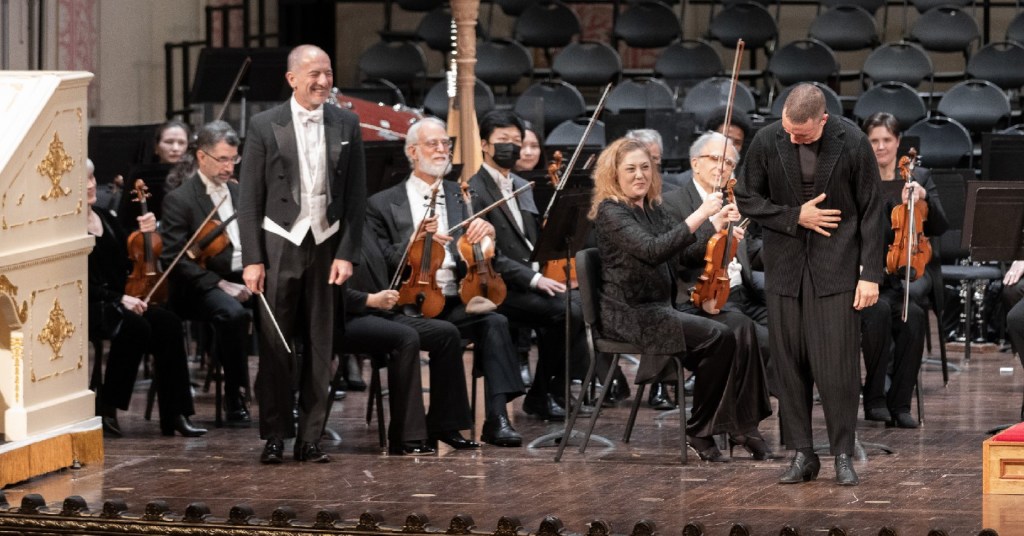
Rossen Milanov, Cameron Carptener, and the Columbus Symphony, photo credit Corinne Mares

Composed 1934-38, Poulenc’s Organ Concerto is a product of the composer’s characteristic neoclassicism, but of a darker, more serious orientation than that employed in his earlier keyboard concertos – namely, the Concert champêtre and the Concerto for Two Pianos, works charming if a bit saccharine. The work is constructed as a single movement, though subdivided into seven discrete sections. It was a special treat to hear the Morton organ, and soloist Cameron Carpenter took masterful command of the instrument. A commanding opening for organ alone invoked the gravitas of Bach, but the lighter section that followed unmistakably bore Poulenc’s neoclassical stamp. A languid Andante moderato, by far the longest section, offered ample contrast.

Carpenter was assertively committed to utilizing the full possibilities of the Morton organ (and spoke in reverence of it during the pre-concert conversation), but one wondered how the piece would have come across differently had a more traditional concert hall organ been available (even in the more serious passages, to my ears the instrument inevitably invoked silent film accompaniment). A dramatic return of the opening material came in the final section before matters were distilled to hymn-like material – suggesting the composer’s reinvigorated interest in Catholicism at the time – and decorated with a delicate passage for solo viola, all a peaceful diversion before the bold closing statement. Carpenter returned with an encore that showed his sterling technique and exploited the instrument’s color and dramatic range.

Janáček’s Glagolitic Mass is a major artistic statement coming from the twilight years of the composer’s life. A setting of the mass in vernacular Czech, it is imposingly scored for large orchestra, organ, chorus, and a quartet of vocal soloists. Cast in eight movements, the first and final are for orchestra alone, the penultimate for organ alone. The opening orchestral introduction was a brassy call to attention, introducing an angular theme in Janáček’s rarefied musical language. In Gospodi pomiluj, the chorus entered as a pious contrast to the bracing orchestra, only to grow in urgency with the addition of soprano Abigail Rethwisch.

Slava was comparatively brighter, with the chorus impressive in negotiating the complexities of both the work itself and of the Czech language. Striking too was the use of organ and the composer’s unique use of the orchestral resources at hand. Jonathan Burton added a lyrical tenor to the extensive Věruju, and an organ interlude anticipated the solo movement to come. Adam Cioffari offered a resonant bass, finely complementing the richness of the chorus. Svet was by turn more pensive, with a touching solo line from concertmaster Joanna Frankel, and all four soloists in concert. That the seventh movement would be scored for organ alone underscored the importance of the instrument to the work; intensely dramatic, it was a further chance for Carpenter to shine, and the orchestra was subsequently given the last word in an ecstatically powerful final statement.

Columbus Symphony opens season in the exuberance of Carmina Burana

Columbus Symphony Orchestra
Rossen Milanov, conductor 

Ashley Fabian, soprano 
Arthur W. Marks, tenor
Ethan Vincent, baritone 

Columbus Symphony Chorus 
Ronald J. Jenkins, chorus director 
Columbus Children’s Choir 
Jeanne Wohlgamuth, artistic director

Ohio Theatre
Columbus, OH
September 30, 2022

Orff: Carmina Burana

There’s only a handful of works from the twentieth century and later that generate an enduring popular appeal, and Orff’s 1937 cantata Carmina Burana is certainly one of them. A choice opener for the Columbus Symphony’s 2022-23 season, it also marked the first full-fledged return of the Chorus post-pandemic, having been relegated to more minor roles in the handful of repertoire last season that called for chorus. Adding to the sense of occasion on opening night was the presence of the League of American Orchestras CEO Simon Woods and Ohio Lt. Governor Jon Husted, introduced by CSO executive director Denise Rehg.

L-R Ronald J. Jenkins, Jeanne Wohlgamuth, Ethan Vincent, Ashley Fabian, Arthur W. Marks, Rossen Milanov with the Columbus Symphony & Chorus and Columbus Children’s Choir, photo credit Corinne Mares

The chorus is certainly the star of Carmina Burana, evident from the onset with the iconic “O Fortuna” that set the dramatic tone sustained for the remainder of the work. Finely prepared by Ronald J. Jenkins in his final season as chorus director, they negotiated no less than three languages – and dead languages at that: Latin, Middle High German, and Old French. The choral scoring more often than not puts the chorus in unison, and a strophic structure dominates, maximizing a directness of expression – this isn’t a work where one gets lost in a web of contrapuntal intricacies. Still, there were times where one wanted better projection over the large orchestra and greater clarity of diction (the texts and translations were fortunately provided in the program books).

It wasn’t all drama and bombast, however, with “Veris leta facies” bringing to life gentler, vernal delights, and the Round Dance sharply contrasting bacchanalia with the more introspective. The Columbus Children’s Choir under the direction of Jeanne Wohlgamuth offered a further choral layer in this lavish tapestry, almost angelic when in dialogue with soprano Ashley Fabian in “Amor volat undique.” Fabian was fittingly clothed in red, evoking the titular red tunic of “Stetit puella rufa tunica,” and served as a fitting foil to her male counterparts. She boasted an impressive command of labyrinthine melismas in “Dulcissime, totam tibi subdo me!”

Tenor Arthur W. Marks appeared offstage (and feathered) in “Olim lacus colueram”, dramatically one of the most striking moments of the work, singing high into his range in a pained dialogue with the masses of the chorus, although I felt the sense of tortured struggle could have been conveyed even more convincingly. I found baritone Ethan Vincent – who last appeared on this stage as Marcello in in La bohème – the most compelling of the trio of soloists. His first appearance in “Omnia Sol temperat” was given with charismatic delivery, and subsequently, he lumbered onstage, pantomiming inebriation in “Estuans interius” – yet ultimately, his delivery bordered on a sumptuousness more fit for Puccini. His command of the wide range demanded in “Dies, nox et omnia”, however, was where he was truly a standout.

Though the chorus rightly deserves the spotlight, the extensive orchestral forces were certainly an entity to be reckoned with. The dance movement for orchestra alone that opens “Uf dem anger” was given a vigorous workout, capped off with a silvery flute solo. “Were diu werlt alle min” was bursting with brassy splendor. The piano (Caroline Hong) features quite prominently in the score, perhaps most strikingly in “Veni, veni, venias.” The occasional uncoordinated entrance notwithstanding, music director Rossen Milanov commanded the disparate forces as a unified whole for a satisfying first entry of the season. As noted in both the program notes and Christopher Purdy’s preconcert lecture, Carmina Burana is in fact the first in a trilogy of related works. Despite the popularity of the first, the latter two remain largely uncharted territory – a potentially fascinating exploration for the CSO to undertake in future seasons.

Milanov and Columbus Symphony make compelling case for Liszt’s Dante Symphony

Columbus Symphony Orchestra
Rossen Milanov, conductor
Brian Mangrum, horn

Women of the Columbus Symphony Chorus
Ronald J. Jenkins, chorus director

Ohio Theatre
Columbus, OH
March 18, 2022

Britten: Four Sea Interludes from Peter Grimes, Op. 33a
Strauss: Horn Concerto No. 1 in E flat major, Op. 11
Liszt: Dante Symphony, S109

Though Franz Liszt is rightly remembered as chiefly a composer for the piano, he produced a vast body of orchestral works – including virtually inventing the tone poem – that should not be overlooked. In some particularly ambitious programming, the Columbus Symphony offered the first local performances of the Dante Symphony, an orchestral portrait of The Divine Comedy. An informative pre-concert conversation between music director Rossen Milanov and Jonathan Combs-Schilling from Ohio State’s Italian department gave thoughtful insight into both the music and its literary inspiration. A visual element was added with Gustave Doré‘s iconic illustrations to accompany the text – produced in 1857, the same year as the symphony – projected along with the music. Though an intriguing idea, the stage lights largely diluted the projections, rendering them more a distraction than an enhancement.

Gustave Doré’s illustration to Dante’s Inferno. Plate VIII: Canto III: The gate of Hell. “Abandon all hope ye who enter here”, photo credit Wikimedia Commons

The first movement Inferno began with an imposing descent to the hell in the low brass – trombones in particular have long been associated with depictions of the underworld, dating back to Monteverdi’s Orfeo. A wound-up tension was purveyed in music that was unrelenting, often overwhelming in ferocity, but Milanov had a thorough grasp of the large-scale form, serving as an incisive guide. Secondary material depicted the doomed love affair of Francesca and Paolo, a languid contrast. A skeletal recitative-like passage in the bass clarinet was quite striking, and Liszt made use of richly chromatic, Wagernian harmonies, sounding at times like a page out of Tristan. Milanov rightly reined in the bombast during the coda, but still yielded a close that was powerfully unforgiving.

The second movement Purgatorio provided some much needed peace after the preceding, with some especially touching scoring for the harp and oboe. This was fittingly music of stasis, held in contemplative limbo, although a triumphant passage and a thorny fugue gave matters both variety and perhaps a glimmer of hope. Liszt had originally envisioned concluding the work with a Paradiso movement, mirroring the source material, but conceded that depicting heaven would be all but impossible. Instead, he provided a lovely Magnificat as something of a pendant to previous movement. It’s a hymn of sorts wherein we manage just a glimpse of the entrance to paradise. It was a magical moment when the women of the Columbus Symphony Chorus appeared practically out of the ether, offering an angelic vision of what lies beyond in the most deeply moving music of the work. The performance was a laudable achievement, and I hope Milanov and the CSO will continue to explore Liszt’s lesser-known orchestral pieces.

The program began with Britten’s Four Sea Interludes from Peter Grimes, a quantity which amazingly hasn’t appeared on a CSO program since 1979. High strings opened with an almost mystical evocation of dawn, though the intonation left something to be desired. “Sunday Morning” saw a brassy awakening, replete with tolling church bells. “Moonlight” was tranquil though not without foreboding as matters took a darker turn in the closing “Storm.”

The ensemble afforded the spotlight to one of its own in Strauss’ Horn Concerto No. 1 in bringing Brian Mangrum front and center, the CSO’s principal horn since 2018. Written when the composer was a precocious 18 year old, the regal E flat major tonality set the stage for a decisive solo entrance, and Mangrum offered a warm, rich tone. A lyrical slow movement saw the horn in dialogue with a rising gesture in the strings, a moment of repose before the jaunty and limber finale.

Rossen Milanov, Brian Mangrum, and the Columbus Symphony. Photo credit Columbus Symphony

A lush La bohème from the Columbus Symphony

Columbus Symphony Orchestra
Rossen Milanov, conductor

S Katy Tucker, video artist
James Marvel, director

Joshua Stewart, Rodolfo
Michelle Johnson, Mimì
Abigail Rethwisch, Musetta
Ethan Vincent, Marcello
Brian Major, Schaunard
Robert Kerr, Colline
Cody Müller, Alcindoro

Columbus Symphony Chorus
Ronald J. Jenkins, chorus director

Ohio Theatre
Columbus, OH
February 4, 2022

Puccini: La bohème

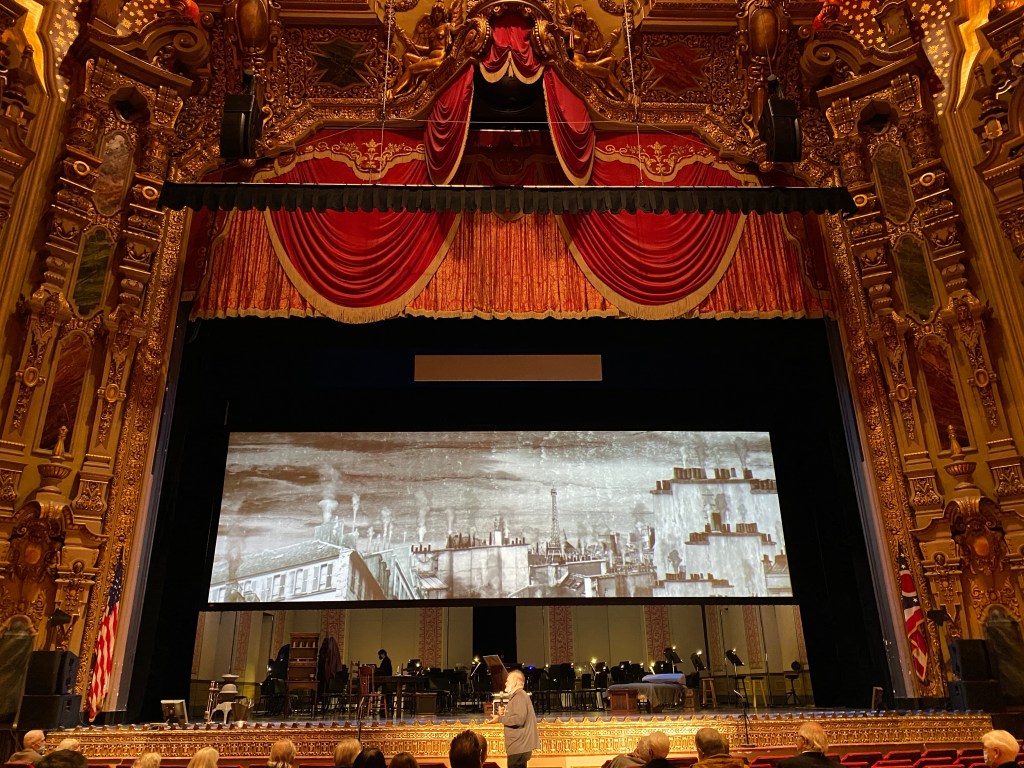
In their most ambitious undertaking so far of the current season, the Columbus Symphony offered a complete staged performance of Puccini’s indelible opera La bohème. The orchestra was perhaps the biggest star of the evening, aided by a compelling cast of singers and chorus, with the narrative brought to life by way of simple yet effective staging further enhanced by video projections, spanning the stage of the Ohio Theatre as a massive canvas.

Ohio Theatre during Christopher Purdy’s pre-concert talk. Note the video projection spanning the stage

La bohème is a compact, fast-paced affair, certainly by operatic standards. Eschewing a full-scale overture, a few bars of orchestral introduction led directly to the opening dialogue wherein we were transported in an instant to a Parisian garret. The four flatmates had a wonderfully conversational chemistry. Michelle Johnson’s Mimì was sweet and pure, but portrayed from the beginning with signs of the tragic character’s illness – an ominous foreshadowing. As Rodolfo, Joshua Stewart’s first moment to shine came in the aria Che gelida manina, sung with great tenderness. Johnson followed with a dulcet but full-bodied Sì, mi chiamano Mimì. A moonlit duet between the two (O soave fanciulla) closed the first act in the loveliest fashion.

Act II took matters to the bustling Latin Quarter, the stage brimming with members of the Columbus Symphony Chorus, excellently prepared by Ronald J. Jenkins. It was interesting to see the chorus members masked – perhaps this was merely Covid protocol, but masked faces in a crowded public setting made this nineteenth-century tableau feel quite topical. Abigail Rethwisch made a terrific Musetta, highlighted by the lilting Quando me’n vo’, her charm a stark foil to the hapless Alcindoro.

Lush harps and projections of falling snow made for an atmospheric opening to Act III, and again rather topical as it quite literally takes place in February (as did the opera’s 1896 premiere). A duet between Mimì and Marcello (Ethan Vincent) was especially touching. The final act returned to the garret where it all began, depicting the cyclical and perhaps inevitable nature of things. A short-lived moment of levity was to be had before the heart-wrenching conclusion, certainly one that packed an emotional punch. Milanov certainly has a gift for opera conducting, and I look forward to any future operatic forays from these forces. A shame the severe winter weather prevented a larger audience!