
Columbus Symphony Orchestra
Rossen Milanov, conductor
Cameron Carpenter, organ
Abigail Rethwisch, soprano
Mariana Karpatova, mezzo-soprano
Jonathan Burton, tenor
Adam Cioffari, bass
Columbus Symphony Chorus
Ronald J. Jenkins, chorus director
Ohio Theatre
Columbus, OH
November 18, 2022
Nielsen: Overture to Maskarade
Poulenc: Organ Concerto in G minor, FP 93
Janáček: Glagolitic Mass
For the final subscription program of the calendar year, the Columbus Symphony served a fascinating program of three compelling yet infrequently heard works – the latter two which made use of the Ohio Theatre’s opulent Morton organ. The overture to Carl Nielsen’s ebullient opera Maskarade was of insouciant charm, with playing lithe and stylish for an energetic curtain-raiser.
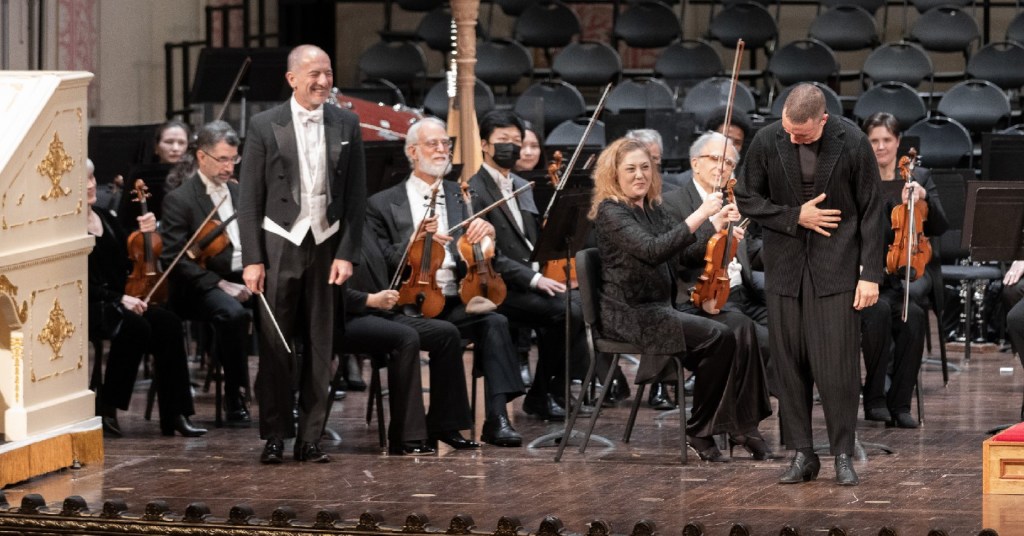
Composed 1934-38, Poulenc’s Organ Concerto is a product of the composer’s characteristic neoclassicism, but of a darker, more serious orientation than that employed in his earlier keyboard concertos – namely, the Concert champêtre and the Concerto for Two Pianos, works charming if a bit saccharine. The work is constructed as a single movement, though subdivided into seven discrete sections. It was a special treat to hear the Morton organ, and soloist Cameron Carpenter took masterful command of the instrument. A commanding opening for organ alone invoked the gravitas of Bach, but the lighter section that followed unmistakably bore Poulenc’s neoclassical stamp. A languid Andante moderato, by far the longest section, offered ample contrast.
Carpenter was assertively committed to utilizing the full possibilities of the Morton organ (and spoke in reverence of it during the pre-concert conversation), but one wondered how the piece would have come across differently had a more traditional concert hall organ been available (even in the more serious passages, to my ears the instrument inevitably invoked silent film accompaniment). A dramatic return of the opening material came in the final section before matters were distilled to hymn-like material – suggesting the composer’s reinvigorated interest in Catholicism at the time – and decorated with a delicate passage for solo viola, all a peaceful diversion before the bold closing statement. Carpenter returned with an encore that showed his sterling technique and exploited the instrument’s color and dramatic range.
Janáček’s Glagolitic Mass is a major artistic statement coming from the twilight years of the composer’s life. A setting of the mass in vernacular Czech, it is imposingly scored for large orchestra, organ, chorus, and a quartet of vocal soloists. Cast in eight movements, the first and final are for orchestra alone, the penultimate for organ alone. The opening orchestral introduction was a brassy call to attention, introducing an angular theme in Janáček’s rarefied musical language. In Gospodi pomiluj, the chorus entered as a pious contrast to the bracing orchestra, only to grow in urgency with the addition of soprano Abigail Rethwisch.
Slava was comparatively brighter, with the chorus impressive in negotiating the complexities of both the work itself and of the Czech language. Striking too was the use of organ and the composer’s unique use of the orchestral resources at hand. Jonathan Burton added a lyrical tenor to the extensive Věruju, and an organ interlude anticipated the solo movement to come. Adam Cioffari offered a resonant bass, finely complementing the richness of the chorus. Svet was by turn more pensive, with a touching solo line from concertmaster Joanna Frankel, and all four soloists in concert. That the seventh movement would be scored for organ alone underscored the importance of the instrument to the work; intensely dramatic, it was a further chance for Carpenter to shine, and the orchestra was subsequently given the last word in an ecstatically powerful final statement.
 quasi-faust