Kronos Quartet celebrates contemporary music at Carnegie Hall

Kronos Quartet
Zankel Hall
Carnegie Hall
New York, NY
January 25, 2020

Gordon: Clouded Yellow
Glass: Quartet Satz
Mazzoli: Enthusiasm Strategies
Mochizuki: Boids
Riley: “The Electron Cyclotron Frequency Parlour” and “One Earth, One People, One Love” from Sun Rings
Dessner: Le Bois
Reich: Different Trains

Encore:
Man: “Silk and Bamboo” from Two Chinese Paintings

The Kronos Quartet’s sold out Saturday night performance at Carnegie’s Zankel Hall was an enthusiastic celebration of music by living, thriving composers, three of whom were present in the audience: Michael Gordon, Missy Mazzoli, and Philip Glass. About half the selections performed were products of Kronos’ ambitious and ingenious initiative Fifty for the Future, wherein 50 new works – 25 by men, 25 by women – are being commissioned over a five year period, with the score along with a recording by Kronos available for free online. A remarkable way to disseminate new repertoire for the venerable string quartet, and one had that project to thank for the works heard on Saturday by Glass, Mazzoli, Mochizuki, and Dessner.
1_small3-600x0
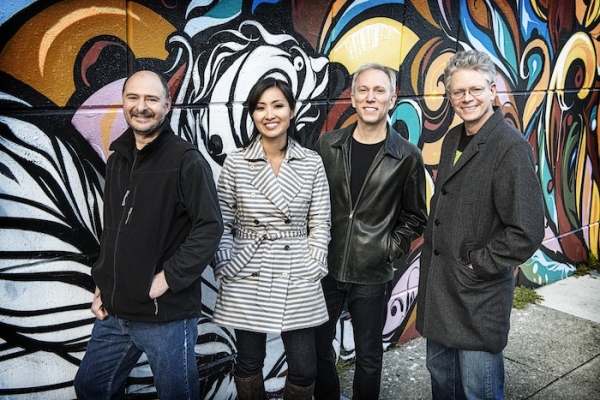
Kronos Quartet (not pictured, cellist Paul Wiancko), photo credit Jay Blakesberg

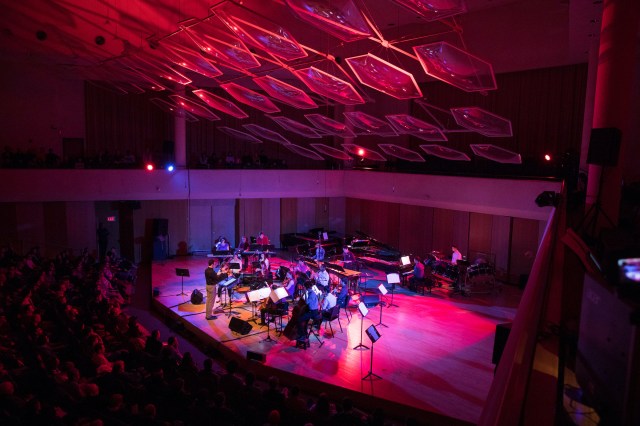
The quartet performed against a backdrop of lighting effects, adding a visual dimension to the already rich aural soundscape. Michael Gordon’s Clouded Yellow opened the evening, evoking its namesake species of butterfly with a striking harmonic palette, mutating over a cello ostinato – one of many fine contributions from cellist Paul Wiancko, substituting for Sunny Yang while she is on maternity leave. A more rhythmically driven section offered a propulsive drive, with matters eventually dissipating to mesmerizing effect. Glass’ Quartet Satz showed the composer at his most lyrical, glacially paced but not without quintessentially Glassian modulations. The New York premiere of Mazzoli’s Enthusiasm Strategies followed, an expression of joy marked by ethereal textures in the strings’ upper registers. Misato Mochizuki’s Boids refers to the flocking behavior of fish, as such, the music was filled with sudden, sharp turns, depicting the entropy found in nature.

A pair of movements from Terry Riley’s extensive suite Sun Rings rounded off the first half. With the NASA Art Program one of the work’s commissioners, Riley drew upon a literal music of the spheres, weaving in recordings of solar winds and other phenomenon: in “The Electron Cyclotron Frequency Parlour”, acoustic textures danced with cosmic electronica. In his informative commentary between selections, first violinist David Harrington noted that the concluding “One Earth, One People, One Love” has become something of an anthem for Kronos. 9/11 fell during the genesis of Sun Rings, forcing the work to take a different direction in the wake of new reality. Riley employed a recording of Alice Walker speaking the eponymous mantra, and projections of the Earth from space put the events on the surface in the context of a vast cosmos. An extended passage for solo cello was particularly moving.

Two larger works filled the second half, beginning with the world premiere of Bryce Dessner’s Le Bois. Drawing on a work by Pérotin and inspired by the modern day destruction by fire of the Notre Dame Cathedral, it began with a monastic drone, which upon taking a myriad of guises, pointed towards a contemplative ending. While I look forward to hearing more from Dessner, this work ultimately didn’t make the strongest impression. Closing the printed program was Reich’s iconic Different Trains, written expressly for Kronos in 1988. Harrington noted this marked turning point for them in which the quartet effectively became a quintet given the newfound need for a full-time sound engineer. Vigorous material opened, brimming with American idealism and optimism as encapsulated by the transcontinental railroad, only for matters to be starkly contrasted by depiction of the trains on the other side of the Atlantic that contemporaneously transported victims to the concentration camps. A definitive performance of this masterpiece.

By way of an encore, the quartet offered Wu Man’s “Silk and Bamboo”, another product of Fifty for the Future. The piece included a substantial percussion part on Chinese gong and woodblocks, expertly handled by violist Hank Dutt. A topical choice given the coincidence of the Lunar New Year, and a wonderfully festive end to the evening.
img_1777
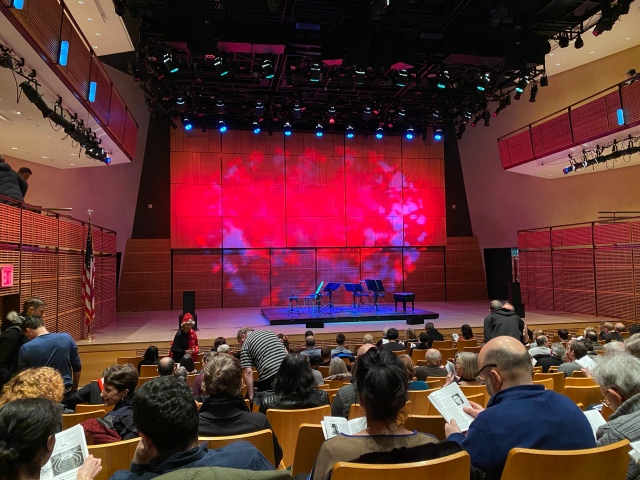
Zankel Hall before the Kronos Quartet’s performance

A Steve Reich celebration at Northwestern

Northwestern University Contemporary Music Ensemble
Northwestern University Percussion Ensemble
Alan Pierson, conductor
Pick-Staiger Concert Hall
Evanston, IL
February 9, 2017

Reich: Clapping Music
Reich: City Life
Reich: Music for 18 Musicians

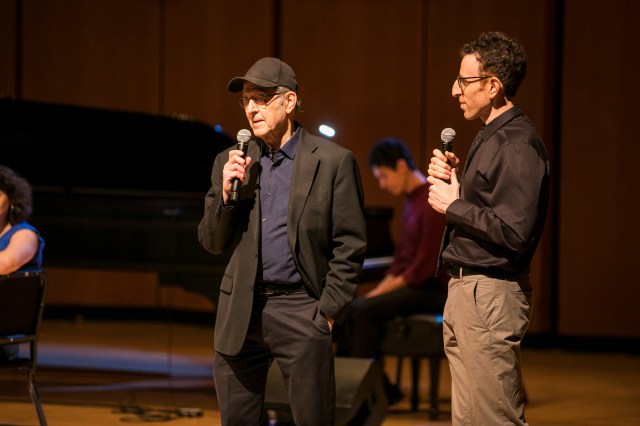
As winner of the 2016 Nemmers Prize in Music Composition, Steve Reich is undertaking a pair of residencies at Northwestern University, the first of which culminated in a performance by the university’s Contemporary Music Ensemble and Percussion Ensemble.  Much attention has been given to Reich in recent months, coinciding with his 80th birthday last October (incidentally, a threshold which minimalist compatriot Philip Glass crossed just a couple weeks ago, acknowledged locally by the Bruckner Orchester Linz).  Three of Reich’s most representative works were programmed, expertly performed by student ensembles, and an engaging onstage Q&A between Reich and conductor Alan Pierson served as an intermezzo before the final selection.

NWM170209_153.jpg
Steve Reich and Alan Pierson, photo credit Todd Rosenberg

The evening began with Reich’s iconic Clapping Music.  Dating from 1971, it was the product of the composer’s aspiration to write music that solely relied on the human body as an instrument.  Ten pairs of performers were onstage, with one clapping a fixed pattern and the other navigating the intricate rhythmic shifts, eventually coming full circle to conclude in unison.  Pierson gestured with his head to punctuate each new segment which ensured all 20 performers remained together, and he was paired with Reich himself – in an age when composition and performance have become increasingly separate disciplines, it was a rare treat indeed to see a composer perform their own work.

The first half was rounded off with the most recent work on the program, City Life (1995), a bustling and not altogether charitable portrait of New York City.  The scoring included two sampling pianos, loaded with an arsenal of prerecorded sounds as a veritable digital incarnation of the prepared piano.  Seamlessly woven into the fabric of the work, the sound samples used functioned as instruments in of themselves.  Ambient mood lighting illuminated the stage, changing color to mark each of the five movements, and added an additional visual dimension to the performance.

It opened with earthy harmonies, almost reminiscent of Copland, before shifting to Reich’s more familiar textures.  The second and fourth movements were the only ones to eschew speech samples and were dark and often tragic in character.  In the central “It’s been a honeymoon – can’t take no mo’”, frenetically repeated figures were marked by rhythmic precision and a detailed use of phasing.  The concluding “Heavy smoke” was the most arresting, with the stage ominously shrouded in a deep red.  The sirens from the opening movement returned, which Reich indicated were an artifact of the World Trade Center bombing of 1993.  Matters ended seemingly peacefully with the stage now a softer blue, but this was an apotheosis of questionable authenticity.

The Music of Steve Reich
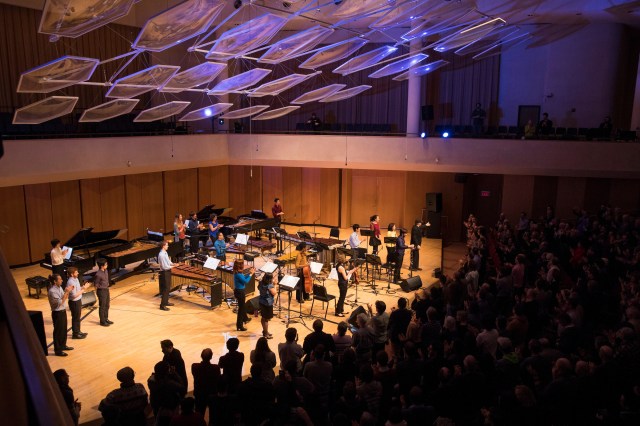
City Life, photo credit Todd Rosenberg

The monumental Music for 18 Musicians was the evening’s highlight, and was preceded by a brief discussion with Reich – a fascinating look into the mind of the composer himself (a very short clip can be viewed here).  Reich touched on his ambivalent relationship with New York City that informed the contents of the previous work, described the medium of Music for 18 Musicians as a “large chamber ensemble” (i.e. not requiring a conductor), and spoke with admiration of the Northwestern student performers.

Conductor-less indeed, the final work took its cue from Balinese gamelan and others where the musicians themselves serve as conductor from within the ensemble, obviating the need for a separate entity.  Here, the metallophone functioned as a de facto conductor, cueing the start of each section.  Spanning the continuum of nearly an hour, it’s difficult to describe the sheer aural impact of the work, one that should surely be on the bucket list of every concertgoer.  Throughout the duration, the effect was singularly mesmerizing, often reaching ecstatic heights.  I was particularly struck by the ethereal voices of the four singers, incidentally, the only performers to be amplified.  The cohesiveness and stamina the titular 18 musicians exuded was a sight to behold, sustained through the otherworldly final moments wherein matters were distilled to the solo violin.

Reich’s next residency and associated concerts will take place in November 2017 – much to look forward to indeed.

NWM170209_370.jpg
After Music for 18 Musicians (Steve Reich on stage at far right), photo credit Todd Rosenberg