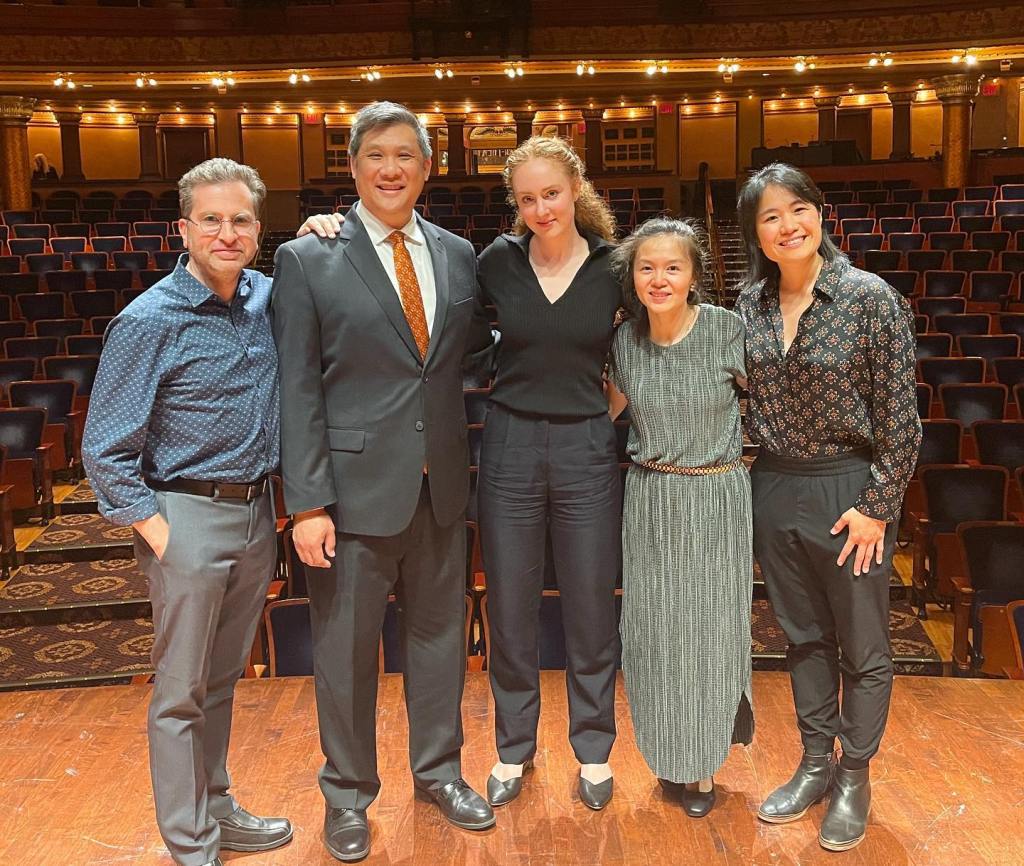
Ólafsson and Wang dazzle in spectacular two piano recital

Yuja Wang, piano
Víkingur Ólafsson, piano
Mandel Concert Hall
Severance Music Center
Cleveland, OH
February 23, 2025

Berio: Wasserklavier (No. 3 from Six Encores)
Schubert: Fantasie in F minor, D940
Cage: Experiences No. 1
Nancarrow: Study No. 6 (arr. Adès)
Adams: Hallelujah Junction
Pärt: Hymn to a Great City
Rachmaninoff: Symphonic Dances, Op. 45

Encores:
Brahms: Waltz in A-flat major, Op. 39 No. 15
Dvořák: Slavonic Dance in E minor, Op. 72 No. 2
Brahms: Hungarian Dance No. 1 in G minor
Brahms: Waltz in E major, Op. 39 No. 2
Brahms: Waltz in G-sharp major, Op. 39 No. 3

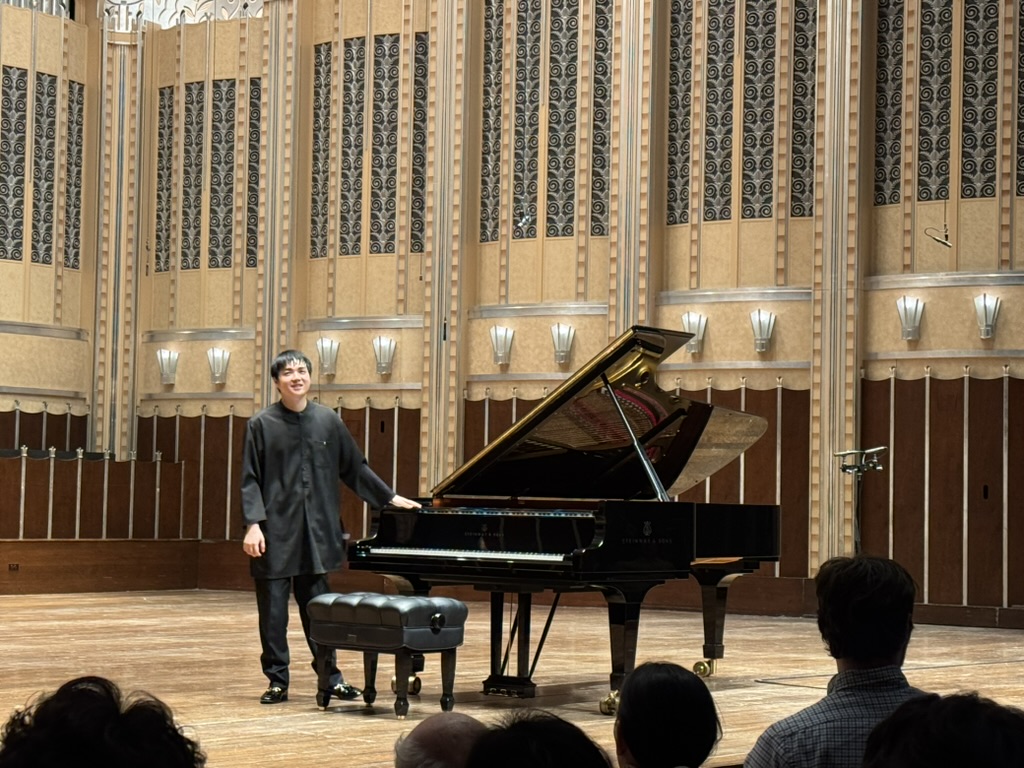
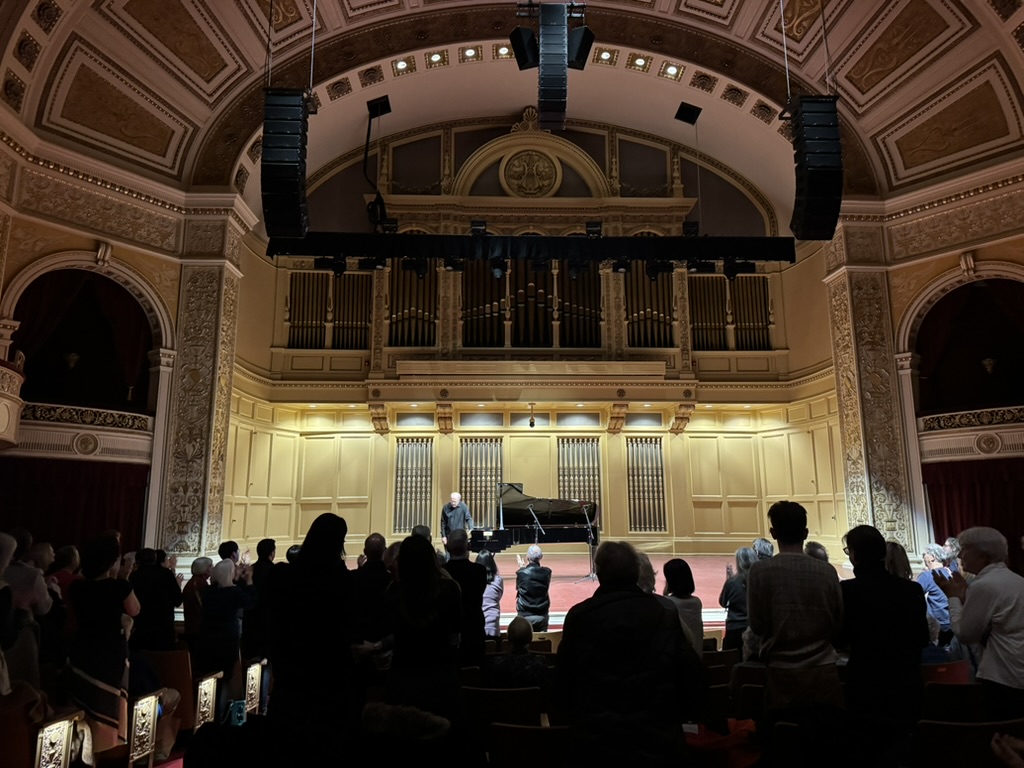
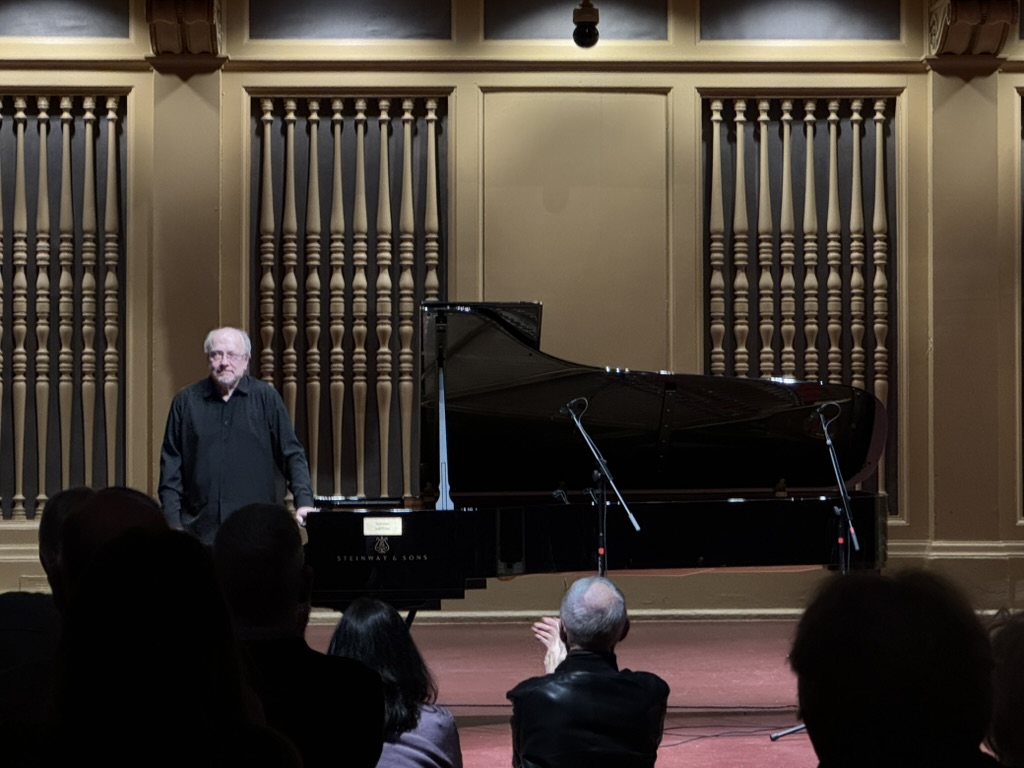
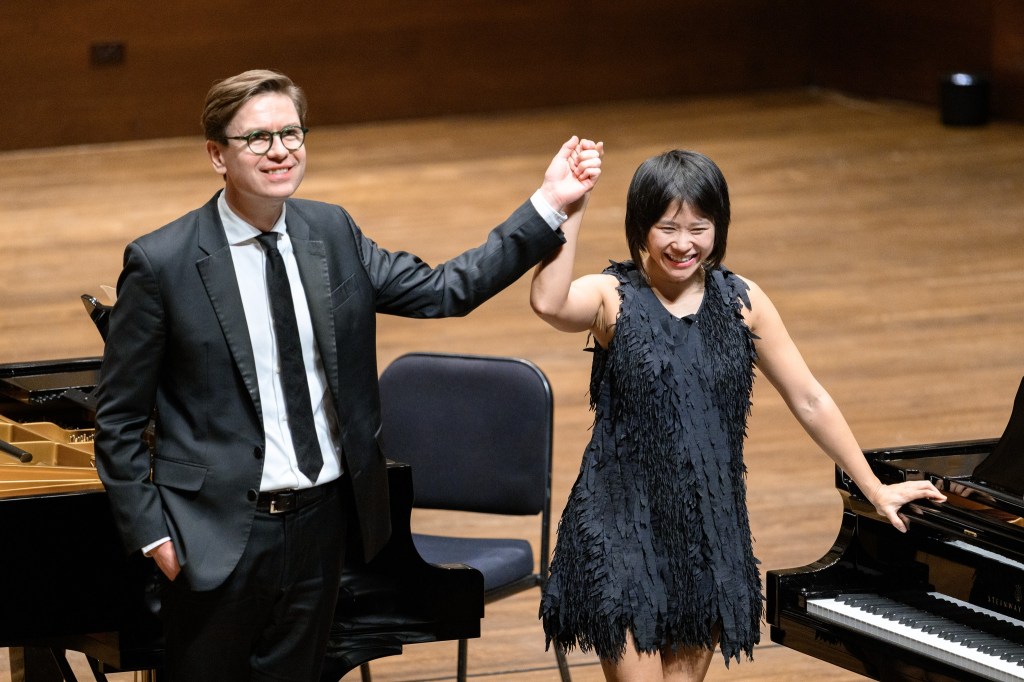
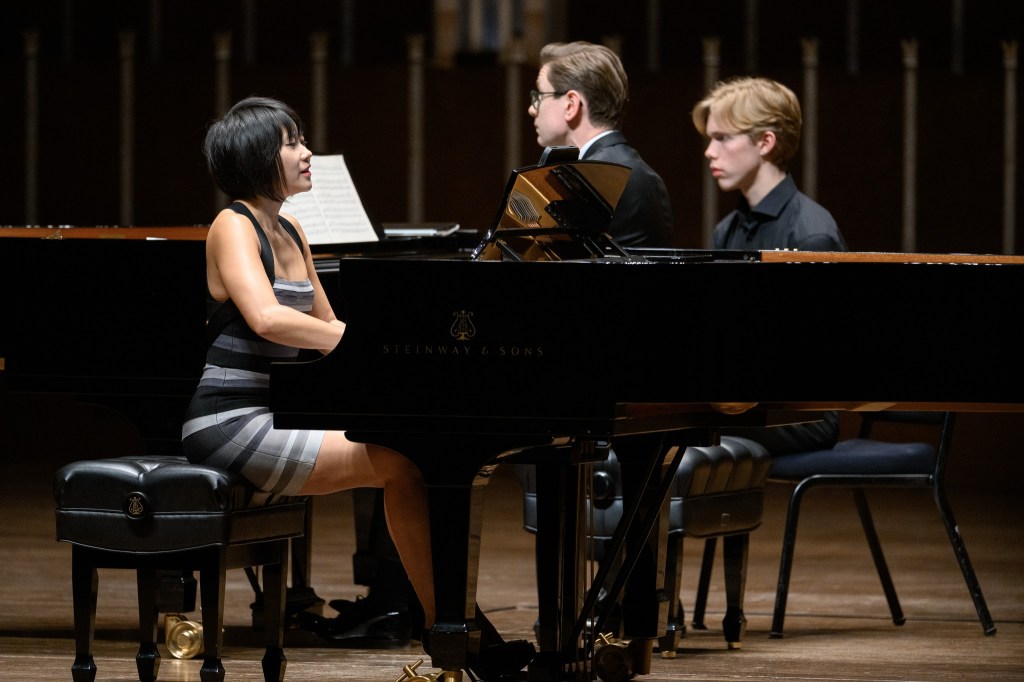
Sunday afternoon marked a remarkable high point in The Cleveland Orchestra’s immensely rewarding recital series, with pianists Yuja Wang and Víkingur Ólafsson joining forces in a stop at Severance Hall on a brief US tour. Both superstar soloists in their own right, it was truly electrifying seeing these two band together. Yet this was more than just a celebrity pairing calculated to maximize box office receipts: their artistic temperaments complemented each other well, showing the whole can be greater than the sum of its parts.

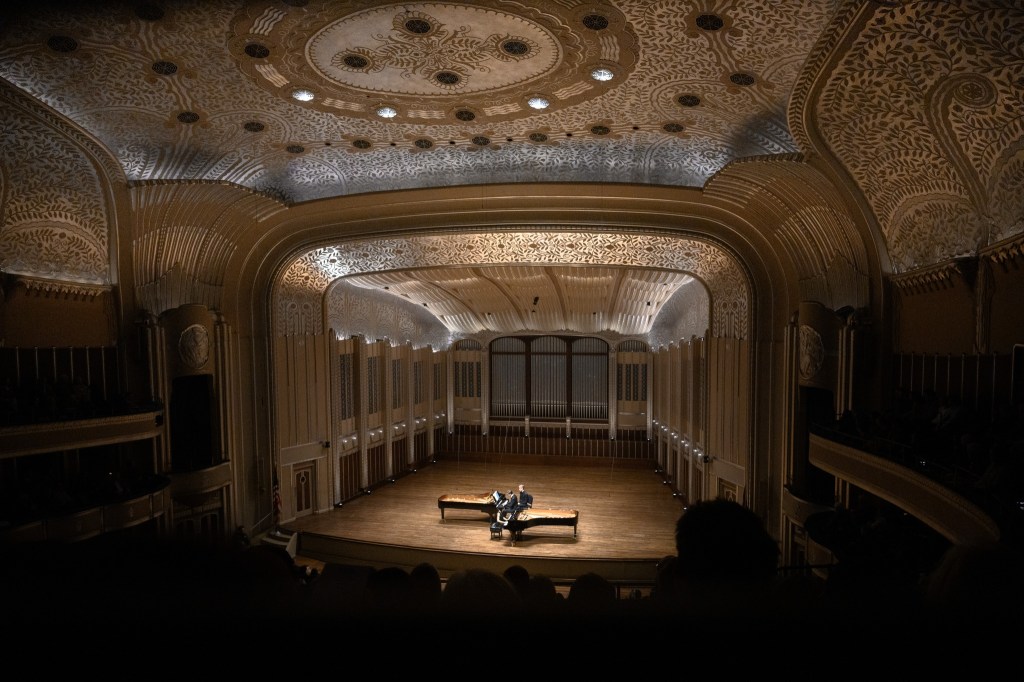
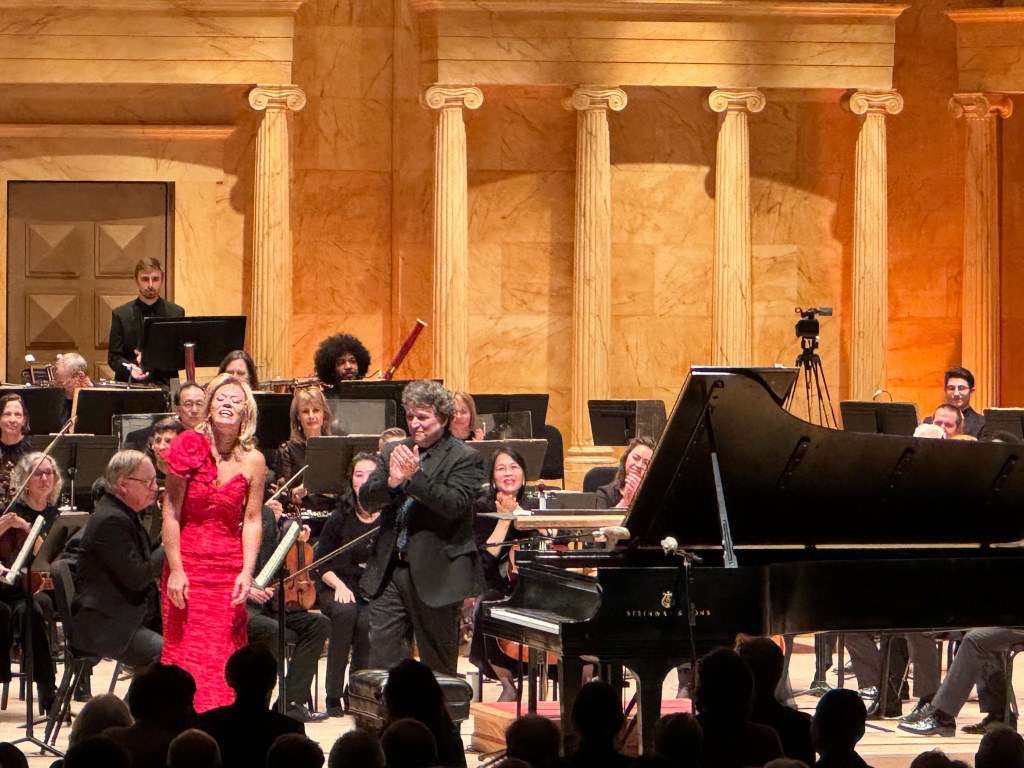
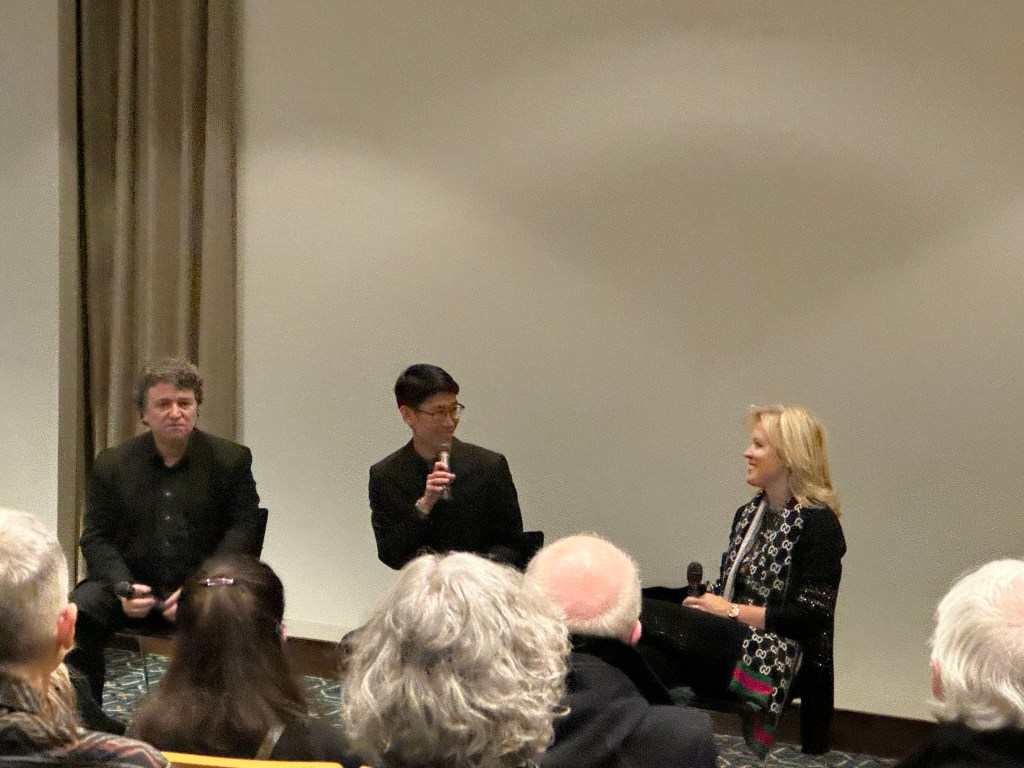
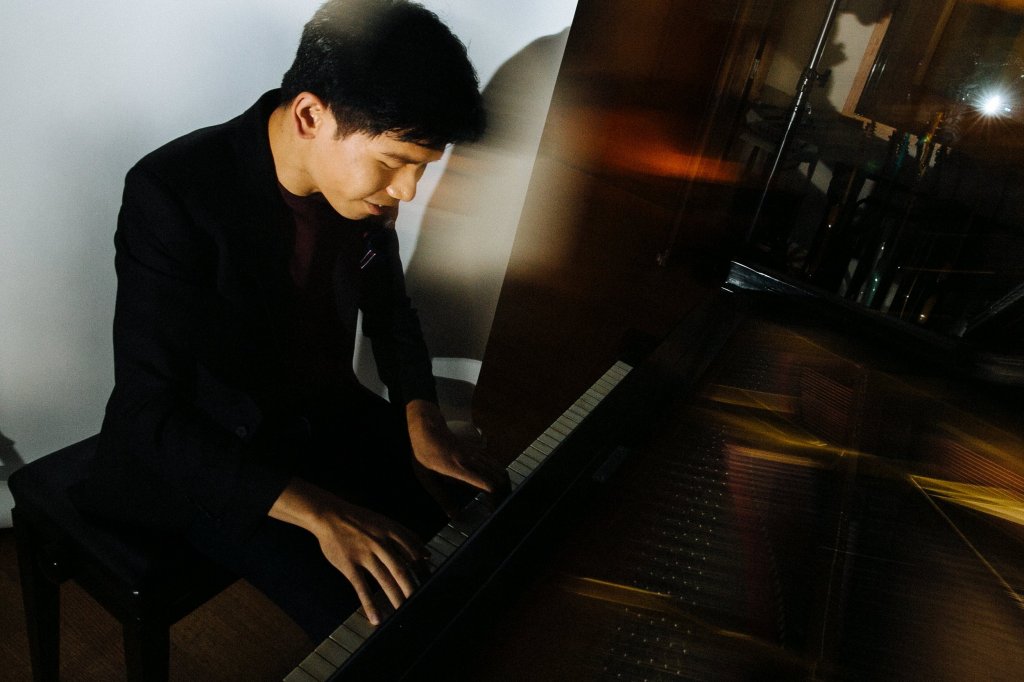
Víkingur Ólafsson and Yuja Wang at Severance Hall, photos credit Human Artist Photography + Cinema 

The program was ripe with discovery, skirting some of the more commonly played fare for two pianos. Luciano Berio’s Wasserklavier began, a meditative opening with liquescent textures freely flowing. The piece made subtle nods to Brahms and Schubert, and fittingly, the pianists artfully segued directly into the latter’s own Fantasie in F minor. Usually played four hands on a single piano, hearing it spread across two instruments gave the work a greater resonance and depth of sound.

Crisply articulated dotted rhythms began, plunging into penetrating drama — rarely will one hear Schubert played with such intensity. Dance-like sections contrasted, exuding joy with the twenty fingers at work, intricately choreographed. A fascinating selection of works from the late 20th-century followed, beginning with John Cage’s Experiences No. 1. The composer’s characteristic minimalist textures were piquantly harmonized, punctuated by silence.

The sixth of Conlon Nancarrow’s 49 studies for player piano followed, made humanly playable in its two-piano arrangement by Thomas Adès (who local concertgoers had the chance to see conduct a remarkable Cleveland Orchestra program just the night before). In this case, the two pianos seemed to be at odds with one another, yet the jagged rhythms fit together in interlocking fashion.

The first half closed with John Adams’ Hallelujah Junction, to my mind, the highlight of the program. Pulsating energy filled Severance Hall with pianistic brilliance. Music of almost perpetual motion — quite a contrast to the minimalism of Cage — gave a larger-than-life portrayal of the namesake town on the California-Nevada border, and demonstrated in no uncertain terms the electric chemistry between these two pianists. The more lyrical pulses of a downtempo section captivated in their rhythmic intricacies, only to build back up to a dazzling density of sound.

Arvo Pärt’s Hymn to a Great City was marked by Wang’s playing in the upper register that rang with the purity of bells, and some delicate filigree that decorated the otherwise barren textures. Rachmaninoff’s Symphonic Dances — his final work — closed the printed program. Hammering out the main theme with pile-driving intensity, an almost manic energy between the two created a rich orchestral sonority. Yet matters were still clear and articulate, with a contrasting theme of haunting lyrical beauty. Sultry waltz rhythms in the central dance were given with stylish playing, and the finale was bold and grandiose, with broad gestures cascading spectacularly.

No less than five encores followed, a delightful selection of dances by Brahms and Dvořák, performed on a single piano, four hands. A charming, convivial close to a memorable afternoon.

Tommy Mesa and Michelle Cann warm a cold evening with colorful recital

Tommy Mesa, cello
Michelle Cann, piano
PNC Theatre
Pittsburgh Playhouse
Pittsburgh, PA
January 20, 2025

Nadia Boulanger: Three Pieces for Cello and Piano
Debussy: Cello Sonata in D minor, L135
Kevin Day: Sonata for Cello and Piano
Casarrubios: Mensajes del agua
Shostakovich: Cello Sonata in D minor, Op. 40

Encore:
Rachmaninoff: Andante from Cello Sonata in G minor, Op. 19

If one longed for an escape from the presidential inauguration and the bitter cold temperatures, Chamber Music Pittsburgh offered a perfect solution the night of January 20 by way of a cello and piano recital. Cuban-American cellist Tommy Mesa was joined by Michelle Cann, and the duo offered a wide-ranging, diverse program, ripe with musical discovery.

Michelle Cann and Tommy Mesa at the PNC Theater, photo credit Chamber Music Pittsburgh

Better known as a pedagogue of enormous influence, Nadia Boulanger was also an accomplished composer in her own right (as was her far too short-lived sister, Lili). The first of her Three Pieces for Cello and Piano boasted an expressive cello melody, underpinned by rippling gestures in the piano’s upper register. The middle piece served as a gentle interlude before the fiery close which saw extrovert playing from both parties to round off these finely crafted gems.

Near the end of his life, Debussy embarked on a set of six sonatas for various instrumental combinations. Sadly, only three were completed, the first being a brief but impactful cello sonata. Introductory material in the piano evidenced a unique soundscape, even for Debussy. Rich tone in the cello and dramatic playing in the piano made for a captivating effect, and yielded a language markedly different from the German tradition (this sonata is worlds apart from the Brahms cello sonatas, for instance). The central Sérénade showed Debussy as the master of effect, with ample use of pizzicato, glissando, and most strikingly, flautando – bowing in such a way as to create a flute-like sound. An interlude that brought to mind the charm of Children’s Corner, ahead of a playful finale that brimmed with Gallic elegance.

A 2016 cello sonata from West Virginia composer Kevin Day closed the first half. Though Day’s first work for the medium, its skillful writing grabbed one in from the beginning with its piquant harmonies and energetic syncopations. The central Lento was especially lovely with a long melody high in the cello’s range, with the piano gently pulsing. The sonata reached a satisfying close with a vigorous, driving finale. Mesa and Cann included this work on their warmly recommended album Our Stories, featuring works by Black and Latinx composers.

Andrea Casarrubios is another composer included on the album, represented in the present program by her work Mensajes del agua (“Messages from water”). Meant to depict the perfection of frozen water, it was meditative in its glacial stillness, and though textures were sparse, it purveyed a deep lyricism. Nikolai Kapustin’s Elegy was originally slotted on the program but jettisoned Monday evening, for which Mesa offered apologies to the Kapustin fans in the audience — a population to which I emphatically identify!

Any disappointment was easily allayed by the masterful performance of Shostakovich’s great cello sonata which closed. The first movement saw pointed articulation and a directness of expression, with Mesa’s burnished tone well-suited to the work. Despite its seeming simplicity, subtleties beneath the surface abounded for both instruments, with Shostakovich ever the subversive. A Largo section was marked by ominous pizzicato figures.

The brief Allegro second movement was perhaps the most remarkable, filled with colorful, sardonic writing. There was somber tragedy in the slow movement, with the cello nearly matching the human voice, and Mesa’s ample vibrato yielded a pained lyricism. A finale was in equal parts playful and gritty, drawing comparison to the composer’s First Piano Concerto from the previous year.

As an encore, the duo offered the slow movement from another great Russian cello sonata: Rachmaninoff’s G minor work. A sumptuously gorgeous close to the evening.

Columbus Symphony offers invigorating survey of 20th- and 21st-century works with Natasha Paremski

Columbus Symphony Orchestra
Rossen Milanov, conductor 
Natasha Paremski, piano
Ohio Theatre
Columbus, OH
May 3, 2024

Lutosławski: Symphony No. 1
Rachmaninoff: Rhapsody on a Theme of Paganini, Op. 43
Clyne: This Moment
Strauss: Suite from Der Rosenkavalier, Op. 59

Last weekend’s Columbus Symphony program was of particularly inspired and enterprising programming, traversing three works from various points of the 20th-century, and a fourth work composed just last year. Witold Lutosławski was at the vanguard of midcentury modernism, and like Shostakovich and Prokofiev, saw his works heavily repressed by the communist authorities. Such was certainly the case for his First Symphony, composed 1941-47 – during and in the immediate aftermath of WWII – which was suppressed for a decade after its first performance.

Natasha Paremski, Rossen Milanov, and the Columbus Symphony

It’s a landmark work, to be sure, brimming with the composer’s individual voice but readily accessible, and kudos to Milanov for giving the first Columbus hearing. In his spoken introduction, the conductor reminisced about meeting Lutosławski while a student in Pittsburgh. Cataclysmic beginnings were to be had in the work, uncompromisingly expressing the bleak spirit of the times – much to the chagrin of the Soviet apparatchiks. The brass provided a certain sheen of brightness, and piano and harp further added to the colorful scoring.

An extended slow movement saw low strings underpinning a horn solo, giving some semblance of peace after the cacophony of the preceding, but not without a certain unease with its pained lyricism. A flowing solo passage from concertmaster Joanna Frankel ranged from the subdued to the impassioned. The Allegretto misterioso was eerie and mysterious, and its fleeting quality reminded me of the Schattenhaft from Mahler’s Seventh. A shimmering interlude near the movement’s close was quite striking before the finale returned to the vigor of the opening. Hats off to the CSO for a blistering performance of a complex score.

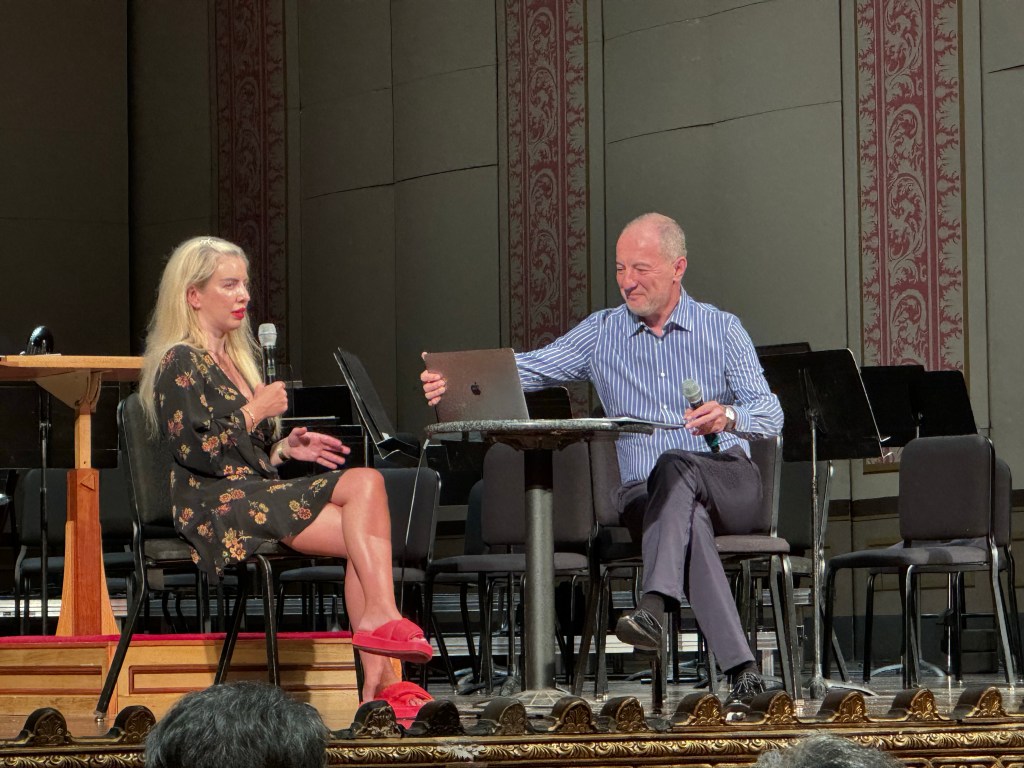
Rachmaninoff’s Rhapsody on a Theme of Paganini was certainly more familiar territory, and brought forth Natasha Paremski as soloist. Paremski was further on hand for a preconcert interview with Milanov (as a sidebar: could Milanov please let his guests speak uninterrupted?). Matters began with a thundering articulation of the skeleton of the ubiquitous theme, and Paremski took things at a rapid, unsentimental tempo, supported by her impressive fingerwork. Variation 7 introduced the Dies irae theme in a meditative manner before building to crashing double octaves. Variation 18 was suitably sumptuous while skirting the saccharine, and Paremski had no shortage of pianistic fireworks in the final variations before the flippant closing gesture.

Anna Clyne’s This Moment came about on commission from the League of American Orchestras, as part of an initiative to proliferate music by women composers. The title alludes to a quote from Buddhist monk Thich Nhat Hanh: “this moment is full of wonders.” The work further invokes quotes from the Kyrie and Lacrimosa of Mozart’s Requiem, which Milanov helpfully had orchestra members demonstrate (and in the present context, perhaps also offered a thematic connection to the Dies irae from the Rachmaninoff). Meditative stillness seemingly stretched the moment, building to more strident material. It’s an appealing piece, but ultimately its six-minute duration didn’t make the strongest impression as a standalone work.

A suite from Strauss’ opera Der Rosenkavalier closed the evening. From bar one, the Ohio Theatre was enveloped in its lush, honeyed, excess. I was struck by the richness of the strings, as well as fine playing from the winds with a standout oboe solo. The Ochs-Waltzes were elegant, stylish, and echt-Viennese, and the suite crested to searing passion.

Preconcert interview with Paremski and Milanov

A devilish afternoon at the Pittsburgh Symphony

Pittsburgh Symphony Orchestra
Manfred Honeck, conductor
Leif Ove Andsnes, piano

Women of the Mendelssohn Choir of Pittsburgh
Daniel Singer, director

Heinz Hall
Pittsburgh, PA
April 21, 2024

Rachmaninoff: Piano Concerto No. 3 in D minor, Op. 30
 Encore:
 Chopin: Mazurka in D major, Op. 33 No. 2
Liszt: Dante Symphony, S109

Sunday afternoon’s Pittsburgh Symphony performance began on a somber note, with a moment of silence in memoriam of Sir Andrew Davis, who served as the PSO’s artistic advisor from 2005-07. Music director Manfred Honeck offered a few words and dedicated the performance to Davis’ memory. On a personal note, I have fond memories of seeing Davis often during his two decade stint at Lyric Opera of Chicago, and caught him in robust form as recently as last June with the Minnesota Orchestra.

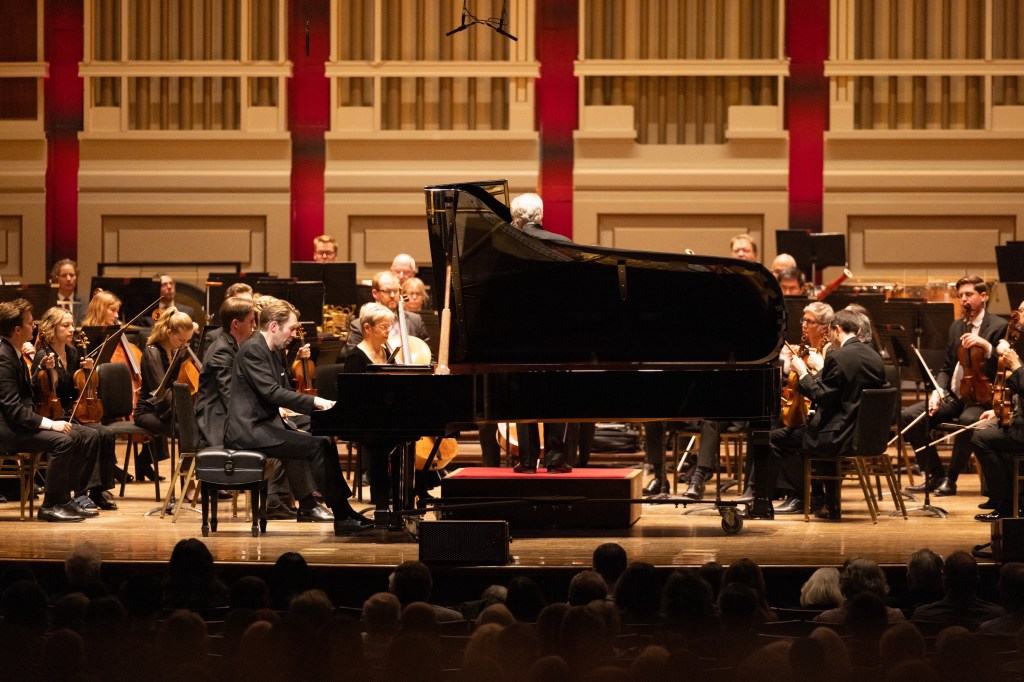
Leif Ove Andsnes with Manfred Honeck and the Pittsburgh Symphony, photos credit George Lange

The first half of the program was devoted to Rachmaninoff’s fiendishly difficult Third Piano Concerto, calling upon Leif Ove Andsnes as soloist. A barren, monastic melody opened, direct and undiluted in its expression before complexities multiplied. Andsnes drew a bold and robust tone, amply projecting through the hall and over the large orchestra. The PSO was a fine partner to the pianist, with some particularly sturdy playing from the brass. Andsnes opted for the larger of the two cadenzas the composer supplied, cresting to a thunderous climax.

The opening of the central intermezzo offered a rare respite for the piano, a strained paragraph for strings and winds to introduce a ravishing melody in the piano, increasingly impassioned. The finale proceeded as an electric march, with a grand, sweeping melody at the heart. One was kept at the edge of their seat through the sparkling coda in this bombshell of a performance. Andsnes returned for an encore in Chopin’s D major mazurka (op. 33 no. 2), bringing out the dance’s stylish rhythms and ineffable charm.

Matters went from warhorse to rarity with the latter half seeing a rare outing of Liszt’s Dante Symphony, an extensive work the composer wrote moved by his reading of the Divine Comedy (and a companion of sorts to the better-known Dante Sonata). This weekend marked the belated Pittsburgh premiere of the work, though I’ve had the unexpected fortune of seeing it elsewhere over the last few years – Chicago (2017) and Columbus (2022). Two large movements represent the Inferno and Purgatorio respectively; not feeling music could adequately represent Paradisio, Liszt instead opted to close with a brief Magnificat that employs a female choir.

Low brass opened in an uncompromising descent to hell, with thundering timpani further conjuring the inferno in no uncertain terms. A bit overblown, perhaps, but Honeck and the PSO were strong advocates of the work and offered a compelling interpretation. A lyrical contrast was provided in material that represented Francesca da Rimini, conveyed by the bass clarinet and harp. With a certain inevitability, the movement was brought to a bleak, crashing close – with all hope duly abandoned.

Purgatorio was far more at peace in music that appropriately suggested a sense of stasis. A fine passage for oboe was a highlight, as well as a moving chorale for low brass – here, no longer a menacing force. The closing Magnificat offered a spiritual glimpse of the divine, with the angelic voices of the women of the Mendelssohn Choir coming from backstage. High strings and harp further conveyed the celestial in this closing hymn, a touchingly beautiful statement that Wagner no doubt looked towards when writing the final moments of Parsifal.

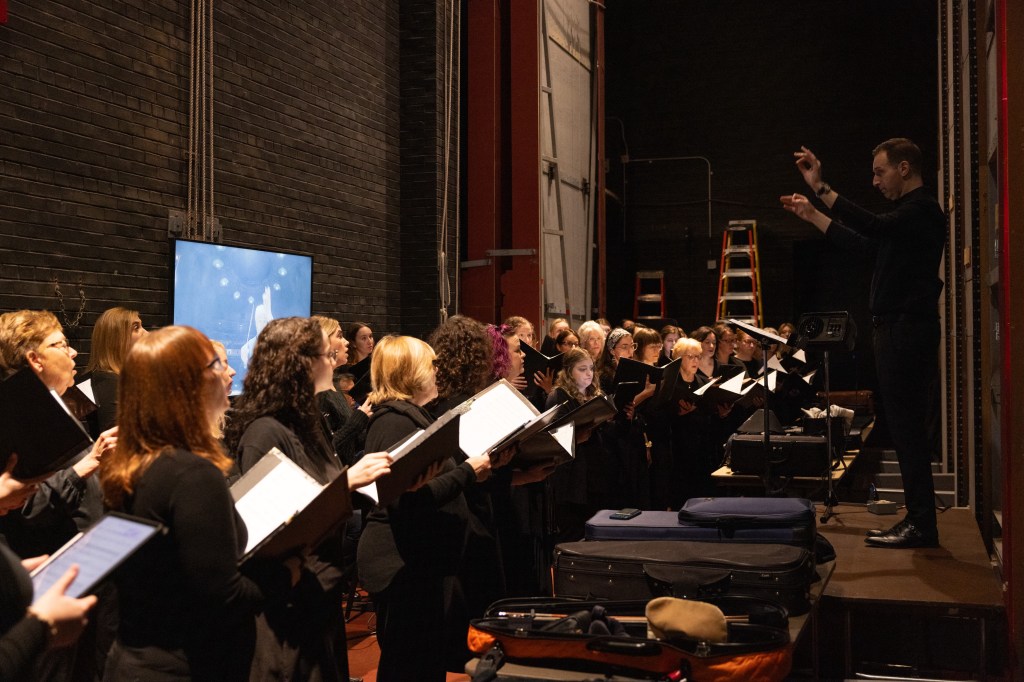
Daniel Singer leads the Women of the Mendelssohn Choir from backstage

Rare Rachmaninoff anchors Columbus Symphony’s decidedly D minor program

Columbus Symphony Orchestra
Rossen Milanov, conductor
Elina Vähälä, violin
Ohio Theatre
Columbus, OH
March 22, 2024

Mozart: Overture to Don Giovanni, K527
Sibelius: Violin Concerto in D minor, Op. 47
Rachmaninoff: Symphony No. 1 in D minor, Op. 13

All three works on last night’s Columbus Symphony program were cast in the stormy key of D minor, a programming choice that seemingly mirrored the gloomy, rainy conditions outside the Ohio Theatre (Beethoven also chose that key for his Tempest sonata). The overture to Mozart’s great opera Don Giovanni is always an effective and attention-grabbing curtain-raiser. Beginning unequivocally bold and tragic, contrasting material was given briskly and with crisp articulation.

Preconcert conversation with Elina Vähälä and Rossen Milanov

Jean Sibelius’s Violin Concerto brought forth soloist Elina Vähälä who shares the composer’s Finnish heritage (though she spent the first part of her childhood in Iowa). Hesitant tremolos in the orchestra opened, with Vähälä’s lyrical, dark-hued solo line taking shape. She delivered with a passion that was fiery yet never showy, not the least in the extended cadenza. A slow movement followed in songful fashion, growing in intensity with a series of searing, rising trills. The foot-tapping rhythmic vitality of the finale left one in good spirits after the Nordic chill of the preceding.

The premiere of Rachmaninoff’s First Symphony is one of music history’s greatest disasters. The most ambitious work to date from the composer then in his early twenties, the first performance of the complex score suffered from inadequate rehearsal time and a purportedly inebriated Alexander Glazunov at the podium. The symphony – despite showing enormous promise – was all but forgotten until after the composer’s death, and Rachmaninoff fell into a deep depression that impeded his ability to write for the next few years. Friday night marked its very belated Columbus premiere, and credit to Milanov and the CSO for shedding light on an unjustly neglected work.

A triplet motif opens all four movements; in the first, it signaled a plunge into darkness. Despite being a youthful work, so many of the hallmarks one associates with Rachmaninoff are already very much apparent: sweeping melodies, colorful orchestrations, folk-inflected themes, and use of the plainchant Dies irae. This is in fact the composer’s first appropriation of Dies irae, a theme that would virtually become his calling card, wandering through so much of his output – and here it was given a particularly scintillating treatment about halfway through the opening movement.

The lilting Allegro animato was a bit gentler, though not immune from the somber Dies irae which acted as a binding agent throughout the work. A Larghetto was a calming interlude, if not quite reaching the heartwrenching heights of the slow movements the composer would become famous for, though an extended clarinet solo seemed to predict that of the Second Symphony. Delicate dialogue between concertmaster Joanna Frankel and principal cello Luis Biava was a further highpoint. A swashbuckling march theme opened the finale, swelling to searing melody in true Rachmaninoff-ian fashion. In the closing moments, the tempo slowed considerably for a coda with gravitas – and at long last, a brief glimpse of D major.

Toledo Symphony offers hearty program of Eastern European concertos

Toledo Symphony Orchestra
Alain Trudel, conductor
Olga Kern, piano
Peristyle Theater
Toledo, OH
January 20, 2024

Lutosławski: Concerto for Orchestra
Rachmaninoff: Piano Concerto No. 2 in C minor, Op. 18

Encore:
Prokofiev: Etude in C minor, Op. 2 No. 4

On a bitter cold and snowy January weekend, the Toledo Symphony Orchestra presented a program that did much to warm and invigorate. Two works were featured, both from the heart of Eastern Europe, and both titled concerto – but of sharply contrasting approach.

Olga Kern, Alain Trudel, and the Toledo Symphony Orchestra

Lutosławski’s Concerto for Orchestra is a landmark of mid-20th century orchestral music – a real shame it doesn’t find its way onto concert programs more often. Music director Alain Trudel keenly guided the opening Intrada as a strident melody took shape over pulsating timpani. Moments of brassy bombast were aplenty, and the scoring further included a substantial part for piano (Valrie Kantorski). As per its title, virtually all instruments were granted a moment in the spotlight, including those such as the English horn that are more often relegated to the background.

The central movement, titled Capriccio notturno ed Arioso, was rather Mendelssohnian in its fleet, rapid textures, drifting away in almost imperceptible evanescence. An end-weighted architecture, the closing movement is longer than the first two combined. The venerable passacaglia form opened, with pizzicato in the double basses outlining a theme which the composer would ingeniously transform. A brilliantly orchestrated conception, textures ranged from a thin thread to the densely cataclysmic. A concerto for orchestra doesn’t necessarily imply equality amongst all instruments, however, and here the brass were certainly the most prominent, especially in the stirring chorale, or the punchy, blazing coda.

Rachmaninoff’s evergreen Piano Concerto No. 2 filled the balance of the program, and brought forth pianist Olga Kern (who mentioned during the preconcert conversation that she came to Toledo on the heels of her performances in Cape Town, South Africa!). The eight opening chords from the soloist tolled like bells, sculpted with a steadily building crescendo. The orchestra responded with Rachmaninoff’s quintessentially rich melodies, decorated by Kern’s flowing accompaniment. At times I found her playing a bit heavy-handed, but she projected well over the orchestra with resonant tone. A blistering march made for an exciting climax to the movement, while a lambent horn call was an especially touching moment.

Kern was perhaps at her finest in the central Adagio sostenuto, in deft conversation with the winds, coaxing a velvety tone out of the mighty Steinway. The finale saw Kern’s pianism playful if fitful, and the movement’s indelible main theme appeared like an old friend, sinuously at first, growing increasingly lyrical to build to the work’s triumphant conclusion. An enthusiastic reception brought Kern back for an encore: a Prokofiev etude taken at such a manic tempo as to close the evening with edge-of-your seat excitement.

Preconcert conversation with Trudel and Kern, moderated by TSO violinist Merwin Siu

A hearty Russian afternoon from Milanov and the Columbus Symphony

Columbus Symphony Orchestra
Rossen Milanov, conductor
Zhu Wang, piano
Ohio Theatre
Columbus, OH
May 7, 2023

Mussorgsky: Dawn on the Moscow River from Khovanshchina
Rachmaninov: Piano Concerto No. 2 in C minor, Op. 18
Tchaikovsky: Symphony No. 5 in E minor, Op. 64

For the penultimate installment of the Masterworks series, Rossen Milanov and the Columbus Symphony turned towards the Russian repertoire in a program anchored by favorites of Rachmaninov and Tchaikovsky. The afternoon began, however, with Mussorgsky’s Dawn on the Moscow River, a quantity which serves as the prelude to his opera Khovanshchina. The CSO opted for its orchestration by Rimsky-Korsakov, though some years later Shostakovich devised an effective version as well. A gentle ebb and flow made for a touchingly restrained musical sunrise – quite a contrast to the sunrises one might find in a Strauss tone poem!

Zhu Wang, photo credit zhuwangpiano.com

Rachmaninov’s evergreen Second Piano Concerto followed with pianist Zhu Wang. Wang’s fluid playing blended well with the orchestra, probing at its lyrical heart. Still, one wanted more dramatic tension, and I found his reading a bit too cool and reserved. The slow movement was sweetly nostalgic and had the pianist in lovely dialogue with the clarinet, though it bordered on the sentimental. Wang gave the finale with vigor and virtuosity, balancing out the more extrovert material with the composer’s quintessentially lush melodies.

Hollow winds opened Tchaikovsky’s Fifth Symphony for a haunting statement of the fate motif that binds the work, and soon surged to great passions. Darkly resonant material began the slow movement with a gorgeous horn solo from Brian Mangrum. Deeply affecting, this movement saw perhaps the most inspired playing of the afternoon. A gently lilting Valse was contrasted with more animated material, and the fate motif returned, pointing inexorably towards the driving finale.

Merz Trio brings Chamber Music Columbus’ 75th season to an impassioned close

Merz Trio
Southern Theatre
Columbus, OH
May 6, 2023

Hu: An Eternal Hope
Rachmaninov: Trio élégiaque No. 1 in G minor
Al-Zand: Lines in Motion
Shostakovich: Piano Trio No. 1 in C minor, Op. 8
Schumann: Piano Trio No. 2 in F major, Op. 80

Encore:
Piaf: La Vie en rose

Chamber Music Columbus’ 75th season has now come to a close, and what a celebration it has been. Seven momentous concerts, each featuring a newly commissioned work, and the season finale from the Merz Trio certainly closed matters on a high note. A particularly lush program, leaning heavily into the Romantic repertoire, it was an evening of energetic and virtuosic performance.

Merz Trio with Karim Al-Zand and Ching-chu Hu, photo credit Merz Trio

Ching-Chu Hu is certainly a familiar presence at the Southern Theatre by now, and the Merz Trio presented the final piece of his season-long fanfare, titled An Eternal Hope. In his spoken remarks, Hu noted the work conveys a hope for growth, beautifully timed with the advent of spring here in early May. A busy piano part made this rather more extrovert than some of the previous installments. It evoked a certain radiance and built to a bold finish. The trio has recently undergone a changing of the guard with a new pianist; one would never have guessed she was new to ensemble given how seamlessly she gelled with her string colleagues.

Rachmaninov’s first Trio élégiaque opened with a soft, undulating gesture in the strings, setting up a distinctly Russian melody in the piano. Though the composer was a mere 18 year old when writing the work, its sumptuous melody and surging passions left little doubt as to who the composer was, with the work fulfilling the promise of its title in leading to a somber, funereal close. Another early work from a major Russian composer followed in a C minor trio from the pen of a 16 year old Shostakovich. Though there were hints of his idiosyncratic wit and sarcasm, it was largely a Romantic work, with meditative beginnings and particularly lovely passage in thirds on the piano.

Sandwiched between the Russian works was Lines in Motion, a commission from Karim Al-Zand, first performed this past January at Chamber Music Houston, where the composer is based. A he discussed in our interview, Al-Zand has a particular affinity for extramusical inspirations. Lines in Motion was no exception, with the composer pointing to selected black and white woodcut illustrations (helpfully reproduced in the program books), corresponding to each of the three movements. As the title suggests, each of prints in question striking use geometric lines to convey a sense of motion on the printed page.

The opening On the Big Sea took inspiration from René Quillivic’s En pleine mar. Roiling piano figurations were answered by calming lines in the strings, and I heard shades of French Impressionism which often used water and the sea as subject material. Angular gestures and bright, brilliant textures dominated In the Big City, capturing the busy skyscraper scene of Frans Masereel’s America. At the Spirit Dance (a nod to Rhythms by Wharton Esherick) was of energetic, driving dance rhythms for a rollicking close. This is a work I certainly look forward to hearing again.

The latter half was devoted to Schumann’s F major piano trio, a work uncharacteristically cheery and optimistic for the often depressive composer. The ensemble purveyed an attractive, singing tone in articulating the bounty of beautiful melody the composer provided. Sophisticated contrapuntal passages provided some textural contrast, delivered with nuanced clarity. The second movement bears the marking Mit innigem Ausdruck (“with innermost expression”), and it was indeed a look inward, lovingly conveyed.

The following movement was marked by a loose suggestion of a waltz figure, while the finale excited in its further use of counterpoint, giving each individual voice of the trio the space to shine. An well-deserved encore was offered, namely, an arrangement of Edith Piaf’s song La Vie en rose, wistful and nostaglic. A memorable close to a memorable season!

Barnatan’s ravishing Rachmaninov closes Columbus Symphony’s Russian festival

Columbus Symphony Orchestra
Rossen Milanov, conductor
Inon Barnatan, piano
Ohio Theatre
Columbus, OH
January 23, 2022

Tchaikovsky: Orchestral Suite No. 3 in G major, Op. 55
Rachmaninov: Piano Concerto No. 3 in D minor, Op. 30

Two weeks after a memorable first entry of the Russian Winter Festival, the Columbus Symphony offered an even more compelling second foray into the repertoire, in this case focusing on Tchaikovsky and Rachmaninov. Despite the seemingly innocuous title, at over forty minutes, Tchaikovsky’s Suite No. 3 is a work very much on the scale of the symphonies. If there are salient differences to be noted, the Suite is rather lighter in character than the often tragic symphonies, and includes scoring for English horn and harp – instruments the composer avoided in the symphonies. The opening Élégie was graceful, delicate, and tinged with melancholy. Tchaikovsky’s arching lyricism was in plain sight, heightened by a languid English horn solo from Robert Royse. The Valse mélancolique that followed was of an ineffable charm, a lilting waltz but with doleful underpinnings, subsequently countered by an energetic yet featherlight scherzo.

Inon Barnatan, photo credit Marco Borggreve

The closing theme and variations is as long as the first three movements combined. Matters were inaugurated by a stately presentation of the theme in the strings, and with charm and delight, Milanov shaped each of the twelve variations that followed with individual character in this first CSO performance of the work. Variation 4 featured a powerful invocation of the Dies irae, and the fugato of the following was given with exacting clarity. Variation 9 closed with a wonderfully virtuosic violin cadenza from associate concertmaster Leonid Polonsky, leading into the deeply melancholic tenth variation. Not only is the suite as a whole end-weighted, but so are the variations themselves with the final few being the most extensive and expressive. A grandiose polonaise concluded the set in bellicose fashion. Following the performance, Milanov offered gratitude and tribute to violist Mary Farrington, stepping down after a remarkable 42 years.

Rachmaninov’s famously virtuosic Piano Concerto No. 3 brought Israeli pianist Inon Barnatan in the spotlight. Haunting, monastic beginnings were taken at an indulgently slow tempo, but vigor was amassed in due course. The sumptuous orchestral accompaniment complemented Barnatan’s virtuosity well, with the pianist conveying a rich tone, amply projected, though perhaps a bit too mild-mannered for such impassioned repertoire. Barnatan opted for the shorter of the two cadenzas Rachmaninov provided, though it still packed a punch, putting his commanding technique on full display – certainly one of the most thrilling moments in the piano concerto literature. Lush textures crested to passionate outpourings in the central movement, and a seamless transition led directly into the energetic march of the finale, building to a blazingly virtuosic conclusion.

2021 Cleveland International Piano Competition: Semi-final round

Gartner Auditorium
Cleveland Museum of Art
Cleveland, OH
July 29 – August 1, 2021

Inevitably postponed last summer due to the pandemic, the Cleveland International Piano Competition has made a remarkable comeback here in 2021, a wonderfully exciting return to in-person performances. An initial pool of over 250 applicants from more than 40 countries was pared down to 26 contestants, all of whom performed in the Competition’s first two rounds. Owing to the travel and health restrictions that still persist, these rounds were conducted virtually, filmed at venues across the world – and available for free viewing on YouTube. Eight outstanding semi-finalists were selected to proceed onsite in Cleveland, a cohort to be further narrowed down to four finalists who will perform a chamber music round with the Escher Quartet and a concerto round with The Cleveland Orchestra under the baton of Jahja Ling.

Compared to the relative brevity of the first two rounds, the semi-finals offer an even more in-depth portrait of each artist, performing a recital of approximately 40 minutes. A few new and welcome additions for this year’s edition: each semi-finalist included in their program a popular song transcription commissioned from composer Alexey Kurbatov. Four selections were available, namely “America” from Bernstein’s West Side Story, Queen’s “Bohemian Rhapsody”, themes from Mission Impossible, and John Williams’ Olympic Fanfare. Regrettably, none of the eight selected the Williams piece, but perhaps a recording can be posted in due course. I also hope publication of these scores is imminent as they undoubtedly can serve as particularly enjoyable encore pieces.

Also for the first time was the inclusion of piano duets – the two performers from each session teamed up following their solo material for either the Fantasie in F minor by Schubert or Mozart’s Sonata for Two Pianos in D major. A lovely addendum that not only tested the contestants’ ability to collaborate with another pianist, but encouraged a spirit of camaraderie. Finally, excellent program notes for every piece performed – from the first round to the finals – were provided by Marissa Glynias Moore, Anna M. O’Connell, and Marco Ladd. Indispensable reading for attendees and a veritable crash course in piano literature. Below are some brief impressions I had of each semi-finalist.

Session 1
July 29, 2021

Ying Li
Mozart: Piano Sonata No. 13 in B-flat Major, K. 333
Grainger: “Ramble on Love” from Der Rosenkavalier
Bartók: Piano Sonata, Sz. 80
Schifrin: Themes from Mission Impossible (arr. Kurbatov)

Honggi Kim
Schifrin: Themes from Mission Impossible (arr. Kurbatov)
Chopin: Twelve Etudes, Op. 25

Schubert: Fantasie in F Minor, D. 940

Ying Li (China) opened the semi-final round with a Mozart sonata, delicate and balanced, exuding the pearly classical style. I found her pacing of the slow movement a bit hard to follow but was quite taken by the sprightly finale. Grainger’s so-called Ramble on Love, paraphrasing themes from Strauss’ Rosenkavalier, gave sumptuous treatment to the source material’s lush and languid melody. Bartók’s Piano Sonata was for me the highlight of her performance, opening with a manic energy – and the live video screens did much to enhance the audience experience, offering close-ups of the intricate hand-crossings.

Honggi Kim (South Korea) opened with the same piece with which Li closed, namely the Kurbatov Mission Impossible transcription. Kim was perhaps a bit more percussive than Li; both displayed how the composer brilliantly interpolated the familiar themes. All contestants are required to present a Chopin etude in the first two rounds – here in the semi-finals, Kim offered all twelve etudes from Op. 25. An ambitious undertaking to be sure, though I found his playing fitfully uneven. No. 2, for instance, would have benefitted from greater clarity, although I did like the way he brought out melodic material in the left hand. In No. 5, one wanted more accentuated contrast between the dissonant sections and the lyrical. The rapid double thirds of No. 6 were quite impressive, however. Op. 25 is certainly an end-weighted set, and perhaps one’s performance should be judged primarily on the final three which concluded on a high note: the rapid octaves of No. 10, a chillingly dramatic “Winter Wind”, and a rather marvelous finish in the intense depths of the “Ocean” etude.

Li and Kim were impressive four-hands partners in the Schubert Fantasie, bringing out contrasts from the brooding to the dancing.

Session 2
July 30, 2021

Jiarui Cheng
Scarlatti: Sonata in B Minor, K. 87
Chopin: Barcarolle in F-sharp Major, Op. 60
Rachmaninov: Variations on a Theme of Corelli, Op. 42
Bernstein: “America” from West Side Story (arr. Kurbatov)

Yedam Kim
Chopin: Polonaise-Fantaisie in A-flat Major, Op. 61
Prokofiev: Sonata No. 4 in C Minor, Op. 29
Mercury: Bohemian Rhapsody (arr. Kurbatov)

Mozart: Sonata for Two Pianos in D Major, K. 448

Jiarui Cheng (China) selected one of the more introspective of the Scarlatti sonatas, emphasizing its lyrical quality. Continuing the thread, he did much to bring out the wistful melancholy in Chopin’s late gem, the Barcarolle. In Rachmaninov’s Corelli Variations, Cheng sculpted an individual character in each variation – an excellent performance. Kurbatov’s transcription of Bernstein’s “America” ended matters on a jovial note.

Yedam Kim (South Korea) opened with a mesmerizing account of Chopin’s Polonaise-Fantaisie – contemporaneous with the previously-heard Barcarolle – the composer’s crowning achievement in the polonaise form. A commanding performance of Prokofiev’s Fourth Sonata followed, with searching, unsettling material leading to a bright and brilliant finale. In the Queen original, “Bohemian Rhapsody” is something of a mini tone poem with its wealth of thematic material and operatic narrative and dramatic flow – qualities very much brought out in Kim’s performance, perhaps the most impressive of the Kurbatov transcriptions.

Session 3
July 31, 2021

Rafael Skorka
Bernstein: “America” from West Side Story (arr. Kurbatov)
Leighton: Fantasia Contrappuntistica, Op. 24 (“Homage to Bach”) (1956)
Brahms: Sieben Fantasien, Op. 116

Martín García García
Schubert: Wanderer-Fantasie in C Major, D. 760
Liszt: “Les cloches de Genève (Nocturne)” from Années de Pèlerinage I, S. 160
Liszt: Étude de Concert, S. 145, No. 2 (“Gnomenreigen”)
Liszt: Transcendental Etude, S. 139, No. 10
Mercury: Bohemian Rhapsody (arr. Kurbatov)

Schubert: Fantasie in F Minor, D. 940

Rafael Skorka (Israel) had confident beginnings with a memorable account of Bernstein’s “America”. The most intriguing discovery during the semi-final round came in the shape of Kenneth Leighton’s Fantasia Contrappuntistica, a 1956 homage to Bach (and to Busoni, given the elder composer’s monumental work of the same title). A virtuosic opening gave way to a pensive chorale and a pair of fugues rounded off the work. Skorka deftly negotiated the contrapuntal intricacies to bring matters to a vigorous close. The pianist continued to make a strong showing in Brahms’ Fantasies, Op. 116, just as convincing in the lyrical selections (nos. 2, 4, and the touching chorale of no. 6) as the more extrovert ones, giving the first piece an energetic workout and reserving the most overt virtuosity for the seventh and final fantasy.

Martín García García (Spain) offered an arresting account of Schubert’s ingenious Wanderer-Fantasie. While his tone at times veered a bit too percussive for my taste, he did much to bring out a wide dynamic and dramatic contrast and a keen sense of the work’s large-scale architecture. An interesting selection of three Liszt pieces followed. Deft use of the pedal did much to bring out the sonorities of the titular bells in Les cloches de Genève while García conveyed much charm in the impish legerdemain of Gnomenreigen. The Transcendental Etude No. 10 was technically impressive, although I found myself longing for even more firepower.

Session 4
August 1, 2021

Byeol Kim
C. Schumann: Notturno in F Major, Op. 6, No. 2
Schumann: Arabeske in C Major, Op. 18
Mendelssohn: Fantasie in F-sharp Minor, Op. 28
Mercury: Bohemian Rhapsody (arr. Kurbatov)
Jalbert: Toccata (2001)
Gottschalk: The Union, Op. 48

Lovre Marušić
Scarlatti: Sonata in E Major, K. 380
Schumann: Kreisleriana, Op. 16
Mercury: Bohemian Rhapsody (arr. Kurbatov)

Mozart: Sonata for Two Pianos in D Major, K. 448

Byeol Kim (South Korea) assembled the most diverse and wide-ranging semi-final program, beginning with music from both the Schumanns. Clara’s Notturno boasted a haunting, Chopinesque melody, a performance which should put Kim in the running for the Female Composer Prize, one of over a dozen special prizes being offered. A limpid account of Robert’s Arabeske followed, and Mendelssohn’s Fantasie in F sharp minor was given a passionate and dramatic performance. I really enjoyed the way Kim brought out the sweeping lyrical main theme in her take on the “Bohemian Rhapsody” transcription. Jalbert’s Toccata was a breathless study in perpetual motion, and Gottschalk’s Union, a wonderfully inventive cornucopia of Americana, put Kim’s searing virtuosity and vast dynamic range on full display. A clear audience favorite, she was the only one of the eight to receive a standing ovation.

Lovre Marušić (Croatia) began with a stately account of Scarlatti’s K380 sonata. Schumann’s extensive Kreisleriana followed. I felt Marušić’s reading would have been even more engaging with sharper contrasts between the wide range of expressions the work explores, but I certainly sensed the pianist becoming increasingly self-assured as the work progressed. Sunday’s session was a high note on which to conclude the semi-finals as we await the jury’s announcement of the four finalists, and the fine level of pianism we can expect from them in the subsequent chamber and concerto rounds.