Renée Fleming brings The Brightness of Light to Cincinnati May Festival

Cincinnati Symphony Orchestra
Robert Moody, conductor
Renée Fleming, soprano
Rod Gilfry, baritone

May Festival Chorus
Matthew Swanson, director

Springer Auditorium
Music Hall
Cincinnati, OH
May 22, 2025

Vaughan Williams: Serenade to Music
Stravinsky: Symphony of Psalms
Puts: The Brightness of Light

This year’s edition of the Cincinnati May Festival featured the incomparable Renée Fleming as Festival Director, affording her the opportunity to curate a diverse selection of repertoire across the festival’s eight-day span. The penultimate program was anchored by Kevin Puts’ ambitious 2019 work The Brightness of Light, starring Fleming alongside baritone Rod Gilfry.
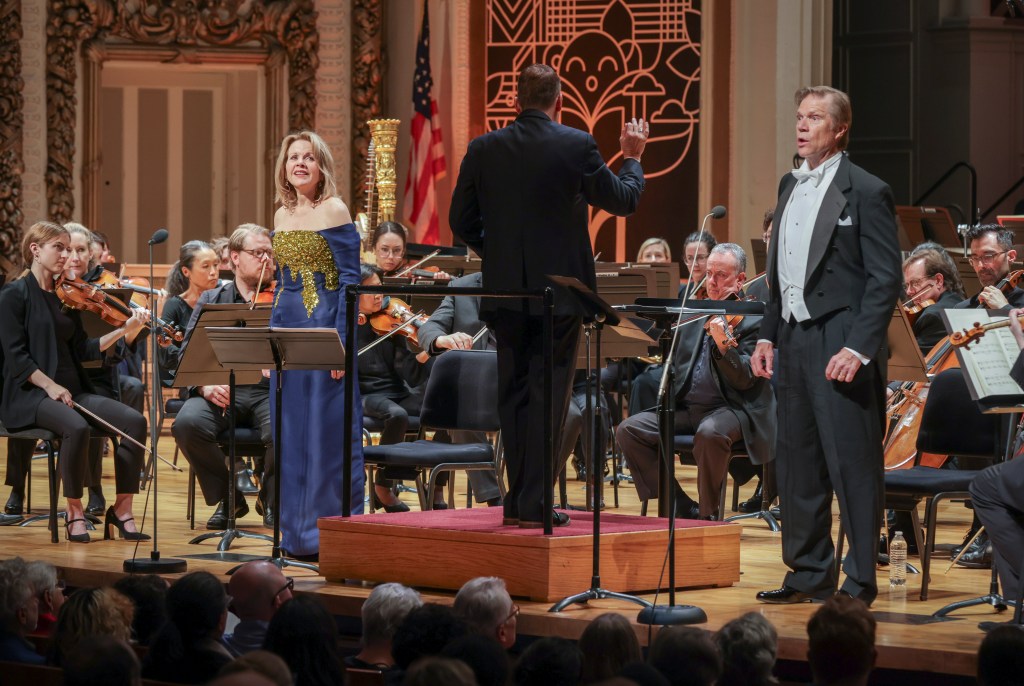
Renée Fleming, Robert Moody, Rod Gilfry and the Cincinnati Symphony perform The Brightness of Light, all photos credit Mark Lyons

The 45-minute conception chronicles the relationship of Georgia O’Keefe and Alfred Stieglitz — from agent to lovers to married couple, closing at O’Keefe’s final years as a widower in the solitude of the American Southwest. Giving the performance a multimedia dimension, projections by Wendall Harrington featured O’Keefe’s art alongside photographs of the couple through the years. The texts were extracted from the vast trove of letters they exchanged, beginning as professional correspondence that quickly turned to love letters.

Therein lies the fundamental challenge with the work, however, as texts of letters rarely provide the best material for vocalists. Poetic as they sometimes were, matters often veered more discursive and verbose. Nonetheless, Fleming and Gilfry captured the essence of their respective characters, painting a largely sympathetic portrait of these enigmatic figures via this epistolary drama. Puts’ musical language isn’t particularly groundbreaking, but remains appealing and approachable, somewhat reminiscent of the mid-century American composers — and thus stylistically contemporary with the two protagonists. Puts called for a large orchestra, and the Cincinnati Symphony supported the singers with aplomb. The composer exploited the orchestra’s colorful potential, as if expressing the colors of an O’Keefe painting in musical terms. Marshaling these forces was conductor Robert Moody, gracefully stepping in as a last-minute substitute for Juanjo Mena.

O’Keefe was quoted in saying that her first memory “is of the brightness of light, light all around,” hence the work’s title and the text with which it began, tenderly intoned by Fleming. The beginning of their correspondence was of playful, innocent humor, but the tone shifted in “A Soul Like Yours,” wherein gentle touches in the piano and violin gave to way to some deeply impassioned singing from Gilfry. Orchestral interludes served as key inflection points, underscoring the importance of the orchestra to the piece despite the top-billing of the two operatic legends — and I wonder if there’s the potential to extract a standalone orchestral suite.

I particularly liked the twang of the violin to mark the transition to the Southwest, and exploring the ups and downs of this relationship yielded musical variety. Matters culminated with the fittingly valedictory “Sunset,” pensive and reflective, a touchingly beautiful use of Fleming’s voice. Despite the work’s sincerity and the strength of this performance, ultimately I left Music Hall with mixed impressions, but much credit nonetheless to the ambition of the performers and creative team.

The first half was comprised of two shorter works that featured the May Festival Chorus, beginning with Vaughan Williams’ Serenade to Music. Luminous sounds blanketed the hall with the beauty of the harp and strings, and the tender voices of the chorus were a meditation on music itself. Serene and with arching lyricism, it made for the loveliest of openers.

Written in 1930 on a Koussevitsky commission for the fiftieth anniversary of the Boston Symphony, the bristling neoclassicism of Stravinsky’s Symphony of Psalms sharply contrasted. The work sets a trio of psalms against a strikingly idiosyncratic orchestration that even called upon not one but two pianos. In his spoken remarks, Moody noted how it would later influence Orff’s Carmina Burana and Bernstein’s Chichester Psalms. Conducting without baton, Moody perhaps channeled his inner Pierre Boulez (who made a benchmark recording of the work with Berlin), imbuing each gesture with clarity and a strict sense of place.

Following a brassy close of the first psalm, the central selection began with a searching oboe solo, drawing richly contrapuntal textures given with severity and exactitude. Longer than the first two combined, the closing entry was a larger-scale conception with disparate elements seamlessly woven together, in due course arriving at a peaceful resolution.
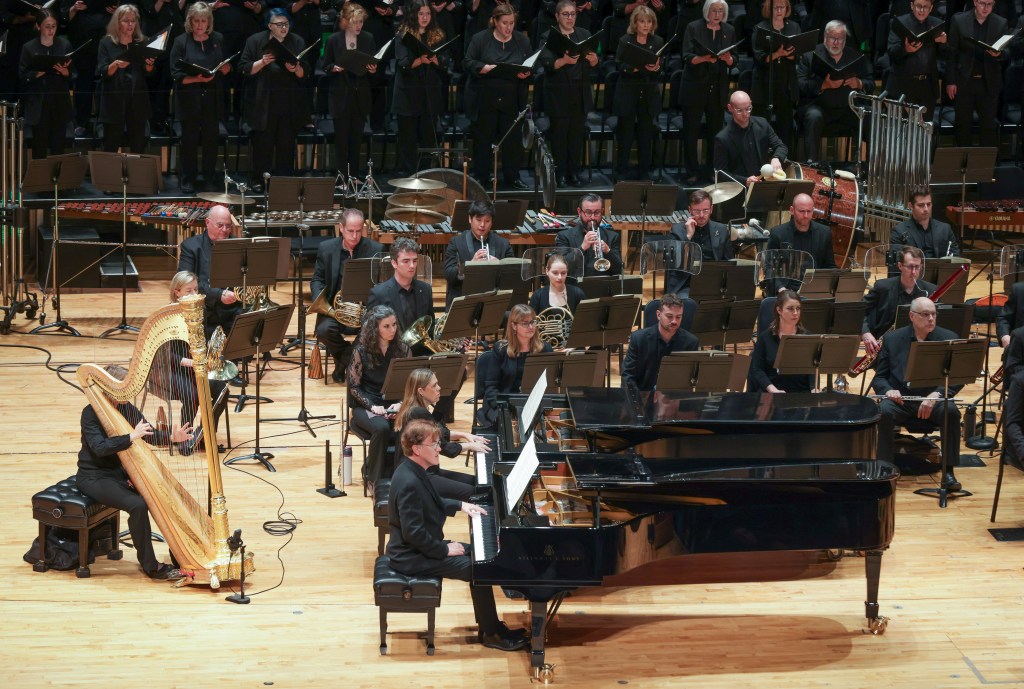
Cincinnati Symphony and May Festival Chorus in Stravinsky’s Symphony of Psalms

Rosamunde Quartet anchors Linton Chamber Music program with sublime Beethoven

Rosamunde String Quartet
First Unitarian Church of Cincinnati
Cincinnati, OH
March 3, 2024

Haydn: String Quartet in C major, Op. 20 No. 2, Hob. III:32
Puts: Credo
Beethoven: String Quartet No. 15 in A minor, Op. 132

Something of a supergroup amongst string quartets, the Rosamunde is comprised of current or former members of the Berlin, New York, and Los Angeles philharmonics, affording these players an opportunity to supplement their orchestral responsibilities by indulging in their love of chamber music. Their Sunday afternoon program at Cincinnati’s Linton Chamber Music offered two major classical period quartets sandwiching a more recent expression in the medium.

Rosamunde String Quartet at Linton Chamber Music. L-R Nathan Vickery, Shanshan Yao, Teng Li, Noah Bendix-Balgley

Dubbed the “father of the sting quartet,” Haydn virtually invented the form – and it was the set of six that comprise the watershed opus 20 in particular that earned him the title. Collectively known as the Sun Quartets owing to an early edition’s cover illustration, the Rosamunde selected the second quartet, in the sunny key of C major. A rather mellow beginning was had with the first violin absent from the opening few bars, and there was a particularly robust part for cello – Haydn was at his most lyrical here. A slow movement was stern and solemn, perhaps a look back towards the Baroque stylistically, but the latter section was truly radiant – and fittingly timed with the late afternoon sunlight streaming through the church’s stained glass windows.

A minuet followed without pause, much more restrained than typical for the composer, and a trio contrasted in the minor. Though less of a hallmark of Haydn’s later quartets, half of opus 20 concludes with a fugue. The four-voice fugue that closed the present example evidenced the Rosamunde’s incisive clarity and taut communication.

A 2007 work by Kevin Puts took the string quartet to the present day. On commission from the Miró Quartet, Puts was tasked with writing a work to capture the “lighter side of America,” a requirement he found quite a challenge given the backdrop of wars in the Middle East and mass shootings back home. The resulting Credo painted short vignettes which inspired feelings of hope in some fashion.

The Violin Guru of Kantonah brought to life an instrument maker in the titular New York town. Improvisatory in character, it seemed to gingerly experiment with the different possibilities of the instruments, and a cross-section of excerpts from the violin repertoire surfaced in the first violin. Infrastructure was inspired by the bridges and highways the composer passed taking the path along the Monongahela River in Pittsburgh. Guttural and motoric, it depicted the marvels of industry with vigor.

Intermezzo: Learning to Dance recollected when Puts observed a mother teaching her daughter how to dance, its nostalgic lyricism capturing a sweet moment. The Pittsburgh tableau was reprised with the vigor turned up one more notch before the closing Credo, the heart of the piece. Puts purveyed a resonant lyricism, grappling and questioning for answers, ultimately finding a peaceful if inconclusive resolution.

Beethoven’s monumental opus 132 completed the program. Somewhat in the manner of where the Puts left off, Beethoven’s penultimate quartet began searching and musing, with the opening movement finding its footing in material that the Rosamunde gave with a rich sonority, a wide-ranging essay that culminated in a blistering coda. The crux of the work came in the central Heiliger Dankgesang, unfolding as a deeply-felt hymn. In his spoken remarks, violinist Noah Bendix-Balgley suggested a connective thread between the Puts and Beethoven in that both find hope in difficult times (in Beethoven’s case, in the wake of recovering from serious illness). At times the mood was simply ecstatic, an expression of joy all too uncommon for the tragic composer. The brief march that followed was rather quotidian by comparison, bringing matters back down to the earthly, and providing a moment of levity before the pathos-laden finale.

Columbus Symphony celebrates American music with standout guest conductor and soloist

Columbus Symphony Orchestra
David Alan Miller, conductor
Aubree Oliverson, violin
Ohio Theatre
Columbus, OH
February 3, 2023

Simon: This Land
Barber: Violin Concerto
 Encore:
 Puts: Arches
Dvořák: Symphony No. 9 in E minor, Op. 95, From the New World

Under guest conductor David Alan Miller, the Columbus Symphony presented an exuberant program of American music – the first half comprised of American composers, the latter the view of a foreigner looking in. As music director of the Albany Symphony Orchestra, Miller has developed a reputation for his commitment to contemporary music, and began the CSO program with a 2019 work of Carlos Simon. This Land is a musical depiction of the Statue of Liberty, and in particular, the Emma Lazarus poem at its base. It began introspectively with earthy harmonies, as a mediation on the poem and monument, and perhaps the less than promised realization of those ideals. A patchwork tapestry of various national anthems took shape, and the brief work closed as pensively as it began.

Aubree Oliverson, David Alan Miller, and the Columbus Symphony, photo credit Corinne Mares

Barber’s Violin Concerto put the considerable talents of soloist Aubree Oliverson in the spotlight. Eschewing introductory material, the music got right down to business with a rich lyricism from bar one, heightened by Oliverson’s warm, amber tone – self-assured, and articulately projecting over the orchestra. The movement was not without moments of tension, but never wandered far from its lyrical heart. A mournful oboe marked the central Andante, music clearly from the same pen as the Adagio for Strings, and the solo writing reached high into the range of Oliverson’s instrument. A breathless moto perpetuo – and the most harmonically adventurous of the movements – made for an exciting, energetic close. Certainly one of the finest concertos to come from this country, and on a personal note, I have fond memories of hearing the work here back in March 2010 – the very first time I attended the Columbus Symphony.

As a well-deserved encore, Oliverson selected another American composer in Kevin Puts, a name which has gotten much attention as of late following the premiere of his opera The Hours at the Met this past November. Arches proved to be a real treat for the audience: the violinist selected the final caprice wherein she drew out the titular arches without respite, increasingly wide and to mesmerizing effect – a jaw-droopingly virtuosic response to the Barber finale.

The evening closed with Dvořák’s “New World” symphony, the crowning product of his American sojourn. Some local concertgoers may have heard the symphony just the night before, concluding the Lviv National Philharmonic’s performance at Denison University. A passionate and brooding opening purveyed drama without bombast, while a stirring chorale began the Largo, setting the stage for the memorable English horn solo. In the scherzo, Dvořák found a way to remind us of his Czech origins in its flavor, seamlessly blended with the “American” material, and the lilting trio was especially delightful. The finale was dramatic to the finish of this polished performance, evidencing Miller’s fine chemistry with this orchestra.