Honeck and Pittsburgh Symphony offer delectable potpourri in Thanksgiving program

Pittsburgh Symphony Orchestra
Manfred Honeck, conductor
Steven Banks, saxophone
Heinz Hall
Pittsburgh, PA
December 1, 2024

Weber: Overture to Der Freischütz
Tomasi: Concerto for Alto Saxophone
Strauss II: Overture to Die Fledermaus
Strauss II: Éljen a Magyar!, Op. 332
Puccini: Intermezzo from Act III of Manon Lescaut
Strauss II: Leichtes Blut, Op. 319
Banks: Strength of My Life from Come As You Are (arr. Corey Dundee)
Strauss II: Kaiser-Walzer, Op. 437
Strauss II: Auf der Jagd, Op. 373

Encores:
Josef Strauss: Feurfest!, Op. 269
Strauss Sr.: Radetzky-Marsch, Op. 228

In a standing tradition, the Pittsburgh Symphony presented a populist Thanksgiving program highlighted by a brimming selection of waltzes, polkas, and marches from the Strauss family. The first half began on a rather more serious note, however, opening with the overture to Weber’s landmark opera Der Freischütz.

Steven Banks, Manfred Honeck, and the PSO. Photo credit Manfred Honeck on Facebook

A long-bowed melody in the arching strings was tempered by warm chorales from the Pittsburgh brass. With vigor, darker material took over in full-fledged operatic drama, though in the end the triumphant conclusion won the day.

A rarity followed in the 1949 Alto Saxophone Concerto by Henri Tomasi, a quantity for the PSO debut of Steven Banks. A modernist soundscape was drawn from its piquant bitonalities, and the lyrical potential of the saxophone was exploited to remarkable effect — a markedly distinct style from the jazz sound one is more accustomed to. The Allegro section that followed the concerto’s introductory remarks was of a coloristic mid-century aesthetic, with a lively orchestration to boot, and Banks traversed a wide array of tone and timbre.

The closing Giration-Final saw the soloist dazzle in rapid fingerwork, and the movement’s dance inflections added to its excitement. As an encore, Banks offered The Lord’s Prayer, a slow and lyrical paragraph that showed yet another side of his instrument — and the power it has to resound unaccompanied.

The Strauss-heavy latter half was very much in the spirit of a Vienna Philharmonic New Year’s Concert, as if Heinz Hall was momentarily morphed into the golden Musikverein (and one should also be reminded that an authentic Austrian-style Christmas market lies a few blocks away at Market Square). One could have hardly asked for a more informed interpreter than Austrian native Manfred Honeck.

Lithe and elegant, the overture to the operetta Die Fledermaus fizzed with vigor and flamboyance. Hungarian folk melodies — including echoes of the indelible Rákóczi March — were woven in the exuberant Éljen a Magyar! Rather different but equally appealing was an intermezzo from Puccini’s Manon Lescaut, lush and filled with longing. Harps swelled for a sumptuous texture, further encouraged by fine playing from the solo cello.

Banks returned to showcase his own composition entitled Come As You Are. Originally scored for tenor saxophone and piano, the suite is a lovely tribute to his faith and family. On offer was an arrangement for tenor sax and strings of the third movement “Strength of My Life.” Touchingly reflective, it was well-suited to the rich, mellow sound of the tenor.

Back to Strauss. The Emperor Waltzes were fittingly regal, and Auf der Jagd concluded the printed program complete with some humorous theatrics. Honeck and the PSO indulged the audience with a pair of encores beginning with Feuerfest! from the pen of Johann Jr’s brother Josef. Brought to life by use of the anvil, it was only outdone by the rambunctious Radetzky March.

In a post-concert performance, the Pittsburgh Cello Quartet (comprised of four PSO cellists) offered a brief selection of mostly holiday fare. More memorable was a transcription of Poulenc’s pensive O magnum mysterium.

Cleveland Orchestra strikes operatic gold in La fanciulla del West

Cleveland Orchestra
Franz Welser-Möst, conductor

Emily Magee, soprano (Minnie)
Roman Burdenko, baritone (Jack Rance)
Limmie Pulliam, tenor (Dick Johnson)
Tony Stevenson, tenor (Nick)

Scott Conner, bass (Ashby)
Iurii Samoilov, baritone (Sonora)
Owen McCausland, tenor (Trin)
Joseph Lattanzi, baritone (Sid)
Benjamin Taylor, baritone (Bello)
Joseph Tancredi, tenor (Harry)
Alex McKissick, tenor (Joe)
Joseph Barron, bass-baritone (Happy)
Kyle Miller, baritone (Jim Larkens)
Zachary Altman, bass-baritone (Billy Jackrabbit)
Taylor Raven, mezzo-soprano (Wowkle)
John Brancy, baritone (Jake Wallace)
Michael Adams, baritone (Jose Castro)
John-Joseph Haney, tenor (Pony Express Rider)

Men of the Cleveland Orchestra Chorus

Mandel Concert Hall
Severance Music Center
Cleveland, OH
May 20, 2023

Puccini: La fanciulla del West

I’ve long felt the Franz Welser-Möst’s greatest achievement as Cleveland Orchestra music director lies in his programming of complete operas, and last weekend’s performance of Puccini’s Fanciulla del West only furthered cemented my contention. Welser-Möst certainly has stellar operatic credentials, holding directorships of the major opera houses of both Zurich and Vienna. Puccini’s 1910 work tends to be overshadowed by the blockbusters that surround it, but Welser-Möst along with TCO and a strong vocal cast made quite the compelling case for it.

Emily Magee as Minnie in The Cleveland Orchestra’s La fanciulla del West, photos credit Roger Mastroianni, courtesy of The Cleveland Orchestra

Announced well before the pandemic – a sign of the long-range planning behind putting on such an ambitious production with an international cast – some cast changes were perhaps all but inevitable, with Emily Magee stepping in for Tamara Wilson as Minnie, and Roman Burdenko singing the role of Jack Rance in place of the originally announced Eric Owens. Though perhaps not as deeply familiar as La bohème or Madama Butterfly, the arresting, lush beginnings from the orchestra made matters instantly recognizable as Puccini, surging with a passion only he could write.

Singing of homesickness – what must have been a common experience for those braving the American West – Kyle Miller’s Jim Larkens was a lovely, inward moment, touchingly accompanied by the harp. Minnie’s entrance showed Emily Magee – despite suffering from a cold – to be a commanding presence, mastering the daunting role. I envy audiences who saw the two performances prior to Saturday, in which her voice presumably would have been in even stronger shape. She blended beautifully with Limmie Pulliam’s Dick Johnson, closing Act I in a sumptuous duet.

This arc continued into the second act, with a rapturous love scene between them before conflict erupted, gunshots chillingly fired, and matters built to the tensely climactic poker scene. The final act began in cacophonous tumult, with the now captured Johnson booming and defiant to the end. Minnie implored for compassion in a heartfelt dialogue with the miners (“Ah! Ah! È Minnie!”), persuasive enough to afford a redemptive ending – for Puccini, a rarity indeed!

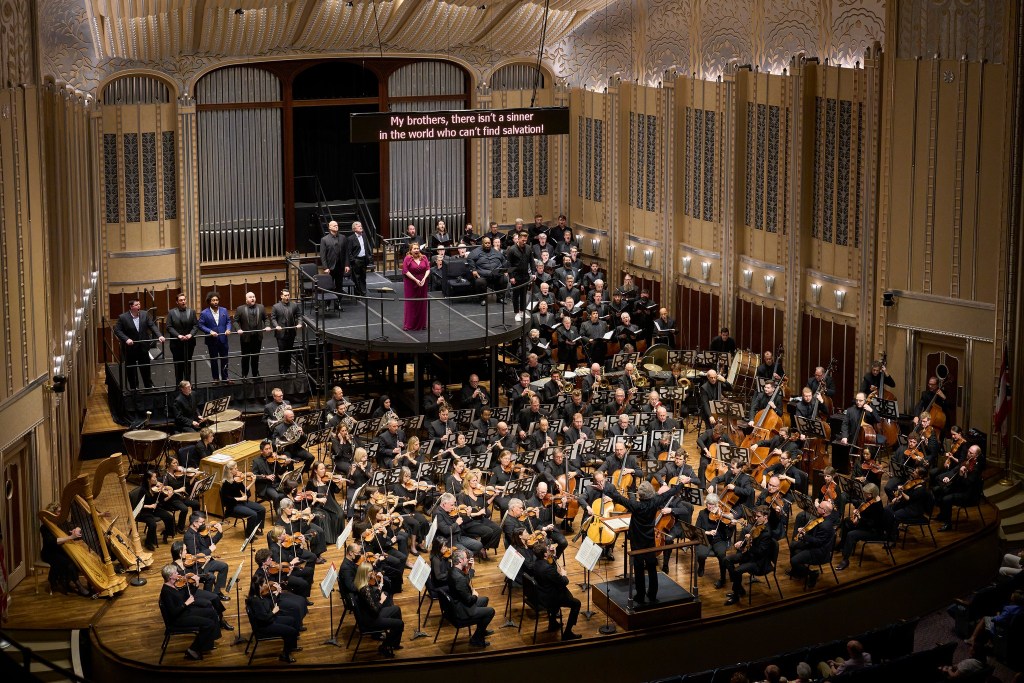
Buttressing the cast of soloists were the men of the Cleveland Orchestra Chorus, colorfully portraying a miscellany of miners at a Gold Rush camp. Performing the work in a concert hall rather than an opera house allowed The Cleveland Orchestra to be front and center rather than relegated to the pit – and rightfully so, as they were perhaps the true star of the show, with meticulous and compelling playing that served Puccini well. One doesn’t always get to hear an opera anchored by such fine orchestral playing, certainly a high note on which to close the 2022-23 concert season.

Franz Welser-Möst leads The Cleveland Orchestra, Chorus, and soloists in La fanciulla del West

A lush La bohème from the Columbus Symphony

Columbus Symphony Orchestra
Rossen Milanov, conductor

S Katy Tucker, video artist
James Marvel, director

Joshua Stewart, Rodolfo
Michelle Johnson, Mimì
Abigail Rethwisch, Musetta
Ethan Vincent, Marcello
Brian Major, Schaunard
Robert Kerr, Colline
Cody Müller, Alcindoro

Columbus Symphony Chorus
Ronald J. Jenkins, chorus director

Ohio Theatre
Columbus, OH
February 4, 2022

Puccini: La bohème

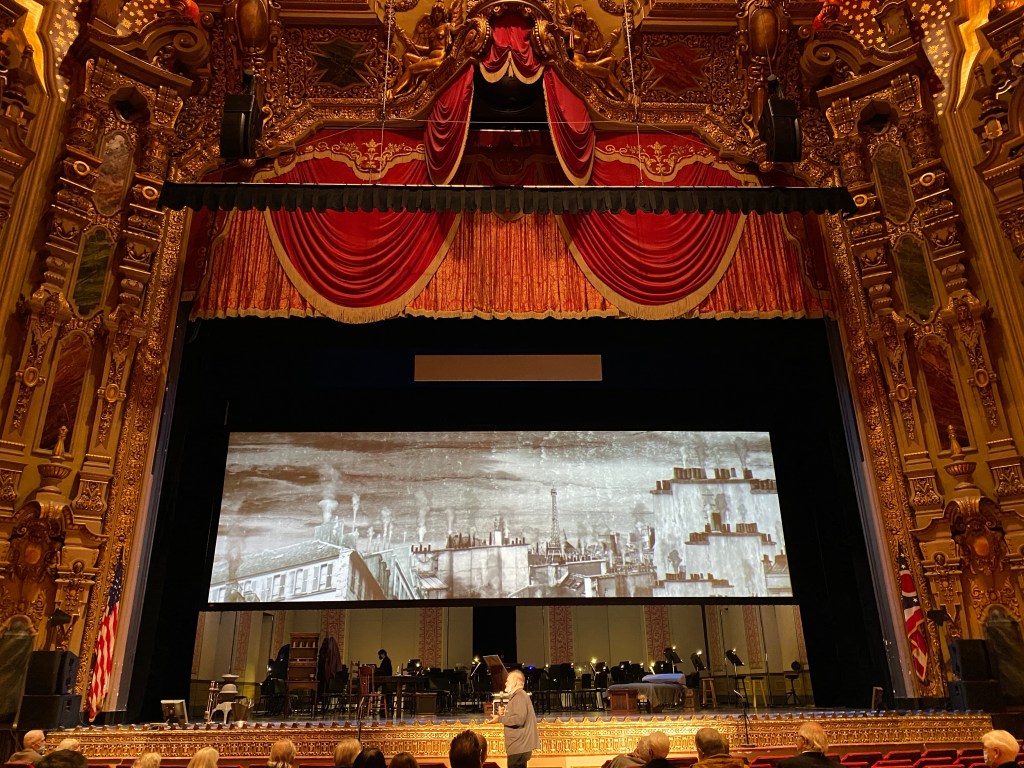
In their most ambitious undertaking so far of the current season, the Columbus Symphony offered a complete staged performance of Puccini’s indelible opera La bohème. The orchestra was perhaps the biggest star of the evening, aided by a compelling cast of singers and chorus, with the narrative brought to life by way of simple yet effective staging further enhanced by video projections, spanning the stage of the Ohio Theatre as a massive canvas.

Ohio Theatre during Christopher Purdy’s pre-concert talk. Note the video projection spanning the stage

La bohème is a compact, fast-paced affair, certainly by operatic standards. Eschewing a full-scale overture, a few bars of orchestral introduction led directly to the opening dialogue wherein we were transported in an instant to a Parisian garret. The four flatmates had a wonderfully conversational chemistry. Michelle Johnson’s Mimì was sweet and pure, but portrayed from the beginning with signs of the tragic character’s illness – an ominous foreshadowing. As Rodolfo, Joshua Stewart’s first moment to shine came in the aria Che gelida manina, sung with great tenderness. Johnson followed with a dulcet but full-bodied Sì, mi chiamano Mimì. A moonlit duet between the two (O soave fanciulla) closed the first act in the loveliest fashion.

Act II took matters to the bustling Latin Quarter, the stage brimming with members of the Columbus Symphony Chorus, excellently prepared by Ronald J. Jenkins. It was interesting to see the chorus members masked – perhaps this was merely Covid protocol, but masked faces in a crowded public setting made this nineteenth-century tableau feel quite topical. Abigail Rethwisch made a terrific Musetta, highlighted by the lilting Quando me’n vo’, her charm a stark foil to the hapless Alcindoro.

Lush harps and projections of falling snow made for an atmospheric opening to Act III, and again rather topical as it quite literally takes place in February (as did the opera’s 1896 premiere). A duet between Mimì and Marcello (Ethan Vincent) was especially touching. The final act returned to the garret where it all began, depicting the cyclical and perhaps inevitable nature of things. A short-lived moment of levity was to be had before the heart-wrenching conclusion, certainly one that packed an emotional punch. Milanov certainly has a gift for opera conducting, and I look forward to any future operatic forays from these forces. A shame the severe winter weather prevented a larger audience!

Cleveland Opera Theater presents an effective and affecting Butterfly

Cleveland Opera Theater
Maltz Performing Arts Center
Cleveland, OH
April 29, 2018

Puccini: Madama Butterfly

Dina Kuznetsova, Cio-Cio San
John Pickle, B.F. Pinkerton
Young Kwang Yoo, Sharpless
Sandra Ross, Suzuki
Mark James Eldred, Goro
Jason Budd, Il Bonzo

Domenico Boyagian, conductor
Scott Skiba, stage director
Matthew D. McCarren, scenographic design
Brittany Merenda, projection design

Make no mistake, opera is alive and well in Cleveland. In the last three weeks, Clevelanders were afforded the opportunity to see as many operas – Apollo’s Fire in L’Orfeo (arguably the first great opera ever written), the magnificent Tristan und Isolde from The Cleveland Orchestra (arguably the most groundbreaking opera ever written), and last but not least, Cleveland Opera Theater’s Madama Butterfly (arguably the most popular opera ever written). The venue of choice for Butterfly was the beautiful Maltz Performing Arts Center, a former synagogue now used as a performance venue by CWRU, and a space which lent itself well to opera.

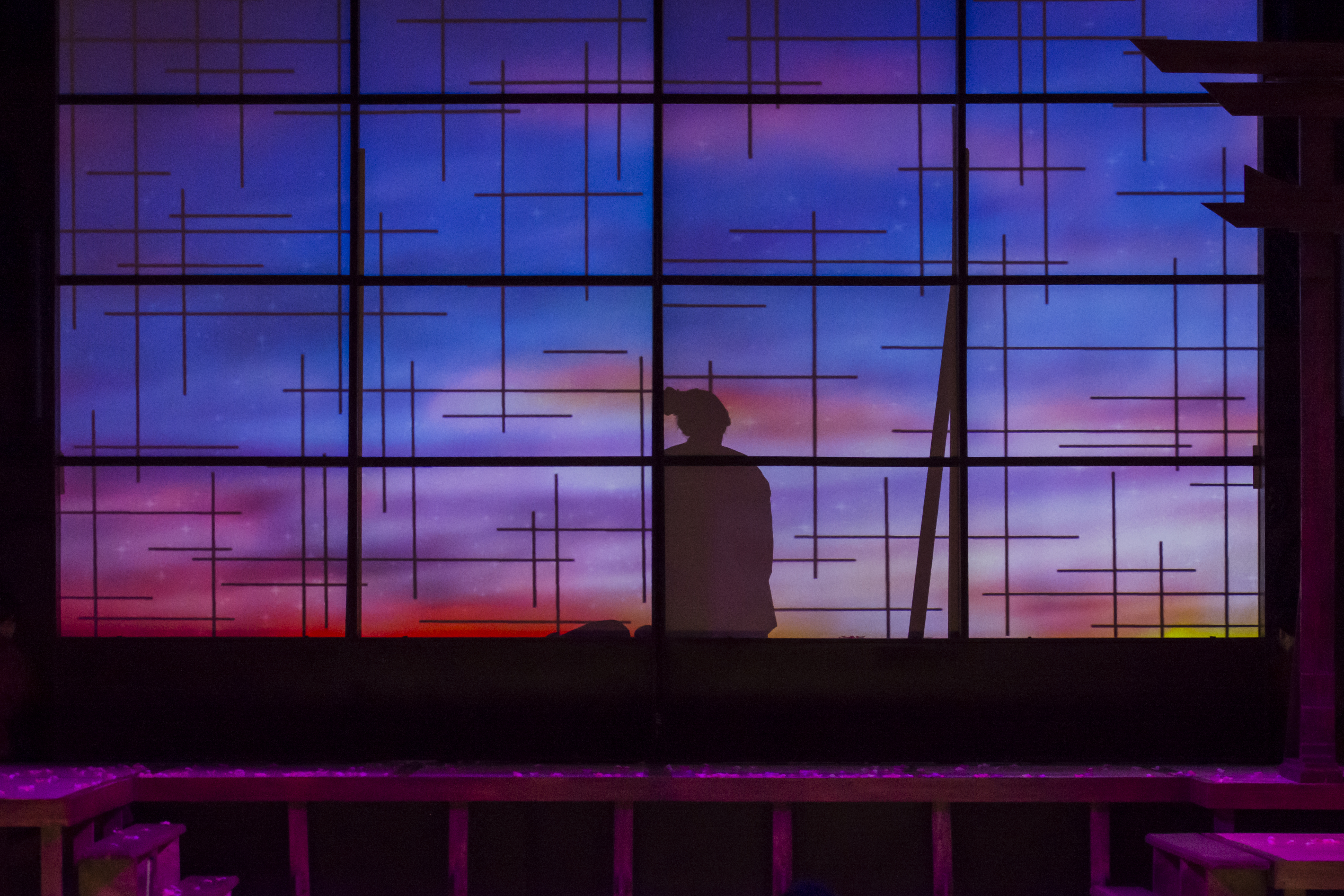
The work opened in faux-orientalism, evocative of its Japanese setting, and while the 30-piece orchestra sounded a bit thin for the lushness of Puccini, they generally exhibited a consummate level of playing and fine support for the vocalists under the baton of conductor Domenico Boyagian. (And amongst their ranks was concertmaster Aubrey Murphy who formerly held that title at the Sydney Opera House). The bulk of the scenery was comprised of a Japanese-style screen that stretched the length of the stage, often enhanced with lighting or projections – simple yet effective. When Pinkerton was introduced, a brass choir intoned The Star-Spangled Banner in stark contrast to the previously heard orientalism. John Pickle played a confident Pinkerton (substituting for an indisposed Timothy Culver), and was especially fine in the ensuing duet with Sharplessthe latter role given by the convincing Young Kwang Yoo – and both voices combined in a truly Puccinian sumptuousness.

In Cio-Cio San’s (i.e. Butterfly) first appearance, she was draped in a radiant pink, and the wedding which quickly followed was presented with ample pageantry. The Star-Spangled Banner was pitted atop the oriental pentatonicism, signifying the (tenuous) union of the two cultures. A booming Jason Budd appeared as Il Bonzo, admonishing and ultimately renouncing Butterfly, dramatically enhanced by the gong – as sure a sign as any that the bliss of the newlyweds would be short-lived. Dina Kuznetsova was memorable in the title role and had excellent chemistry with Pickle as evidenced by the gorgeous extended duet that closed the first act.

Three years separated the following act, and the set depicted an American flag Butterfly had hung as a beacon of sorts to her husband now an ocean apart – and in keeping with historical accuracy, a 45 star flag was special ordered for the performance. Kuznetsova shone in the opera’s most recognizable excerpt, Un bel dì vedremo – filled with longing and hoping, yet tempered by a more rational perspective, as if she had gained wisdom during the intervening years and knew that all could not be well. And this was indeed confirmed in her drawn out dialogue with Sharpless, in which the truth that Pinkerton married another all but unraveled. The act concluded with the “Humming Chorus”, here portrayed as a candlelight procession with the chorus dispersed throughout the sanctuary. Gentle touches in the harp added to the scene’s ethereal beauty, to my mind, the afternoon’s scenic and musical highlight.

Looming tragedy clouded the opening of Act III, yet there was striking contrast in the warmth of the sunrise. Pinkerton at long last returned (new wife in tow) – noticeably aged – and Pickle portrayed him as not incapable of remorse, having seemingly matured from the Don Juan of his younger days. Still, this did little to mitigate the tragic ending – with Butterfly’s child wrapped in the American flag to signify her loss of custody, she had little recourse but to take her own life to avert the shame she would otherwise undergo. Pinkerton cried out for her, but by then it was too late, and an iridescent butterfly was projected onto the screen – a final image of heartbreaking power.

DSC_0188
Set design of COT’s Madama Butterfly, all photos credit Noah Listgarten