Cleveland Orchestra Franz Welser-Möst, conductor Daniil Trifonov, piano Mandel Concert Hall Severance Music Center Cleveland, OH October 9, 2025
Prokofiev: Symphony No. 7 in C-sharp minor, Op. 131 Brahms: Piano Concerto No. 2 in B-flat major, Op. 83
Encore: Prokofiev: No. 20 from Visions fugitives, Op. 22
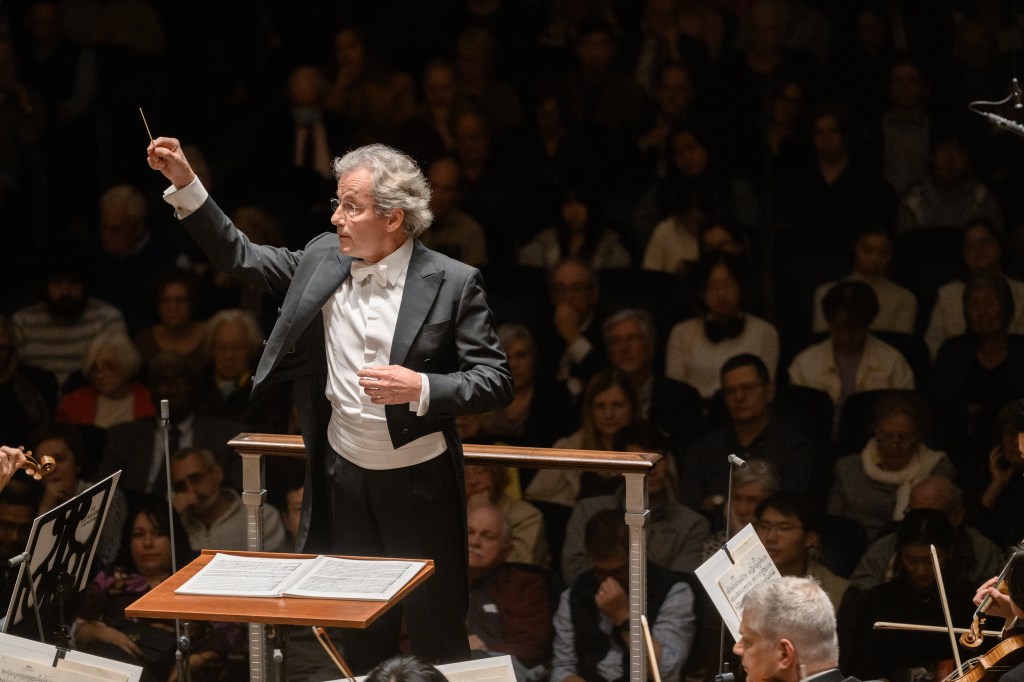
I’ve been intrigued by Franz Welser-Möst’s endeavor to perform and record all seven of the Prokofiev symphonies with The Cleveland Orchestra. After some eight years, that cycle came to fruition this weekend with the enigmatic Seventh Symphony, the last major work the composer completed. Only the First and Fifth of these symphonies are performed with any regularity, so it’s been a welcome opportunity to discover the rest — though the quality can be uneven.
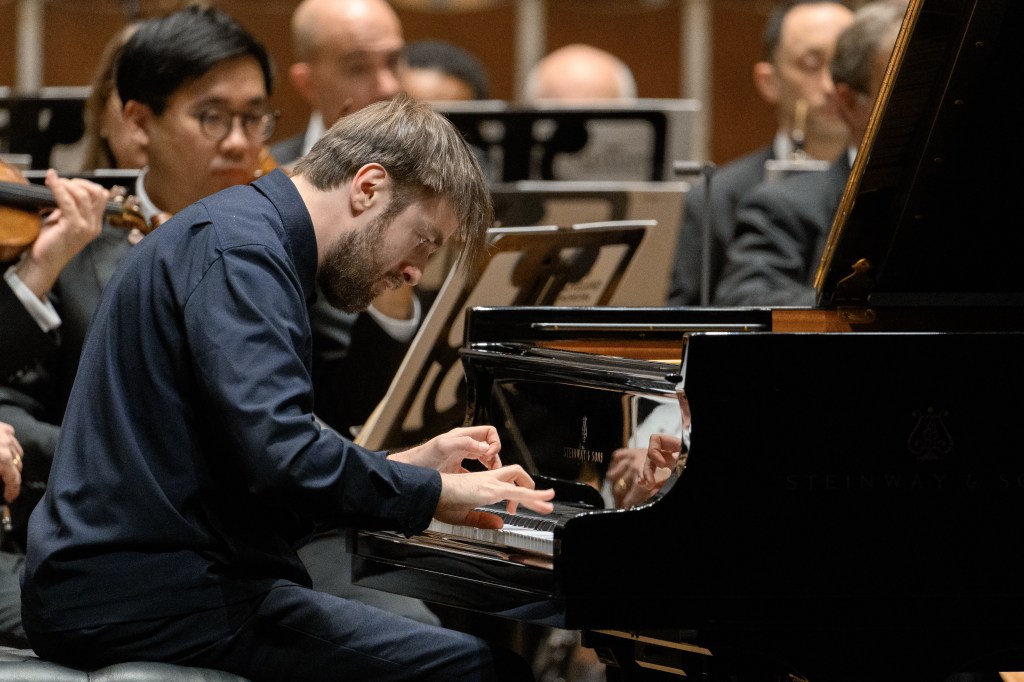
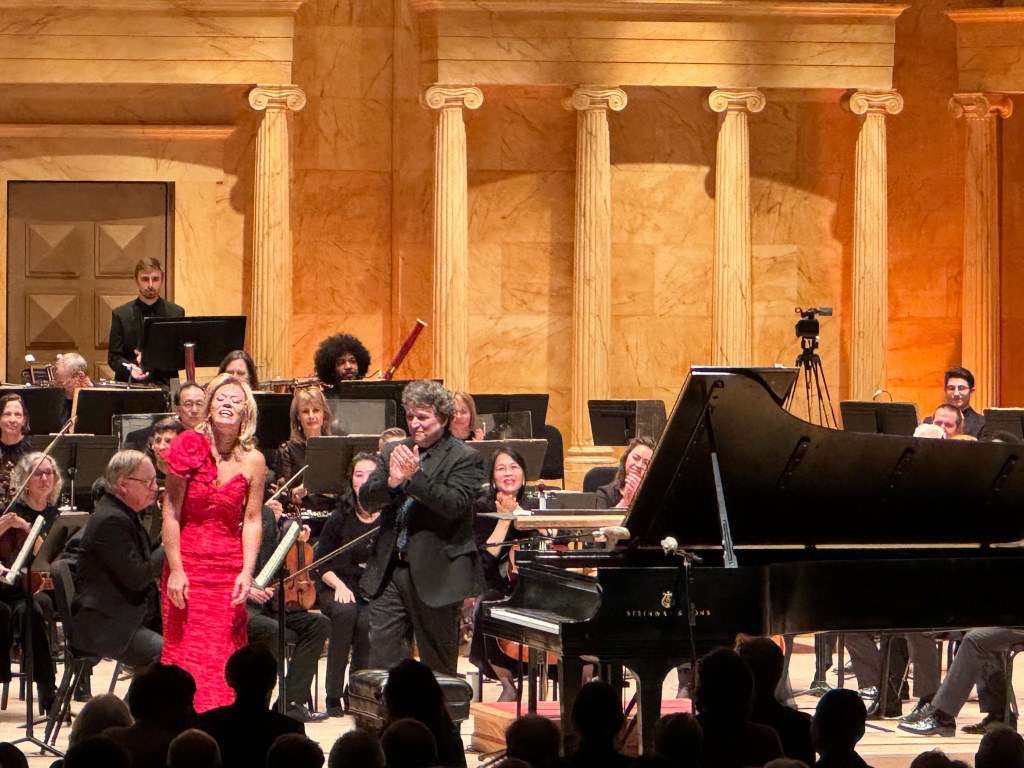
Daniil Trifonov performs Brahms with The Cleveland Orchestra. Photos credit Human Artist / Yevhen Gulenko
Moderately-paced material opened the work in the unusual key of C-sharp minor (common in the piano literature, rare for the orchestra), somewhat mysterious in character in the way that composers’ late works often are. The lyricism was straightforward and unadorned, but what stood out were the striking instrumental combinations, spattered with liberal use of the glockenspiel. A scherzo followed with vestiges of a waltz. A bit spikier than the restrained opening, it was still generally reserved until the boisterous close.
In the Andante espressivo, one was reminded of the poignant lyricism in Prokofiev’s ballet scores, contrasted by the playful and rather sardonic finale. The composer revised the original quiet ending for a bombastic one in an attempt to better appease the Soviet authorities, but was to said to have preferred the original — a preference which Welser-Möst rightfully respected in these performances.
Having been educated at the Cleveland Institute of Music on the precipice of his meteoric rise, pianist Daniil Trifonov remains a local favorite. He served as a probing soloist in Brahms’ daunting Second Piano Concerto (a follow up to his performance of the First two seasons ago — so effectively, another cycle came to a close Thursday evening). An amber horn call opened to herald the gentle arpeggios that rolled across the keyboard. Right at the beginning there was a solo cadenza which put Trifonov’s bold sound and rich tone on full display. An impassioned performance, he conceived the spacious first movement in broad strokes, with piano and orchestra functioning as equal partners in a work that’s perhaps more symphony than concerto.
Though the two works on this program had little in common, they mirrored each other in terms of structure, so as with the Prokofiev, a scherzo followed ahead of the slow movement. Brahms’ was generally a sunny affair though not without discord, played with a driving intensity that was briefly abated during the gentler trio and a passage of ravishing lyricism. Principal cellist Mark Kosower opened the Andante with a gorgeous solo, also serving to give the pianist a momentary but well-earned rest. This slow movement made for a serene moment in an otherwise energetic work. And despite the weight and seriousness of the preceding, the closing movement was of joyous abandon.
As an encore, Trifonov fittingly returned to the composer that opened the evening in Prokofiev, namely the last of the Visions fugitives, a suite of twenty artfully crafted miniatures for piano (the pianist performs the whole set on his recital programs this season). A touching way to bring the evening full-circle.
Bruce Liu, piano Heinz Hall Pittsburgh, PA June 7, 2025
Tchaikovsky: The Seasons, Op. 37a – January, February, May, June Tchaikovsky (arr. Wild): “Dance of the Four Swans” from Swan Lake, Op. 20 Scriabin: Piano Sonata No. 4 in F-sharp major, Op. 30 Tchaikovsky: The Seasons, Op. 37a – July, August, October Chopin: Fantasie-Impromptu in C-sharp minor, Op. 66 Prokofiev: Piano Sonata No. 7 in B-flat major, Op. 83 – mvts 2 & 3
Encore: Chopin: Nocturne No. 20 in C-sharp minor, Op. posth.
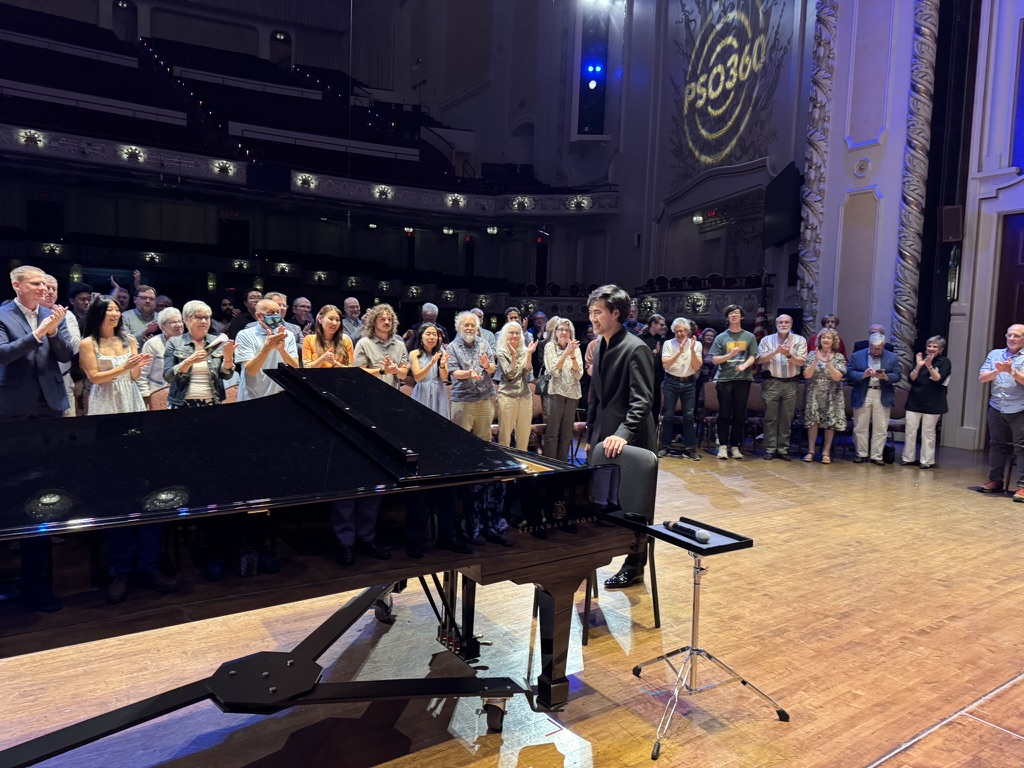
Filling in on short notice for Alice Sara Ott, pianist Bruce Liu was not only tasked with a Pittsburgh Symphony concerto appearance, but also an entry in the distinguished PSO360 series, an intimate chamber music presentation on stage at Heinz Hall. Instead of a collaboration with PSO players, Liu opted for a solo recital — the first to do so since the series’ inception in the 2017-18 season.
Bruce Liu’s PSO360 recital
A recent recording for Deutsche Grammophon featured Liu performing Tchaikovsky’s suite The Seasons, and Saturday’s recital was anchored by selections from that charming collection. The work shows the more intimate side of the composer — quite a contrast to the emotionally-fraught symphonies and concertos — and quite a perfect choice for the salon setting of a PSO360 performance. Liu imbued each with character and attention to detail, closing the first grouping with the beguiling June barcarolle.
A further Tchaikovsky work followed in Earl Wild’s transcription from Swan Lake in which Liu brought out the feathery filigree (as a sidebar: Earl Wild was a Pittsburgh native and attended Carnegie Mellon). The mystical world of Scriabin followed in the Piano Sonata No. 4 in F-sharp major. The opening movement was languid and atmospheric, further enhanced by the blue light which shrouded the stage — corresponding to the composer’s synesthetic association with F-sharp. The brief Prestissimo volando which closed was explosive, almost like a sudden burst of light and energy.
Three more excerpts from The Seasons followed, highlighted by the melancholic Autumn Song (October). One was certainly keen to hear Chopin played by a laureate of the Chopin Competition, and his Fantasie-Impromptu lived up to expectation. Why Liu jettisoned the first movement of Prokofiev’s Seventh Sonata I don’t know — musically it made little sense to present only a torso of the work. Regardless, the thrilling toccata finale made an exciting close to the recital. For a lone encore, Liu returned to Chopin with a pensive account of the C-sharp minor nocturne.
ProMusica Chamber Orchestra David Danzmayr, conductor Fiona Khuong-Huu, violin Southern Theatre Columbus, OH January 28, 2024
Prokofiev: Symphony No. 1 in D major, Op. 25, Classical Saint-Saëns: Introduction et Rondo capriccioso, Op. 28 Ravel: Tzigane Haydn: Symphony No. 104 in D major, Hob. I:104, London
Last weekend’s ProMusica performances introduced Columbus audiences to the remarkable – and remarkably young – violinist Fiona Khuong-Huu. Just 16 years old, she has already scored a New York Philharmonic debut and is currently a student in Juilliard’s pre-college division. Additionally, she is recipient of the Fomin Scholarship Fund from the Chicago-area North Shore Chamber Festival, an organization helmed by ProMusica’s creative partner Vadim Gluzman.
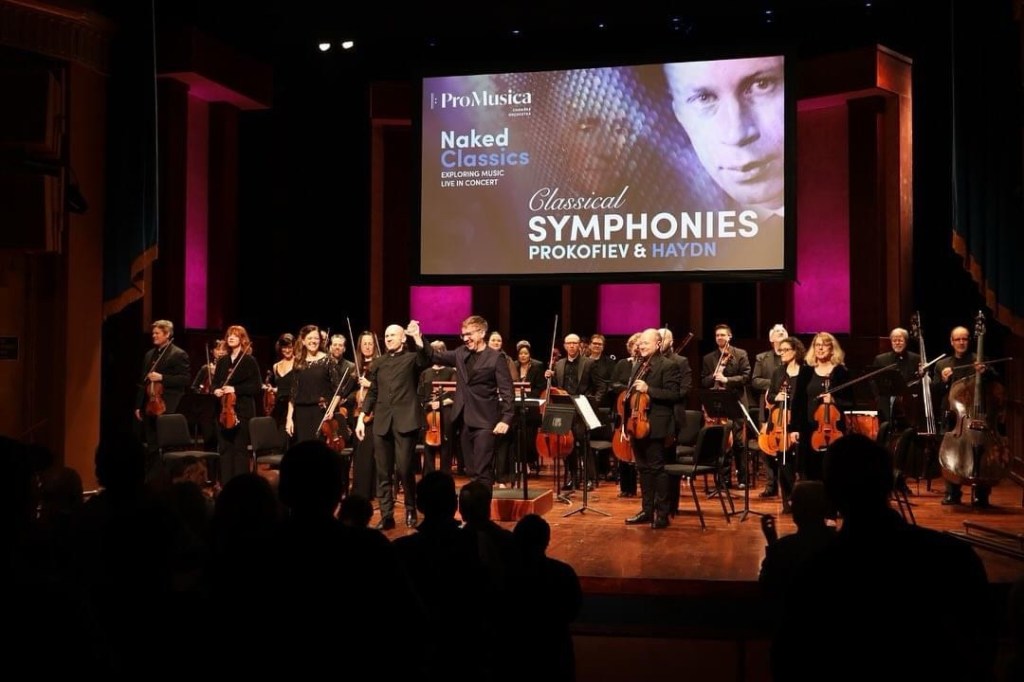
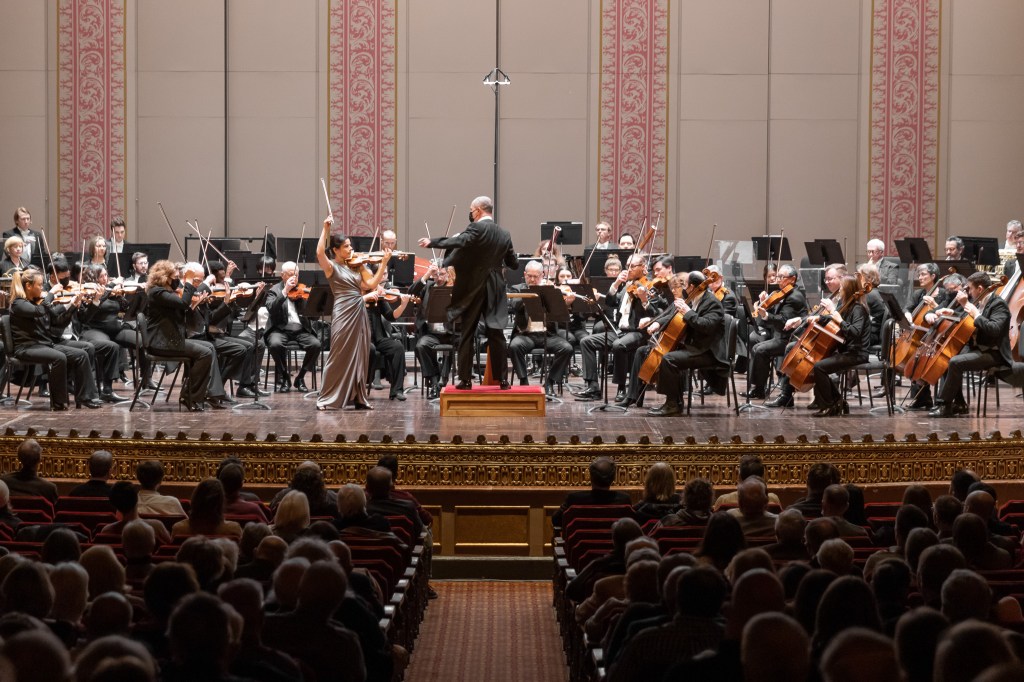
Fiona Khuong-Huu, David Danzmayr, and ProMusica, photos credit ProMusica
Khuong-Huu offered two 10-minute or so virtuoso showpieces, beginning with Saint-Saëns’ Introduction and Rondo capriccioso. A long-bowed melody marked the introductory material, and the violinist played with a rich tone and a maturity beyond her years. The Rondo was elegantly ornamented, with Khuong-Huu self-assured across the range of her instrument. In a particularly striking moment, the soloist played a series of rapid, wide-ranging arpeggios as the theme surfaced in the winds.
Ravel’s Tzigane opened with a monologue for violin alone, replete with modal inflections in invocation of Romani music. It’s a work that made substantial technical demands, surmounted by the soloist with seeming effortlessness. It’s also a piece filled with novel timbres, from the rapid pizzicato passages to a substantial part for harp (Jeanne Norton). Khuong-Huu certainly has a bright future ahead of her, and a career I look forward to watching.
The evening began and ended with “classical” symphonies of various flavors – Prokofiev’s First, which consciously sought to emulate and imitate his symphonic forbears, and Haydn’s last, a veritable archetype of the form. The fizzy opening of the Prokofiev was further buttressed by a buoyant contrasting theme, almost weightless, though vigor was amassed as much was made from efficient use of the chamber-sized orchestra. The delicate inner voices were intricately brought out in the Larghetto, and the piquant dissonances of the haughty gavotte were given a stylish reading. The effervescence of the whirlwind finale was a worthy rival to Haydn himself.
A broad-stroked introduction began Haydn’s London symphony at the other end of the program, pointing towards an essay in equal parts energetic and elegant, epitomizing classical symmetry and balance. The irregularly dispersed accents and pauses of the minuet were of charming effect, as was the finale, derived from a Croatian folk song that sounded almost indistinguishable from a bona fide Haydn theme.
The preceding Friday night saw a further installment of Naked Classics, hosted by the ebullient and informed Paul Rissmann. Parallels and contrasts between the Haydn and Prokofiev symphonies were illuminated, culminating in a performance of both works. Here, the two symphonies were intertwined, with a movement of Prokofiev alternating with a movement of Haydn, an approach which may have helped illustrate comparisons but ultimately made for a disjointed listen.
Toledo Symphony Orchestra Alain Trudel, conductor Olga Kern, piano Peristyle Theater Toledo, OH January 20, 2024
Lutosławski: Concerto for Orchestra Rachmaninoff: Piano Concerto No. 2 in C minor, Op. 18
Encore: Prokofiev: Etude in C minor, Op. 2 No. 4
On a bitter cold and snowy January weekend, the Toledo Symphony Orchestra presented a program that did much to warm and invigorate. Two works were featured, both from the heart of Eastern Europe, and both titled concerto – but of sharply contrasting approach.
Olga Kern, Alain Trudel, and the Toledo Symphony Orchestra
Lutosławski’s Concerto for Orchestra is a landmark of mid-20th century orchestral music – a real shame it doesn’t find its way onto concert programs more often. Music director Alain Trudel keenly guided the opening Intrada as a strident melody took shape over pulsating timpani. Moments of brassy bombast were aplenty, and the scoring further included a substantial part for piano (Valrie Kantorski). As per its title, virtually all instruments were granted a moment in the spotlight, including those such as the English horn that are more often relegated to the background.
The central movement, titled Capriccio notturno ed Arioso, was rather Mendelssohnian in its fleet, rapid textures, drifting away in almost imperceptible evanescence. An end-weighted architecture, the closing movement is longer than the first two combined. The venerable passacaglia form opened, with pizzicato in the double basses outlining a theme which the composer would ingeniously transform. A brilliantly orchestrated conception, textures ranged from a thin thread to the densely cataclysmic. A concerto for orchestra doesn’t necessarily imply equality amongst all instruments, however, and here the brass were certainly the most prominent, especially in the stirring chorale, or the punchy, blazing coda.
Rachmaninoff’s evergreen Piano Concerto No. 2 filled the balance of the program, and brought forth pianist Olga Kern (who mentioned during the preconcert conversation that she came to Toledo on the heels of her performances in Cape Town, South Africa!). The eight opening chords from the soloist tolled like bells, sculpted with a steadily building crescendo. The orchestra responded with Rachmaninoff’s quintessentially rich melodies, decorated by Kern’s flowing accompaniment. At times I found her playing a bit heavy-handed, but she projected well over the orchestra with resonant tone. A blistering march made for an exciting climax to the movement, while a lambent horn call was an especially touching moment.
Kern was perhaps at her finest in the central Adagio sostenuto, in deft conversation with the winds, coaxing a velvety tone out of the mighty Steinway. The finale saw Kern’s pianism playful if fitful, and the movement’s indelible main theme appeared like an old friend, sinuously at first, growing increasingly lyrical to build to the work’s triumphant conclusion. An enthusiastic reception brought Kern back for an encore: a Prokofiev etude taken at such a manic tempo as to close the evening with edge-of-your seat excitement.
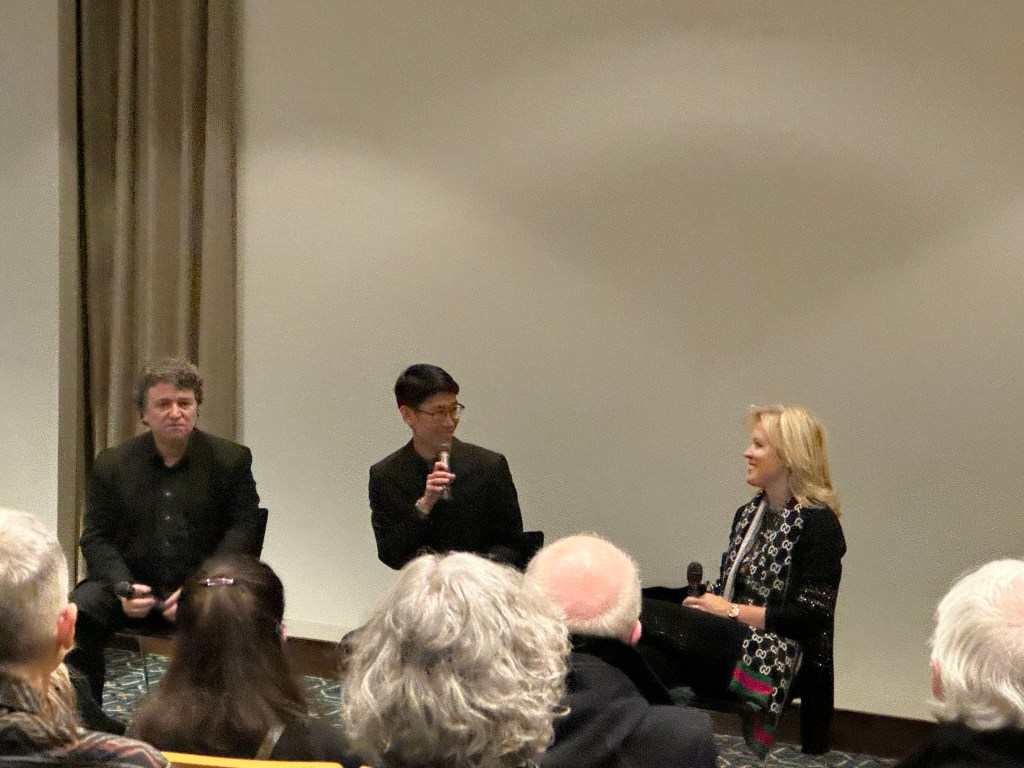
Preconcert conversation with Trudel and Kern, moderated by TSO violinist Merwin Siu
Cleveland Orchestra Franz Welser-Möst, conductor Mandel Concert Hall Severance Music Center Cleveland, OH January 18, 2024
Prokofiev: Symphony No. 2 in D minor, Op. 40 Webern: Symphony, Op. 21 Prokofiev: Symphony No. 5 in B-flat major, Op. 100
Franz Welser-Möst is back in Cleveland to start the year off with two weeks of subscription concerts before taking the orchestra on tour to Carnegie Hall and Miami. The conductor seemed in robust form, his first local appearance since undergoing cancer treatment, as well as official confirmation that he will be stepping down as music director in 2027, following a remarkable quarter century in that capacity.
Welser-Möst conducts Prokofiev, photo credit Roger Mastroianni
Thursday’s program offered three works all bearing the title “symphony” and composed within the span of two decades, but each vastly different conceptions of the form. The evening was bookended by Prokofiev, beginning with the rarely-heard Second Symphony. The conductor has turned ample attention to Prokofiev in recent seasons, including traversals of the lesser-known symphonies, albeit with mixed results when the work is more curiosity than masterpiece – though I found the Second to be much more convincing than the Third or Fourth. It’s also worth nothing that the Second was last intended to be performed in March 2020, only to be the first of months of Covid cancellations.
The work opened blistering and uncompromising, in mechanistic fury – in the composer’s own words, music of “iron and steel.” A product of the 1920s, it embraced a celebration of industry that also gave inspiration to Varèse, Antheil, and Honegger, as well as Prokofiev’s own Scythian Suite. Rhythmic pulsating continued unabated with the industriousness of an assembly line, and Welser-Möst managed to find clarity amongst the busy textures. The work’s unusual structure has been compared to that of Beethoven’s final piano sonata: a stormy sonata-form opening movement, followed by an expansive set of variations. A flowing oboe melody (Frank Rosenwein) carved out the theme, a somber turn inward. Animated transformations of the theme followed, while the fourth variation served as the work’s only extended slow passage. The manic and frenetic came back in due course, and strikingly, the theme returned at the end in its unadulterated form, with hauntingly orchestrated final chords shrouded in mystery.
Anton Webern’s sole symphony follows a similar two movement form, but couldn’t be more different. The orchestra was reduced to modest, classically-sized proportions, and barren, almost emaciated textures. Conductor and orchestra gave the coloristic score a nuanced, exacting reading, with the composer’s distinctive Klangfarbenmelodie technique yielding a protean ebb and flow as gestures were passed throughout the ensemble.
Prokofiev’s masterpiece in the form, the Fifth, closed the program (which like the Second, has also been recently recorded by these forces). The orchestra again swelled to the brim of the stage, and articulated a broad opening statement in which one felt the voice of a man with newfound energy and confidence. Welser-Möst emphasized the grand sweep of the movement, pointing towards a triumphant, blazing finale. The Allegro marcato had mechanistic echoes of the earlier symphony, highlighted by the shrill clarinet of Afendi Yusuf as well as prominent piano. With its militant snares, this is to my ears the closest Prokofiev came to sounding like his Soviet compatriot Shostakovich.
The brooding triple meter of the Adagio wouldn’t have sounded out of place in Romeo and Juliet which dates from a similar time, while the angular main melody of the finale had a distinctly Soviet feel. Welser-Möst was keen not to hit the listeners all at once by way of a slow, carefully-judged buildup in potency, leading to the pile-driving intensity of the work’s final statement. This weekend’s Carnegie Hall audiences certainly have an invigorating listen in store.
Rimsky-Korsakov: Suite from The Snow Maiden Prokofiev: Violin Concerto No. 1 in D major, Op. 19 Shostakovich: Symphony No. 6 in B minor, Op. 54
The Columbus Symphony’s first program of 2023 surveyed three giants of the Russian repertoire – Rimsky-Korsakov, Prokofiev, and Shostakovich. A suite from Rimsky’s opera The Snow Maiden opened, an appealing selection of highlights, though its twelve minute duration barely scratches the surface of the expansive opera – a work which the composer considered his finest. The Introduction brimmed with a quintessentially Russian melancholy. “Dance of the Birds” unmistakably portrayed the subject material from this master of orchestration, and “Dance of the Buffoons” – the most recognizable excerpt – made for a rollicking close.
Bella Hristova, Rossen Milanov, and the Columbus Symphony, photo credit Corinne Mares
Prokofiev’s First Violin Concerto brought forth music director Rossen Milanov’s Bulgarian compatriot Bella Hristova – who was graciously on hand for a pre-concert interview with the conductor. Dreamy, meditative material opened, with a beguiling melody from the soloist. The movement gathered momentum, making relentless technical demands without being an overt display of showmanship. A thorny though brief scherzo as the concerto’s centerpiece showed the composer in a more recognizable guise as an enfant terrible. Severe challenges by and large met with aplomb, one nonetheless wanted cleaner intonation when the scoring reached high into the soloist’s register.
The finale served as the most wide-ranging segment of this compact concerto, at its endpoint landing on dreamy material in the spirit of where it all began. As an encore, Hristova offered the Bulgarian folk song “Ratchenitsa”, quipping that it would “break the mood of that gorgeous ending” – which it surely did, but in the best way possible!
Shostakovich’s Sixth Symphony dates from 1939, right on the cusp of World War II. It’s a powerful statement to be sure, but a perplexing work, not in the least because of its unusual structure: three movements, beginning with a vast Largo that occupies more space than the latter two fast movements combined. A searching melody in the low strings opened, not quite grounded. Sparse textures prevailed in this deeply personal, unembellished statement, sustaining a desolate atmosphere. A particularly striking moment came when string trills were pitted against strident brass.
The following Allegro was light-hearted, playful fare by contrast, gaining enormous vigor with its bombastic percussion. A oblique invocation of the Dies irae, however, suggested the darkness of the opening had hardly been overcome. The closing Presto was marked by a rambunctious dance-like theme, as caustic and sardonic as anything Shostakovich wrote.
Gartner Auditorium Cleveland Museum of Art Cleveland, OH July 29 – August 1, 2021
Inevitably postponed last summer due to the pandemic, the Cleveland International Piano Competition has made a remarkable comeback here in 2021, a wonderfully exciting return to in-person performances. An initial pool of over 250 applicants from more than 40 countries was pared down to 26 contestants, all of whom performed in the Competition’s first two rounds. Owing to the travel and health restrictions that still persist, these rounds were conducted virtually, filmed at venues across the world – and available for free viewing on YouTube. Eight outstanding semi-finalists were selected to proceed onsite in Cleveland, a cohort to be further narrowed down to four finalists who will perform a chamber music round with the Escher Quartet and a concerto round with The Cleveland Orchestra under the baton of Jahja Ling.
Gartner Auditorium before Session 1 of the Semi-Final Round
Compared to the relative brevity of the first two rounds, the semi-finals offer an even more in-depth portrait of each artist, performing a recital of approximately 40 minutes. A few new and welcome additions for this year’s edition: each semi-finalist included in their program a popular song transcription commissioned from composer Alexey Kurbatov. Four selections were available, namely “America” from Bernstein’s West Side Story, Queen’s “Bohemian Rhapsody”, themes from Mission Impossible, and John Williams’ Olympic Fanfare. Regrettably, none of the eight selected the Williams piece, but perhaps a recording can be posted in due course. I also hope publication of these scores is imminent as they undoubtedly can serve as particularly enjoyable encore pieces.
Also for the first time was the inclusion of piano duets – the two performers from each session teamed up following their solo material for either the Fantasie in F minor by Schubert or Mozart’s Sonata for Two Pianos in D major. A lovely addendum that not only tested the contestants’ ability to collaborate with another pianist, but encouraged a spirit of camaraderie. Finally, excellent program notes for every piece performed – from the first round to the finals – were provided by Marissa Glynias Moore, Anna M. O’Connell, and Marco Ladd. Indispensable reading for attendees and a veritable crash course in piano literature. Below are some brief impressions I had of each semi-finalist.
Session 1 July 29, 2021
Ying Li Mozart: Piano Sonata No. 13 in B-flat Major, K. 333 Grainger: “Ramble on Love” from Der Rosenkavalier Bartók: Piano Sonata, Sz. 80 Schifrin: Themes from Mission Impossible (arr. Kurbatov)
Honggi Kim Schifrin: Themes from Mission Impossible (arr. Kurbatov) Chopin: Twelve Etudes, Op. 25
Schubert: Fantasie in F Minor, D. 940
Ying Li (China) opened the semi-final round with a Mozart sonata, delicate and balanced, exuding the pearly classical style. I found her pacing of the slow movement a bit hard to follow but was quite taken by the sprightly finale. Grainger’s so-called Ramble on Love, paraphrasing themes from Strauss’ Rosenkavalier, gave sumptuous treatment to the source material’s lush and languid melody. Bartók’s Piano Sonata was for me the highlight of her performance, opening with a manic energy – and the live video screens did much to enhance the audience experience, offering close-ups of the intricate hand-crossings.
Honggi Kim (South Korea) opened with the same piece with which Li closed, namely the Kurbatov Mission Impossible transcription. Kim was perhaps a bit more percussive than Li; both displayed how the composer brilliantly interpolated the familiar themes. All contestants are required to present a Chopin etude in the first two rounds – here in the semi-finals, Kim offered all twelve etudes from Op. 25. An ambitious undertaking to be sure, though I found his playing fitfully uneven. No. 2, for instance, would have benefitted from greater clarity, although I did like the way he brought out melodic material in the left hand. In No. 5, one wanted more accentuated contrast between the dissonant sections and the lyrical. The rapid double thirds of No. 6 were quite impressive, however. Op. 25 is certainly an end-weighted set, and perhaps one’s performance should be judged primarily on the final three which concluded on a high note: the rapid octaves of No. 10, a chillingly dramatic “Winter Wind”, and a rather marvelous finish in the intense depths of the “Ocean” etude.
Li and Kim were impressive four-hands partners in the Schubert Fantasie, bringing out contrasts from the brooding to the dancing.
Session 2 July 30, 2021
Jiarui Cheng Scarlatti: Sonata in B Minor, K. 87 Chopin: Barcarolle in F-sharp Major, Op. 60 Rachmaninov: Variations on a Theme of Corelli, Op. 42 Bernstein: “America” from West Side Story (arr. Kurbatov)
Yedam Kim Chopin: Polonaise-Fantaisie in A-flat Major, Op. 61 Prokofiev: Sonata No. 4 in C Minor, Op. 29 Mercury: Bohemian Rhapsody (arr. Kurbatov)
Mozart: Sonata for Two Pianos in D Major, K. 448
Jiarui Cheng (China) selected one of the more introspective of the Scarlatti sonatas, emphasizing its lyrical quality. Continuing the thread, he did much to bring out the wistful melancholy in Chopin’s late gem, the Barcarolle. In Rachmaninov’s Corelli Variations, Cheng sculpted an individual character in each variation – an excellent performance. Kurbatov’s transcription of Bernstein’s “America” ended matters on a jovial note.
Yedam Kim (South Korea) opened with a mesmerizing account of Chopin’s Polonaise-Fantaisie – contemporaneous with the previously-heard Barcarolle – the composer’s crowning achievement in the polonaise form. A commanding performance of Prokofiev’s Fourth Sonata followed, with searching, unsettling material leading to a bright and brilliant finale. In the Queen original, “Bohemian Rhapsody” is something of a mini tone poem with its wealth of thematic material and operatic narrative and dramatic flow – qualities very much brought out in Kim’s performance, perhaps the most impressive of the Kurbatov transcriptions.
Session 3 July 31, 2021
Rafael Skorka Bernstein: “America” from West Side Story (arr. Kurbatov) Leighton: Fantasia Contrappuntistica, Op. 24 (“Homage to Bach”) (1956) Brahms: Sieben Fantasien, Op. 116
Martín García García Schubert: Wanderer-Fantasie in C Major, D. 760 Liszt: “Les cloches de Genève (Nocturne)” from Années de Pèlerinage I, S. 160 Liszt: Étude de Concert, S. 145, No. 2 (“Gnomenreigen”) Liszt: Transcendental Etude, S. 139, No. 10 Mercury: Bohemian Rhapsody (arr. Kurbatov)
Schubert: Fantasie in F Minor, D. 940
Rafael Skorka (Israel) had confident beginnings with a memorable account of Bernstein’s “America”. The most intriguing discovery during the semi-final round came in the shape of Kenneth Leighton’s Fantasia Contrappuntistica, a 1956 homage to Bach (and to Busoni, given the elder composer’s monumental work of the same title). A virtuosic opening gave way to a pensive chorale and a pair of fugues rounded off the work. Skorka deftly negotiated the contrapuntal intricacies to bring matters to a vigorous close. The pianist continued to make a strong showing in Brahms’ Fantasies, Op. 116, just as convincing in the lyrical selections (nos. 2, 4, and the touching chorale of no. 6) as the more extrovert ones, giving the first piece an energetic workout and reserving the most overt virtuosity for the seventh and final fantasy.
Martín García García (Spain) offered an arresting account of Schubert’s ingenious Wanderer-Fantasie. While his tone at times veered a bit too percussive for my taste, he did much to bring out a wide dynamic and dramatic contrast and a keen sense of the work’s large-scale architecture. An interesting selection of three Liszt pieces followed. Deft use of the pedal did much to bring out the sonorities of the titular bells in Les cloches de Genève while García conveyed much charm in the impish legerdemain of Gnomenreigen. The Transcendental Etude No. 10 was technically impressive, although I found myself longing for even more firepower.
Session 4 August 1, 2021
Byeol Kim C. Schumann: Notturno in F Major, Op. 6, No. 2 Schumann: Arabeske in C Major, Op. 18 Mendelssohn: Fantasie in F-sharp Minor, Op. 28 Mercury: Bohemian Rhapsody (arr. Kurbatov) Jalbert: Toccata (2001) Gottschalk: The Union, Op. 48
Lovre Marušić Scarlatti: Sonata in E Major, K. 380 Schumann: Kreisleriana, Op. 16 Mercury: Bohemian Rhapsody (arr. Kurbatov)
Mozart: Sonata for Two Pianos in D Major, K. 448
Byeol Kim (South Korea) assembled the most diverse and wide-ranging semi-final program, beginning with music from both the Schumanns. Clara’s Notturno boasted a haunting, Chopinesque melody, a performance which should put Kim in the running for the Female Composer Prize, one of over a dozen special prizes being offered. A limpid account of Robert’s Arabeske followed, and Mendelssohn’s Fantasie in F sharp minor was given a passionate and dramatic performance. I really enjoyed the way Kim brought out the sweeping lyrical main theme in her take on the “Bohemian Rhapsody” transcription. Jalbert’s Toccata was a breathless study in perpetual motion, and Gottschalk’s Union, a wonderfully inventive cornucopia of Americana, put Kim’s searing virtuosity and vast dynamic range on full display. A clear audience favorite, she was the only one of the eight to receive a standing ovation.
Lovre Marušić (Croatia) began with a stately account of Scarlatti’s K380 sonata. Schumann’s extensive Kreisleriana followed. I felt Marušić’s reading would have been even more engaging with sharper contrasts between the wide range of expressions the work explores, but I certainly sensed the pianist becoming increasingly self-assured as the work progressed. Sunday’s session was a high note on which to conclude the semi-finals as we await the jury’s announcement of the four finalists, and the fine level of pianism we can expect from them in the subsequent chamber and concerto rounds.
Sergei Babayan, piano
Daniil Trifonov, piano
Mixon Hall
Cleveland Institute of Music
Cleveland, OH
February 19, 2020
Schumann: Andante and Variations for Two Pianos, Op. 46
Pärt: Pari intervallo
Mozart: Sonata for Two Pianos in D Major, K448
Rachmaninov: Suite No. 1 for Two Pianos, Op. 5, Fantasie-Tableaux
Rachmaninov: Suite No. 2 for Two Pianos, Op. 17
Encore:
Prokofiev, transc. Babayan: Idée fixe from The Queen of Spades, Op. 70
To inaugurate the celebrations surrounding the Cleveland Institute of Music’s landmark centennial year, two of the most distinguished pianists associated with the institution teamed up for a duo recital on Wednesday night. Sergei Babayan has held the title of CIM’s Artist-in-Residence since 1992, shortly after taking first prize in the Cleveland International Piano Competition, and at the second piano was his former student Daniil Trifonov. Trifonov’s meteoric rise is surely indebted in part to CIM where he earned an artist certificate in 2013, with an artist diploma following in 2015. Both pianists generously donated their time for the evening, and this benefit concert raised over $100,000 for the student scholarship fund. In his opening remarks, CIM’s president and CEO Paul Hogle further underscored the Institute’s role in the dynamic classical music scene of northeast Ohio, epitomized by over half of The Cleveland Orchestra being connected to CIM as alumni or faculty – if not both.
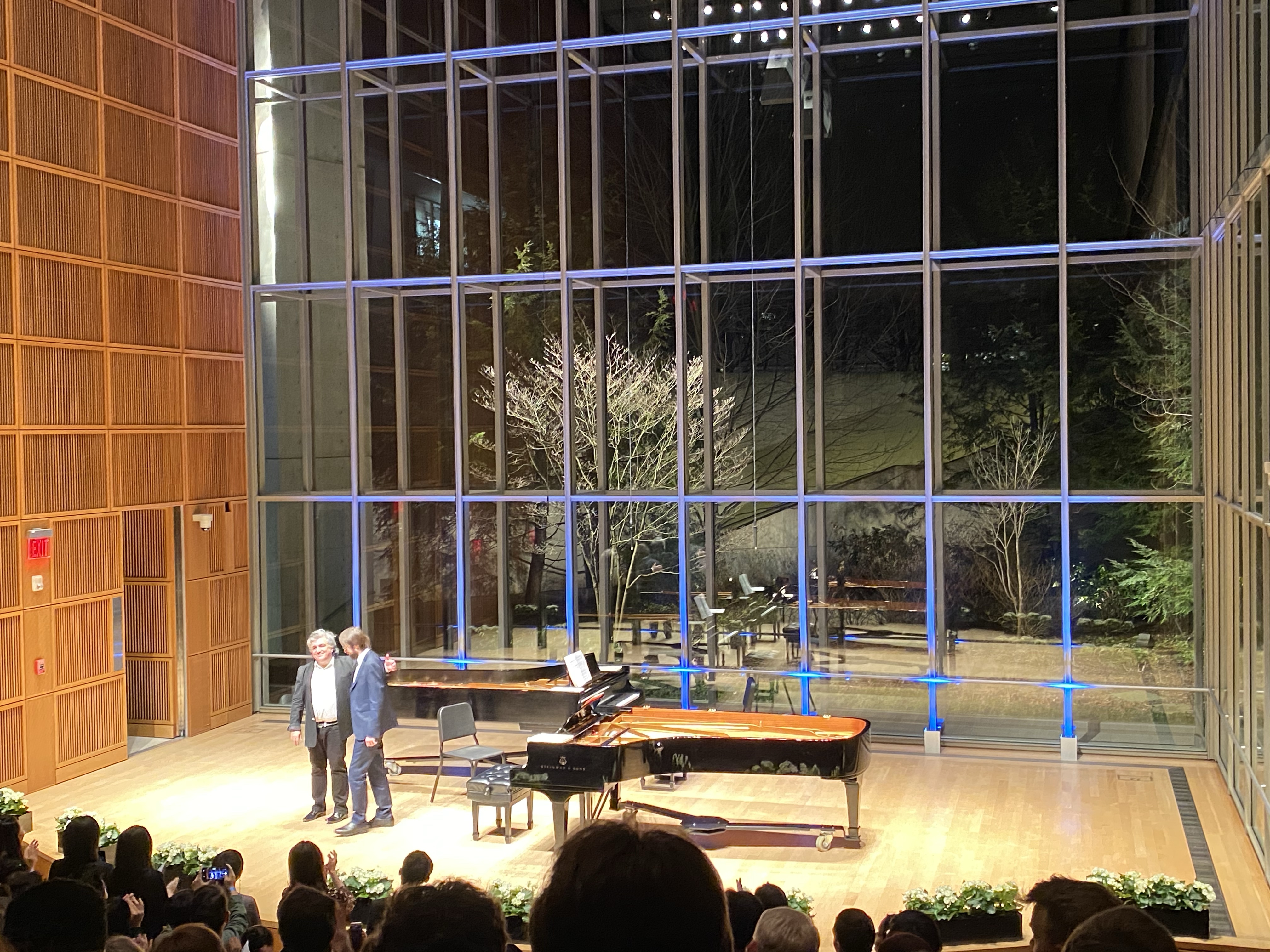
Sergei Babayan and Daniil Trifonov at Mixon Hall
Two pianos on the stage of intimate Mixon Hall made a bold impression, and while both instruments were oriented in opposite directions, their keyboards were aligned to enhance the natural communication between this teacher-student duo. Schumann’s Andante and Variations began the program. An intensely lyrical presentation of the theme opened, burgeoning into quintessentially Schumannesque music of Romantic fantasy and imagination. A militant march variation made for a powerful climax, with matters eventually giving way to a lovely, ruminative conclusion. Arvo Pärt’s Pari intervallo was quite far removed from any other selection performed, but certainly a highlight in spite of its brevity. Evaporated to the essential, its monastic austerity was enchantingly pensive and otherworldly in its repeated bell-like invocations, with the pianists sustaining a meditative state of unblinking concentration.
Mozart’s effervescent Sonata for Two Pianos in D major closed the first half, recalling Babayan’s memorable recital with Martha Argerich two seasons ago. Vigorous energy opened this pearl of the two piano literature, with seamless, crystalline playing evidencing the innate understanding amongst the duo. Rapid passages were crisply in sync, a must in the unforgiving transparency of this repertoire. A singing quality, almost akin to an operatic aria, was given to the central Andante, heightened by its delicate ornaments. The music became rather more unbuttoned in the finale, interspersed with varied material but inexorably gravitating back towards the joyous main theme, of dancing lightness and sparkling articulations.
The latter half was devoted to both of Rachmaninov’s hyper-Romantic Suites for Two Pianos. The “Barcarolle” of the First flowed with liquescent ease, and the pianists cleanly negotiated the detailed filigree. “La nuit… L’amour…” proceeded as a love song of often hypnotic beauty, and the following “Les larmes” was marked by its melancholy cantilena. While both pianists have a reputation for their leonine power, here we saw them turn inwards in music of quiet intimacy: perhaps the description of Rachmaninov possessing “fingers of steel and a heart of gold” applies to them as well. It was the former persuasion, however, that had the last word in the “Pâques” finale. Babayan introduced the theme at a moderate, measured pace, before matters erupted into a modal frenzy to close the suite with formidable weight and power.
A commanding, kinetic opening to the Second Suite showed in no uncertain terms that neither pianist was waning in energy as we neared the end of the program, cutting through the thickness of the dense chordal textures with ease. Here, for the first time, Trifonov assumed the primo role. The “Valse” was handled with rapid legerdemain, varied by an entrancing waltz theme, and the “Romance” offered a wonderfully lyrical interlude. An inevitable tour de force was to be had in the “Tarantelle”: a powerhouse conclusion punctuated by the relentless rhythms of the titular dance. As an encore, the pianists turned to one of Babayan’s own remarkable Prokofiev transcriptions (which can be heard on his emphatically recommended recording with Argerich), namely, the “Idée fixe” from The Queen of Spades, closing the festive evening in pile-driving intensity.
Cleveland Orchestra
Franz Welser-Möst, conductor
Severance Hall
Cleveland, OH
January 30, 2020
Prokofiev: Symphony No. 6 in E flat minor, Op. 111
Bridge: The Sea, H100
Dukas: The Sorcerer’s Apprentice
Following their annual residency in Miami, The Cleveland Orchestra is back home for a hearty stretch of concerts leading up to another tour this spring that will take them to Europe and the Middle East. Franz Welser-Möst, continuing his often revelatory exploration of Prokofiev, opened the program with the composer’s seldom heard Sixth Symphony. If the Fifth Symphony celebrates the glories and triumphs of World War II, the Sixth takes a much darker approach in its bracing depiction of the war’s tragedies and losses. As Welser-Möst noted in his spoken introduction, here we have the usually complacent Prokofiev living on the “knife’s edge” of what was acceptable artistically to the Soviet authorities – with its ambiguities and underlying tragedy, it draws comparison to the subversive works of Shostakovich.
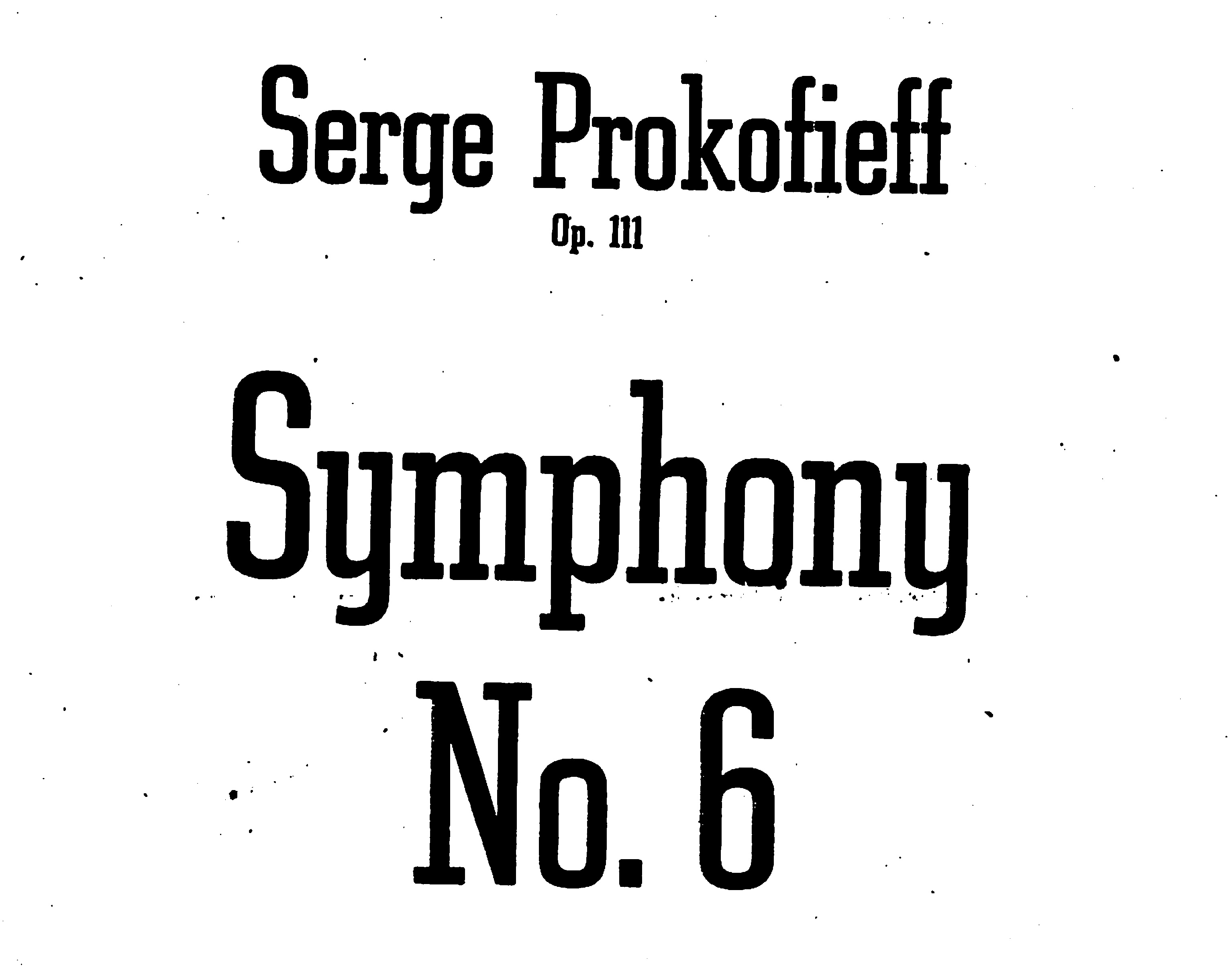
Title page of Prokofiev’s Sixth Symphony
The opening Allegro moderato was thorny and unforgiving, foregoing the familiar cohesion of sonata form for a structure underpinned by garish thematic transitions, through which Welser-Möst guided the orchestra with exacting precision. Stark textures were drawn from the low brass and rather busy piano, and the metallic climaxes depicted in no uncertain terms the true trauma of war. The central Largo served as the emotional crux, with arching strings introducing a pained lyricism. A percussive section, however, ensured this was far from a purely meditative affair, and the celesta added another striking timbre. The motoric finale, patently Prokofiev, delivered rapid fire repeated notes with a Haydnesque wit. An interjection of sparse and forlorn material gave pause before the conclusion – cacophonous, bombastic, and in apparent triumph, albeit only skin-deep.
An even rarer quantity followed after intermission in Frank Bridge’s orchestral suite The Sea. The Cleveland Orchestra gave the US premiere of the work under first music director Nikolai Sokoloff in 1923, and remarkably, hasn’t touched it since. Its four movements depict the titular entity in various guises, and would be a clear inspiration for the Four Sea Interludes from Peter Grimes by Britten, Bridge’s one and only composition student. Additionally, Bridge spent much time on the coast at Eastbourne, where Debussy too gleaned inspiration for another indelible musical sea portrait, La mer.
“Seascape” opened in lavish orchestration with a flowing melody in clear evocation of the sea – music of great beauty and appeal. The scherzo-like frothiness of “Sea Foam” depicted the ever-changing surface, while “Moonlight” unfolded as a nocturne with a delicate flute melody in counterpoint with the harp. Thundering timpani and dissonant brass conjured the closing “Storm”, but the sun shone through for a resplendent end – let us hope it is not nearly another century before we hear the work again!
Dukas’ one-hit wonder The Sorcerer’s Apprentice closed the evening in exciting fashion. Quiet mystery opened, setting the stage for the indestructible march theme, giving the bassoon and contrabassoon a rare moment in the spotlight. The orchestra amassed to vigor in bringing Goethe’s fantastical poem to life in musical terms, only to dissipate in a closing gesture as blistering as it was sudden.
Cleveland Orchestra
Lorenzo Viotti, conductor
Yuja Wang, piano
Severance Hall
Cleveland, OH
November 29, 2019
Prokofiev: Suite from The Love for Three Oranges, Op. 33bis
Rachmaninov: Piano Concerto No. 4 in G minor, Op. 40
Encore:
Gluck-Sgambati: “Dance of the Blessed Spirits” from Orfeo ed Euridice
Poulenc: Sinfonietta, FP 141
Ravel: La valse
Over the Thanksgiving weekend, The Cleveland Orchestra dependably serves a musical feast, and this year was hardly an exception. Friday (coincidentally, the 150th birthday of the orchestra’s founder, Adella Prentiss Hughes) marked the local debut of 29-year-old conductor Lorenzo Viotti. Currently principal conductor of Portugal’s Gulbenkian Orchestra, and dubbed to assume the same role with the Netherlands Philharmonic Orchestra next season, Viotti is a conductor who Cleveland music director Franz Welser-Möst singled out as being especially promising during an interview previewing the current season. Viotti’s colorfully appealing program was bifurcated by nationality with a Russian first half preceding a French second.
Lorenzo Viotti, photo credit Desiré van den Berg
Prokofiev’s six-movement suite from The Love for Three Oranges opened with the composer’s characteristically vigorous orchestrations, bringing to life the opera’s colorful cast of characters with gentler, dancing winds contrasting. The following “Infernal Scene” was darkly surreal in its unusual timbres, while the “Marche” – the opera’s most indelible quantity – was given a crisply rhythmic and foot-tapping workout. “The Prince and the Princess” made for a lyrical interlude, the deeply touching language anticipating Romeo and Juliet. Viotti roused the requisite virtuosity for the roiling “Flight” that closed.
As central to repertoire as Rachmaninov’s works for piano and orchestra are, the Fourth Concerto has been relegated to periphery, not having been performed by this orchestra since 1996. An arsenal of energy opened, quickly paving the way for the full-bodied entry of the incomparable Yuja Wang. The fiendishly difficult piano writing was easily surmounted by her fleet fingerwork, and about two thirds of the way through the movement, matters burgeoned to a climax as grand and lush as anything Rachmaninov wrote. The solo introduction of the Largo was of deep melancholy, revealing Wang’s lyrical gifts, and in due course aided by burnished strings.
Textures grew impassioned and stormier, leading to the jarring transition to the closing Allegro vivace. Wang’s sleight-of-hand pianism negotiated the jazz-inflected rhythmic complexities, and chains of double octaves were effortlessly delivered with fire and panache. The orchestra supported Wang with a colorful accompaniment – Jeffrey Rathbun’s oboe a standout – culminating in a muscular conclusion. While ultimately perhaps not as memorable as the composer’s other works in the medium, it certainly merits hearings at more regular intervals! Although not indulging the Severance Hall audience in one of her encore marathons, Wang nonetheless responded to the hearty ovation with the wistful lyricism of a transcription from Gluck’s Orfeo ed Euridice.
The Cleveland Orchestra gave the US premiere of Poulenc’s Sinfonietta under George Szell in 1949, but remarkably hasn’t touched it since. Kudos then to Viotti for resurrecting this vintage gem, which despite its obscurity, local audiences had the chance to hear as recently as this past March on a CityMusic program. The opening movement brimmed with melodies of immediate appeal, piquant and bright, a sort of synthesis of 20th-century sensibilities within a classical economy, invoking comparison to Prokofiev’s Classical symphony. The inner movements were respectively joyfully light-hearted and sweetly songful, the latter with noteworthy solo passages from the trumpet and clarinet. Perhaps an expression of post-war bliss, the finale was utterly untroubled, and delectably so.
Continuing with French appropriations Germanic forms, matters turned to waltz in Ravel’s iconic La valse. Originally conceived for solo piano (heard just the previous weekend in Soyeon Kate Lee’s recital at the Cleveland Museum of Art), the orchestral version shows in no uncertain terms the composer’s stunning mastery of instrumentation. Beginning with barely audible rumbles, a sultry waltz theme took shape, with sumptuous harps adding to the dizzyingly rich tapestry: a glitteringly cataclysmic dissolution of the once venerable waltz.






 quasi-faust