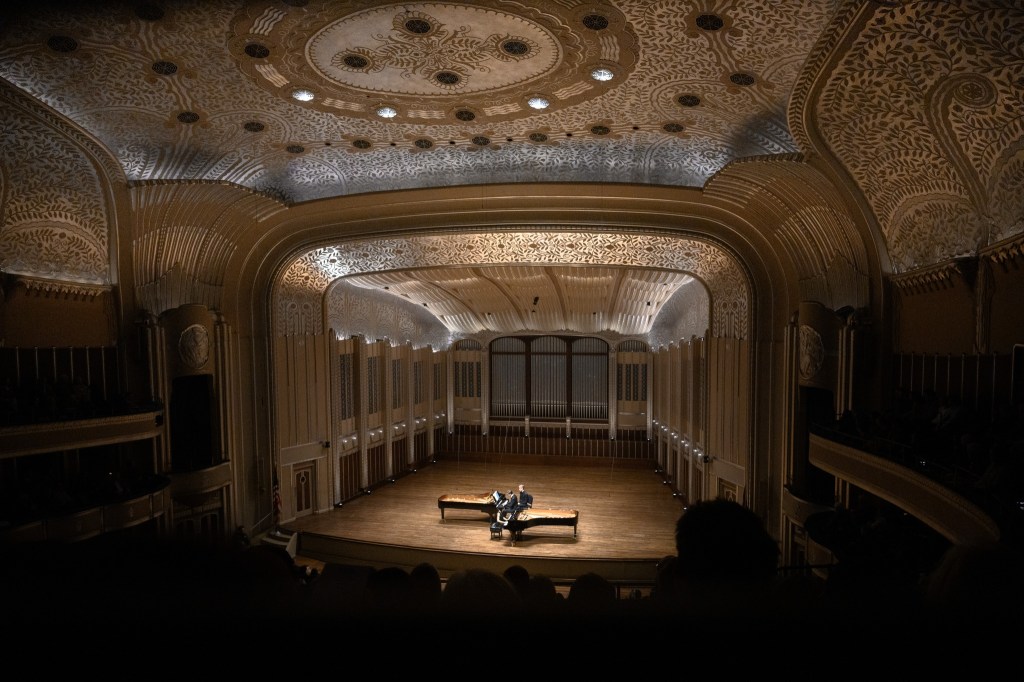
Víkingur Ólafsson makes magnificent Pittsburgh Symphony debut with impassioned Brahms

Pittsburgh Symphony Orchestra
Manfred Honeck, conductor
Víkingur Ólafsson, piano
Heinz Hall
Pittsburgh, PA
April 27, 2025

Jani: Flare
Beethoven: Symphony No. 1 in C major, Op. 21
Brahms: Piano Concerto No. 1 in D minor, Op. 15

Encores:
Rameau/Ólafsson: The Arts and the Hours
Rameau: Le Rappel des oiseaux

With a Grammy award, an extensive discography, and appearances with the world’s leading orchestras and at the most prestigious concert halls, it’s a bit surprising it’s taken until 2025 for Icelandic pianist Víkingur Ólafsson to debut with the Pittsburgh Symphony. It was worth the wait, however, as he treated Pittsburgh audiences to an arresting, majestic performance of Brahms’ brooding First Piano Concerto (though he was originally scheduled to perform the Second Concerto).
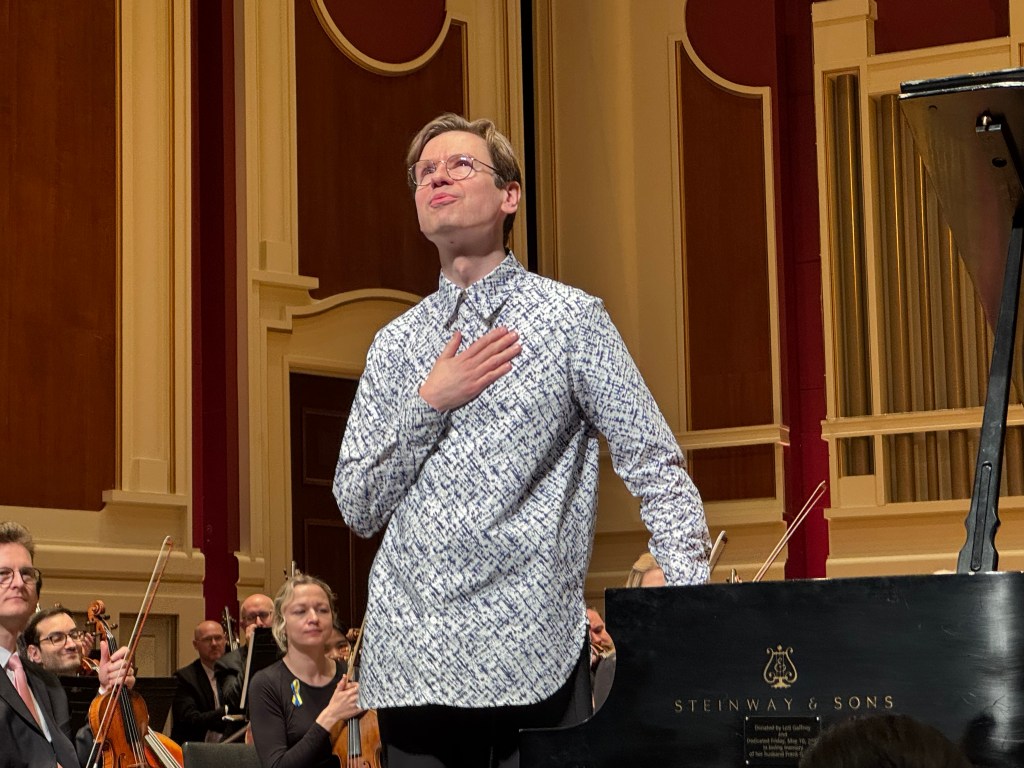
Víkingur Ólafsson at the Pittsburgh Symphony

There was dramatic tension from bar one, with a dark and impassioned orchestral introduction. Ólafsson entered by way of a dulcet chorale, scaling to ferocious tremolos. He purveyed a bold and commanding tone, showing that music of great technical demands can be wholly devoid of showy virtuosity. A thoughtful and probing interpreter, Ólafsson’s absorption in the music was absolute, even bobbing his head during the orchestral interludes like a bona fide rockstar before the expansive first movement reached a bleak, uncompromising close.

The central Adagio was plaintive and filled with longing, and the pianist’s deft voicing and phrasing brought out a resonant lyricism. A ferocious fugato marked the closing rondo finale, with both pianist and orchestra seemingly running on endless reserves of dramatic energy. From the piano bench, Ólafsson eyed his orchestral colleagues with joy and admiration — there was some impressive contrapuntal playing to be heard — and the long journey pointed to a triumphant end.

With charismatic charm, Ólafsson addressed the audience and expressed his gratitude to be in Pittsburgh, reminiscing how impressed he was by the PSO’s playing when he caught them during a performance in Berlin in 2013 (reviewed by a colleague here). He generously offered a pair of encores, both by Rameau — his own transcription styled as The Arts and the Hours from Rameau’s final opera (Les Boréades), and the intricate gem Le Rappel des oiseaux. An impressive way to cap off the most significant local debut of the season.

The program began with the 2021 work Flare by German composer Sophia Jani. Loosely drawing inspiration from the poetry of Mary Oliver, Flare was of a colorful soundscape. Clangorous brass formed the backbone of the work, building to bold climaxes in a style that seemed to be a nod towards film scores.

Beethoven’s First Symphony rounded off the program — if there’s a connective thread, all three works program were by German composers, and all counted as one of their composers’ earliest forays into writing for orchestra. A work very much in Manfred Honeck’s wheelhouse, the weight of the introductory material in the youthful C major symphony gave way to buoyant textures that effervesced — though the development was not without fire and drama. The slow movement was articulate with careful detailing of the rhythmic inflections. Wholly at peace and untroubled, but contrasts were sharpened to add tension. A minuet sparkled with exuberance, a warmup for the boisterous finale, with perhaps the occasional hint to the dramatic style the composer would soon develop.
Ólafsson and Wang dazzle in spectacular two piano recital

Yuja Wang, piano
Víkingur Ólafsson, piano
Mandel Concert Hall
Severance Music Center
Cleveland, OH
February 23, 2025

Berio: Wasserklavier (No. 3 from Six Encores)
Schubert: Fantasie in F minor, D940
Cage: Experiences No. 1
Nancarrow: Study No. 6 (arr. Adès)
Adams: Hallelujah Junction
Pärt: Hymn to a Great City
Rachmaninoff: Symphonic Dances, Op. 45

Encores:
Brahms: Waltz in A-flat major, Op. 39 No. 15
Dvořák: Slavonic Dance in E minor, Op. 72 No. 2
Brahms: Hungarian Dance No. 1 in G minor
Brahms: Waltz in E major, Op. 39 No. 2
Brahms: Waltz in G-sharp major, Op. 39 No. 3

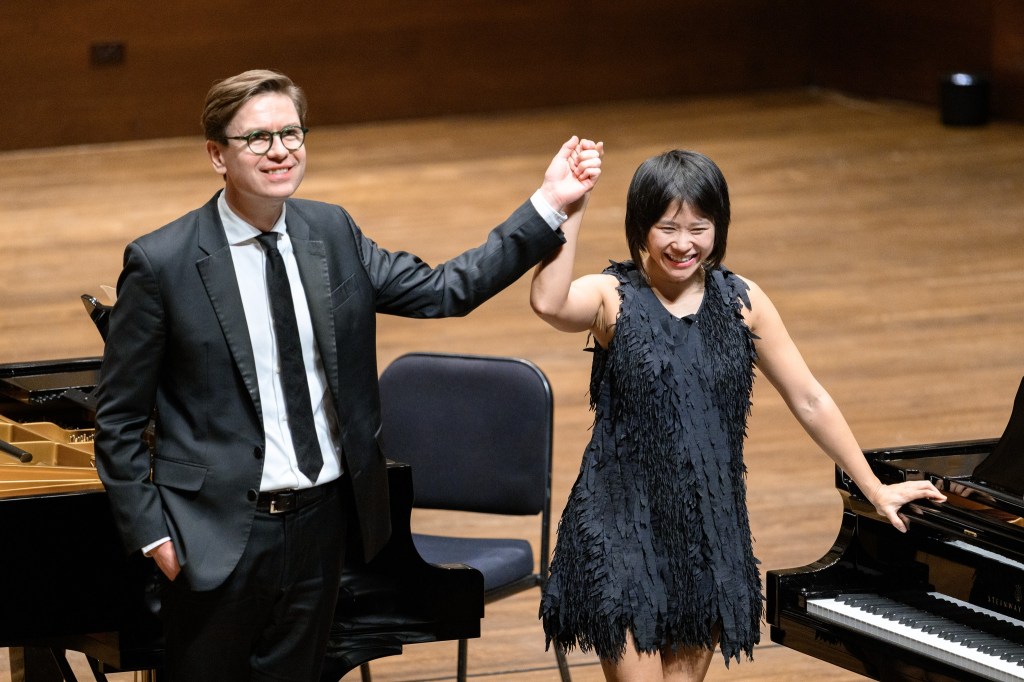
Sunday afternoon marked a remarkable high point in The Cleveland Orchestra’s immensely rewarding recital series, with pianists Yuja Wang and Víkingur Ólafsson joining forces in a stop at Severance Hall on a brief US tour. Both superstar soloists in their own right, it was truly electrifying seeing these two band together. Yet this was more than just a celebrity pairing calculated to maximize box office receipts: their artistic temperaments complemented each other well, showing the whole can be greater than the sum of its parts.

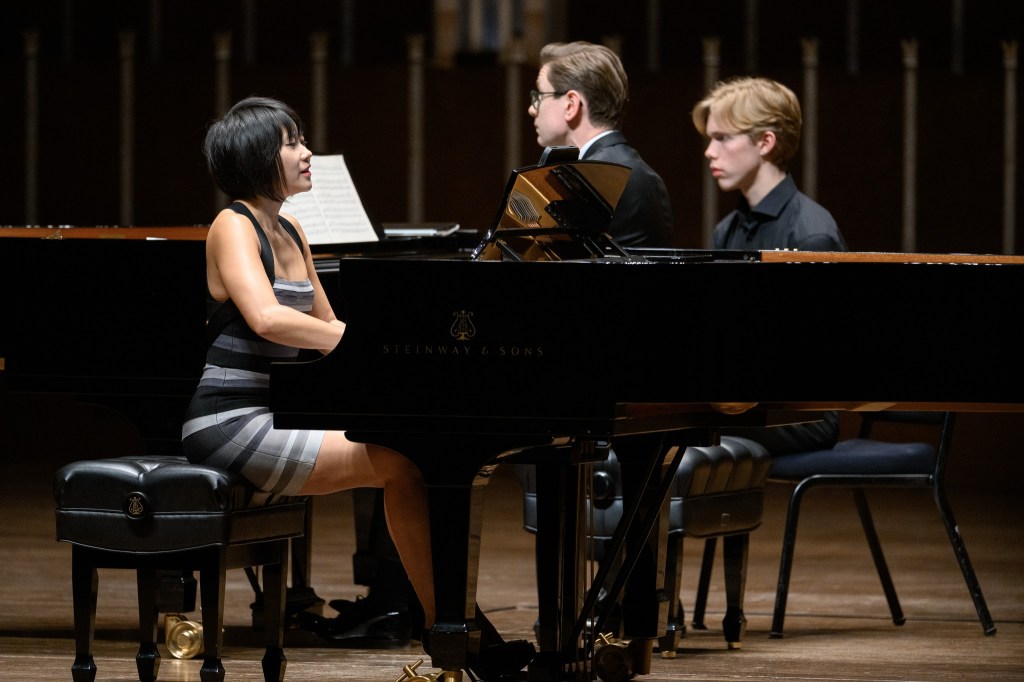
Víkingur Ólafsson and Yuja Wang at Severance Hall, photos credit Human Artist Photography + Cinema 

The program was ripe with discovery, skirting some of the more commonly played fare for two pianos. Luciano Berio’s Wasserklavier began, a meditative opening with liquescent textures freely flowing. The piece made subtle nods to Brahms and Schubert, and fittingly, the pianists artfully segued directly into the latter’s own Fantasie in F minor. Usually played four hands on a single piano, hearing it spread across two instruments gave the work a greater resonance and depth of sound.

Crisply articulated dotted rhythms began, plunging into penetrating drama — rarely will one hear Schubert played with such intensity. Dance-like sections contrasted, exuding joy with the twenty fingers at work, intricately choreographed. A fascinating selection of works from the late 20th-century followed, beginning with John Cage’s Experiences No. 1. The composer’s characteristic minimalist textures were piquantly harmonized, punctuated by silence.

The sixth of Conlon Nancarrow’s 49 studies for player piano followed, made humanly playable in its two-piano arrangement by Thomas Adès (who local concertgoers had the chance to see conduct a remarkable Cleveland Orchestra program just the night before). In this case, the two pianos seemed to be at odds with one another, yet the jagged rhythms fit together in interlocking fashion.

The first half closed with John Adams’ Hallelujah Junction, to my mind, the highlight of the program. Pulsating energy filled Severance Hall with pianistic brilliance. Music of almost perpetual motion — quite a contrast to the minimalism of Cage — gave a larger-than-life portrayal of the namesake town on the California-Nevada border, and demonstrated in no uncertain terms the electric chemistry between these two pianists. The more lyrical pulses of a downtempo section captivated in their rhythmic intricacies, only to build back up to a dazzling density of sound.

Arvo Pärt’s Hymn to a Great City was marked by Wang’s playing in the upper register that rang with the purity of bells, and some delicate filigree that decorated the otherwise barren textures. Rachmaninoff’s Symphonic Dances — his final work — closed the printed program. Hammering out the main theme with pile-driving intensity, an almost manic energy between the two created a rich orchestral sonority. Yet matters were still clear and articulate, with a contrasting theme of haunting lyrical beauty. Sultry waltz rhythms in the central dance were given with stylish playing, and the finale was bold and grandiose, with broad gestures cascading spectacularly.

No less than five encores followed, a delightful selection of dances by Brahms and Dvořák, performed on a single piano, four hands. A charming, convivial close to a memorable afternoon.