Academy of St. Martin in the Fields players delight in an evening of chamber music

Academy of St. Martin in the Fields Chamber Ensemble
Tomo Keller, violin
Harvey De Souza, violin
Robert Smissen, viola
Richard Harwood, cello
Lynda Houghton, double bass
Timothy Orpen, clarinet
Julie Price, bassoon
Stephen Stirling, horn

Southern Theatre
Columbus, OH
November 4, 2023

Nielsen: Serenata in vano, FS 68
Dvořák: String Quintet No. 2 in G major, Op. 77
Beethoven: Septet in E-flat major, Op. 20

Eight members of the illustrious Academy of St. Martin in the Fields made their way to Columbus Saturday evening for a varied program of chamber music. Matters began with Carl Nielsen’s Serenata in vano (“Serenade in Vain”), a quintet scored for the unusual combination of clarinet, bassoon, horn, cello, and double bass – an instrumentation that intentionally overlaps with that of the Beethoven Septet with which it was written to be paired, as was indeed the case at present.
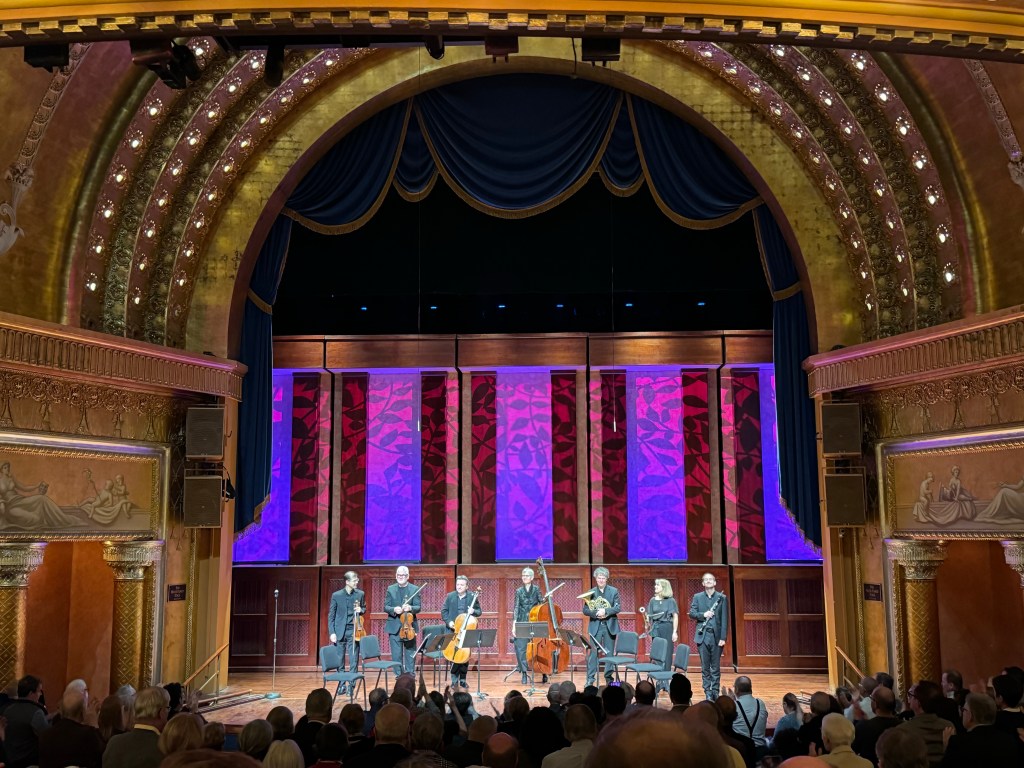
ASMF Chamber Ensemble at the Southern Theatre

Pizzicato strumming in the strings underpinned the dominant clarinet (Timothy Orpen) melody (Nielsen was certainly a composer who knew how to write for clarinet, as epitomized by the significant Clarinet Concerto). The cello (Richard Harwood) was later granted a richly singing melody, enhanced by the warmth of the horn (Stephen Stirling). A lovely opener that showcased the individual personality of each instrument.

Dvořák’s String Quintet No. 2 in G major was a watershed work for the composer, capturing the attention of Brahms and vastly expanding his reputation. Like the Eighth Symphony in the same key that would follow some years later, it’s a warm and bucolic work, the jovial first movement in particular being given with flexible abandon, and always lyrical at heart – even during the heightened drama and tension of the development. The inclusion of double bass in place of the a second viola or cello as is more typical for a string quintet gave the work an added heft.

The scherzo was noted for its Bohemian inflections in its rhythmic vitality – a device that would become one of Dvořák’s signatures. The flowing, lyrical melody of the slow movement showed the quintet in deft balance, as they were perhaps even more so in the joyous finale that brought the first half to an energetic close.

Like the preceding, Beethoven’s Septet was a work that did much to enhance its composer’s renown. Following a bold, quasi-orchestral introduction, delicate filigree from violinist Tomo Keller served to bridge the elegant main theme. The Adagio cantabile boasted a long-breathed melody, first in the clarinet and then answered by the violin, while the horn and bassoon interlocked with an intricately-crafted countermelody. A bouncy minuet followed, perhaps more familiar from its use in the Op. 49 No. 2 piano sonata.

A theme and variations comprised the fourth movement, with a stately presentation of the theme preceding an increasingly florid set of embellishments. The mournful intro of the finale took the manner of a funeral march (a style the composer would often revisit), but quickly gave way following some fiery violin work, with the ensemble offering cohesion and chemistry even at its blistering Presto.
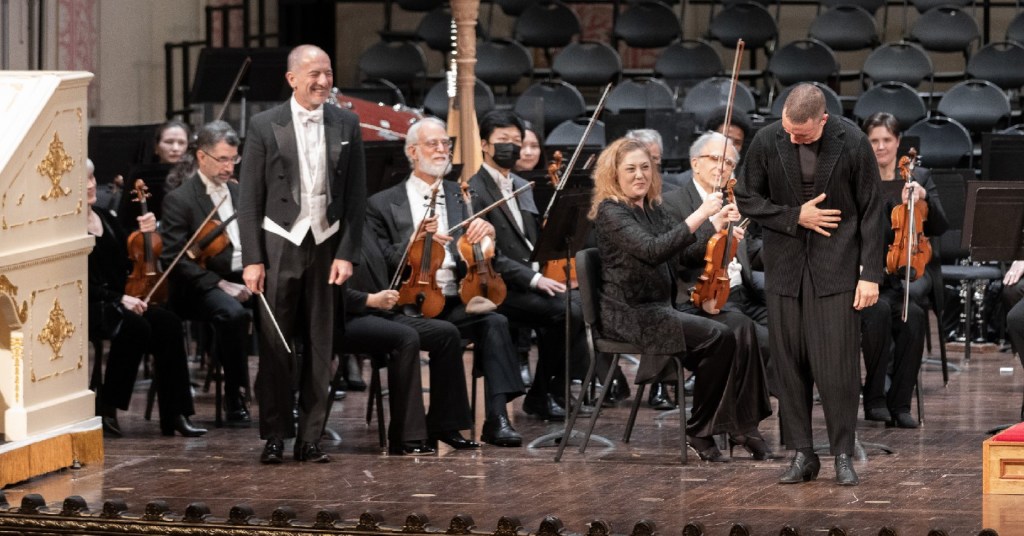
Columbus Symphony, Chorus, and soloists deliver a riveting Glagolitic Mass

Columbus Symphony Orchestra
Rossen Milanov, conductor
Cameron Carpenter, organ

Abigail Rethwisch, soprano
Mariana Karpatova, mezzo-soprano
Jonathan Burton, tenor
Adam Cioffari, bass

Columbus Symphony Chorus
Ronald J. Jenkins, chorus director

Ohio Theatre
Columbus, OH
November 18, 2022

Nielsen: Overture to Maskarade
Poulenc: Organ Concerto in G minor, FP 93
Janáček: Glagolitic Mass

For the final subscription program of the calendar year, the Columbus Symphony served a fascinating program of three compelling yet infrequently heard works – the latter two which made use of the Ohio Theatre’s opulent Morton organ. The overture to Carl Nielsen’s ebullient opera Maskarade was of insouciant charm, with playing lithe and stylish for an energetic curtain-raiser.

Rossen Milanov, Cameron Carptener, and the Columbus Symphony, photo credit Corinne Mares

Composed 1934-38, Poulenc’s Organ Concerto is a product of the composer’s characteristic neoclassicism, but of a darker, more serious orientation than that employed in his earlier keyboard concertos – namely, the Concert champêtre and the Concerto for Two Pianos, works charming if a bit saccharine. The work is constructed as a single movement, though subdivided into seven discrete sections. It was a special treat to hear the Morton organ, and soloist Cameron Carpenter took masterful command of the instrument. A commanding opening for organ alone invoked the gravitas of Bach, but the lighter section that followed unmistakably bore Poulenc’s neoclassical stamp. A languid Andante moderato, by far the longest section, offered ample contrast.

Carpenter was assertively committed to utilizing the full possibilities of the Morton organ (and spoke in reverence of it during the pre-concert conversation), but one wondered how the piece would have come across differently had a more traditional concert hall organ been available (even in the more serious passages, to my ears the instrument inevitably invoked silent film accompaniment). A dramatic return of the opening material came in the final section before matters were distilled to hymn-like material – suggesting the composer’s reinvigorated interest in Catholicism at the time – and decorated with a delicate passage for solo viola, all a peaceful diversion before the bold closing statement. Carpenter returned with an encore that showed his sterling technique and exploited the instrument’s color and dramatic range.

Janáček’s Glagolitic Mass is a major artistic statement coming from the twilight years of the composer’s life. A setting of the mass in vernacular Czech, it is imposingly scored for large orchestra, organ, chorus, and a quartet of vocal soloists. Cast in eight movements, the first and final are for orchestra alone, the penultimate for organ alone. The opening orchestral introduction was a brassy call to attention, introducing an angular theme in Janáček’s rarefied musical language. In Gospodi pomiluj, the chorus entered as a pious contrast to the bracing orchestra, only to grow in urgency with the addition of soprano Abigail Rethwisch.

Slava was comparatively brighter, with the chorus impressive in negotiating the complexities of both the work itself and of the Czech language. Striking too was the use of organ and the composer’s unique use of the orchestral resources at hand. Jonathan Burton added a lyrical tenor to the extensive Věruju, and an organ interlude anticipated the solo movement to come. Adam Cioffari offered a resonant bass, finely complementing the richness of the chorus. Svet was by turn more pensive, with a touching solo line from concertmaster Joanna Frankel, and all four soloists in concert. That the seventh movement would be scored for organ alone underscored the importance of the instrument to the work; intensely dramatic, it was a further chance for Carpenter to shine, and the orchestra was subsequently given the last word in an ecstatically powerful final statement.

Blomstedt and Cleveland Orchestra stellar partners in Nielsen and Beethoven

Cleveland Orchestra
Herbert Blomstedt, conductor
Mandel Concert Hall
Severance Music Center
Cleveland, OH
February 12, 2022

Nielsen: Symphony No. 4, Op. 29, The Inextinguishable
Beethoven: Symphony No. 5 in C minor, Op. 67

An appearance from the remarkably indefatigable Herbert Blomstedt is virtually guaranteed to yield stupendous results, and Saturday night’s performance was certainly no exception. The Swedish-American conductor paired major symphonies of Nielsen and Beethoven, the same two composers which comprised his debut program with this orchestra in April 2006. It’s a fitting coupling to be sure, both composers major symphonists of their respective generations, and in the present case, both works employed a progressive tonality, taking the listener on a journey to a distant destination rather than coming full circle.

Herbert Blomstedt and The Cleveland Orchestra, photo credit Roger Mastroianni, courtesy of The Cleveland Orchestra

Nielsen’s musical language can be somewhat intractable and austere, but The Cleveland Orchestra is well-equipped for the challenge. A compelling performance of the Fifth Symphony was given a few seasons ago, and this weekend the orchestra rose to the task even more under Blomstedt’s incisive guidance. The clangorous introductory material was given with clarity and inexorable drive. Nielsen’s palette is resolutely tonal though craggy and unforgiving; some respite was to be had when the conductor coaxed a piquant lyricism from the woodwinds. Despite the first movement’s busyness, matters closed in a simple grandeur, with the pulsating of the timpani foreshadowing their role to come.

The gentle and folksy nature of the Poco allegretto seemed to take its cue from the analogous movement of a Brahms symphony. Dulcet clarinets were the highlights in this movement scored for winds alone, occasionally buttressed by touches of pizzicato strings. Pained and discursive strings opened the slow movement. A lyrical dialogue was had between concertmaster Peter Otto and principal viola Wesley Collins before the material built to a stentorian climax. The finale opened in rapid-fire energy and the dueling timpanists (Paul Yancich and Tom Freer) on opposite ends of the stage were to thrilling effect. Blomstedt has an uncanny ability to get the expansive orchestra to morph into a single organism, and nowhere was this more apparent than in the unambiguously triumphant ending.

It’s a great challenge to make Beethoven’s Fifth – surely the most frequently performed symphony in the repertoire – sound more than merely routine, but Blomstedt certainly did. This weekend also served as something of a capstone to his memorable all-Beethoven program presented at Blossom last summer. The Allegro con brio was commanding and authoritative, its energy taut, focused, and searingly intense. Long, flowing lines in the low strings brought out the warmth of the slow movement with thoughtful contrasts illuminating the double variation structure. The scherzo, though weighty in its own right, served as something of a preface to the grandiose finale, a glorious race to the finish line of this archetypal journey from darkness to light.