Pittsburgh Symphony rings in holiday season with a joyous Messiah

Pittsburgh Symphony Orchestra
Manfred Honeck, conductor

Mendelssohn Choir of Pittsburgh
Daniel Singer, director

Jeanine De Bique, soprano
Reginald Mobley, countertenor
John Matthew Myers, tenor
Joshua Hopkins, baritone

Heinz Hall
Pittsburgh, PA
December 7, 2024

Handel: Messiah, HWV 56

If there’s a sign the holiday season is upon us, surely it would be a performance of Handel’s timeless oratorio Messiah — although it’s worth remembering that its first performance coincided instead with Easter. Buttressing Manfred Honeck and the Pittsburgh Symphony was the Mendelssohn Choir and a quartet of vocal soloists — two of which along with the Choir were featured in the previous night’s performance of the Fauré Requiem.
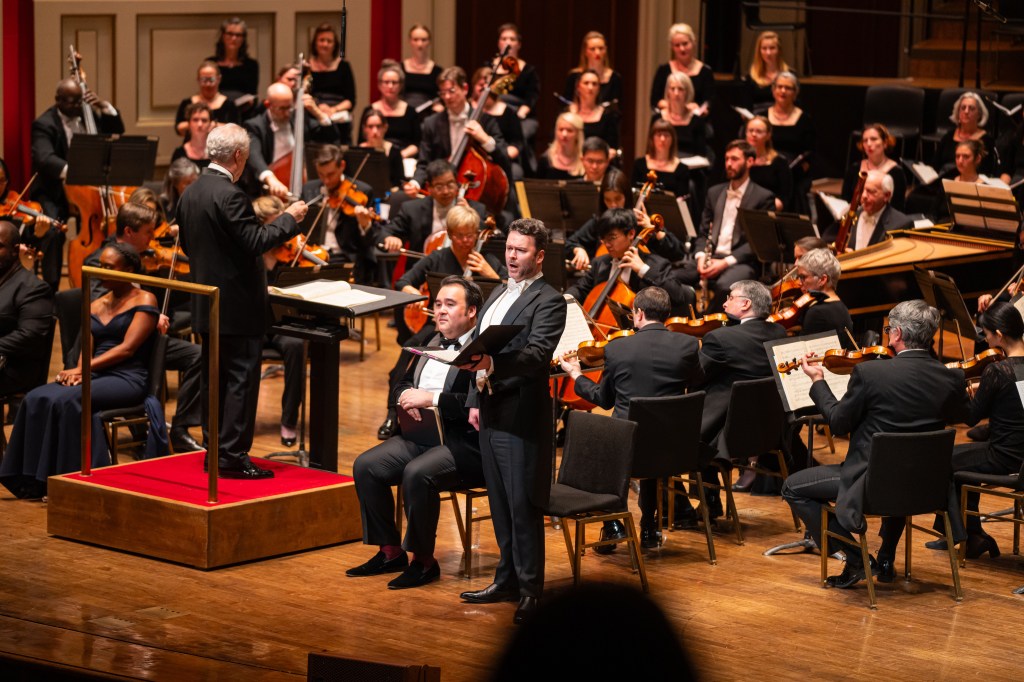
Reginald Mobley (cropped), Jeanine De Bique, John Matthew Myers, and Joshua Hopkins perform with Honeck and the PSO. Photos credit Josh Milteer / Pittsburgh Symphony Orchestra

As is often done, cuts were made to the present performance with Honeck artfully selecting 41 of the 53 segments for a brisk 90 minutes of music. The opening Sinfonia for orchestra alone was crisply articulated, a stern, minor-key affair in sharp contrast from the exultant quality of most of the work. Tenor John Matthew Myers had the first vocal appearance of the evening in “Comfort ye, my people,” purveying a smooth, lyrical tone that was comforting indeed.

Baritone Joshua Hopkins maintained an imposing vocal presence, apparent from his entry in the recitative “Thus saith the Lord.” A highlight of the generally more introspective Part II of the work came in Hopkins’ aria “Why do the nations so furiously rage” — and one longs for a year when this isn’t so topical. “The trumpet shall sound” from the third and final part was fittingly bright with tenor and trumpet in clarion conversation.

Reginald Mobley offered a flexible countertenor, wide in range and elastic in melisma. “Behold, a virgin shall conceive” saw him in delicate dialogue with the principal strings and continuo. All selections that featured the soloists were for a single performer, save for “O death, where is thy sting?” which engaged Mobley and Hopkins in duet. Their voices blended harmoniously — a pity there weren’t more opportunities to hear the quartet in concert with each other.

Appearing for the first time near the end of Part I was soprano Jeanine De Bique, delicate and nuanced. She was particularly angelic in Part III’s aria “I know that my Redeemer liveth,” decorated in tinsel by high and strings and organ. “If God be for us” was a poignant and intimate moment ahead of the exuberant close, with solo passages from the concertmaster and cello touchingly decorating the soprano’s vocal line.

Of course the star of any Messiah performance is the chorus, and the Mendelssohn Choir delivered in spades. “And the Glory of the Lord,” marked their entry, delivering with clarity the intricate, multi-layered choral writing. The Hallelujah chorus, recognizable far beyond the confines of the concert hall, was festive and bright, and the audience followed the time-honored tradition of rising to their feet. “Worthy is the Lamb” closed the evening in the brilliance and weight of the full ensemble.
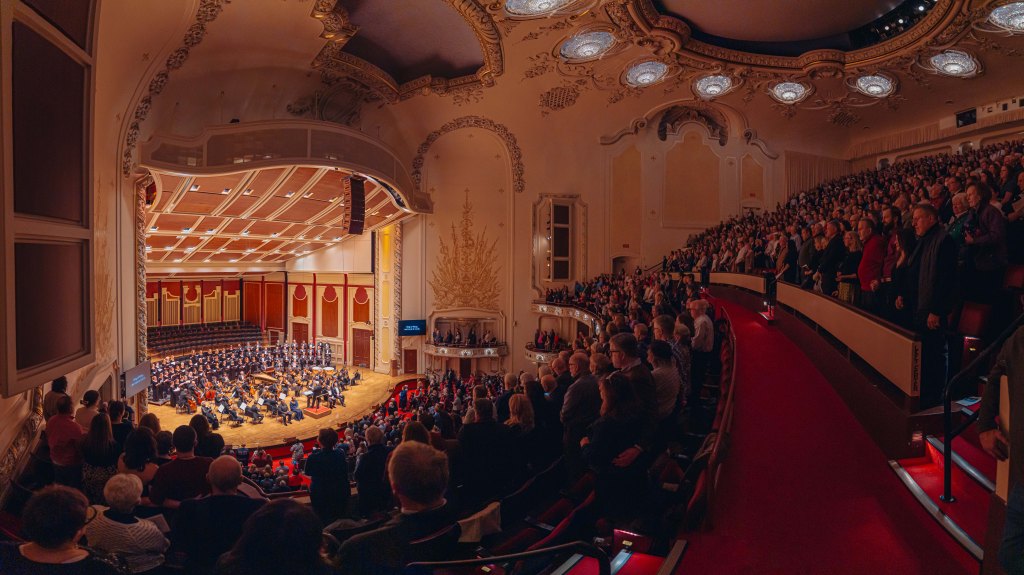
The PSO performs Handel’s Messiah at Heinz Hall

VIVO closes festival in style with French repertoire, Choi premiere

Alicia Hui, violin †
Siwoo Kim, violin †‡
Henry Kramer, piano *‡
Jeffrey Myers, violin *
John Stulz, viola *†
Alice Yoo, cello *
Matthew Zalkind, cello †‡
Gabriel Campos Zamora, clarinet †

* Fauré / † Choi / ‡ Ravel

Southern Theatre
Columbus, OH
September 4, 2022

Fauré: Piano Quartet No. 1 in C minor, Op. 15
Choi: With Winds III
Ravel: Piano Trio

VIVO Music Festival closed the eighth edition of its annual chamber music celebration Sunday afternoon at the Southern Theatre, an event which also served to unofficially open Chamber Music Columbus’ banner 75th season. As with all of the elder organization’s upcoming concerts, Sunday’s included a newly commissioned work, as well as poem from the season’s poet laureate, Jennifer Hambrick – known to listeners of WOSU, as well as the host of VIVO’s “Beer & Beethoven” held a few nights prior. Hambrick’s entry “Stones to join the mountain with the rock” fit the spirit of the occasion, the joining of forces of two very fine chamber music organizations.

L-R: Jaehyuck Choi, Jeffrey Myers, John Stulz, Gabriel Campos Zamora, Alicia Hui, Alice Yoo, Siwoo Kim, Henry Kramer, Matthew Zalkind. Photo credit VIVO Music Festival

Fauré’s Piano Quartet No. 1 boasted dark-hued, dramatic beginnings, rather Brahmsian in persuasion, with the virtuosic piano writing and its tumultuous octaves (Henry Kramer) a standout. The scherzo was markedly more Gallic and of irresistible charm, while the Adagio was a gorgeous respite, with a particularly affecting and resonant cello line (Alice Yoo). The finale recalled the virtuosity of the beginning to bring the opening selection to an enthusiastic close.

South Korean composer Jaehyuck Choi was present to introduce his clarinet quintet With Winds III, the first of Chamber Music Columbus’ seven commissions to come to life. A taste of Choi’s work was sampled at the aforementioned Beer & Beethoven event in which violinist Alicia Hui performed his Self in Mind I. In addition to VIVO, violist John Stulz also counts himself a member of the Paris-based new music group Ensemble intercontemporain, and it was there he first became acquainted with Choi. Choi’s commission served as a tribute to CMC’s founder James N. Cain, and moreover, the clarinet quintet medium was apropos as one of the organization’s first performances featured the Walden Quartet with clarinetist Donald McGinnis. Choi spoke of finding influence from contrasting works of visual arts, a thread he discussed at length during my interview with him a few months prior.

Terse, rapid gestures in the strings opened, punctuated by a long-breathed tone in the clarinet (Gabriel Campos Zamora), emblematic of the work’s near obsession with pointed contrasts. The work’s dense textures made substantial use of extended techniques, pushing the capabilities of both the musicians and their instruments alike. A passage cast in the violin’s highest possible range was otherworldly in effect, while a mute in the clarinet provided yet another striking sonority in work’s final segment before matters evaporated into silence.

The afternoon closed with Ravel’s remarkable Piano Trio. The opening Modéré was dreamy and evocative, with the performers adroitly negotiating the 8/8 meter – suggestive of the Basque zortziko – complexities that felt all but effortless in this musical conversation amongst friends. What followed was a rare scherzo from Ravel, its gossamer textures almost like a work of Saint-Saëns. The Passacaille easily serves as the heart of the work, searching probing depths. A solemn statement, it was a juxtaposition of the austere and the deeply felt. Decorative filigree was abundant in the finale, given with meticulous attention to detail, and the self-assured piano in particular pointed towards a big-boned finish.