Gardner and Denk deliver inspired performances at Mostly Mozart

Mostly Mozart Festival Orchestra
Edward Gardner, conductor
Jeremy Denk, piano
David Geffen Hall
Lincoln Center
New York, NY
July 29, 2017

Mozart: Masonic Funeral Music, K477
Beethoven: Piano Concerto No. 4 in G major, Op. 58
 Encore:
 Mozart: Piano Sonata No. 16 in C major, K545 – 2. Andante
Schubert: Symphony No. 5 in B flat major, D485

A New York summer tradition for over half a century, the Mostly Mozart Festival is a paean to not only its eponymous composer, but as the name suggests, those who bore his influence.  Saturday night’s program embodied just that with music of Mozart prefacing works by Beethoven and Schubert that exuded a quintessentially Mozartean classicism.  At the podium was the probing English conductor Edward Gardner who opened the evening with a user-friendly introduction, explicating the connections between the selections on the program.
168-colour-hi-res-E-Gardner-28June2016-c-B-Ealovega
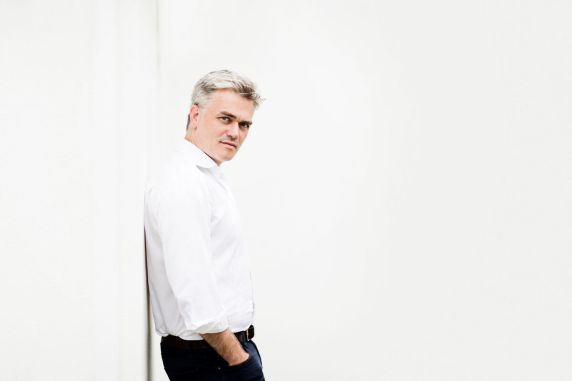
Edward Gardner, photo credit Benjamin Ealovega
The only work from Mozart’s pen on the printed program was a certified rarity, namely the Masonic Funeral Music.  In his remarks, Gardner noted the enlarged wind section – inclusive of basset horns and the contrabassoon – and humorously commented that this orchestration was perhaps well-suited to Tony Bennett.  He then demonstrated the work’s striking interpolation of a Gregorian chant, aptly describing it as of an “astounding resonance.”  Gardner’s reading was deftly balanced, exuding a funereal pathos that anticipated the Masonic passages in The Magic Flute, and made a case for more frequent hearings of this finely-crafted gem.

The heart of the program was Beethoven’s genial Piano Concerto No. 4 in G major, which brought forth the charismatic soloist Jeremy Denk.  Denk’s unaccompanied entrance was of a dreamy serenity, and bell-like clarity of tone.  His fingers spun a wondrously flowing melodic line, and not at the expense of plumbing the intensity of the work’s more dramatic moments.  Denk and Gardner were a somewhat unusual coupling; while the pianist was patently idiosyncratic, often looking out into the audience with closed eyes, and playing with a remarkable (perhaps too remarkable) flexibility, Gardner was much more straight-laced.  In spite of the incongruity of their approaches, their results were largely inspired, and Gardner’s sensitive accompaniment was adroitly balanced with the piano.

Denk began the first movement’s cadenza unassumingly, only to soon fill the depths of the Geffen Hall with resound.  Agitated strings opened the Andante con moto, in due course calmed by the beauty of Denk’s chordal passages.  The jocular concluding rondo was elegant yet down to earth, pearly and effervescent even through the minor key episodes.  Denk obliged the enthusiastic audience with an encore by – you guessed it – Mozart, the slow movement from the Piano Sonata in C major, K545, familiar to any young piano student.  Under Denk’s hands, this was a study in poise and refinement.

While Schubert looked ahead to Romanticism in his tempestuous Fourth Symphony, the Fifth was quite to the contrary: a glance backwards towards his classical antecedents.  The Festival Orchestra delivered the opening movement with a blended and homogeneous sound, opting for the repeat of the graceful exposition, and Gardner guided orchestra and audience alike through development’s exploration of distant keys with aplomb.  Gorgeous tones seemed to pour from Gardner’s baton in the slow movement, highlighted by an especially fine flute solo from Jasmine Choi, who that evening treated concertgoers to a pre-concert recital with pianist Roman Rabinovich.  A bit more fire was introduced in the minuet, though not without a certain joviality.  The finale was taken at a brisk pace, a beaming Haydnesque wit tempered by Mozartean drama, a fitting way to close Schubert’s lovely tribute to his predecessors.

Andsnes and Hamelin dazzling in two piano recital

Leif Ove Andsnes, piano
Marc-André Hamelin, piano
Symphony Center
Chicago, IL
April 30, 2017

Mozart: Larghetto and Allegro in E-flat Major for Two Pianos
Stravinsky: Concerto for Two Pianos
Debussy: En blanc et noir
Stravinsky: The Rite of Spring

Encores:
Stravinsky: Madrid for Two Pianos from Four Studies for Orchestra (transc. Soulima Stravinsky)
Stravinsky: Circus Polka for Two Pianos (transc. Babin)
Stravinsky: Tango for Two Pianos (transc. Babin)

It is a rare opportunity indeed to see not one, but two of the world’s leading concert pianists on stage together.  This was fortunately the case Sunday afternoon, when Marc-André Hamelin and Leif Ove Andsnes stopped at Symphony Center as part of a 13-city tour of a bracing program that explored music for two pianos.  Their partnership goes back a decade when they performed the two piano version of The Rite of Spring at the Risør Chamber Music Festival, where Andsnes served as artistic director.  Not three weeks prior to the Chicago performance, the pair finally recorded the piece for Hyperion along with additional works of Stravinsky for the same medium also featured in the recital, and one is grateful this inspired collaboration has been preserved on disc given the pair’s absolutely electric chemistry.

01ANDSNES-superJumbo
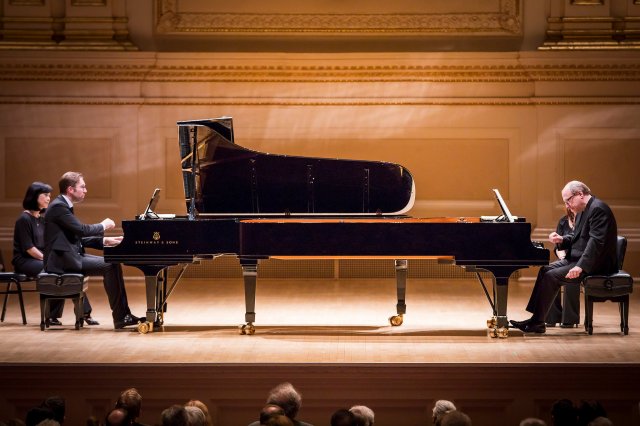
Andsnes and Hamelin presenting the same program at Carnegie Hall, two days prior to their Symphony Center appearance, photo credit Chris Lee
The program opened unassumingly with Mozart’s Larghetto and Allegro in E flat major, with Andsnes taking the primo part in the whole of the first half.  The Larghetto was graceful but not without shades of melancholy, as in the best of the Mozart’s slow movements.  Cast in sonata form, the Allegro remained unfinished at the time of the composer’s death, and was presented in a completed version by Paul Badura-Skoda.  The sprightly main theme evidenced the duo’s rapport from the start, in what was an energetic warmup for all that was to follow.

Stravinsky’s Concerto for Two Pianos is a substantial if neglected work from his neoclassical period, written for him and his son Soulima to play together, and one couldn’t have asked for better advocates in Andsnes and Hamelin.  The first movement was of bold, sweeping gestures, delivered with a knife-edged acerbity.  The delicate ornamentation in the ensuing “Notturno” gave it a mysterious charm, while contrasting sections were more march-like.  Spiky dissonances characterized much of the “Quattro variazioni”, while the finale opened with a brief but declamatory prelude to set up an intricate fugue.  The theme of the preceding variations was not heard until it was presented as the subject of the fugue – the composer had originally intended for the last two movements to be in reverse, but settled on the present ordering to give the work a more forceful ending.  And a forceful ending it certainly had!

Written in 1915, Debussy’s En blanc et noir is very much a product of the First World War.  The angular themes of the opening movement made for a striking visual effect with Andsnes and Hamelin perfectly in sync as a mirror image of each other.  The somberness of wartime was particularly apparent in the central movement, which made dissonant allusions to the Lutheran chorale “Ein’ feste Burg ist unser Gott” to depict the German enemy.  The final movement – which, perhaps significantly, was dedicated to Stravinsky – was fleet and mercurial, a stark departure in its apparent playfulness.

Stravinsky’s Rite of Spring has been heard on the same stage innumerable times from the Chicago Symphony, but hearing it on two pianos was a refreshing and altogether different experience.  It was in this version that the seminal work was first heard – an early performance involved the composer with Debussy: what a sight that must have been.  The work is actually carefully written such that it can be performed on one piano, four hands, but the decision to split it across two pianos was a wise one, not just for obvious logistical concerns, but the resonance of two instruments along with two separate sets of pedals allowed for a much greater range of orchestral effect.

Hamelin commanded the primo from here to the end of the program, opening with the famous bassoon line.  In spite of Hamelin’s attention to nuance, what’s striking in the bassoon sounded admittedly pedestrian on the piano.  This was quickly allayed, however, as “The Augers of Spring” built to electrifying orchestral sonority and power.  Despite the orchestral score not calling for piano (as Petrushka does, and quite prominently), the work sounded very natural pianistically.  The memorable performance was by and large a steel-fingered assault with hurricane-like intensity, continuing unmitigated through the final, crashing flourish.

A rousing, well-deserved ovation brought the pair back for three encores, all by Stravinsky.  “Madrid” appropriately had an irresistible Spanish tinge, with a hint of the jota.  The “Circus Polka” (“we’ve prepared all these lovely things for you”, noted Hamelin in his introduction to the delight of the audience) was Stravinsky at his wittiest, replete with bitonalities (and perhaps an inspiration for Hamelin’s own “Circus Galop”).  Lastly, the “Tango” was sultry, yet not without the composer’s unmistakable stamp.  Thanks are due to both for being on hand for an engaging Q&A session following the concert, and their chemistry there was just as palpable as it was on stage.

Hamelin Andsnes
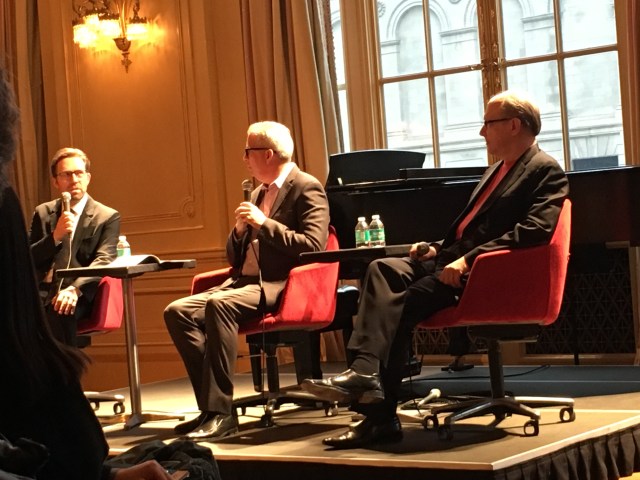
Leif Ove Andsnes, James Fahey (Director of Programming, Symphony Center Presents), and Marc-André Hamelin during the post-concert Q&A

Van Zweden, Trifonov, and the Cleveland Orchestra find fresh inspiration in Mozart and Beethoven

Cleveland Orchestra
Jaap van Zweden, conductor
Daniil Trifonov, piano
Severance Hall
Cleveland, OH
November 27, 2016

Britten: Sinfonia da Requiem, Op. 20
Mozart: Piano Concerto No. 23 in A major, K488
Beethoven: Symphony No. 5 in C minor, Op. 67

Over the Thanksgiving weekend, the Cleveland Orchestra presented a sumptuous program anchored by seminal works of Mozart and Beethoven.  After being heralded earlier this year as the New York Philharmonic’s music director-designate, all eyes have been on Jaap van Zweden.  The program played on his strengths, and even the most familiar of repertoire sounded dynamic and anew under his probing guidance.

Antwerp_JvZ1-263x200.jpg
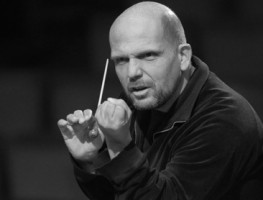
Jaap van Zweden, photo credit Bert Hulselmans

The afternoon began in somewhat less familiar territory with Britten’s Sinfonia da Requiem, a work the orchestra has not performed since the 1970s.  A triptych of succinct, interconnected movements, it encapsulates the composer’s pacifist leanings and is an important precursor to the watershed War Requiem.  The opening Lacrymosa began quite strikingly in the timpani and piano, keyboardist Joela Jones providing an unrelenting, anxious ostinato.  The oboe passages of principal Frank Rosenwein were strained and pained in a texture that built to surging brass climaxes in its ethos of despair.

Nervous flutes opened the Dies irae but the heart of the piece was in the concluding Requiem aeternam.  While in lesser hands it can sound like a plodding passacaglia, under van Zweden’s baton it was peaceful and plaintive, building to an arching lyricism in serene resolution, worlds apart from the austerity of the opening.

Mozart’s Piano Concerto No. 23 brought forth the remarkable young pianist Daniil Trifonov, who has an important connection to the city having studied at the Cleveland Institute of Music.  The concerto opened in the airy textures of the strings, with a gesture as gentle as an exhale, and it was with that naturalness the music flowed.  Trifonov’s entrance was unassuming and graceful, and he emphasized the work’s lyrical beauty and dramatic contrasts as per his propensity to the Romantic repertoire, though never in excess.  The cadenza was fleet and deftly balanced, displaying Trifonov’s astonishing dexterity.

7714
Daniil Trifonov

Cast in the relative key of F sharp minor, the slow movement was filled with longing, and the winds were almost decadent in the splendor of their singing lines.  Trifonov would often glance heavenward as if seeking some divine inspiration, fitting for music this sublime.  The sprightly rondo finale is inherently familiar to many Clevelanders, in its frequent appearances as theme music on WCLV.  Although there were shades of darkness in its minor key episodes, the overall mood was of pure joie de vivre.

Perhaps the greatest interpretative challenge of Beethoven’s Fifth Symphony is making one of the most popular pieces in the literature sound anything but trite and clichéd.  Van Zweden proved amply up to the challenge as was apparent right from the crispness of the arresting opening, in a first movement that was lean and taut.  Its violent contrasts were emphasized, keeping the audience on the edge of their seats as it seemingly could devolve into wild abandon at any moment, yet matters were always tightly controlled.

The slow movement began with some especially lovely tones in the cellos, and the interplay between the martial and lyrical themes was cleanly delineated.  I was especially struck by the clarity of the third movement’s fugato section, the contrapuntal lines weaving in and out of the strings.  The finale was an exuberant and joyous affair, and the noteworthy addition of the trombone and the piccolo heightened its sense of drama to bring the concert to a rousing close.