Dover Quartet presents decidedly American program at Chamber Music Pittsburgh

Dover Quartet
PNC Theatre
Pittsburgh Playhouse
Pittsburgh, PA
April 21, 2025

Montgomery: Strum
Fé: Rattle Songs (arr. Tate)
Tate: Woodland Songs
Dvořák: String Quartet No. 12 in F major, Op. 96, American

Closing Chamber Music Pittsburgh’s 64th season was the dynamic Dover Quartet. Challenging the Euro-centric associations one may have with the string quartet medium, the Dovers offered a thoughtful program of bona fide Americana, with a first half devoted to Black and Indigenous voices. Anchored by Dvořák’s American quartet (which one member described as his “gateway drug into string quartet playing”), the Dovers sought to explore the influences absorbed in Dvořák’s piece — an initiative that will also be captured on an upcoming recording.
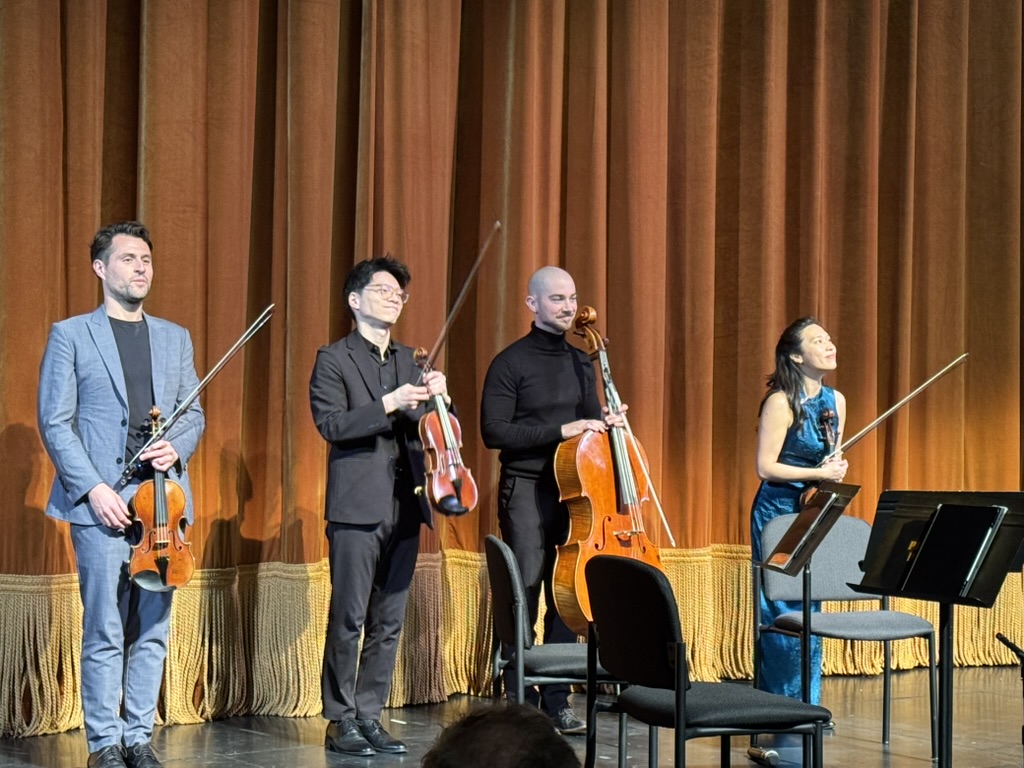
Dover Quartet at Chamber Music Pittsburgh

Jessie Montgomery’s Strum has found a prominent place in the repertoire, and for good reason given its warm appeal. The viola was strummed like a guitar at the opening, and there was colorful interplay between bowed and plucked textures.

Camden Shaw, the Dover’s cellist, found himself quite taken by the album Mahk Jchi (“Our Hearts”) from the Native American a cappella group Ulali. The album features Native songs in a strikingly modernist bent, and includes the Rattle Songs by Ulali member Pura Fé. Shaw engaged Chickasaw composer Jerod Impichchaachaaha’ Tate to arrange the songs for string quartet. Seven brief pieces were conceived as a single entity, and the folk themes were artfully woven into the fabric of the sting quartet.

Generally lyrical works, the third piece stuck out as being gritty and percussive, bringing to life the titular rattles. “Women’s Shuffle” was somewhat bluesy, and the rapid repetitions in the closing “Great Grandpah’s Banjo” were an invigorating invocation of the instrument. It speaks to Tate’s skill as a composer and understanding of the repertoire for indigenous music to be so seamlessly transformed for string quartet.

Next, we got to hear a piece from Tate himself, written on commission for the Dovers in 2024. Woodland Songs paints a portrait of five woodland animals which also have a namesake Chickasaw clan. “Squirrel” opened vigorously — and not without a certain mischief. “Woodpecker” demanded great virtuosity from the quartet, countered by the quiet majesty of “Deer.” In “Fish,” one heard a lovely pizzicato line in the high register of the cello, set amidst swells of strings. The closing “Raccoon” — the clan to which the composer belongs — capped off the work with an autobiographical statement. For those interested in hearing more of Tate’s music, the Carnegie Mellon Philharmonic will be performing his Fire and Light this Sunday (April 27) at Heinz Hall.

Completing the program was a refreshing and energetic reading of Dvořák’s American. The genial main theme first surfaced in the viola, and Dover’s light and lithe textures painted the work as a lovely paean to the Czech composer’s adopted country. Still, there was ample drama and contrasts to capture one’s attention. The Lento was delicate and deeply felt, while the Scherzo radiated insouciant charm, an ethos that continued into the finale that closed in the highest of spirits.

One might also be reminded of Chamber Music Pittsburgh’s previous concert with PUBLIQuartet which featured improvisations on this quartet. Being the season finale, the upcoming 2025-26 was revealed, which most notably, will feature a return to the Carnegie Music Hall.
Guest conductor, cellist feature in Columbus Symphony program

Columbus Symphony Orchestra
Kenneth Bean, conductor 
Tommy Mesa, cello
Ohio Theatre
Columbus, OH
May 17, 2024

Mendelssohn: The Hebrides, Op. 26
Montgomery: Divided
Tchaikovsky: Variations on a Rococo Theme, Op. 33
Beethoven: Symphony No. 2 in D major, Op. 36

The penultimate offering of the Columbus Symphony season saw a local podium debut from Kenneth Bean, currently an assistant conductor at the Princeton Symphony Orchestra (CSO music director Rossen Milanov’s other ensemble). The evening began with Mendelssohn’s Hebrides overture, a bit rushed here for my taste, not quite capturing the foggy mystery of the Scottish coast. Matters improved, however, with more measured drama, and fine solo passages from the clarinets.

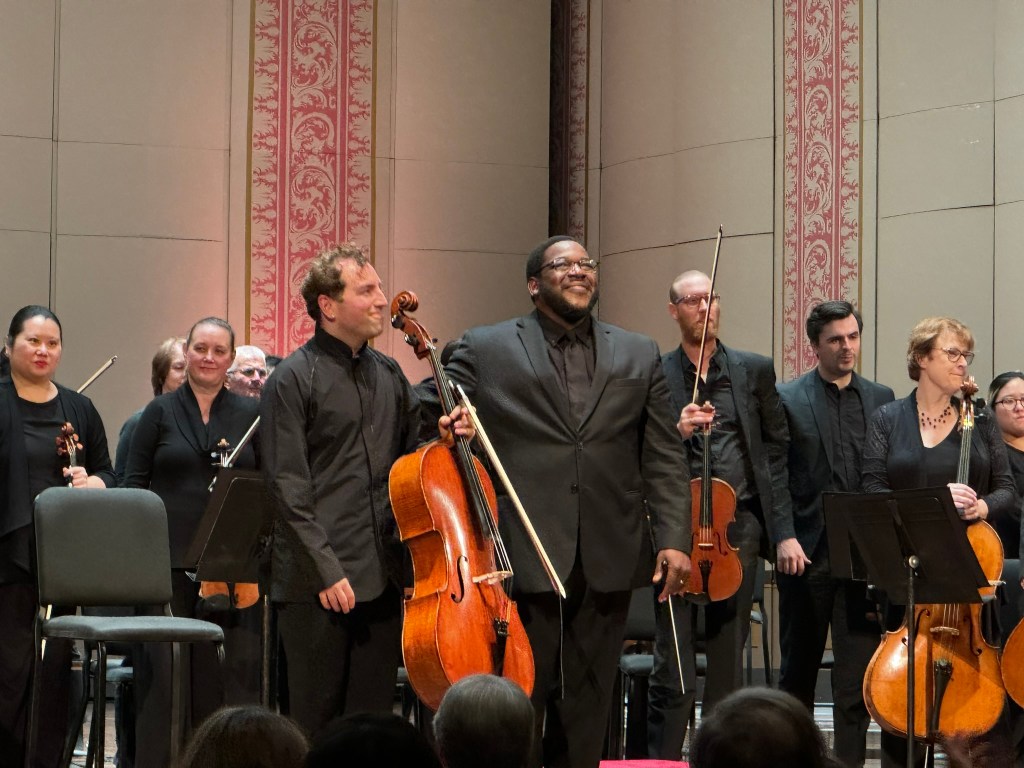
Tommy Mesa and Kenneth Bean with the Columbus Symphony

Two works for cello and orchestra followed, bringing forth Cuban-American cellist Tommy Mesa. Both works fell short of a full-fledged cello concerto, but said much in the space of their more modest dimensions. Mesa himself gave the premiere of Jessie Montgomery’s Divided with the Sphinx Ensemble at Carnegie Hall in 2022. The work’s title refers to the divisions and inequalities rampant in American society, with the cello often at grating odds with the orchestra. A drone from the soloist in the manner of a lamentation opened. The orchestra joined as if in conflict with the soloist, but the cello part became more declamatory and impassioned, a lyricism that suggested tepid resolution.

Tchaikovsky’s Rococo Variations began with an elegant presentation of the alluring theme following a brief orchestral introduction. The variations that succeeded further elaborated on the theme, and displayed Mesa’s limber technique – though his intonation at times left something to be desired. A slow variation offered contrast, and Mesa was perhaps at his best in a pensive section ahead of the ebullient conclusion.

Though still an early work, Beethoven’s Second Symphony is very much recognizable as the composer’s own, an epoch-defining musical language that had already begun to crystallize. A weighty introduction was anchored by the timpani before the first movement proper took flight with a jovial theme interwoven with drama. It was in this work that Bean seemed to gel best with the CSO. An extended Larghetto was calm and bucolic, though not quite of the heart-wrenching depths Beethoven would aspire to in his slow movements to come. The Second is noted for using a scherzo in place of the time-honored minuet, something that would certainly become one of the composer’s hallmarks, and the jocular finale brought the work to a bold finish.

Walking into paradise at the Kansas City Symphony

Kansas City Symphony
Michael Stern, conductor
Julia Bullock, soprano
Helzberg Hall
Kauffman Center for the Performing Arts
Kansas City, MO
June 3, 2023

Delius: The Walk to the Paradise Garden
Montgomery: Five Freedom Songs
Mahler: Symphony No. 4 in G major

Under the baton of music director Michael Stern, the Kansas City Symphony’s program for the first weekend of June paired the most charming of the Mahler symphonies with a certified rarity and a recent work which the ensemble co-commissioned. Frederick Delius’ The Walk to the Paradise Garden, an extended interlude from his opera A Village Romeo and Juliet, made for a lovely opener. Marked by a gentle, rising theme, there was especially fine playing from the oboe. Lush textures and surging phrases in this gem of a piece piqued my interest in exploring more Delius.

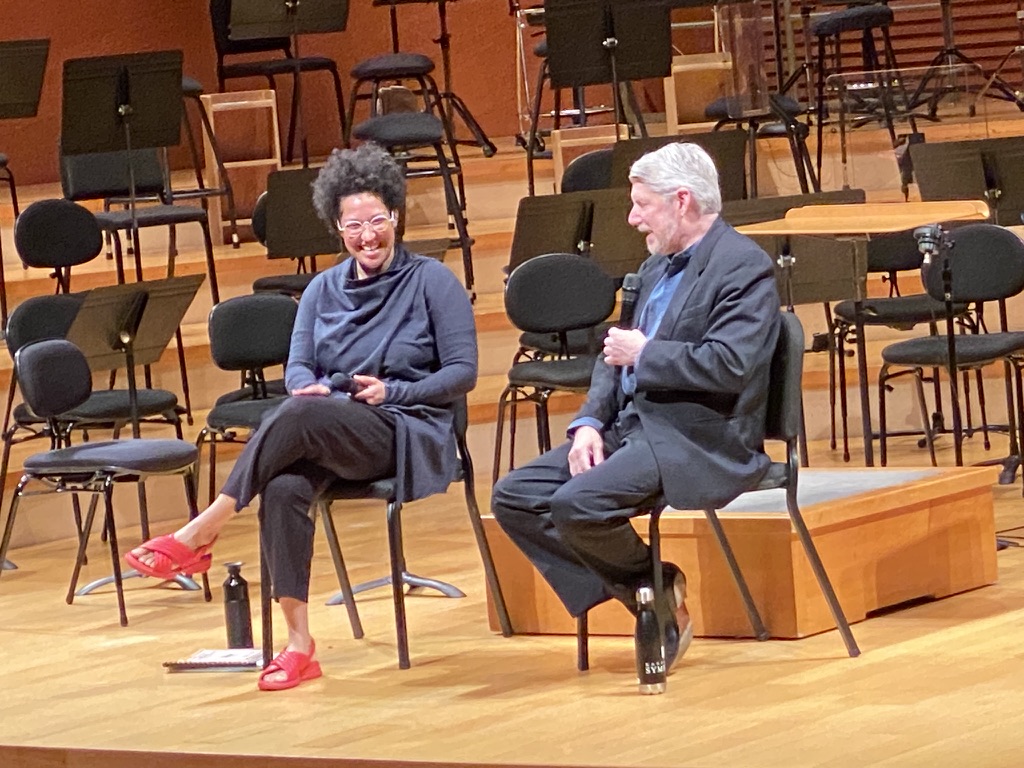
Pre-concert conversation with Michael Stern and Julia Bullock

Jessie Montgomery’s 2021 work Five Freedom Songs takes its texts from the anthology Slave Songs of the United States and featured soprano Julia Bullock, whom the composer collaborated with in the song cycle’s conception. Between Bullock being amplified and the inclusion of a drum set, it had more of the guise of a popular idiom, contrasted by the sophistication of Montgomery’s orchestration – which in the opening “My Lord, What a Morning” included the delicate addition of glockenspiel; concertmaster Jun Iwasaki’s passage in the reflective “I Want to Go Home” was fittingly wistful.

“Lay dis Body Down” amounted to a somber funeral procession, wherein different groups of instruments plodded along at different paces – not unlike something one might encounter in a Mahler symphony. “My Father, How Long?” was a work a defiance, its text emanating form a jail in Georgetown, South Carolina on the brink of revolt, a theme explored further in the closing “The Day of Judgment,” with a percussive effect achieved by the string players tapping on the body of their instruments.

Like the Delius that opened, Mahler’s Fourth Symphony depicts entry to paradise (sharply contrasted from the Montgomery which concerns the struggle to find a higher place). Bright sounds of sleigh bells opened, limpid and graceful in this tautly proportioned work – much leaner than the composer’s previous symphonies, but a work that nonetheless manages to be just as all-encompassing. Crisply articulated, Stern purveyed a rich lyricism, though there was certainly no shortage of dramatic tension – one even encounters the germ of the funereal theme that famously opens the Fifth Symphony.

The scherzo saw Iwasaki playing a detuned violin, gritty and rustic. Clarinets were pointed outward for their shrill interjections: Mahler at his satirical best in this deconstructing of the presumably innocuous ländler. The Ruhevoll is one of my favorite things Mahler wrote: beginning with singing cellos, it surged to pained lyricism, reaching and reaching for a higher spiritual plane, a destination achieved in Das himmlische Leben, for which Bullock returned. Honeyed clarinet conveyed a childlike innocence, and without amplification here, Bullock nonetheless projected well and with clear German diction in this wonderfully touching portrait of the afterlife.

Powerful Brahms and charming Dvořák at the Columbus Symphony

Columbus Symphony Orchestra
Rossen Milanov, conductor
Shai Wosner, piano
Ohio Theatre
Columbus, OH
November 5, 2022

Montgomery: Starburst
Brahms: Piano Concerto No. 2 in B-flat major, Op. 83
 Encore:
 Schubert: Hungarian Melody, D817
Dvořák: Symphony No. 6 in D major, Op. 60

Jessie Montgomery is a contemporary composer that has rightfully garnered much attention in recent years, and the Columbus Symphony opened their program with her 2012 work Starburst – a welcome further foray into her work after their inclusion of Banner last season (a program which in fact paired Montgomery with the same composers here). Starburst quite literally bursted with infectious, sparkling energy. One only wished this was sustained longer than its 5-minute duration, and I hope Montgomery is a composer the CSO continues to visit.

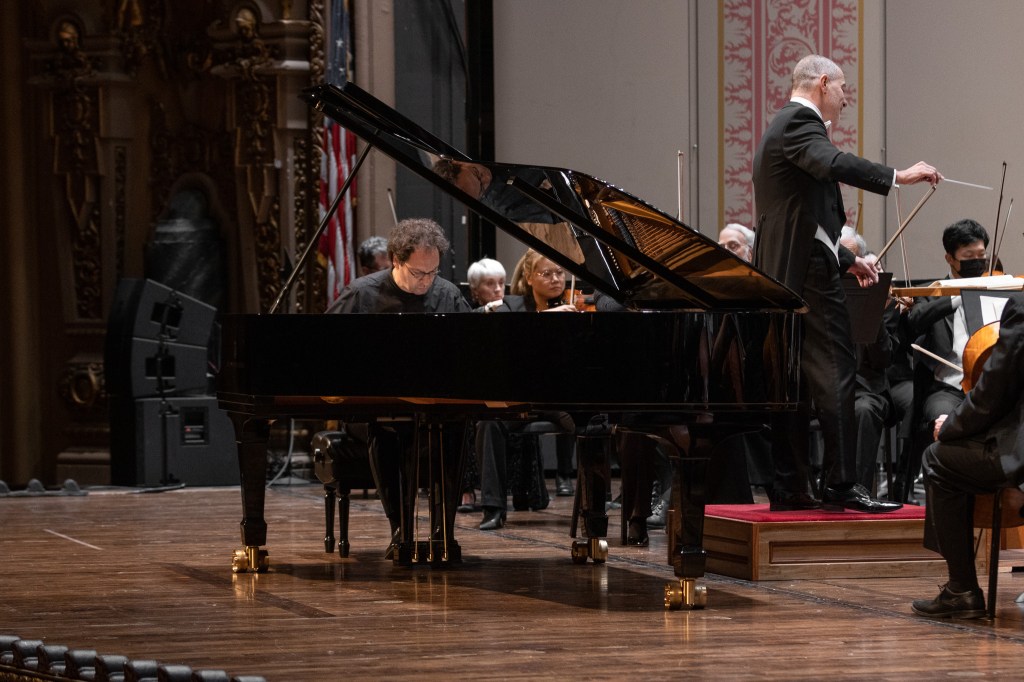
Shai Wosner with Rossen Milanov and the Columbus Symphony, photo creditt Corinne Mares

Brahms’ vast Second Piano Concerto made for a heavier contrast, and featured Israeli pianist Shai Wosner. A mellow horn call from principal Brian Mangrum made for a majestic opening to the weighty first movement. Wosner performed with intense, singular focus, though I felt his playing veered a bit too cautious and restrained. Although his technique wasn’t flawless, it nonetheless served well the daunting demands of the work. Both pianist and conductor Rossen Milanov seemed aligned in their conception of the grand, sweeping arc of the movement.

The scherzo that followed was hardly a trifle, still bearing much of the weight of the preceding, but sprightlier material contrasted. A deeply lyrical cello solo (Luis Biava) opened the Andante, and the piano entered with a gentle, song-like touch. The payoff came in the finale with its folk-inflected abandon, though hardly short on drama. As an encore, Wosner offered a lovely account of Schubert’s Hungarian Melody.

Dvořák’s Sixth Symphony was a milestone for the composer in that it was the first to published, and shows him blossoming into a mature symphonist. The spacious, expansive Allegro non tanto opened with a gentle, bucolic theme over pulsating accompaniment. It was certainly apposite to precede the symphony with Brahms as it bears the elder composer’s influence (particularly from Brahms’ own D major symphony), yet not without Dvořák’s individual hallmarks. 

A touching moment of repose was to be had in the Adagio, its thematic material charmingly introduced in the winds. The composer unmistakably revealed in his Czech origins in the lively furiant that followed, and the orchestra deftly negotiated the ever-changing meters, an energetic warmup of sorts for the jubilant finale.

Columbus Symphony opens season with appealing Brahms and Dvořák

Columbus Symphony Orchestra
Rossen Milanov, conductor
Stefan Jackiw, violin
Ohio Theatre
Columbus, OH
October 22, 2021

Montgomery: Banner
Brahms: Violin Concerto in D major, Op. 77
 Encore:
 Bach: Largo from Violin Sonata No. 3 in C major, BWV 1005
Dvořák: Symphony No. 8 in G major, Op. 88

Friday marked opening night of the Columbus Symphony’s Masterworks series, the core of its landmark 70th season. As is standard practice from most American orchestras, the CSO would typically open the season with a rendition of the national anthem. Extraordinary times, however, make business as usual ring hollow, and a thoughtful opener was to be had in Jessie Montgomery’s 2014 work Banner. Written in 2014, two hundred years after Francis Scott Key’s indelible poem, the work pits the Star-Spangled Banner against a wealth of melodies from other cultures, depicting in musical terms the vast array of cultures that comprise the United States today. While the contours of the Star-Spangled Banner form the backbone of the work, no less than seven other songs are woven together into a single multicultural fabric, often yielding a spiky polytonality. A deeply engaging opener, and I hope the CSO continues to explore Montgomery’s work in future seasons.

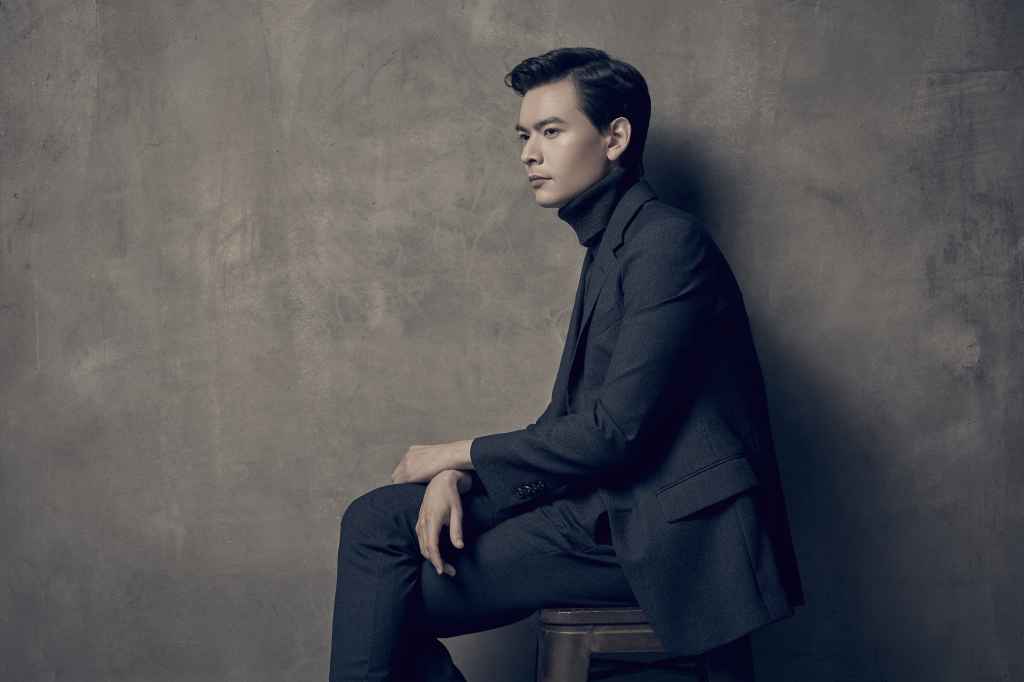
Stefan Jackiw, photo credit stefanjackiw.com

The remainder of the program retreated to more familiar territory in seminal works of Brahms and Dvořák. Stefan Jackiw served as a commendable soloist in the Brahms Violin Concerto. The graceful and genial opening gave way to the dramatic, punctuated by Jackiw’s jagged entrance. He displayed an accomplished virtuosity, delivering the extended cadenza with flair, but never without sensitivity, continually drawing focus towards the work’s lyrical heart. A rapturous oboe solo opened the central Adagio, answered in the rich lyricism of the solo violin. The Hungarian finale was given with both effervescence and drama, and the orchestra matched Jackiw’s high spirits. As an encore, Jackiw offered the Largo from Bach’s C major sonata – a lovely pendant.

Dvořák’s Symphony No. 8 closed the evening, and here, Milanov opted to conduct from memory. The work saw brooding beginnings, but rays of sunlight quickly broke through. The principal winds – the flute in particular – were the standouts here. A second movement Adagio proceeded as calm and untroubled affair, while the lilting penultimate movement had a dancing charm – though one wanted perhaps even more emphasis on the insouciant dance rhythms. Clarion trumpet calls heralded the boisterous finale. All in all, a very satisfying start to the season.