ProMusica Chamber Orchestra David Danzmayr, conductor Katherine McLin, violin Marc Moskovitz, cello Spencer Myer, piano Southern Theatre Columbus, OH January 23, 2022
Coleridge-Taylor: Four Novelletten, Op. 52 – Nos. 3 & 4 Beethoven: Triple Concerto in C major, Op. 56 Mendelssohn: Symphony No. 3 in A minor, Op. 56, Scottish
A true rarity – and wonderful discovery – opened ProMusica’s January program, namely the latter two entries of Samuel Coleridge-Taylor’s Four Novelletten, scored for string orchestra with a touch of percussion. The Valse was imbued with melancholy, in a similar vein to Tchaikovsky’s Valse mélancolique heard earlier in the day from the Columbus Symphony. Free-falling solo passages from assistant concertmaster Rebecca Willie added much charm, and the modest percussion neatly complemented the strings. A vigorous foil was to be had in the closing Allegro molto – with music of such quality and allure, I wish there had been time for the complete work!
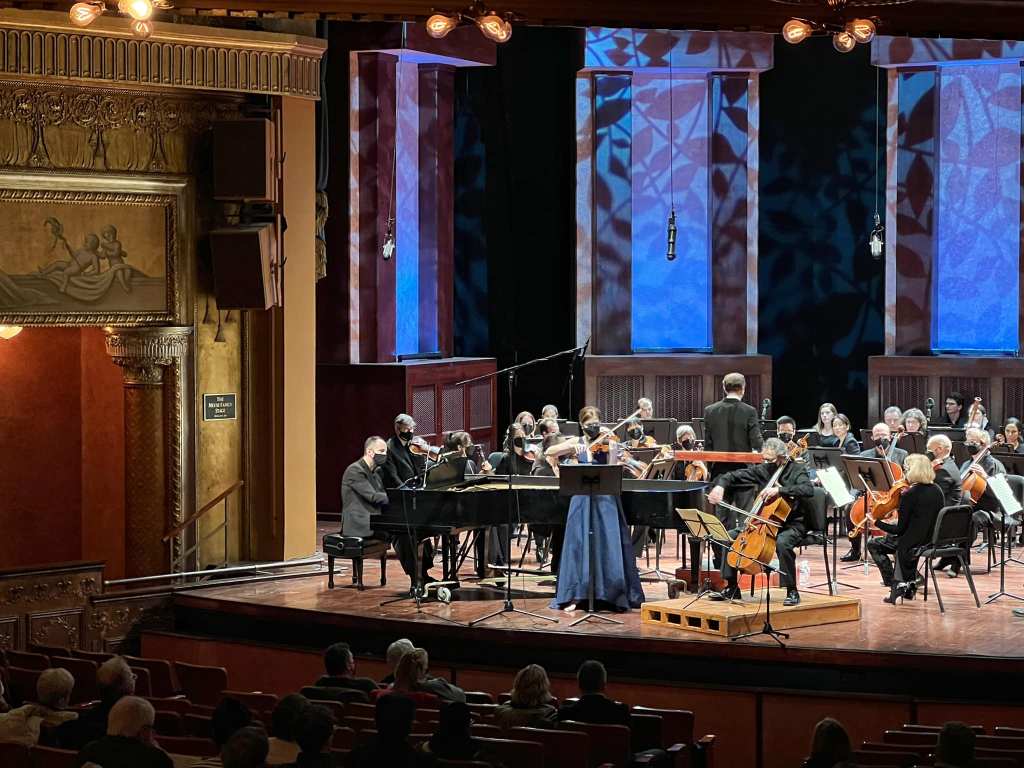
Spencer Myer, Katherine McLin, and Marc Moskovitz with David Danzmayr and ProMusica, photo credit ProMusica
Beethoven’s Triple Concerto formed the heart of the program – and as a somewhat late program change, a tip of the hat to the soloists for nonetheless putting together a tight and convincing performance. ProMusica’s concertmaster Katherine McLin and principal cello Marc Moskovitz were buttressed by pianist Spencer Myer, and the trio purveyed a warm chemistry, both amongst themselves and with the orchestra at large. The graceful orchestral introduction began in the low strings, and Moskovitz’s lyrical cello introduced the soloists – the cello being the most prominent of the trio (in the informative post-concert conversation, it was suggested that this is effectively Beethoven’s cello concerto in all but name). What followed in the spacious opening movement was genial and untroubled, showing a lighter side of the composer – worlds apart from weighty works that comprise the adjacent opus numbers, namely the Eroica symphony and Appassionata piano sonata. The serene Largo peered inward, given with the intimacy of chamber music, before a seamless transition to the rambunctious Rondo alla Polacca, wherein once again the main theme was guided by the cello.
Mendelssohn’s Scottish symphony closed the program and offered the finest playing of the evening. Matters opened in brooding solemnity, conveying the composer’s awe of his Scottish sojourn. The first movement was shrouded in mystery, encouraged by Danzmayr’s taut dynamic control, and often passionate with some particularly notable playing from the clarinet. As a counter to the weight of the preceding, the scherzo was of folksy charm, quintessentially Mendelssohnian in its sparkling textures. A certain solemnity returned in the following movement, heightened by striking chorale writing, while the vigorous finale was an uncompromising affair until the triumphant closing material, unequivocally arriving in the major.
Gartner Auditorium Cleveland Museum of Art Cleveland, OH July 29 – August 1, 2021
Inevitably postponed last summer due to the pandemic, the Cleveland International Piano Competition has made a remarkable comeback here in 2021, a wonderfully exciting return to in-person performances. An initial pool of over 250 applicants from more than 40 countries was pared down to 26 contestants, all of whom performed in the Competition’s first two rounds. Owing to the travel and health restrictions that still persist, these rounds were conducted virtually, filmed at venues across the world – and available for free viewing on YouTube. Eight outstanding semi-finalists were selected to proceed onsite in Cleveland, a cohort to be further narrowed down to four finalists who will perform a chamber music round with the Escher Quartet and a concerto round with The Cleveland Orchestra under the baton of Jahja Ling.
Gartner Auditorium before Session 1 of the Semi-Final Round
Compared to the relative brevity of the first two rounds, the semi-finals offer an even more in-depth portrait of each artist, performing a recital of approximately 40 minutes. A few new and welcome additions for this year’s edition: each semi-finalist included in their program a popular song transcription commissioned from composer Alexey Kurbatov. Four selections were available, namely “America” from Bernstein’s West Side Story, Queen’s “Bohemian Rhapsody”, themes from Mission Impossible, and John Williams’ Olympic Fanfare. Regrettably, none of the eight selected the Williams piece, but perhaps a recording can be posted in due course. I also hope publication of these scores is imminent as they undoubtedly can serve as particularly enjoyable encore pieces.
Also for the first time was the inclusion of piano duets – the two performers from each session teamed up following their solo material for either the Fantasie in F minor by Schubert or Mozart’s Sonata for Two Pianos in D major. A lovely addendum that not only tested the contestants’ ability to collaborate with another pianist, but encouraged a spirit of camaraderie. Finally, excellent program notes for every piece performed – from the first round to the finals – were provided by Marissa Glynias Moore, Anna M. O’Connell, and Marco Ladd. Indispensable reading for attendees and a veritable crash course in piano literature. Below are some brief impressions I had of each semi-finalist.
Session 1 July 29, 2021
Ying Li Mozart: Piano Sonata No. 13 in B-flat Major, K. 333 Grainger: “Ramble on Love” from Der Rosenkavalier Bartók: Piano Sonata, Sz. 80 Schifrin: Themes from Mission Impossible (arr. Kurbatov)
Honggi Kim Schifrin: Themes from Mission Impossible (arr. Kurbatov) Chopin: Twelve Etudes, Op. 25
Schubert: Fantasie in F Minor, D. 940
Ying Li (China) opened the semi-final round with a Mozart sonata, delicate and balanced, exuding the pearly classical style. I found her pacing of the slow movement a bit hard to follow but was quite taken by the sprightly finale. Grainger’s so-called Ramble on Love, paraphrasing themes from Strauss’ Rosenkavalier, gave sumptuous treatment to the source material’s lush and languid melody. Bartók’s Piano Sonata was for me the highlight of her performance, opening with a manic energy – and the live video screens did much to enhance the audience experience, offering close-ups of the intricate hand-crossings.
Honggi Kim (South Korea) opened with the same piece with which Li closed, namely the Kurbatov Mission Impossible transcription. Kim was perhaps a bit more percussive than Li; both displayed how the composer brilliantly interpolated the familiar themes. All contestants are required to present a Chopin etude in the first two rounds – here in the semi-finals, Kim offered all twelve etudes from Op. 25. An ambitious undertaking to be sure, though I found his playing fitfully uneven. No. 2, for instance, would have benefitted from greater clarity, although I did like the way he brought out melodic material in the left hand. In No. 5, one wanted more accentuated contrast between the dissonant sections and the lyrical. The rapid double thirds of No. 6 were quite impressive, however. Op. 25 is certainly an end-weighted set, and perhaps one’s performance should be judged primarily on the final three which concluded on a high note: the rapid octaves of No. 10, a chillingly dramatic “Winter Wind”, and a rather marvelous finish in the intense depths of the “Ocean” etude.
Li and Kim were impressive four-hands partners in the Schubert Fantasie, bringing out contrasts from the brooding to the dancing.
Session 2 July 30, 2021
Jiarui Cheng Scarlatti: Sonata in B Minor, K. 87 Chopin: Barcarolle in F-sharp Major, Op. 60 Rachmaninov: Variations on a Theme of Corelli, Op. 42 Bernstein: “America” from West Side Story (arr. Kurbatov)
Yedam Kim Chopin: Polonaise-Fantaisie in A-flat Major, Op. 61 Prokofiev: Sonata No. 4 in C Minor, Op. 29 Mercury: Bohemian Rhapsody (arr. Kurbatov)
Mozart: Sonata for Two Pianos in D Major, K. 448
Jiarui Cheng (China) selected one of the more introspective of the Scarlatti sonatas, emphasizing its lyrical quality. Continuing the thread, he did much to bring out the wistful melancholy in Chopin’s late gem, the Barcarolle. In Rachmaninov’s Corelli Variations, Cheng sculpted an individual character in each variation – an excellent performance. Kurbatov’s transcription of Bernstein’s “America” ended matters on a jovial note.
Yedam Kim (South Korea) opened with a mesmerizing account of Chopin’s Polonaise-Fantaisie – contemporaneous with the previously-heard Barcarolle – the composer’s crowning achievement in the polonaise form. A commanding performance of Prokofiev’s Fourth Sonata followed, with searching, unsettling material leading to a bright and brilliant finale. In the Queen original, “Bohemian Rhapsody” is something of a mini tone poem with its wealth of thematic material and operatic narrative and dramatic flow – qualities very much brought out in Kim’s performance, perhaps the most impressive of the Kurbatov transcriptions.
Session 3 July 31, 2021
Rafael Skorka Bernstein: “America” from West Side Story (arr. Kurbatov) Leighton: Fantasia Contrappuntistica, Op. 24 (“Homage to Bach”) (1956) Brahms: Sieben Fantasien, Op. 116
Martín García García Schubert: Wanderer-Fantasie in C Major, D. 760 Liszt: “Les cloches de Genève (Nocturne)” from Années de Pèlerinage I, S. 160 Liszt: Étude de Concert, S. 145, No. 2 (“Gnomenreigen”) Liszt: Transcendental Etude, S. 139, No. 10 Mercury: Bohemian Rhapsody (arr. Kurbatov)
Schubert: Fantasie in F Minor, D. 940
Rafael Skorka (Israel) had confident beginnings with a memorable account of Bernstein’s “America”. The most intriguing discovery during the semi-final round came in the shape of Kenneth Leighton’s Fantasia Contrappuntistica, a 1956 homage to Bach (and to Busoni, given the elder composer’s monumental work of the same title). A virtuosic opening gave way to a pensive chorale and a pair of fugues rounded off the work. Skorka deftly negotiated the contrapuntal intricacies to bring matters to a vigorous close. The pianist continued to make a strong showing in Brahms’ Fantasies, Op. 116, just as convincing in the lyrical selections (nos. 2, 4, and the touching chorale of no. 6) as the more extrovert ones, giving the first piece an energetic workout and reserving the most overt virtuosity for the seventh and final fantasy.
Martín García García (Spain) offered an arresting account of Schubert’s ingenious Wanderer-Fantasie. While his tone at times veered a bit too percussive for my taste, he did much to bring out a wide dynamic and dramatic contrast and a keen sense of the work’s large-scale architecture. An interesting selection of three Liszt pieces followed. Deft use of the pedal did much to bring out the sonorities of the titular bells in Les cloches de Genève while García conveyed much charm in the impish legerdemain of Gnomenreigen. The Transcendental Etude No. 10 was technically impressive, although I found myself longing for even more firepower.
Session 4 August 1, 2021
Byeol Kim C. Schumann: Notturno in F Major, Op. 6, No. 2 Schumann: Arabeske in C Major, Op. 18 Mendelssohn: Fantasie in F-sharp Minor, Op. 28 Mercury: Bohemian Rhapsody (arr. Kurbatov) Jalbert: Toccata (2001) Gottschalk: The Union, Op. 48
Lovre Marušić Scarlatti: Sonata in E Major, K. 380 Schumann: Kreisleriana, Op. 16 Mercury: Bohemian Rhapsody (arr. Kurbatov)
Mozart: Sonata for Two Pianos in D Major, K. 448
Byeol Kim (South Korea) assembled the most diverse and wide-ranging semi-final program, beginning with music from both the Schumanns. Clara’s Notturno boasted a haunting, Chopinesque melody, a performance which should put Kim in the running for the Female Composer Prize, one of over a dozen special prizes being offered. A limpid account of Robert’s Arabeske followed, and Mendelssohn’s Fantasie in F sharp minor was given a passionate and dramatic performance. I really enjoyed the way Kim brought out the sweeping lyrical main theme in her take on the “Bohemian Rhapsody” transcription. Jalbert’s Toccata was a breathless study in perpetual motion, and Gottschalk’s Union, a wonderfully inventive cornucopia of Americana, put Kim’s searing virtuosity and vast dynamic range on full display. A clear audience favorite, she was the only one of the eight to receive a standing ovation.
Lovre Marušić (Croatia) began with a stately account of Scarlatti’s K380 sonata. Schumann’s extensive Kreisleriana followed. I felt Marušić’s reading would have been even more engaging with sharper contrasts between the wide range of expressions the work explores, but I certainly sensed the pianist becoming increasingly self-assured as the work progressed. Sunday’s session was a high note on which to conclude the semi-finals as we await the jury’s announcement of the four finalists, and the fine level of pianism we can expect from them in the subsequent chamber and concerto rounds.
Cleveland Orchestra
Bernard Labadie, conductor
Isabelle Faust, violin
Severance Hall
Cleveland, OH
February 15, 2018
Rigel: Symphony No. 4 in C minor, Op. 12 No. 4
Mendelssohn: Violin Concerto in E minor, Op. 64
Encore:
Kurtág: Doloroso, from Signs, Games and Messages
Mozart: Symphony No. 40 in G minor, K550
Despite Thursday evening’s program containing two of the most popular works in the repertoire, matters began with a certified rarity, a little-known work by a little-known composer: the Symphony No. 4 in C minor of Henri-Joseph Rigel. German born but transplanted to Paris, he was a contemporary of Haydn and Mozart with no less than fourteen symphonies to his name. The C minor work in question, published in a set of six that comprise the composer’s Op. 12, is one which this weekend’s conductor Bernard Labadie has championed for some time; I recall him including it on a Chicago Symphony program a few years back (reviewed by a colleague here).
Labadie imbued the opening with a nervous energy, a textbook example of Sturm und Drang, and the thematic material was sharply defined, given with an appropriate punch. The Teutonic fire was tempered by Gallic sensibilities during the central slow movement, a graceful, untroubled affair in the relative major, while the minor key intensity returned for the sprightly finale.
Bernard Labadie, photo credit Dario Acosta
Isabelle Faust, photo credit Felix Bröde
More familiar terrain was to be had in the Mendelssohn Violin Concerto which brought forth soloist Isabelle Faust. Faust took flight over the orchestra with the haunting, almost mystical theme, a rich lyricism emanating from her 1704 Stradivarius. The rapid scalar passages demonstrated her sound and confident technique (it should be remembered that this concerto was written for the legendary virtuoso Ferdinand David), while she opted for a more burnished tone in the introspective moments. At the movement’s end came a dramatic coda, while an ordinary composer would have closed here, the endless innovation of Mendelssohn’s fertile mind called for a long-breathed note in the bassoon to serve as a seamless transition to the Andante, a sublime song without words.
Further transitional material connected the finale, passionately yearning before giving way to the movement proper, spirited and celebratory. Faust received an enthusiastic and certainly well-deserved ovation – she seemed genuinely moved by it – and treated the audience to a most imaginative encore choice in Kurtág’s Doloroso, atmospheric in its unnervingly barren texture.
One could reasonably trace the Rigel symphony as a distant forebear to Mozart’s incomparable Symphony No. 40 in G minor, it also being a work of searing intensity in the minor. Labadie elected to conduct the Mozart from memory, and the fact that he remained seated at a piano bench did little to detract from the energy he offered. The work began in a whisper, almost sotto voce, with germs of themes building to great pathos, occasionally alleviated by a more lyrical secondary theme. Labadie achieved deft balance of the instrumental voices, and one was grateful that Mozart later rescored the work to include the clarinet as the pair added a lovely and mellifluous contrast.
The Andante served as a respite with the downward cascades in the winds especially charming, while the irregular syncopations of the minuet were dynamically punctuated, countered by the gentler trio (a horn flub or two notwithstanding). The brisk finale was a whirlwind of orchestral effect, one moment in the minor, the next in a joyous major, and perhaps most impressive was the sophisticated fugato, executed with a crystal-clear precision.



 quasi-faust