McGegan’s Cleveland Orchestra program effervesces with classical charm

Cleveland Orchestra
Nicholas McGegan, condcutor
Michael Sachs, trumpet
Severance Hall
Cleveland, OH
November 21, 2019

Schubert: Selections from Rosamunde, D797: Overture – Ballet Music No. 1 – Entr’acte No. 3 – Ballet Music No. 2
Hummel: Trumpet Concerto in E major
Haydn: Symphony No. 104 in D major, Hob. I:104, London

This marked the third consecutive November Nicholas McGegan has stood at The Cleveland Orchestra podium, and his charm and affable spirit without fail warms an otherwise chilly time of the year. The present program straddled the eighteenth and nineteenth centuries, with Hummel’s Trumpet Concerto the centerpiece, bringing into the spotlight Cleveland principal Michael Sachs. Proceeding in reverse chronological order, McGegan opened with selections from Schubert’s incidental music to Rosamunde.
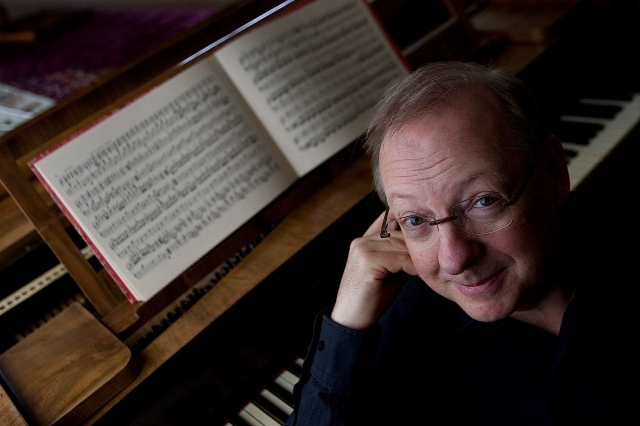
Nicholas+McGegan+Photographer+Randy+Beach.jpg
Nicholas McGegan, photo credit Randy Beach

What is known as the overture to Rosamunde was in fact the repurposed overture to Schubert’s earlier (and unsuccessful) opera Der Zauberharfe. A bold sense of drama opened, but the remainder of the work bubbled with a graceful Schubertian charm. The first of the ballets was of a symphonic weight in its Sturm und Drang sensibility, but more mellow material offered contrast near the end, heightened by the clarinet of Afendi Yusuf. One of Schubert’s most cherished melodies, later reused in one of the impromptus for piano as well as the thirteenth string quartet, resounded through a choir of strings and winds in the Entr’acte. Another ballet rounded off McGegan’s suite, given with a rustic abandon.

Hummel’s Trumpet Concerto remained a forgotten quantity until it was rediscovered in the 1950s by trumpeter Armando Ghitalla. Originally cast in the key of E major, Ghitalla opted to publish the work transposed to E flat for ease of playability on the modern trumpet. It continues to be most often heard in the lower tonality today, including in Sachs’ two previous performances of the work with this orchestra. This time, however, Sachs stayed faithful to the composer’s intentions, easily surmounting the inherent technical hurdles. The martial opening was bright and brilliant with the soloist offering a limpid flexibility and climactic trills. The long-breathed tones of the central Andante, interjected by further trilling gestures, were pitted over an undulating accompaniment – a lyrical essay to be sure, but not without a certain grandeur. A jaunty rondo served as the finale, showcasing Sachs’ rapid-fire virtuosity and a never-waning vigor from both soloist and orchestra.

Haydn’s final entry of his long series of symphonies concluded the evening. The attention-grabbing opening made a sharp turn to the doleful minor before this introductory material gave way to the delectably appealing material firmly in the home key of D major. Here and throughout, McGegan drew out a playing in equal parts refined and joyous. The slow movement was a gentle affair, deftly balanced and crisply articulated. A rhythmic vitality served the minuet well, with Jeffrey Rathbun’s oboe of note in the trio. Energy was never at the expense of clarity in the effusive finale, the main subject of which was rooted in a Croatian folk song.
Vivaldi features prominently on Cleveland Orchestra’s Thanksgiving menu

Cleveland Orchestra
Nicholas McGegan, conductor
Peter Otto, violin
Severance Hall
Cleveland, OH
November 23, 2018

Vivaldi: Le quattro stagioni
Mozart: Ballet Music for Idomeneo, K367 – Chaconne
Haydn: Symphony No. 94 in G major, Hob. I:94, Surprise

The Cleveland Orchestra’s Thanksgiving weekend concerts were an ample serving of comfort food, with the first half devoted to Vivaldi’s The Four Seasons – a follow up of sorts to last season’s traversal of another seasonal quadriptych, namely Haydn’s oratorio The Seasons. Initially published as part of the composer’s The Contest Between Harmony and Invention (Op. 8), The Four Seasons comprise the first four and certainly best known selections. These concerts were not without some controversy, however, as the violin soloist was originally slated to be the ousted William Preucil (whom I saw perform the work on this stage back in February 2007, coincidentally also under the baton of McGegan). First associate concertmaster Peter Otto was on hand to more than capably take the reins.

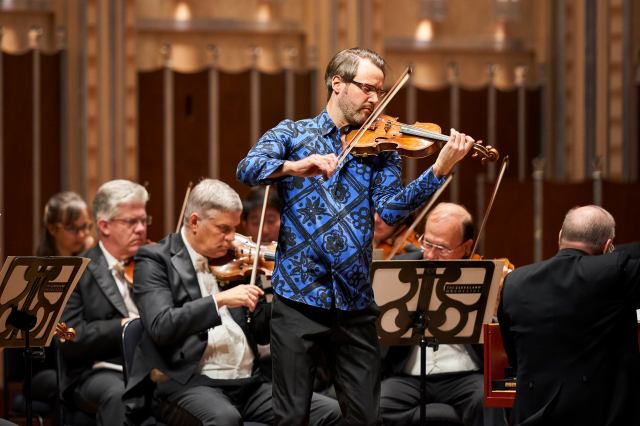
CLO112318_160
Peter Otto, all photos credit Roger Mastroianni, Courtesy of The Cleveland Orchestra

The immediately familiar strains of Spring featured Otto in some sprightly interplay with second violin chair Stephen Rose. Some minor intonation issues were apparent initially but soon resolved. The Largo was of long-bowed repose while the closing was a joyous dance filled with rapid passagework. A minor-key haze marked Summer, taking flight in due course in evidence of the orchestra’s tight chemistry under McGegan’s expert direction from the harpsichord. A remarkable expressiveness was achieved in the finale, while the fire returned in the breathless finale.

Autumn boasted the rustic charm of the harvest, given with an authentic rhythmic snap. An affecting melody played over undulating arpeggios in the harpsichord made the Adagio molto a standout, while the closing Allegro was – appropriately – a joyful Thanksgiving. Winter introduced dissonances that must have been shocking to audiences in Vivaldi’s day; the songful Largo, however, was enough to warm even the coldest of winter days.

The Viennese classicism of Haydn and Mozart rounded off the program. Mozart’s opera Idomeneo is thought of as his first fully mature operatic foray. The composer produced a fine suite of ballet music to accompany the work as per the French tradition, likely owing to the French origins of the original libretto. McGegan offered the opening chaconne; although satisfying I would have preferred inclusion of the modest remainder of the ballet score. Apparent from the declamatory opening onward was the immediate charm of a Mozart opera, here with the intimacy of communication fostered through the reduced-sized orchestra in playing of sparkling transparency and clarity.

Last on the menu was Haydn’s Symphony No. 94 in G major, known by its memorable moniker Surprise. A graceful and leisurely introduction set the stage for the vigor of the movement proper. Under McGegan, the orchestra operated as a single organism, achieving a wide range of expression in the development even within classical proportions. The Andante is what earned the work its nickname, full of tongue-in-cheek wit, and McGegan maximized the dynamic contrasts to further its irresistible appeal. A fine oboe solo from Jeffrey Rathbun counted as another highlight; the penultimate movement carried the swagger of an Old World minuet while the finale was a whirlwind of effervescence – one only wished it could have lasted longer.

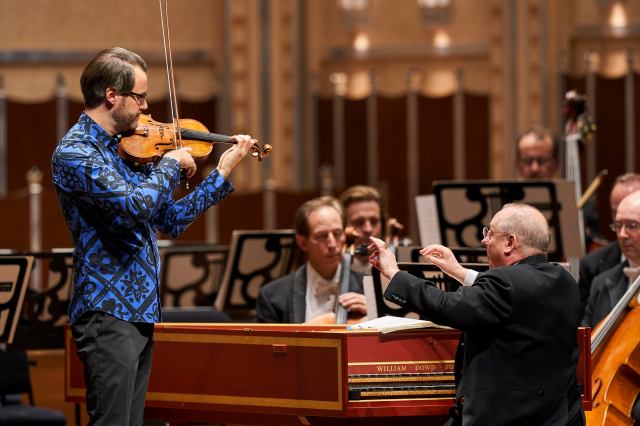
CLO112318_214
Peter Otto and Nicholas McGegan