ProMusica closes the year with lush Brahms and Mendelssohn

ProMusica Chamber Orchestra
David Danzmayr, conductor
Vadim Gluzman, violin
Southern Theatre
Columbus, OH
December 10, 2022

Chin: subito con forza
Brahms: Violin Concerto in D major, Op. 77
 Encore:
 Gluck: “Dance of the Blessed Spirits” from Orfeo ed Euridice (trans. Kreisler)
MacMillan: One
Mendelssohn: Symphony No. 5 in D major, Op. 107, Reformation

The final ProMusica program of the year presented two major scores from the 19th century (both in D major!), each prefaced by a brief but fitting contemporary work. Unusk Chin’s 2020 work subito con forza certainly made for an energetic opening. An homage of sorts to Beethoven, the opening gesture invoked the Coriolan overture before veering in a different direction, and powerful writing for the piano hinted at the Emperor piano concerto.
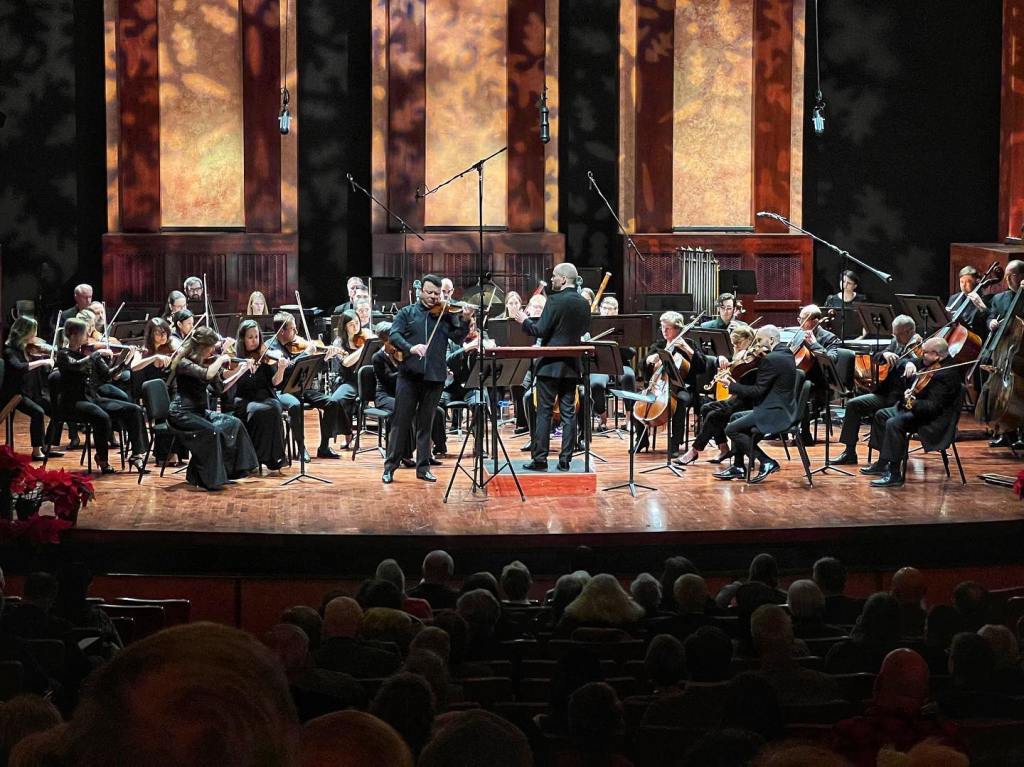
Vadim Gluzman, David Danzymar, and ProMusica, photo credit ProMusica

In her opening remarks, ProMusica CEO Janet Chen noted that this marks ten years since David Danzmayr and Vadim Gluzman assumed their current roles of music director and creative partner respectively. What followed was a veritable celebration of this now decade-long collaboration in Brahms’ Violin Concerto. The orchestral introduction was marked by an arching lyricism, and a fiery contrasting theme provided set up for the violin’s entrance. More lyrical material saw Gluzman sailing into the upper range of his instrument with a tone limber and flexible. The partnership between conductor, soloist, and orchestra certainly paid its dividends in convincingly conveying the large-scale architecture of the expansive opening movement.

A choir of winds opened the plangent Adagio, and Gluzman responded with a songful lyricism of his own. The Hungarian-inflected finale was a jocular affair, given with authentic flair. Gluzman returned with an encore in Gluck’s “Dance of the Blessed Spirits” from the opera Orfeo ed Euridice – presented in Kreisler’s transcription for violin with a touch of orchestral accompaniment. Its gorgeous, long-bowed melody was a lovely pendant to the Brahms.

As the title suggests, James MacMillan’s 2012 essay One explores single-line melodies, monastic in its starkness and somewhat suggestive of Gregorian chant. The religious orientation was apropos as it led without pause to Mendelssohn’s Reformation symphony – a fitting follow up to last season’s performances of the Scottish and Italian symphonies (perhaps a future ProMusica season could offer the rarely heard First and Second symphonies?). The slow introduction saw a rich invocation in the strings of the divine Dresden amen; the movement proper took shape with vigor in the stormier minor, delivered with momentum and precision.

The Allegro vivace was playful, lighter fare by contrast, and the gentle Andante was noted for its languid melody in the strings. The finale introduced the Lutheran hymn Ein feste Burg ist unser Gott in the flute (Nadine Hur) with matters building to a climax of both contrapuntal intricacy and festive exuberance.
Perlman delights in Lyric Opera recital

Itzhak Perlman, violin
Rohan De Silva, piano
Civic Opera House
Chicago, IL
April 23, 2017

Vivaldi: Sonata in A Major for Violin and Continuo, Op. 2 No. 2, RV 31
Beethoven: Violin Sonata No. 5 in F major, Op. 24, Spring
Schumann: Fantasiestücke, Op. 73
Ravel: Violin Sonata No. 2 in G major

Encores:
Kreisler: Sicilienne and Rigaudon in the style of Francœur
Tchaikovsky, transcribed Auer: Lensky’s Aria from Eugene Onegin
Wieniawski: Etude-Caprice in A minor, Op.18 No. 4
Williams: Theme from Schindler’s List
Brahms, transcribed Joachim: Hungarian Dance No. 1 in G minor
Franz Ries: Perpetuum mobile, from Suite No. 3 in G major, Op. 34

An Itzhak Perlman recital is always a major event, as evidenced by the near-capacity crowd he drew at the cavernous Civic Opera House.  With an opera season ending in March, the venue was certainly put to good use in an enjoyable afternoon from Perlman and long-time recital partner, the Sri Lankan pianist Rohan De Silva.  A stage set of classical pillars provided an elegant backdrop (the advantages of performing in an opera house), and video screens showing close-up views in real time flanked the stage, helping to create a sense of intimacy in a large hall.

Exclusive-press-shot-Itzhak-3253-new_by-Lisa-Marie-Mazzucco
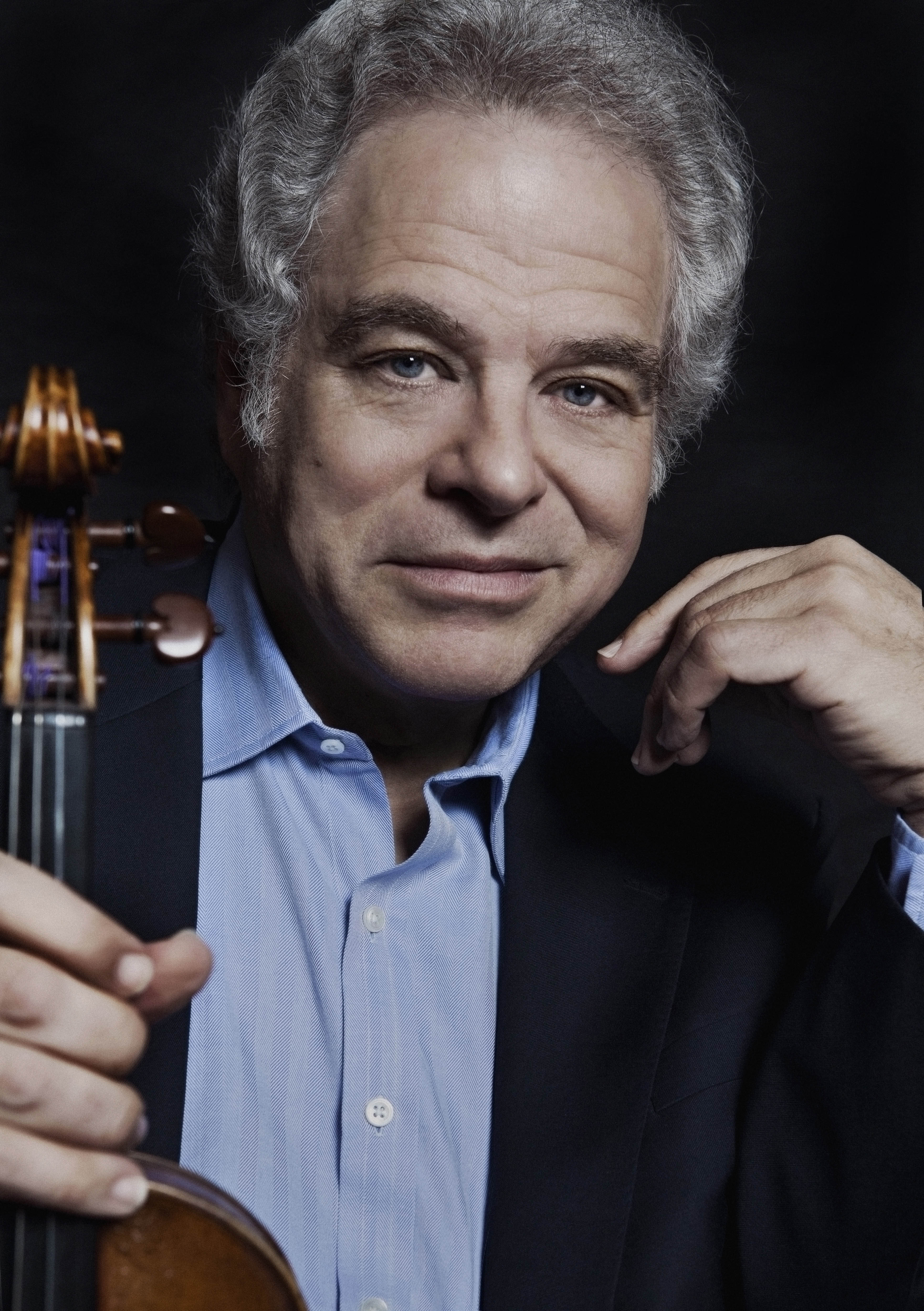
Itzhak Perlman, photo credit Lisa-Marie Mazzucco
Perlman arranged his program chronologically, beginning with the Sonata in A major for Violin and Continuo by Vivaldi.  An energetic presto opened, effectively serving as a warmup to the sprightly second movement.  The slow movement was brief but genuinely expressive, and a joyful finale rounded off this compact work of a mere seven minutes.

In an unannounced change from the printed program which suggested Beethoven’s first violin sonata (Op. 12 No. 1), Perlman elected for the more seasonally appropriate though well-worn Spring sonata (Op. 24).  It opened with a wonderfully bucolic grace, although Perlman’s intonation was regrettably suspect at times.  A languid Adagio molto espressivo followed with some especially lovely playing from De Silva.  The two closing movements both were marked by a delightful interplay between violin and piano, and an elegant melody heightened the finale.

Schumann’s Fantasiestücke, Op. 73 offered some Romantic fervor, with Perlman presenting them in the continuous, unbroken cycle that the composer intended, rather than three separate works.  I was struck by the rippling of the first and the fire of the last, yet in these works originally envisioned for cello or clarinet, they sounded somewhat timid on the violin, requiring more vigor to compensate than Perlman managed to muster.

Ravel’s relatively brief Violin Sonata No. 2 in G major was the only work programmed for the second half in what was surely a calculated move to allow ample time for encores.  Beginning with a single note line in the solo piano, the first movement was one of coloristic writing, pitting the violin and piano on more austere terms with one another than the previous works which favored conviviality.  Ravel’s own take on American musical traditions came to light in the second movement “Blues”, much like in the Piano Concerto of a few years later, replete with blue notes and slides.

Perlman played the accented pizzicatos with his bow hand and the others were plucked up on the fingerboard, but in the former one wished for a greater abrasiveness.  The last movement was acutely virtuosic, yet the delivery was rather dry and detached – but certainly not enough not to garner an enormous standing ovation, as much a recognition for Perlman’s extraordinary career as for Sunday afternoon’s performance.

And ample encores there were – no fewer than six.  While the four sonatas fared a bit lackluster, it was during the encores that the violinist truly sprung to life, and Perlman became Perlman.  With a charismatic stage presence, he explained to the audience that he brought with him a list of every work he’s played in Chicago – humorously suggesting it dated back to 1912 – so as to avoid duplication.  No Perlman recital would be complete without a work of Kreisler, and he offered the illustrious composer-violinist’s Sicilienne and Rigaudon in the style of Francœur, once erroneously thought to be a bona fide work of its namesake.  Perlman exuded an effortless charm in the Sicilienne; the Rigaudon proved that his remarkable prestidigitation is still very much intact.

“Lensky’s Aria” from Tchaikovsky’s Eugene Onegin followed – quite appropriate as Lyric Opera presented the complete work on the same stage just a few months prior – in a transcription by the legendary Leopold Auer.  A work of rich melancholy, it proved to be surprisingly well-suited to the violin.  The Wieniawski Etude-Caprice in A minor came next; a signature work of Perlman, it never fails to impress.  This was only outdone by the Theme from Schindler’s List – one of John William’s finest film scores, it should be remembered that Perlman played in the original soundtrack.  His deeply moving performance had particular poignancy on Sunday given the proximity to Holocaust Remembrance Day.

Two briefer works brought the afternoon to an agreeable close: the searing passion of the first of Brahms’ rousing Hungarian Dances, and the dizzying acrobatics of Franz Ries’ Perpetuum mobile.

Perlman Lyric
Civic Opera House