
Pittsburgh Opera
Antony Walker, conductor
Daniel Rigazzi, director
Rafael Davila, Turiddu
Eve Gigliotti, Santuzza
Marianne Cornetti, Mamma Lucia
Sebastian Catana, Alfio
Kimberly Anne Laret, peasant woman
Sebastian Catana, Tonio
Jonathan Burton, Canio
Fran Daniel Laucerica, Beppe
Caitlin Gotimer, Nedda
Ricardo Jose Rivera, Silvio
Benedum Center for the Performing Arts
Pittsburgh, PA
November 9, 2024
Mascagni: Cavalleria rusticana
Leoncavallo: Pagliacci
Though unrelated and quite distinct, Mascagni’s Cavalleria rusticana and Leoncavallo’s Pagliacci have become so inextricably linked that the epithet “Cav/Pag” is ubiquitous in the opera world to denote their coupling. Despite not intending to be paired, they make a satisfying whole, both exemplars of the Italian verismo tradition — and a welcome alternative to more well-worn operas of Puccini (though Pittsburgh Opera proved earlier this season that Tosca is always worth another listen). Saturday night’s performance at the Benedum marked Pittsburgh Opera’s first presentation of this double feature since 1996.
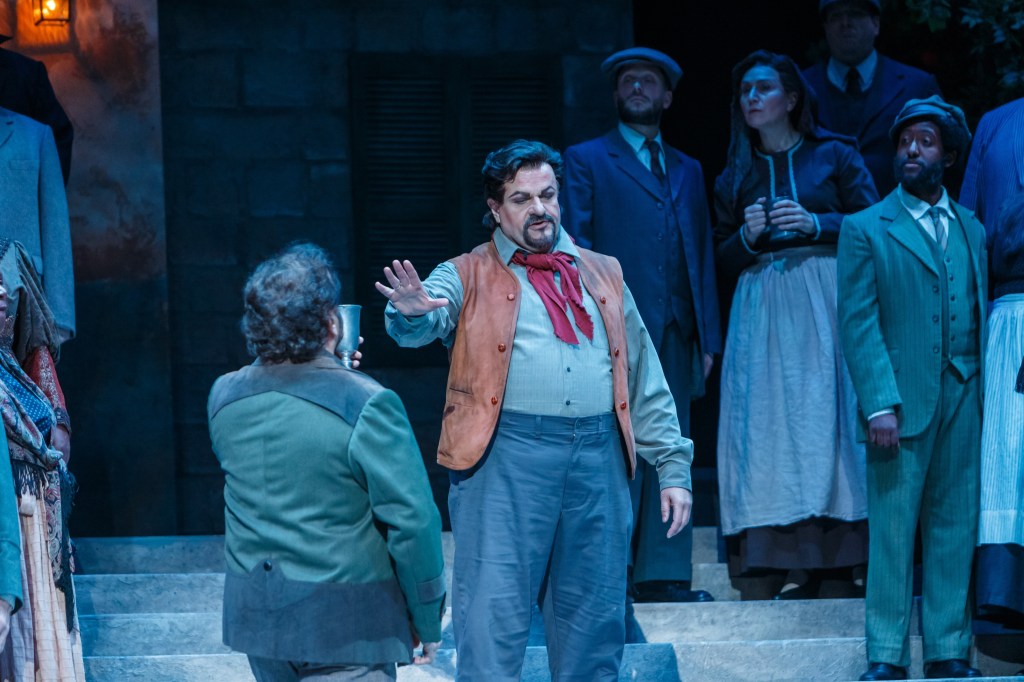
Cavalleria saw serene beginnings in the opening prelude, with arching strings and a lovely solo passage from the oboe. The first vocal appearance of the evening took the shape of a beguiling offstage serenade, with tenor Rafael Davila as Turiddu. The curtain opened to reveal a terra cotta tinted set, bringing to life a dense Sicilian town. As Santuzza, Eve Gigliotti offered a rich, honeyed tone with genuine feeling. Davila’s vocal instrument was emotive and flexible, blending well with Gigliotti in their duet. As Lola, Pittsburgh Opera Resident Artist Audrey Welsh provided a lighter, coquettish foil to Gigliotti. Sebastian Catana’s Alfio was of powerful projection, particularly effective in a fiery duet with Santuzza.
The Pittsburgh Opera Orchestra had ample opportunity to shine alone during Cavalleria. The Easter hymn was a particularly pensive statement, beginning gently, and swelling to a lushness enhanced by the Chorus. The singularly famous intermezzo was a standout moment, a passage of repose before the drama rapidly catapulted to its inevitably tragic end.
Unlike the inward beginnings of Cavalleria, Pagliacci opened in a blaze. The hapless Tonio (an excellent Sebastian Catana returning for double duty) opened with an introspective monologue in the opera’s Prologue, breaking the fourth wall in speaking to the audience directly. The curtain opened to reveal the same set from Cavalleria being repurposed, suggesting an interconnectivity that isn’t really there but works nonetheless.
Jonathan Burton was imposing as the boorish Canio; as Nedda, Caitlin Gotimer contrasted with a delicate and plaintive voice. Rounding out what was to my ears the stronger of the two casts was Ricardo Jose Rivera as Silvio: suave, and particularly effective in a passionate duet with Nedda, a quantity further enhanced by some lovely playing from the cellos in the pit. The iconic aria for Canio “Vesti la giubba” was given with genuine, affecting emotion, though one wanted perhaps even more.
A pensive intermezzo bridged the two acts, and the latter constructed a play-within-a-play, a conceit later used to great effect in Strauss’ Ariadne. Elegant, festive material was further highlighted by a colorful cast on stage that included acrobats and performers on stilts, reminiscent of the French Quarter scene from Puccini’s La bohème. Beppe’s (Fran Daniel Laucerica) serenade “O Colombina” was long-breathed and astutely phrased, pointing towards the opera’s darker ending. Canio broke character with the tragic force, and the final line “the comedy is over” brought the work to a crashing close.
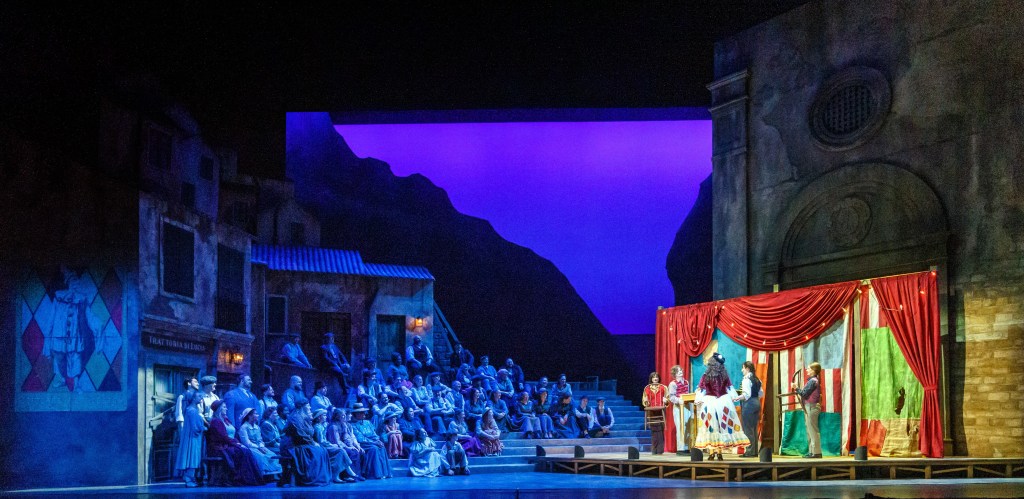
Pagliacci’s play-within-a-play construct
 quasi-faust