Apollo’s Fire explores a colorful confluence of cultures in O Jerusalem!

Apollo’s Fire
Jeanette Sorrell, conductor

Amanda Powell, soprano
Jeffrey Strauss, baritone
Sorab Wadia, tenor
Jacob Perry, tenor
Daphna Mor, winds and vocals
Zafer Tawil, oud and qanun

Gartner Auditorium
Cleveland Museum of Art
Cleveland, OH
March 11, 2020

I. O Jerusalem!
Ir me kero, Madre a Yerushalayim
Kuándo el Rey Nimrod
Bani Adam

II. The Jewish Quarter
Tzur mishelo akhalnu
Nani Nani
A la Una yo nací

III. The Christian & Armenian Quarters
Havun-Havun
Falconieri: Passacaglia in G minor
Rossi: La Bergamasca
Santa Maria, Strela do Dia, No. 100 from Cantigas de Santa Maria Codex

IV. Mosque, Synagogue, & Cathedral
Muslim Call to Prayer
Sancta Maria succure miseris
Monteverdi: Nigra sum sed formosa, from Vespers of 1610
Nigra sum sed formosa
Tzur mishelo akhalnu
Ki eshmera Shabbat
Monteverdi: Gloria Patri and Lauda Jerusalem, from Vespers of 1610

V. The Arab Quarter
Qanun improvisation
Lamma bada
Longha Farahfaza
Longha Nahawand

VI. Neighborhood Fiesta
La Komida la Manyana

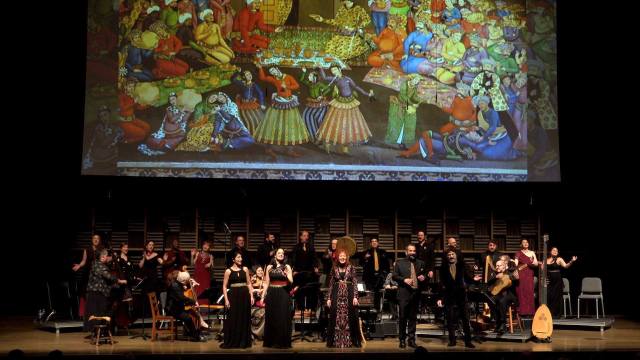
First presented to enthusiastic audiences last year, Apollo’s Fire’s O Jerusalem! is a fascinating travelogue through its titular city’s tapestry of musical cultures. In addition to AF’s usual circuit around the Cleveland area, the program this year was also performed further afield in both New York and Chicago. Cleverly conceived in six sections, each gathered around a common a common theme – including each of the quarters of the Old City – the program thoughtfully illuminated Jerusalem’s rich and diverse heritage through music, further enhanced by a kaleidoscope of projected images.
90101632_10157996240692398_3048093935843934208_o
Apollo’s Fire in O Jerusalem, photo credit Apollo’s Fire

A pair of medieval Sephardic songs opened, featuring soloists Jeffrey Strauss, Sorab Wadia, and Amanda Powell. The violins entered in procession from the back of the hall, enveloping the Gartner Auditorium in a spiritual longing, buttressed in due course by the chorus. Bani Adam closed the first segment on a lively and festive note. Daphna Mor (who along with Brian Kay was on hand for an informative preconcert talk) served as a commendable vocalist in the sacred Hebrew poem Tzur mishelo akhalnu, and there was a touching wistfulness to Amanda Powell’s rendition of the lullaby Nani Nani, countered by rumblings in the plucked strings. Rather more celebratory was the Sephardic ballad A la Una yo nací to round off the exploration of the Jewish Quarter.

The sacred Armenian chant Havun-Havun brought cellist René Schiffer in the spotlight, expertly navigating the subtle modal intricacies. Pivoting to the secular repertoire, the Passacaglia in G minor of seventeenth-century composer Andrea Falconieri unfurled as an animated dialogue between slices of the orchestra. Santa Maria, Strela do Dia rallied the whole ensemble to end the first half in blistering energy. The Muslim call to prayer brought the audience back from intermission, halting the mundane day-to-day in its moving solemnity. In an analogous vein, the Gregorian chant Sancta Maria succure miseris was of dignified unity. Nigra sum sed formosa was intriguingly presented in both Monteverdi’s setting from the Vespers and in its roots as plainchant. The former featured the excellent tenor Jacob Perry, and in the winding melismas of the latter one saw parallels to the similarly discursive inflections of a muezzin. A further sequence of Jewish material highlighted Strauss’ natural affinity for the repertoire, while two additional selections from the Vespers again called upon Perry, there with angelic echoes from the women of the chorus.

The penultimate segment musically traversed the Arab Quarter, opening with a dazzling improvisation on the qanun by Zafer Tawil, who introduced the work by speaking of his hopes for peace in the conflict-laden region – a sentiment which received enthusiastic applause. Tawil joined forces with Powell in Lamma bada, an Arab/Andalusian mwasha, and the segment concluded with a pair of jaunty instrumentals, the latter featuring extended improvisations from several orchestral soloists. La Komida la Manyana closed the evening, a veritable celebration of all the preceded. An enjoyable, festive evening – and while matters proceeded largely business as usual on Wednesday, this has unexpectedly become perhaps the last local public performance for the time being as the spreading coronavirus has necessitated cancellation of such gatherings through at least the coming weeks.

Apollo’s Fire in lively Vivaldi concertos – and a tribute to a deceased canary

Apollo’s Fire
Jeannette Sorrell, conductor
Jeffrey Strauss, baritone
Kathie Stewart, traverso
St. Paul’s Episcopal Church
Cleveland Heights, OH
March 8, 2019

Vivaldi: Concerto in D for Two Violins, Two Cellos, and Strings, RV 564
Bach: Brandenburg Concerto No. 3 in G major, BWV 1048
Vivaldi: Concerto in B Minor for Four Violins, RV 580 (from L’estro armonico, Op. 3)
Telemann: Funeral Cantata for an Artistically Trained Canary-Bird, TWV 20:37
Vivaldi: Flute Concerto in D, Il gardellino, RV 428 (from Six Flute Concertos, Op. 10)
Vivaldi/Sorrell: La Folia, after Trio Sonata in D minor, RV 63 (from Twelve Trio Sonatas, Op. 1)

Branded as “Three Duels and a Funeral”, Apollo’s Fire (fresh off their win at the Grammys) offered a generous program comprised of a trio of Vivaldi concertos along with a funereal oddity by Telemann, fleshed out with additional music by Bach and more Vivaldi. The first “duel” presented was Vivaldi’s Concerto in D for Two Violins, Two Cellos, and Strings. Despite the evening’s moniker, these concertos were rather congenial affairs as far as duels are concerned, with the opening work particularly affecting in its consonant combination of soloists on both ends of the string spectrum (violinists Johanna Novom and Adriane Post, cellists René Schiffer and Rebecca Landell Reed), further encouraged by the crisp cohesiveness of the supporting ensemble. Novom led the central Largo with beautifully singing lines which Post duly imitated, while rapid fire playing amongst the four soloists made for a rousing finale.

Jeffrey Strauss and Apollo’s Fire in Telemann’s Canary Cantata, photo credit Apollo’s Fire

In her spoken introduction, Jeannette Sorrell referred to Bach’s Brandenburg Concerto No. 3 as the “most democratic piece in classical music”, owing to its equal treatment of all nine players. Matters were propelled forward with joyous energy, only to arrive at a harmonic stasis in the slow movement of only two chords, wherein Sorrell’s continuo acted as a ghostly recitative. The work closed with a driving theme, vigorously passed from instrument to another. Vivaldi’s Concerto in B minor for Four Violins saw Novom and Post resume soloist duties along with Susanna Perry Gilmore and Carrie Krause. One was quite taken intricate interplay amongst the quartet during this comparatively sober work, not in the least during a striking moment when the orchestral accompaniment all but dropped out of the fold.

The evening’s centerpiece was a work of remarkable musical eccentricity, namely Telemann’s Funeral Cantata for an Artistically Trained Canary-Bird. Written at the behest of a Hamburg patron whose pet canary fell victim to a hungry feline, the Canary Cantata retells just that over the course of its 17-minute duration, ultimately an ingenious blend of tragedy and comedy. Handling the vocal line (originally in German, presented here in Sorrell’s English translation) with verve and aplomb was baritone Jeffrey Strauss, who further brought the text to life via some choice props and acting under the direction of Christine McBurney – judiciously used to add comedy without gimmick. As detailed in an interview with Cleveland Classical, Strauss’ vitality was all the more laudable given his recent recovery from major heart surgery. Sighing strings opened the work in this music of very fine quality, such that it could easily be mistaken for that of a rather more serious subject matter. The aria “My dear Canary, sleep well tonight!” was genuinely moving, a lovely tribute to the protagonist’s avian friend. A genuine curiosity, expertly performed, and perhaps an inspiration for Alkan’s equally perplexing and similarly themed Marcia funebre sulla morte d’un Papagallo from almost a century later.

This ornithological thread was continued in one further Vivaldi concerto, the Flute Concerto in D bearing the nickname “Il gardellino” (The Goldfinch). Principal flute Kathie Stewart delivered an obvious invocation of birdcalls in her limber and fluid playing, and a charming cantabile led to the fluttering finale. Vivaldi’s rendering of La Folia has become one of AF’s signature pieces; originally a trio sonata, the evening closed with Sorrell’s arrangement, recomposed as a concerto grosso. A commanding reading of the canonical chord progression gave way to a breathless tour de force, with some good-natured dueling between violinists Alan Choo and Emi Tanabe emblematic of the ensemble’s blistering virtuosity.