
Pittsburgh Symphony Orchestra
Manfred Honeck, conductor
Emanuel Ax, piano
Heinz Hall
Pittsburgh, PA
February 21, 2025
Ishizaki: Spin
Mozart: Piano Concerto No. 25 in C major, K503
Encore:
Chopin: Nocturne No. 7 in C-sharp minor, Op. 27 No. 1
Korngold: Symphony in F-sharp major, Op. 40
All three works on Manfred Honeck’s generous Pittsburgh Symphony engaged in some fashion with the rich musical heritage of Vienna. The opening turned to a local voice, 24-year-old Pittsburgh area native Hannah Ishizaki, currently a doctoral student in music composition at Princeton (see NEXTpittsburgh for a lovely interview). Receiving its world premiere was Spin, a five-minute curtain-raiser that drew on dance traditions as disparate as Viennese waltz and electronic dance music.
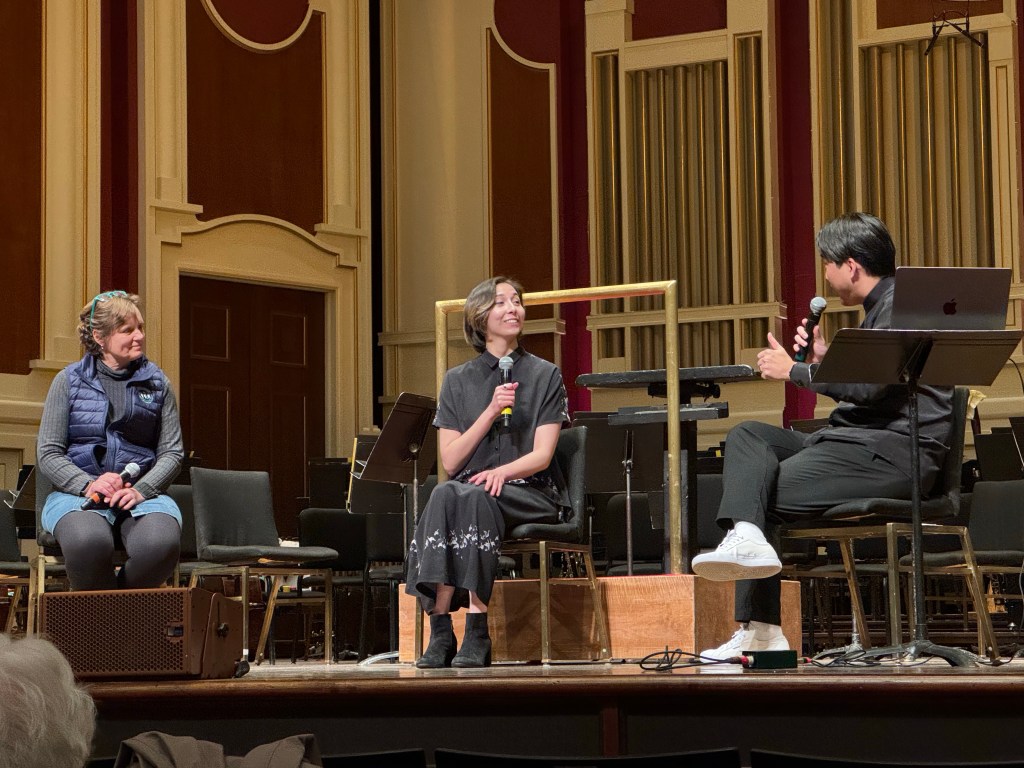
The work began almost in media res, as if it had always been in motion, dropping the needle in the thick of things. Driving rhythms made for an exciting listen, and Ishizaki made skillful use of the large orchestra she employed. A homecoming for the composer, writing for this orchestra in this hall is not without deep personal significance. A solo passage invoking a kinetic dance club beat was given to the contrabassoon, whom the composer counts as a mentor.
There’s hardly a more choice soloist in a Mozart piano concerto than Emanuel Ax, and the regal no. 25 in C major was a particularly fine vehicle for the pianist’s pearly technique and refined interpretation. A bold opening was fitting for one of the composer’s grandest conceptions in the medium, and the orchestra offered a nuanced reading, with detailed inflections and attention to the inner voices. The pianist’s entry was in the shape of just a single line, hesitant at first, before its full flourishing, displaying the crystalline, rippling playing of this masterful Mozartean.
Easily surmounting the decorative trills, rapid scales, and other technical demands, Ax also offered his own cadenza, an essay artfully expressive and wide-ranging. The central Andante served as a songful blending of piano and orchestra, and the finale brimmed with Viennese elegance, pointed and articulate. More so than the typical Mozart finale, it also probed the lyrical, particularly when Ax was in a lovely dialogue with the winds. A warmly enthusiastic reception — Ax seemed visibly moved — brought him back for an encore in a Chopin nocturne, a quantity which starkly contrasted the languid and the dramatic.
Something of a Mozart of his day, Erich Wolfgang Korngold was a prodigy in Vienna of extraordinary precocity. Fleeing the Nazis, he then found fame and fortune in Hollywood where he became one of the first major composers of film scores (John Williams cites him as a major influence). His sole symphony dates from the mid-1950s and is cast in the unusual key of F-sharp major. It’s not a work one encounters in concert often, but seems to have had a resurgence lately — a performance by the Berlin Philharmonic was quite memorable for this listener, and The Cleveland Orchestra has also programmed it in a recent season.
A jagged primary theme took shape in the clarinet, teetering on the brink of tonality, but firmly residing in the late Romantic tradition. Honeck and the PSO delivered a bracing, razor-sharp reading of this dense score with singular drama. As sumptuous as it gets, it’s almost to the point of excess and — as if one perhaps had a few too many slices of sachertorte. A high-octane scherzo followed, further showing the variegated color spectrum, with particularly piquant splashes from the piano and celesta. Matters were at the very edge of control without ever falling into chaos, and the brass passages had the cinematic effect of a film score.
Korngold looked towards Austrian compatriot Anton Bruckner in the towering slow movement, conceived in this case as a memorial to FDR. Brass and strings resounded through Heinz Hall, swelling to lush textures, though a solo passage for flute was delicately forlorn. The finale returned to the vigor and angular gestures of the opening, and militant brass fanfares threaded George M. Cohan’s Over There into the score. A welcome opportunity to hear a major if infrequently performed work — and certainly a highlight of the PSO season thus far.
In a brief post-concert performance, a quintet of PSO string players offered the first movement of Dvořák’s String Quintet No. 2, Op. 77. The use of double bass gives this work an orchestral heft, and made for a delightful capstone to the Dvořák heard the previous week.

 quasi-faust