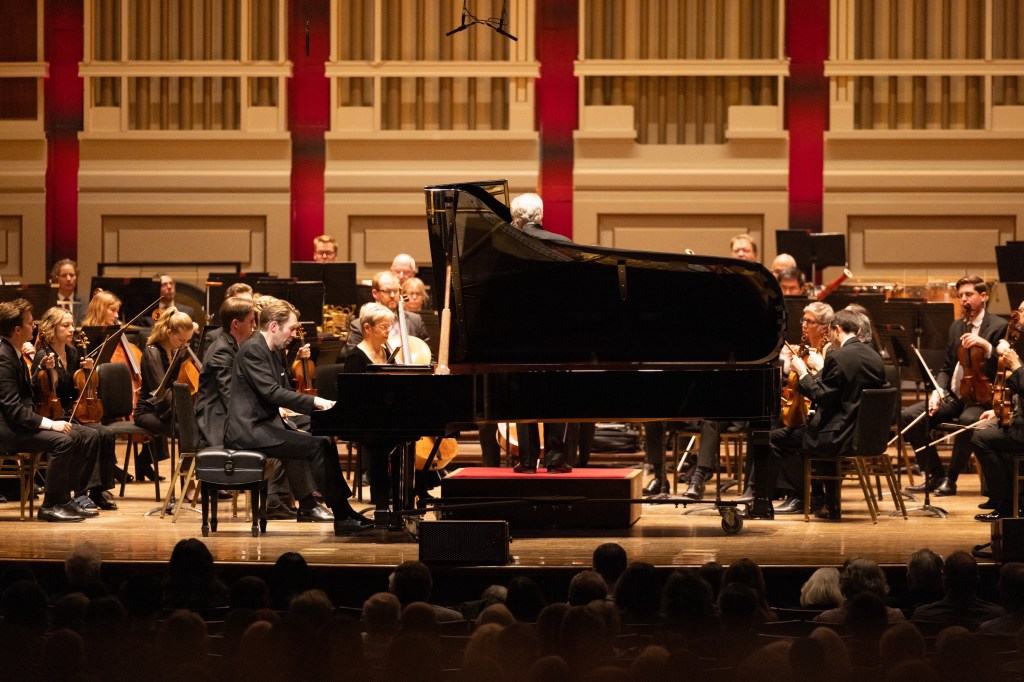
Yuja Wang headlines Pittsburgh Symphony’s glittering gala

Pittsburgh Symphony Orchestra
Manfred Honeck, conductor
Yuja Wang, piano
David McCarroll, violin
Justine Campagna, violin
Heinz Hall
Pittsburgh, PA
September 20, 2025

López: “Techno” from Fiesta!
Strauss Jr: Éljen a Magyár!, Op. 332 (arr. Nischkauer)
Shostakovich: “Waltz II” from Suite for Variety Orchestra No. 1
Sarasate: Navarra
Mascagni: “Intermezzo” from Cavalleria rusticana
Mancini: Strings on Fire
Tchaikovsky: Piano Concerto No. 1 in B-flat minor, Op. 23

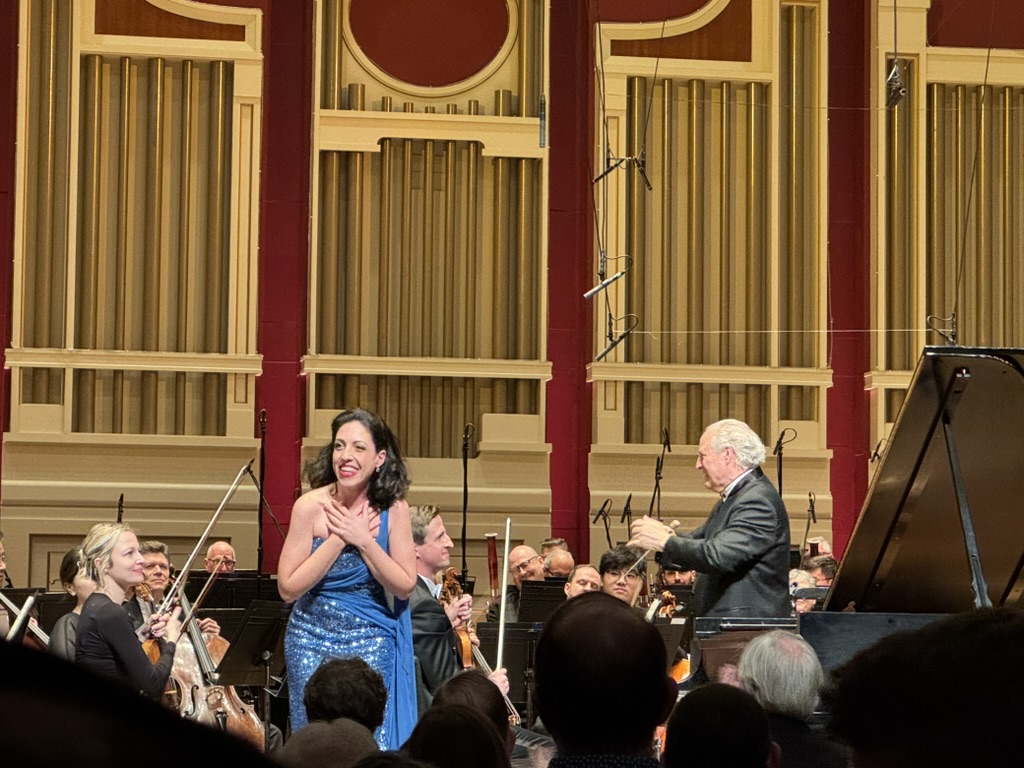
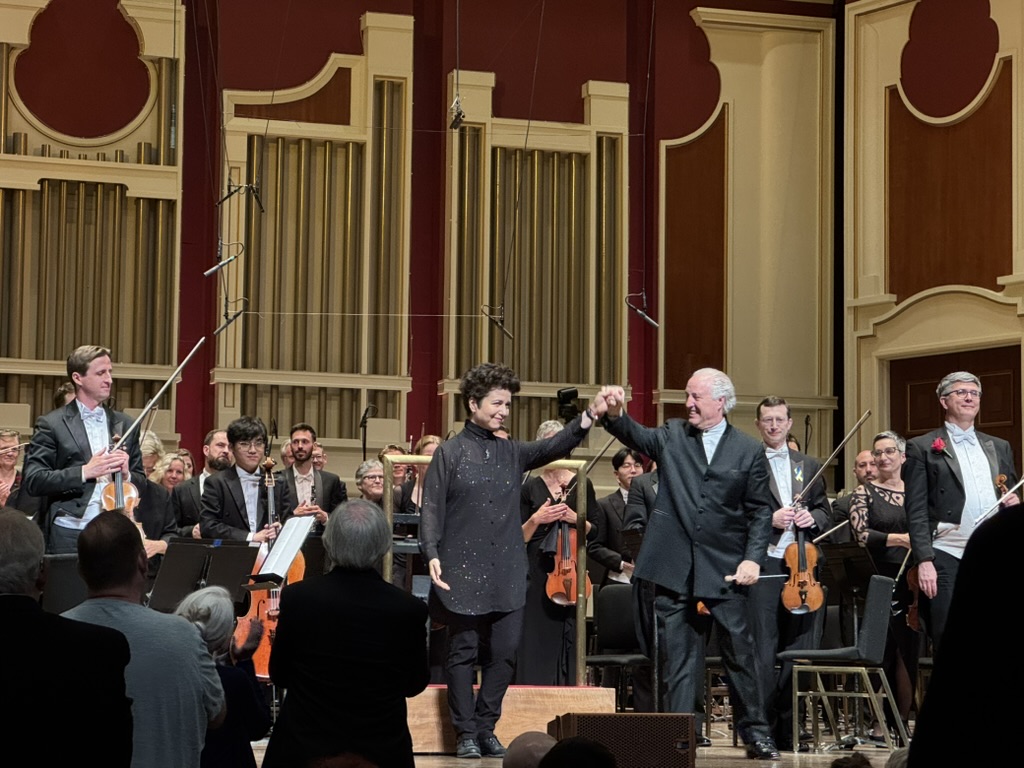
A celebratory gala concert marked the start of the Pittsburgh Symphony’s 2025-26 concert season, featuring a potpourri of appealing orchestral works guided by music director Manfred Honeck before star pianist Yuja Wang took the Heinz Hall stage. A major fundraising event for the organization as well, and a successful one — reportedly raising nearly $1 million.
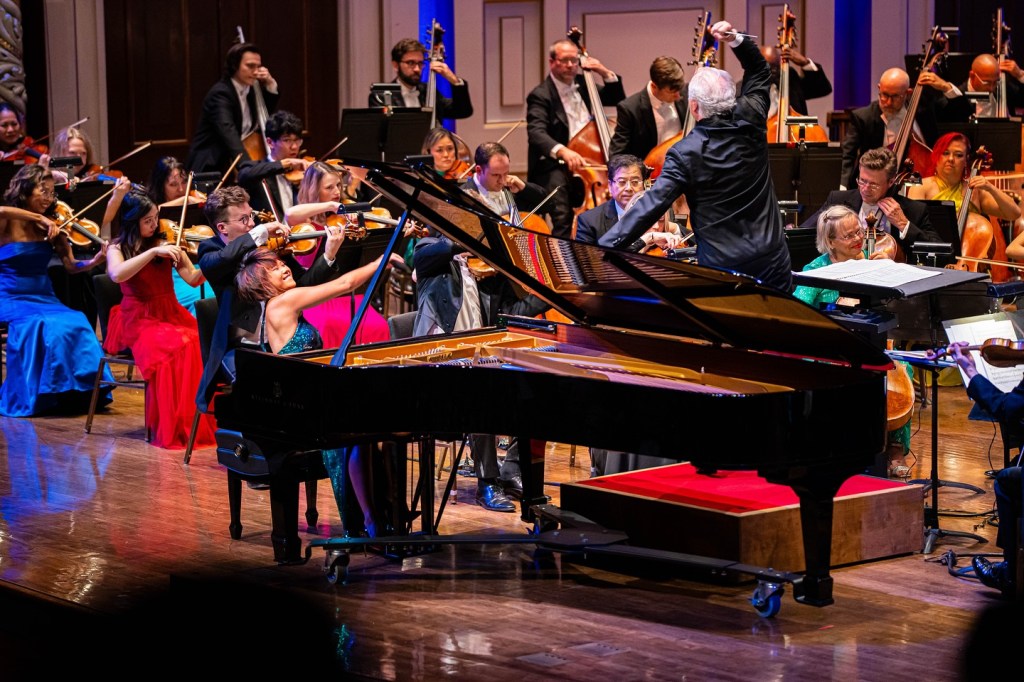
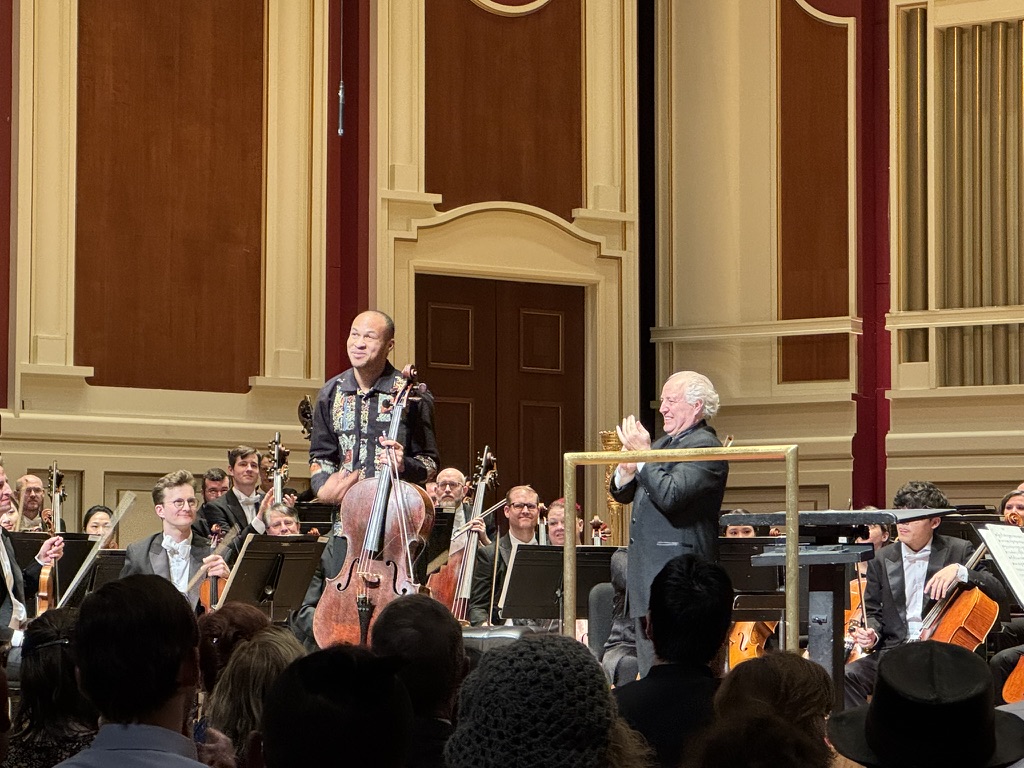
Yuja Wang with Manfred Honeck and the PSO, photos credit JMilteer Photography

Techno from the Fiesta! suite by Jimmy López certainly made for exciting first notes of the season with its driving kinetic energy, enhanced by an expanded percussion section. Strauss’ Éljen a Magyár! charmed in its infectiously lilting rhythms, and served as an acknowledgment of the composer’s 200th birthday.

Another anniversary was marked with Shostakovich, who we note died 50 years ago. A waltz from his Suite for Variety Orchestra No. 1 was nearly Chopinesque in its blending of elegance and melancholy. Sarasate’s Navarra featured dueling PSO violinists David McCaroll and Justine Campagna, playing the material with inimitable Spanish charm and coruscating virtuosity.

Mascagni’s indelible intermezzo from Cavalleria rusticana (which local audiences got to hear complete at Pittsburgh Opera last season) saw delicate strings blossom into the sumptuous. Finally, Henry Mancini’s (best remembered as composer of The Pink Panther and other films) Strings on Fire was just that — a sizzling, energetic workout.

I heard Yuja Wang play Tchaikovsky’s First Piano Concerto at The Cleveland Orchestra this past March, and was dazzled by her consummate virtuosity, command of the keyboard, and refined playing that revealed details I hadn’t heard before even in this overly familiar warhorse. There’s little else to say about it, but what a thrill it was to see her deliver such impassioned and assured playing with the Pittsburgh musicians, her first local appearance since 2013. Despite a thunderous ovation and numerous curtain calls, she didn’t indulge the capacity crowd with an encore, but perhaps it would have been all but gratuitous after such a satisfying take on Tchaikovsky.
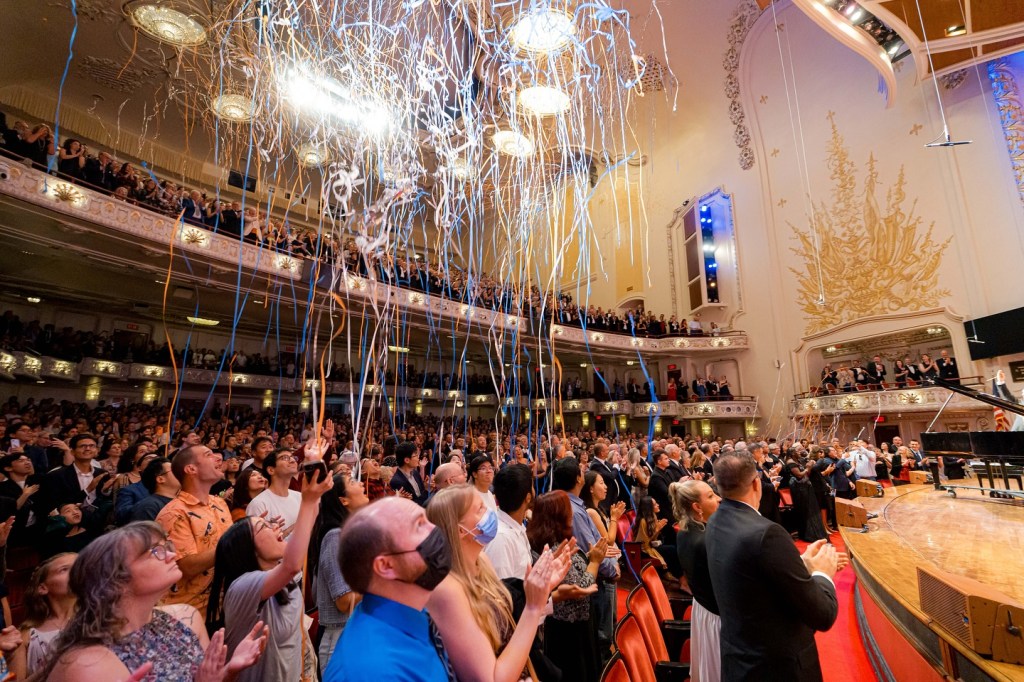
Honeck closes Pittsburgh season with scorching Shostakovich

Pittsburgh Symphony Orchestra
Manfred Honeck, conductor
Beatrice Rana, piano
Heinz Hall
Pittsburgh, PA
June 13, 2025

Auerbach: Frozen Dreams
Mendelssohn: Piano Concerto No. 1 in G minor, Op. 25
 Encore:
 Tchaikovsky/Pletnev: Intermezzo from The Nutcracker
Shostakovich: Symphony No. 10 in E minor, Op. 93

In the final subscription program of the season, Manfred Honeck and the Pittsburgh Symphony selected a program which has become a familiar format this season: a new work, a concerto with an impressive soloist, and a major symphony to cap things off. Friday’s new work was the world premiere of Lera Auerbach’s Frozen Dreams (which Honeck is due to conduct in Vienna the following weekend).

Lera Auerbach with Honeck and the PSO

Frozen Dreams had its roots in a 2020 work for string quartet. The expanded version for full orchestra gave the composer the opportunity to include some unique bits of instrumentation — for example, scraping the edge of the gong — to create an otherworldly, spiritual dimension, and a dreamy, phantasmagoric atmosphere. A folk-inspired theme took shape in a solo line from concertmaster David McCarroll. Pointillist-styled textures circulated around the orchestra in this captivating music that though required acute listening drew one in. The distinctive tones of the gong returned before matters faded to silence.

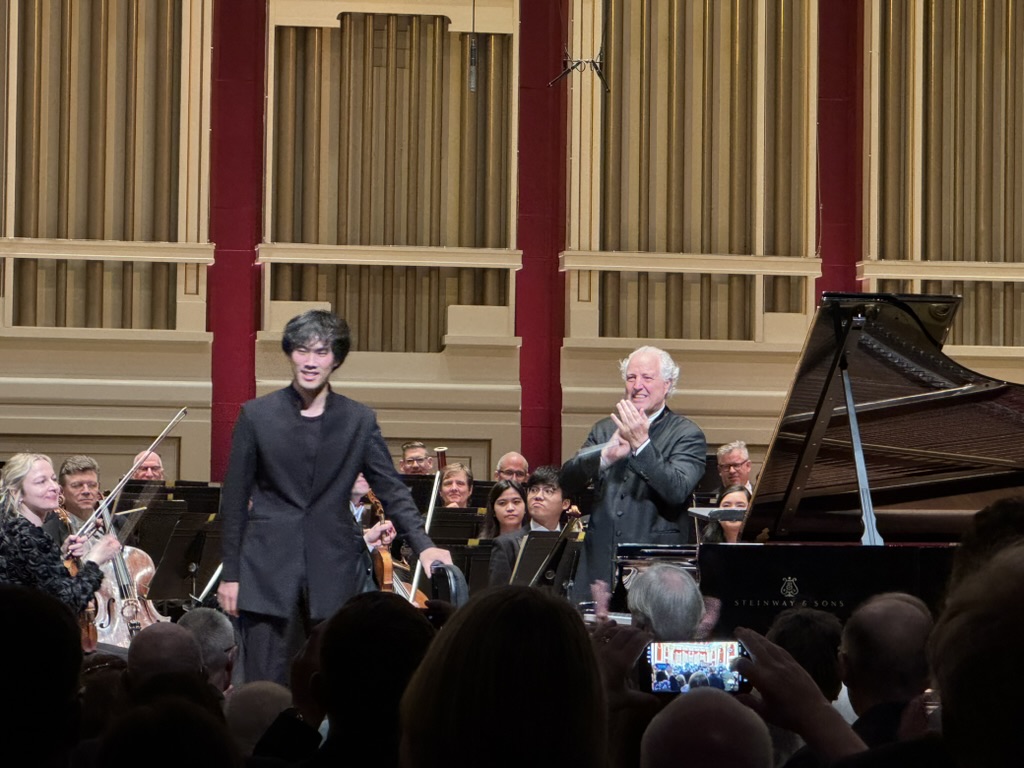
Mendelssohn’s brilliant Piano Concerto No. 1 saw the return of Italian pianist Beatrice Rana. A sizzling orchestral opening introduced her fleet fingers in playing that sparkled like the sequins of her dress. More lyrical passages were delicately shaped. Some lovely playing in the low strings and brass surfaced in the central Andante in service of Rana’s graceful pianism. The fiery finale saw the pianist in crisp command of the keyboard. As an encore, Rana had much to say in the lyrical and passionate Intermezzo from Tchaikovsky’s Nutcracker (part of an ingenious set of transcriptions by Mikhail Pletnev).

Shostakovich’s massive and shattering Tenth Symphony made for an imposing close to the season. A deep gravitas was felt from the very beginning, with the richness of the strings sounding world-weary, further answered by a lonesome clarinet. Gradually, the movement built to powerful and often ferocious climaxes, only to close on a forlorn flute. The Allegro served as an uncompromising portrait of Stalin’s brutality, a breathless aural assault. The following Allegretto began quietly unsettled, and morphed into a grotesque dance. Ponderous introductory material in the finale took flight into what seemed at first glance a jubilant fanfare, but a much grimmer reality was revealed in due course. The work ended, however, in what potentially could be felt as a glimmer of hope — but not without ambiguity and uncertainty.

Beatrice Rana with Honeck and the PSO

Angelic Mahler – and an unexpected debut – at the Pittsburgh Symphony

Pittsburgh Symphony Orchestra
Manfred Honeck, conductor
Bruce Liu, piano
Lilit Davtyan, soprano
Heinz Hall
Pittsburgh, PA
June 6, 2025

Vali: The Camel Bell
Beethoven: Piano Concerto No. 3 in C minor, Op. 37
 Encore:
 Chopin: Fantasie-Impromptu in C-sharp minor, Op. 66
Mahler: Symphony No. 4 in G major

Both of the Pittsburgh Symphony’s final two subscription programs of the season are scheduled to open with a world premiere, the first of which saw Reza Vali’s The Camel Bell come into being. Born in Iran, Vali is a composer with strong connections to Pittsburgh, having completed his PhD in composition at Pitt and subsequently teaching for many years at Carnegie Mellon. Additionally, this counts as his fourth PSO commission — the first three of which have been recorded on a recent Naxos release.

Bruce Liu with Manfred Honeck and the PSO

In his prefatory remarks, Vali likened the work to a “dialogue between great musical civilizations,” specifically noting it weaves together European, American, and Persian influences. A burst of energy began, and work explored the sounds of quarter tones – somewhat jarring to the Western ear, but a striking effect. Inflections even of jazz surfaced in this kaleidoscopic confluence of musical cultures, and I enjoyed the dueling solos between violinists David McCarroll and Jeremy Black. A tour de force closed one of the most impressive new pieces the PSO has introduced this season.

Pianist Alice Sara Ott was regrettably obliged to bow out of this weekend’s appearances due to acute tendinitis — much admiration to Bruce Liu for stepping in on short notice (as well as for the PSO360 recital situated between the two performances of this program). Liu has come to prominence after capturing first prize in the 2021 International Chopin Piano Competition, so a PSO debut from him was a welcome surprise.

Crisply articulated, the orchestral introduction to Beethoven’s Piano Concerto No. 3 introduced the C minor tonality, replete with requisite tension. Liu entered the fold by way of a fiery flourish on the keyboard, while nonetheless purveying a tone elegant and rippling, and the cadenza was given with dramatic flair. The unaccompanied piano opened the central Largo, prayer-like, and probing its great expressive potential. I was struck by Liu’s limber, flexible fingerwork in the stylishly elegant finale, ending in the brightness of C major. As an encore, Liu offered a marvelous account of Chopin’s impassioned Fantasie-Impromptu.

Mahler’s Fourth Symphony is a different animal than the composer’s other symphonies, slimmer and rather classically proportioned, yet still unmistakably Mahlerian. Music director Manfred Honeck drew the orchestral fabric with clarity and transparency, and a classical economy that brought out its details and nuances — and not without an infectious lilt. In the second movement, concertmaster McCarroll played a de-tuned violin, purveying a coarse, rustic quality further enhanced by a shrill clarinet.

In the sprawling Ruhevoll we were given the first glimpse of heaven, plaintive and serene, seemingly at peace — but still not without a certain strife with which to contend. The finale began with an innocent purity, free from world-weary concerns. Soprano Lilit Davtyan perhaps could have benefitted from clearer diction, but I was mostly taken by the angelic quality of her voice, and the way the orchestra deftly matched it.

Víkingur Ólafsson makes magnificent Pittsburgh Symphony debut with impassioned Brahms

Pittsburgh Symphony Orchestra
Manfred Honeck, conductor
Víkingur Ólafsson, piano
Heinz Hall
Pittsburgh, PA
April 27, 2025

Jani: Flare
Beethoven: Symphony No. 1 in C major, Op. 21
Brahms: Piano Concerto No. 1 in D minor, Op. 15

Encores:
Rameau/Ólafsson: The Arts and the Hours
Rameau: Le Rappel des oiseaux

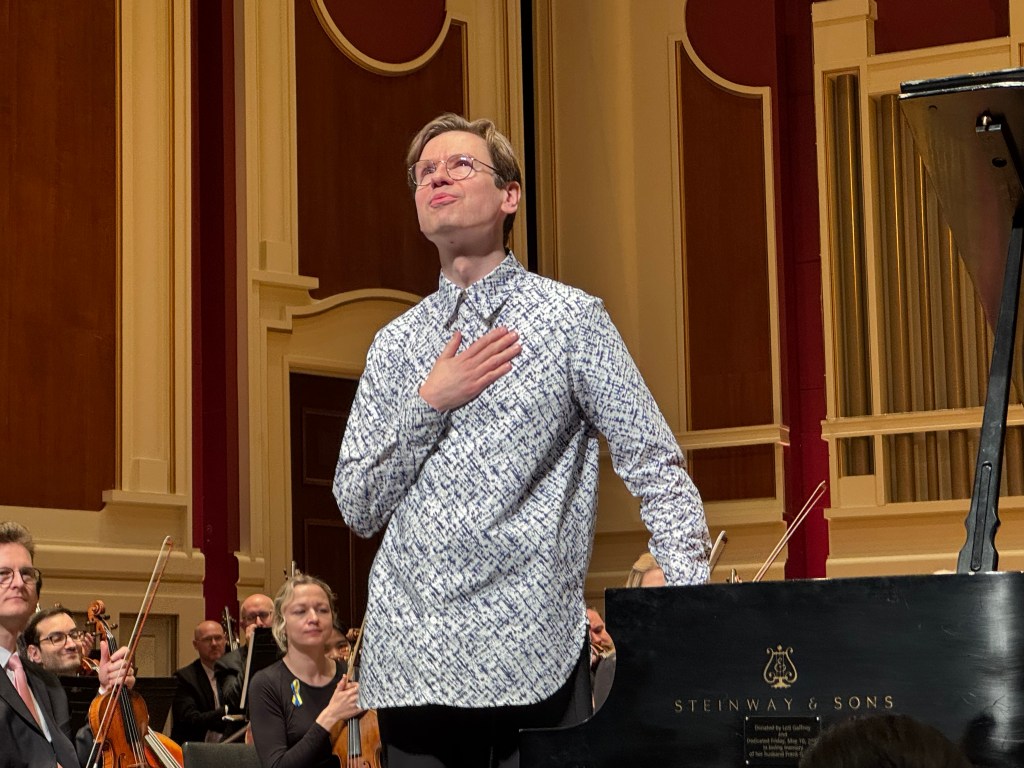
With a Grammy award, an extensive discography, and appearances with the world’s leading orchestras and at the most prestigious concert halls, it’s a bit surprising it’s taken until 2025 for Icelandic pianist Víkingur Ólafsson to debut with the Pittsburgh Symphony. It was worth the wait, however, as he treated Pittsburgh audiences to an arresting, majestic performance of Brahms’ brooding First Piano Concerto (though he was originally scheduled to perform the Second Concerto).

Víkingur Ólafsson at the Pittsburgh Symphony

There was dramatic tension from bar one, with a dark and impassioned orchestral introduction. Ólafsson entered by way of a dulcet chorale, scaling to ferocious tremolos. He purveyed a bold and commanding tone, showing that music of great technical demands can be wholly devoid of showy virtuosity. A thoughtful and probing interpreter, Ólafsson’s absorption in the music was absolute, even bobbing his head during the orchestral interludes like a bona fide rockstar before the expansive first movement reached a bleak, uncompromising close.

The central Adagio was plaintive and filled with longing, and the pianist’s deft voicing and phrasing brought out a resonant lyricism. A ferocious fugato marked the closing rondo finale, with both pianist and orchestra seemingly running on endless reserves of dramatic energy. From the piano bench, Ólafsson eyed his orchestral colleagues with joy and admiration — there was some impressive contrapuntal playing to be heard — and the long journey pointed to a triumphant end.

With charismatic charm, Ólafsson addressed the audience and expressed his gratitude to be in Pittsburgh, reminiscing how impressed he was by the PSO’s playing when he caught them during a performance in Berlin in 2013 (reviewed by a colleague here). He generously offered a pair of encores, both by Rameau — his own transcription styled as The Arts and the Hours from Rameau’s final opera (Les Boréades), and the intricate gem Le Rappel des oiseaux. An impressive way to cap off the most significant local debut of the season.

The program began with the 2021 work Flare by German composer Sophia Jani. Loosely drawing inspiration from the poetry of Mary Oliver, Flare was of a colorful soundscape. Clangorous brass formed the backbone of the work, building to bold climaxes in a style that seemed to be a nod towards film scores.

Beethoven’s First Symphony rounded off the program — if there’s a connective thread, all three works program were by German composers, and all counted as one of their composers’ earliest forays into writing for orchestra. A work very much in Manfred Honeck’s wheelhouse, the weight of the introductory material in the youthful C major symphony gave way to buoyant textures that effervesced — though the development was not without fire and drama. The slow movement was articulate with careful detailing of the rhythmic inflections. Wholly at peace and untroubled, but contrasts were sharpened to add tension. A minuet sparkled with exuberance, a warmup for the boisterous finale, with perhaps the occasional hint to the dramatic style the composer would soon develop.

Manfred Honeck and the Pittsburgh Symphony herald springtime with Beethoven’s Pastoral

Pittsburgh Symphony Orchestra
Manfred Honeck, conductor
Francesco Piemontesi, piano
Heinz Hall
Pittsburgh, PA
March 30, 2025

Eisendle: heliosis
Liszt: Piano Concerto No. 2 in A major, S125
 Encore:
 Schubert: Impromptu in G-flat major, Op. 90 No. 3
Habibi: Jeder Baum spricht
Beethoven: Symphony No. 6 in F major, Op. 68, Pastoral

Over the closing weekend of March, Manfred Honeck and the Pittsburgh Symphony offered a program anchored by Beethoven’s Pastoral symphony, certainly an apt way to mark the arrival of spring (and I’m happy to report I spotted some cherry blossoms on the way to Heinz Hall!). In the graceful material that opened the symphony, the PSO radiated a joyous exuberance from the stage.

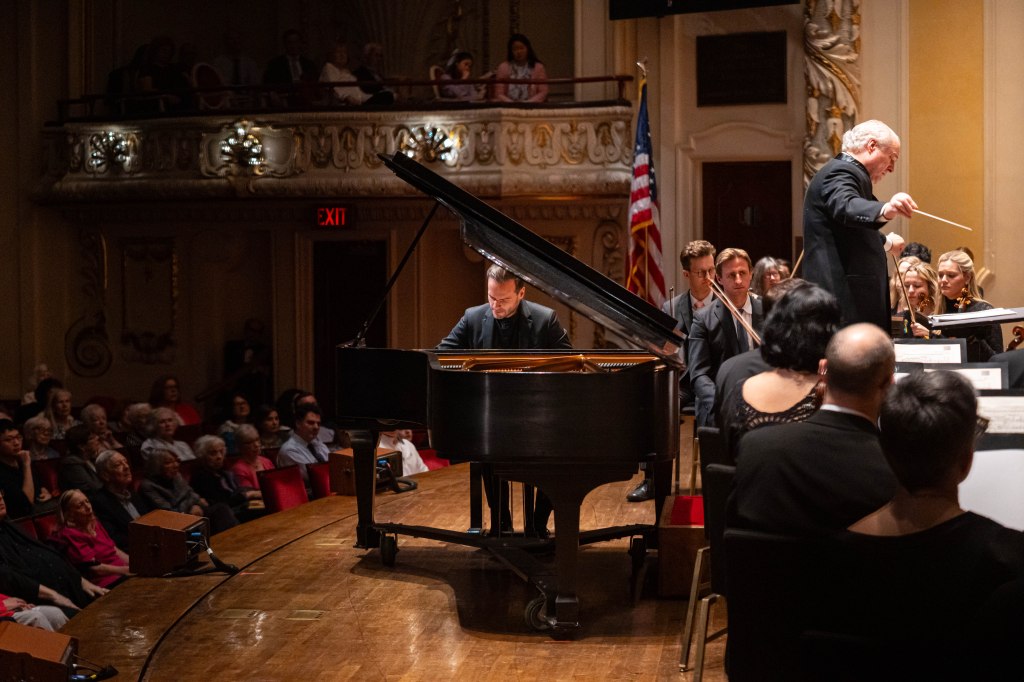
Francesco Piemontesi, Manfred Honeck, and the PSO, photo credit JMilteer Photography

I was particularly touched by the warmth of the clarinet in the gentle slow movement, hardly portending the storm that lay ahead. The PSO romped through the minuet that followed, with Honeck inviting the musicians to stomp their feet, perhaps giving the authentic air of a country dance. Ample drama painted the ensuing storm in vivid realism, making the closing Shepherd’s Song all the more rewarding.

Prefacing the Beethoven was the 2019 work Jeder Baum spricht (“Every Tree Speaks”) by Iranian composer Iman Habibi. Written for the Philadelphia Orchestra’s celebration of Beethoven’s 250th anniversary, it was explicitly conceived to precede the Fifth and Sixth symphonies, and makes numerous if somewhat veiled references to both. The title comes from Beethoven’s diaries, and in his prerecorded video remarks, Habibi noted a further resonance to the current climate crisis. An invocation of the fate motif from the Fifth opened, and a panoply of nature sounds abounded in this brief, five-minute prelude.

Opening the program was another contemporary work, a 2021 piece by Austrian composer Hannah Eisendle entitled heliosis (a medical term for sunstroke). Following an attention-grabbing opening, there was a retreat to a desolate, sun-drenched soundscape. The scoring emphasized the percussion, and its driving rhythms to my ears echoed Stravinsky’s Rite of Spring.

The program further featured pianist Francesco Piemontesi in Liszt’s Second Piano Concerto (a work I also heard him play at the Chicago Symphony just a few months earlier). Gentle winds began, answered by rolling arpeggios across the piano, as if gingerly exploring the potential of the instrument. Virtuosity was quickly ramped up, however, with the theme being transformed into an energetic march. In a more serene moment, the piano was in a richly lyrical duet with the cello (Anne Martindale Williams), a moment of respite before the fiery end. As an encore, the pianist selected Schubert’s G-flat impromptu — lovely and lyrical, and also a favorite of Piemontesi’s mentor Alfred Brendel.

Cellist Kanneh-Mason makes memorable Pittsburgh Symphony debut

Pittsburgh Symphony Orchestra
Manfred Honeck, conductor
Sheku Kanneh-Mason, cello
Heinz Hall
Pittsburgh, PA
March 21, 2025

Shekhar: Lumina
Shostakovich: Cello Concerto No. 1 in E-flat major, Op. 107
 Encore: I Say a Little Prayer
Strauss: Don Juan, Op. 20
Strauss: Symphonic Fantasy from Arabella, Op. 79 (arr. Honeck/Ille)

The Pittsburgh Symphony is to be commended for its advocacy of contemporary music, with many of this season’s programs introducing a recent work by a living composer. This week’s program began with the 2020 work Lumina by Nina Shekhar. Shekhar is currently a doctoral student in music composition at Princeton (presumably classmates with Hannah Ishizaki, featured on a PSO program a month ago). The composer also draws from an engineering background, evident in the present work that concerns the spectrum of light.

Sheku Kanneh-Mason with Manfred Honeck and the Pittsburgh Symphony

It’s a work that demands attention from both performers and audience. Silence is just as important as sound, and effects are achieved through subtle, nearly imperceptible gestures: microtones, harmonics, bowing of the vibraphone. A soft-spoken essay, it occasionally burgeoned into strident climaxes. I’m not sure this is a piece that fully earned the attention it required, yet I appreciate the PSO’s attention to a rising composer.

The main draw of the evening was the Pittsburgh debut of cellist Sheku Kanneh-Mason in the Cello Concerto No. 1 of Shostakovich. Kanneh-Mason drew a fittingly gritty tone out of his Matteo Goffriller instrument that dates from 1700, delivering a variation on the composer’s musical signature with a caustic bite. The cellist was flexible and limber, imbuing the score with character and color. Manfred Honeck and the PSO supported the soloist with piquant accompaniment. Unusually for Shostakovich, the horn is the only brass instrument used — a tip of the hat to William Caballero for single-handedly serving as the brass section. The Moderato was of desolate, pained lyricism, reduced to a skeletal orchestration.

Like the composer’s First Violin Concerto, an extended cadenza served as effectively a standalone movement in the heart of the work. One was struck by Kanneh-Mason’s expressive range — and while not an overtly virtuosic affair, the cellist showed a deep command of his instrument. The finale was quintessential Shostakovich in both its urgency and coloristic writing, up to the blistering end. As an encore, Kanneh-Mason offered a transcription I Say a Little Prayer, the Burt Bacharach song made famous by both Dionne Warwick and Aretha Franklin — a lovely piece in its jazzy pizzicato (for a recording, see Kanneh-Mason’s warmly recommend album Song).

The second half was devoted to Richard Strauss, beginning with his iconic tone poem Don Juan. Its opening was akin to drinking from a firehose, with blazing virtuosity and brassy splendor. The music crested to searing passions, highlighted by a long and languid oboe solo from Cynthia Koledo DeAlmeida. By the coda, matters came crashing down for a tragic, somber end.

Closing the program was an appealing alternative to the more well-worn tone poems, in the world premiere of a suite based on Strauss’ opera Arabella. Conceived by Manfred Honeck and arranged by Tomáš Ille (a team that has previously devised suites based on Elektra and Janáček’s Jenůfa), it captured the essence of the opera in a span of eighteen minutes. A bold, dense opening was arresting in its rich chromaticism. A lilting waltz — in a similar spirit to Rosenkavalier — contrasted, and the PSO’s superb playing brought out a gorgeous lyricism, leading to a brilliant close.

Honeck leads lavish program of varied Viennese repertoire in Pittsburgh

Pittsburgh Symphony Orchestra
Manfred Honeck, conductor
Emanuel Ax, piano
Heinz Hall
Pittsburgh, PA
February 21, 2025

Ishizaki: Spin
Mozart: Piano Concerto No. 25 in C major, K503
 Encore:
 Chopin: Nocturne No. 7 in C-sharp minor, Op. 27 No. 1
Korngold: Symphony in F-sharp major, Op. 40

All three works on Manfred Honeck’s generous Pittsburgh Symphony engaged in some fashion with the rich musical heritage of Vienna. The opening turned to a local voice, 24-year-old Pittsburgh area native Hannah Ishizaki, currently a doctoral student in music composition at Princeton (see NEXTpittsburgh for a lovely interview). Receiving its world premiere was Spin, a five-minute curtain-raiser that drew on dance traditions as disparate as Viennese waltz and electronic dance music.

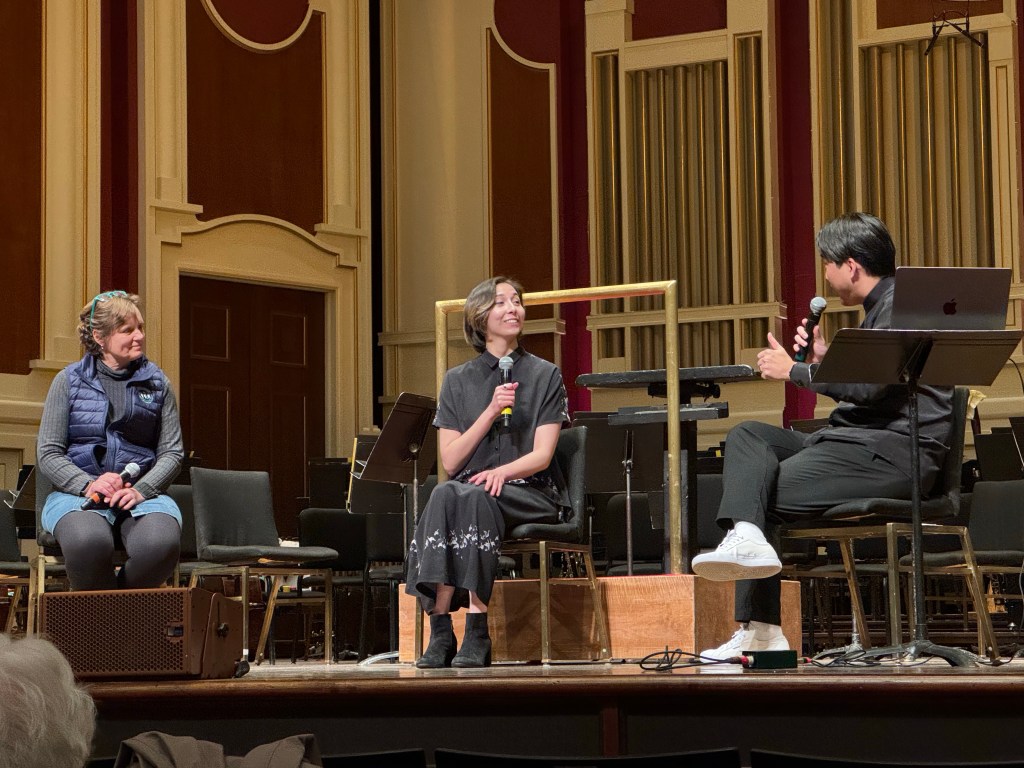
Pre-concert interview with piccolo Rhian Kenny, composer Hannah Ishizaki, and assistant conductor Moon Doh

The work began almost in media res, as if it had always been in motion, dropping the needle in the thick of things. Driving rhythms made for an exciting listen, and Ishizaki made skillful use of the large orchestra she employed. A homecoming for the composer, writing for this orchestra in this hall is not without deep personal significance. A solo passage invoking a kinetic dance club beat was given to the contrabassoon, whom the composer counts as a mentor.

There’s hardly a more choice soloist in a Mozart piano concerto than Emanuel Ax, and the regal no. 25 in C major was a particularly fine vehicle for the pianist’s pearly technique and refined interpretation. A bold opening was fitting for one of the composer’s grandest conceptions in the medium, and the orchestra offered a nuanced reading, with detailed inflections and attention to the inner voices. The pianist’s entry was in the shape of just a single line, hesitant at first, before its full flourishing, displaying the crystalline, rippling playing of this masterful Mozartean.

Easily surmounting the decorative trills, rapid scales, and other technical demands, Ax also offered his own cadenza, an essay artfully expressive and wide-ranging. The central Andante served as a songful blending of piano and orchestra, and the finale brimmed with Viennese elegance, pointed and articulate. More so than the typical Mozart finale, it also probed the lyrical, particularly when Ax was in a lovely dialogue with the winds. A warmly enthusiastic reception — Ax seemed visibly moved — brought him back for an encore in a Chopin nocturne, a quantity which starkly contrasted the languid and the dramatic.

Something of a Mozart of his day, Erich Wolfgang Korngold was a prodigy in Vienna of extraordinary precocity. Fleeing the Nazis, he then found fame and fortune in Hollywood where he became one of the first major composers of film scores (John Williams cites him as a major influence). His sole symphony dates from the mid-1950s and is cast in the unusual key of F-sharp major. It’s not a work one encounters in concert often, but seems to have had a resurgence lately — a performance by the Berlin Philharmonic was quite memorable for this listener, and The Cleveland Orchestra has also programmed it in a recent season.

A jagged primary theme took shape in the clarinet, teetering on the brink of tonality, but firmly residing in the late Romantic tradition. Honeck and the PSO delivered a bracing, razor-sharp reading of this dense score with singular drama. As sumptuous as it gets, it’s almost to the point of excess and — as if one perhaps had a few too many slices of sachertorte. A high-octane scherzo followed, further showing the variegated color spectrum, with particularly piquant splashes from the piano and celesta. Matters were at the very edge of control without ever falling into chaos, and the brass passages had the cinematic effect of a film score.

Korngold looked towards Austrian compatriot Anton Bruckner in the towering slow movement, conceived in this case as a memorial to FDR. Brass and strings resounded through Heinz Hall, swelling to lush textures, though a solo passage for flute was delicately forlorn. The finale returned to the vigor and angular gestures of the opening, and militant brass fanfares threaded George M. Cohan’s Over There into the score. A welcome opportunity to hear a major if infrequently performed work — and certainly a highlight of the PSO season thus far.

In a brief post-concert performance, a quintet of PSO string players offered the first movement of Dvořák’s String Quintet No. 2, Op. 77. The use of double bass gives this work an orchestral heft, and made for a delightful capstone to the Dvořák heard the previous week.

Manfred Honeck, Emanuel Ax, and the Pittsburgh Symphony

Pittsburgh Symphony rings in holiday season with a joyous Messiah

Pittsburgh Symphony Orchestra
Manfred Honeck, conductor

Mendelssohn Choir of Pittsburgh
Daniel Singer, director

Jeanine De Bique, soprano
Reginald Mobley, countertenor
John Matthew Myers, tenor
Joshua Hopkins, baritone

Heinz Hall
Pittsburgh, PA
December 7, 2024

Handel: Messiah, HWV 56

If there’s a sign the holiday season is upon us, surely it would be a performance of Handel’s timeless oratorio Messiah — although it’s worth remembering that its first performance coincided instead with Easter. Buttressing Manfred Honeck and the Pittsburgh Symphony was the Mendelssohn Choir and a quartet of vocal soloists — two of which along with the Choir were featured in the previous night’s performance of the Fauré Requiem.

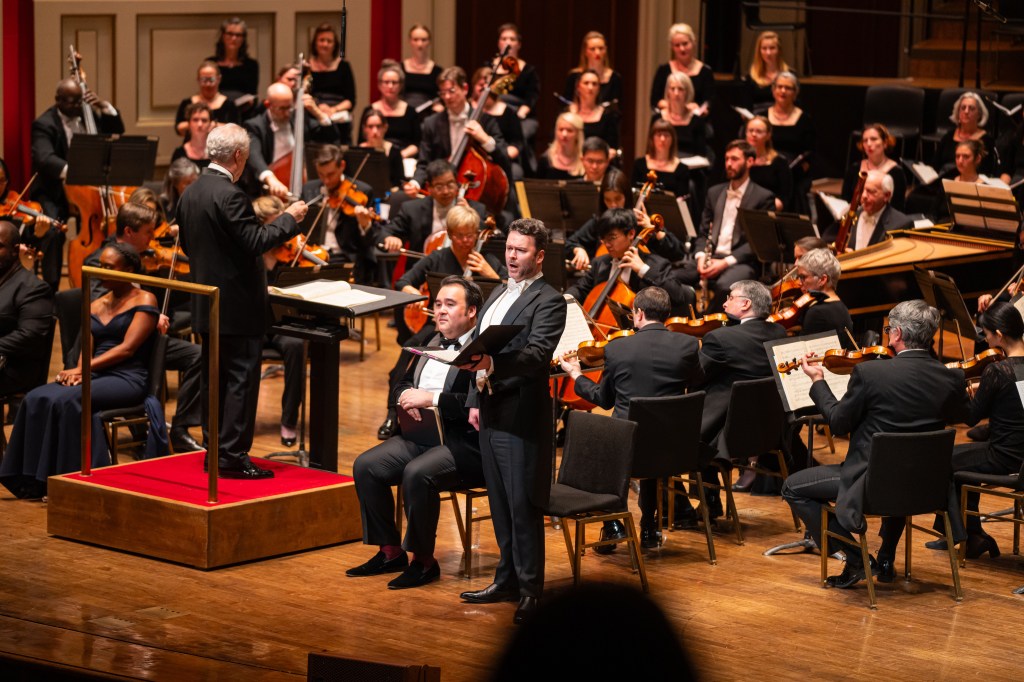
Reginald Mobley (cropped), Jeanine De Bique, John Matthew Myers, and Joshua Hopkins perform with Honeck and the PSO. Photos credit Josh Milteer / Pittsburgh Symphony Orchestra

As is often done, cuts were made to the present performance with Honeck artfully selecting 41 of the 53 segments for a brisk 90 minutes of music. The opening Sinfonia for orchestra alone was crisply articulated, a stern, minor-key affair in sharp contrast from the exultant quality of most of the work. Tenor John Matthew Myers had the first vocal appearance of the evening in “Comfort ye, my people,” purveying a smooth, lyrical tone that was comforting indeed.

Baritone Joshua Hopkins maintained an imposing vocal presence, apparent from his entry in the recitative “Thus saith the Lord.” A highlight of the generally more introspective Part II of the work came in Hopkins’ aria “Why do the nations so furiously rage” — and one longs for a year when this isn’t so topical. “The trumpet shall sound” from the third and final part was fittingly bright with tenor and trumpet in clarion conversation.

Reginald Mobley offered a flexible countertenor, wide in range and elastic in melisma. “Behold, a virgin shall conceive” saw him in delicate dialogue with the principal strings and continuo. All selections that featured the soloists were for a single performer, save for “O death, where is thy sting?” which engaged Mobley and Hopkins in duet. Their voices blended harmoniously — a pity there weren’t more opportunities to hear the quartet in concert with each other.

Appearing for the first time near the end of Part I was soprano Jeanine De Bique, delicate and nuanced. She was particularly angelic in Part III’s aria “I know that my Redeemer liveth,” decorated in tinsel by high and strings and organ. “If God be for us” was a poignant and intimate moment ahead of the exuberant close, with solo passages from the concertmaster and cello touchingly decorating the soprano’s vocal line.

Of course the star of any Messiah performance is the chorus, and the Mendelssohn Choir delivered in spades. “And the Glory of the Lord,” marked their entry, delivering with clarity the intricate, multi-layered choral writing. The Hallelujah chorus, recognizable far beyond the confines of the concert hall, was festive and bright, and the audience followed the time-honored tradition of rising to their feet. “Worthy is the Lamb” closed the evening in the brilliance and weight of the full ensemble.

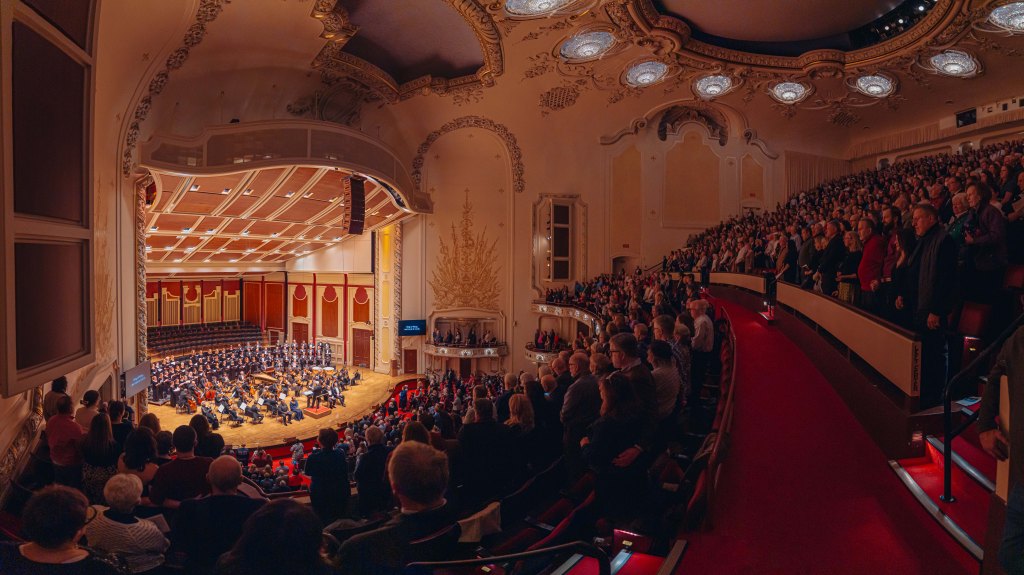
The PSO performs Handel’s Messiah at Heinz Hall

Honeck and Pittsburgh Symphony offer delectable potpourri in Thanksgiving program

Pittsburgh Symphony Orchestra
Manfred Honeck, conductor
Steven Banks, saxophone
Heinz Hall
Pittsburgh, PA
December 1, 2024

Weber: Overture to Der Freischütz
Tomasi: Concerto for Alto Saxophone
Strauss II: Overture to Die Fledermaus
Strauss II: Éljen a Magyar!, Op. 332
Puccini: Intermezzo from Act III of Manon Lescaut
Strauss II: Leichtes Blut, Op. 319
Banks: Strength of My Life from Come As You Are (arr. Corey Dundee)
Strauss II: Kaiser-Walzer, Op. 437
Strauss II: Auf der Jagd, Op. 373

Encores:
Josef Strauss: Feurfest!, Op. 269
Strauss Sr.: Radetzky-Marsch, Op. 228

In a standing tradition, the Pittsburgh Symphony presented a populist Thanksgiving program highlighted by a brimming selection of waltzes, polkas, and marches from the Strauss family. The first half began on a rather more serious note, however, opening with the overture to Weber’s landmark opera Der Freischütz.

Steven Banks, Manfred Honeck, and the PSO. Photo credit Manfred Honeck on Facebook

A long-bowed melody in the arching strings was tempered by warm chorales from the Pittsburgh brass. With vigor, darker material took over in full-fledged operatic drama, though in the end the triumphant conclusion won the day.

A rarity followed in the 1949 Alto Saxophone Concerto by Henri Tomasi, a quantity for the PSO debut of Steven Banks. A modernist soundscape was drawn from its piquant bitonalities, and the lyrical potential of the saxophone was exploited to remarkable effect — a markedly distinct style from the jazz sound one is more accustomed to. The Allegro section that followed the concerto’s introductory remarks was of a coloristic mid-century aesthetic, with a lively orchestration to boot, and Banks traversed a wide array of tone and timbre.

The closing Giration-Final saw the soloist dazzle in rapid fingerwork, and the movement’s dance inflections added to its excitement. As an encore, Banks offered The Lord’s Prayer, a slow and lyrical paragraph that showed yet another side of his instrument — and the power it has to resound unaccompanied.

The Strauss-heavy latter half was very much in the spirit of a Vienna Philharmonic New Year’s Concert, as if Heinz Hall was momentarily morphed into the golden Musikverein (and one should also be reminded that an authentic Austrian-style Christmas market lies a few blocks away at Market Square). One could have hardly asked for a more informed interpreter than Austrian native Manfred Honeck.

Lithe and elegant, the overture to the operetta Die Fledermaus fizzed with vigor and flamboyance. Hungarian folk melodies — including echoes of the indelible Rákóczi March — were woven in the exuberant Éljen a Magyar! Rather different but equally appealing was an intermezzo from Puccini’s Manon Lescaut, lush and filled with longing. Harps swelled for a sumptuous texture, further encouraged by fine playing from the solo cello.

Banks returned to showcase his own composition entitled Come As You Are. Originally scored for tenor saxophone and piano, the suite is a lovely tribute to his faith and family. On offer was an arrangement for tenor sax and strings of the third movement “Strength of My Life.” Touchingly reflective, it was well-suited to the rich, mellow sound of the tenor.

Back to Strauss. The Emperor Waltzes were fittingly regal, and Auf der Jagd concluded the printed program complete with some humorous theatrics. Honeck and the PSO indulged the audience with a pair of encores beginning with Feuerfest! from the pen of Johann Jr’s brother Josef. Brought to life by use of the anvil, it was only outdone by the rambunctious Radetzky March.

In a post-concert performance, the Pittsburgh Cello Quartet (comprised of four PSO cellists) offered a brief selection of mostly holiday fare. More memorable was a transcription of Poulenc’s pensive O magnum mysterium.

A devilish afternoon at the Pittsburgh Symphony

Pittsburgh Symphony Orchestra
Manfred Honeck, conductor
Leif Ove Andsnes, piano

Women of the Mendelssohn Choir of Pittsburgh
Daniel Singer, director

Heinz Hall
Pittsburgh, PA
April 21, 2024

Rachmaninoff: Piano Concerto No. 3 in D minor, Op. 30
 Encore:
 Chopin: Mazurka in D major, Op. 33 No. 2
Liszt: Dante Symphony, S109

Sunday afternoon’s Pittsburgh Symphony performance began on a somber note, with a moment of silence in memoriam of Sir Andrew Davis, who served as the PSO’s artistic advisor from 2005-07. Music director Manfred Honeck offered a few words and dedicated the performance to Davis’ memory. On a personal note, I have fond memories of seeing Davis often during his two decade stint at Lyric Opera of Chicago, and caught him in robust form as recently as last June with the Minnesota Orchestra.

Leif Ove Andsnes with Manfred Honeck and the Pittsburgh Symphony, photos credit George Lange

The first half of the program was devoted to Rachmaninoff’s fiendishly difficult Third Piano Concerto, calling upon Leif Ove Andsnes as soloist. A barren, monastic melody opened, direct and undiluted in its expression before complexities multiplied. Andsnes drew a bold and robust tone, amply projecting through the hall and over the large orchestra. The PSO was a fine partner to the pianist, with some particularly sturdy playing from the brass. Andsnes opted for the larger of the two cadenzas the composer supplied, cresting to a thunderous climax.

The opening of the central intermezzo offered a rare respite for the piano, a strained paragraph for strings and winds to introduce a ravishing melody in the piano, increasingly impassioned. The finale proceeded as an electric march, with a grand, sweeping melody at the heart. One was kept at the edge of their seat through the sparkling coda in this bombshell of a performance. Andsnes returned for an encore in Chopin’s D major mazurka (op. 33 no. 2), bringing out the dance’s stylish rhythms and ineffable charm.

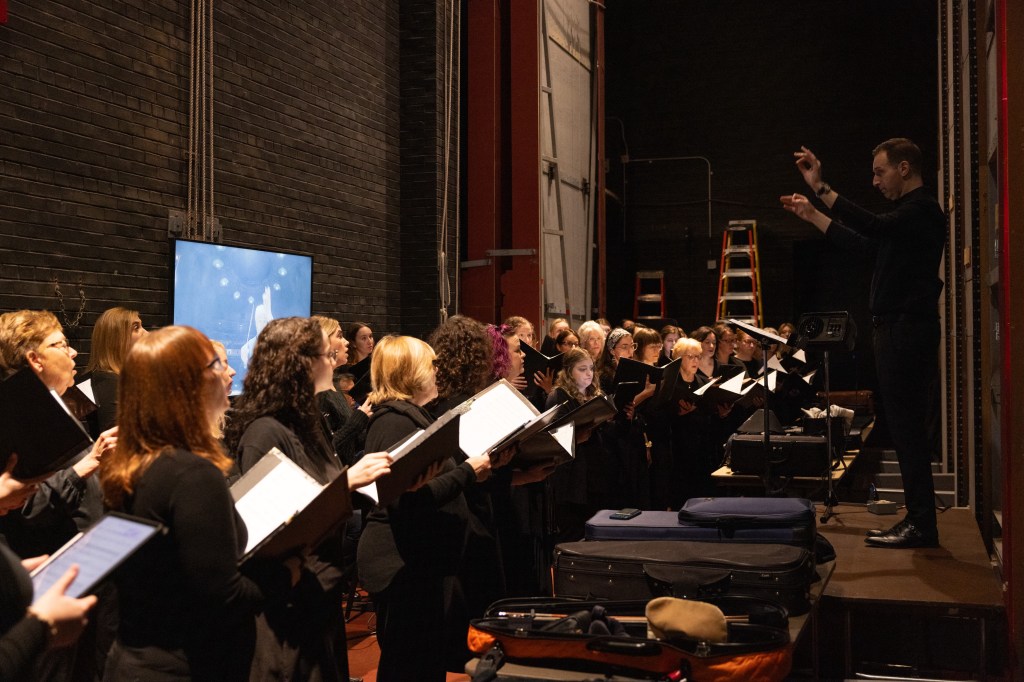
Matters went from warhorse to rarity with the latter half seeing a rare outing of Liszt’s Dante Symphony, an extensive work the composer wrote moved by his reading of the Divine Comedy (and a companion of sorts to the better-known Dante Sonata). This weekend marked the belated Pittsburgh premiere of the work, though I’ve had the unexpected fortune of seeing it elsewhere over the last few years – Chicago (2017) and Columbus (2022). Two large movements represent the Inferno and Purgatorio respectively; not feeling music could adequately represent Paradisio, Liszt instead opted to close with a brief Magnificat that employs a female choir.

Low brass opened in an uncompromising descent to hell, with thundering timpani further conjuring the inferno in no uncertain terms. A bit overblown, perhaps, but Honeck and the PSO were strong advocates of the work and offered a compelling interpretation. A lyrical contrast was provided in material that represented Francesca da Rimini, conveyed by the bass clarinet and harp. With a certain inevitability, the movement was brought to a bleak, crashing close – with all hope duly abandoned.

Purgatorio was far more at peace in music that appropriately suggested a sense of stasis. A fine passage for oboe was a highlight, as well as a moving chorale for low brass – here, no longer a menacing force. The closing Magnificat offered a spiritual glimpse of the divine, with the angelic voices of the women of the Mendelssohn Choir coming from backstage. High strings and harp further conveyed the celestial in this closing hymn, a touchingly beautiful statement that Wagner no doubt looked towards when writing the final moments of Parsifal.

Daniel Singer leads the Women of the Mendelssohn Choir from backstage