ProMusica Chamber Orchestra David Danzmayr, conductor Kian Soltani, cello Southern Theatre Columbus, OH October 8, 2022
Kernis: Musica Celestis Haydn: Cello Concerto No. 1 in C major, Hob. VIIb:1 Vali: “The Girl from Shiraz” from Persian Folk Songs Beethoven: Symphony No. 5 in C minor, Op. 67
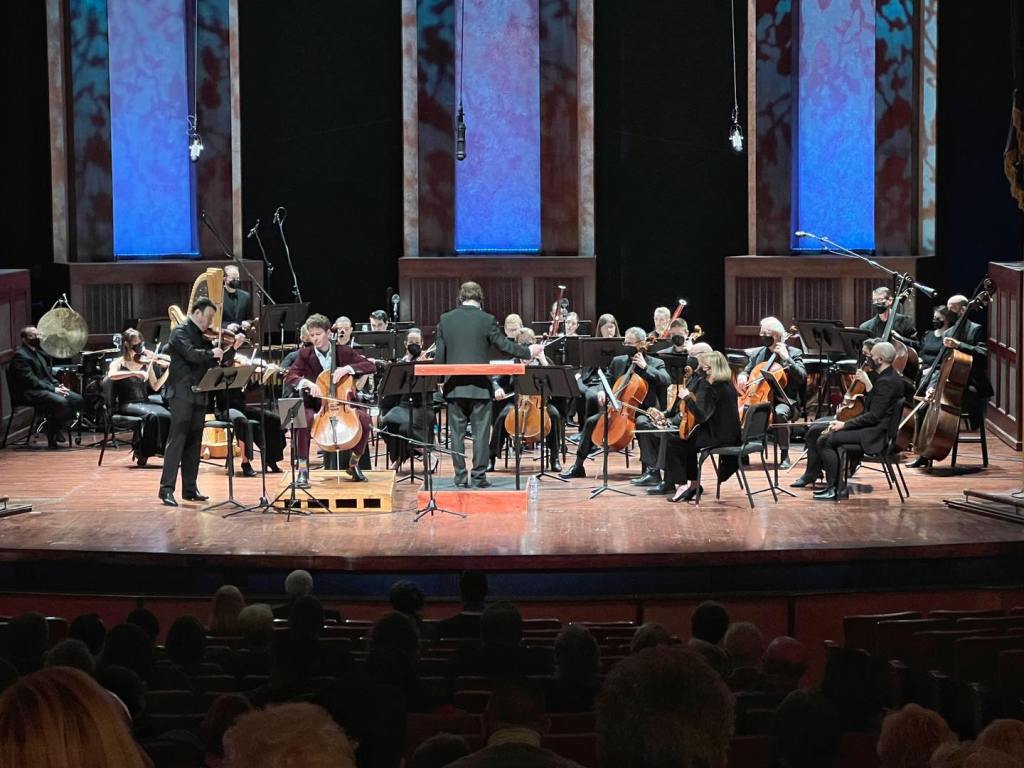
ProMusica’s 2022-23 season opener was particularly auspicious in that it served as a platform for the local debut of Kian Soltani, a rapidly rising star in the cello world. The program began with the 1990 work for string orchestra Musica Celestis by American composer Aaron Jay Kernis. At the time of composition, the composer had been immersed in the work of Hildegard von Bingen, and the spirit of her work was woven into Kernis’ idiosyncratic texture. The piece unfolded glacially, with soaring passagework for both concertmasters. It reached celestial heights, ultimately arriving at peaceful resolution.
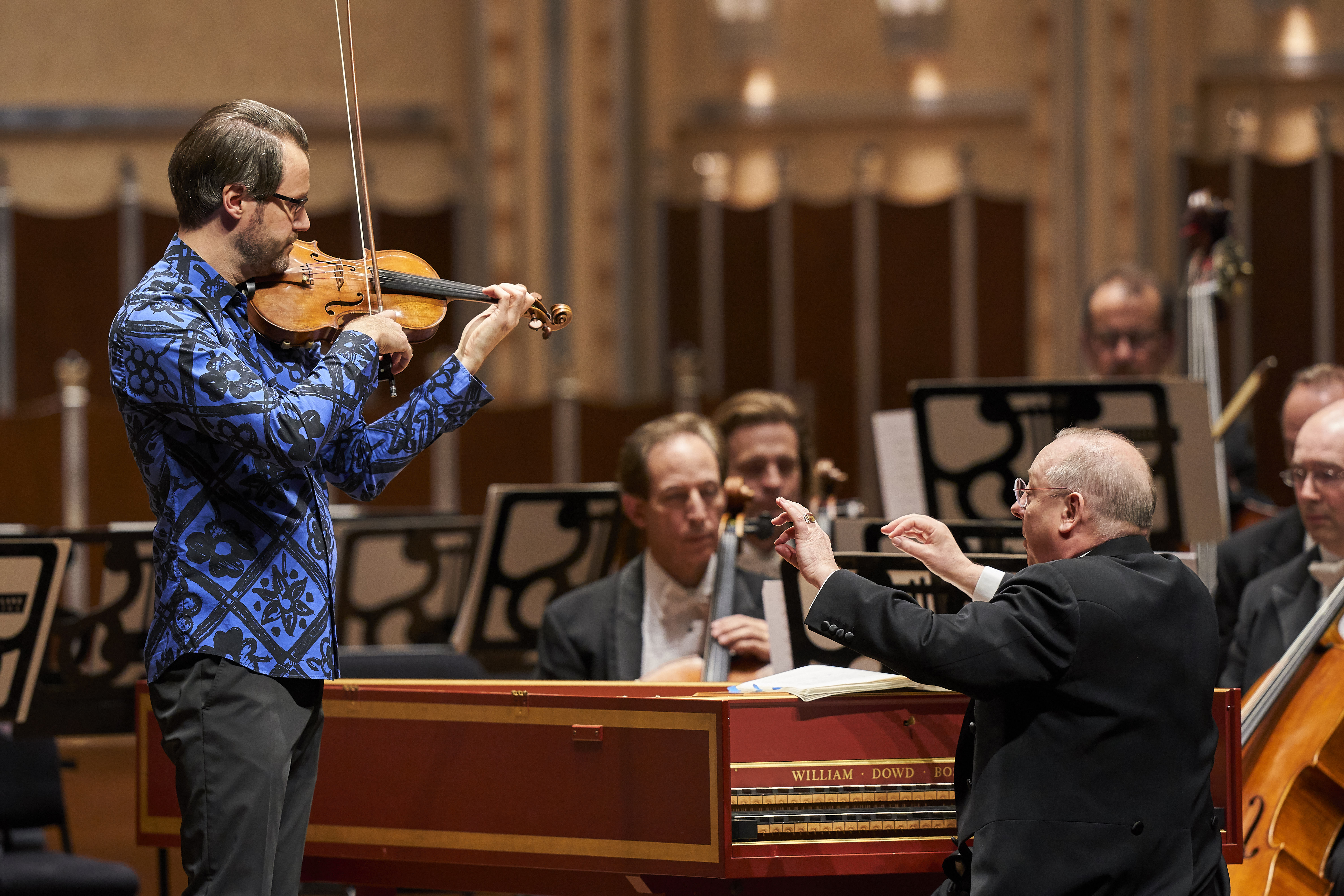
Kian Soltani, David Danzmayr, and ProMusica, photo credit ProMusica
A crisp, rhythmically punctuated introduction opened Haydn’s Cello Concerto No. 1. Soltani entered with a richly burnished tone, brimming with Viennese elegance, effortlessly fluent. Matters weren’t all pearly, however, with appropriate vigor given to the stormier sections. The cellist boasted a long-bowed, graceful melody in the central Adagio, and the finale rounded things off in the highest of spirits, with blistering virtuosity and vivacity.
Born in Austria of Iranian parentage, it was only fitting for Soltani to follow the Haydn with a work by Iranian composer Reza Vali – and Vali had in fact went to school with the cellist’s father in Iran. “The Girl from Shiraz,” a selection from the composer’s Persian Folk Songs – a work that just received its premiere earlier this year – made for an enticing contrast to the Haydn. A languid, winding melody in the cello introduced the titular melody, and the percussion scoring gave the work a decidedly non-Western feel. The latter section, known as “Love Drunk,” was a rambunctious and boisterous foil, pointing to a thunderous closing gesture.
Following the brilliance and intriguing programming choices of the first half, the balance of the program was rather more prosaic in Beethoven’s Fifth Symphony which nonetheless served as an exciting work with which to open the season. Danzmayr led a taut and focused performance, bringing out the work’s essential dramatic qualities.
ProMusica Chamber Orchestra David Danzmayr, conductor Vadim Gluzman, violin Joshua Roman, cello Southern Theatre Columbus, OH April 2, 2022
Golijov: Last Round Mendelssohn: Violin Concerto in E Minor, Op. 64 Encore: Silvestrov: Serenade Roman: Confluence Haydn: Symphony No. 94 in G major, Hob. I:94, Surprise
April’s ProMusica program began in the always intriguing world of contemporary Argentine composer Osvaldo Golijov, namely with the 1996 string orchestra work Last Round. It was a lively, high-octane opener, marked by rhythmic drive and astringent harmonies. The more languid, tango-inflected latter section contrasted in its impassioned lyricism.
Vadim Gluzman, Joshua Roman, David Danzmayr, and ProMusica Chamber Orchestra, photo credit ProMusica
Mendelssohn’s evergreen Violin Concerto followed with ProMusica’s Creative Partner and Principal Guest Artist Vadim Gluzman as soloist. The haunting opening melody was clear-toned as it seared and soared, and Gluzman projected well atop the vigorous and supportive orchestral accompaniment. The cadenza displayed his virtuosity and control over whole range of the violin’s register, with the work clearly ingrained deep in his fingers. The Andante proceeded as a gentle song without words, and the finale was fleet and featherlight. As an encore, Gluzman turned towards music of his Ukrainian home country in Valentin Silvestorv’s deeply poignant Serenade. In contending with a heartbreaking global situation, Gluzman reminded us of the importance of art, referencing the Soviet quote “when the cannons are heard, the muses are silent. When the cannons are silent, the muses are heard.”
The latter half saw saw the latest entry in ProMusica’s enterprising Composer/Performer Project, an endeavor which features musicians distinguished in both disciplines – and has resulted in now 68 commissions. Joshua Roman’s Confluence was at last brought to life almost exactly two years to the day of the originally scheduled premiere, owing to covid cancellations. Roman was appointed principal cellist of the Seattle Symphony at age 22 – the youngest principal player in that ensemble’s history – but left after just a few years to pursue a solo career, and this marked the fourth work of his featured on a ProMusica program.
Confluence is a fifteen-minute work that hearkens back to the double concerto, featuring both cello and violin as soloists. A pulsating marimba made for a striking opening, and Gluzman’s rapid violin blended well with Roman’s lyrical cello. Roman did much to capitalize on his instrument’s resonant bass register, and true to the title, the work was marked by a confluence of harmonious, lyrical voices. A glass harp (wine glasses) added to the colorful soundscape, and a tender ending felt at peace with the world – in a way, at odds with the uncertain backdrop in which the piece was written.
The program closed with Haydn’s Surprise symphony, and Austrian conductor David Danzmayr showed a natural affinity for music of his compatriot. An effervescent joie de vivre made matters all the more delightful, and the musicians were clearly having fun in emphasizing the dynamic contrasts of the Andante which earned this symphony its moniker.
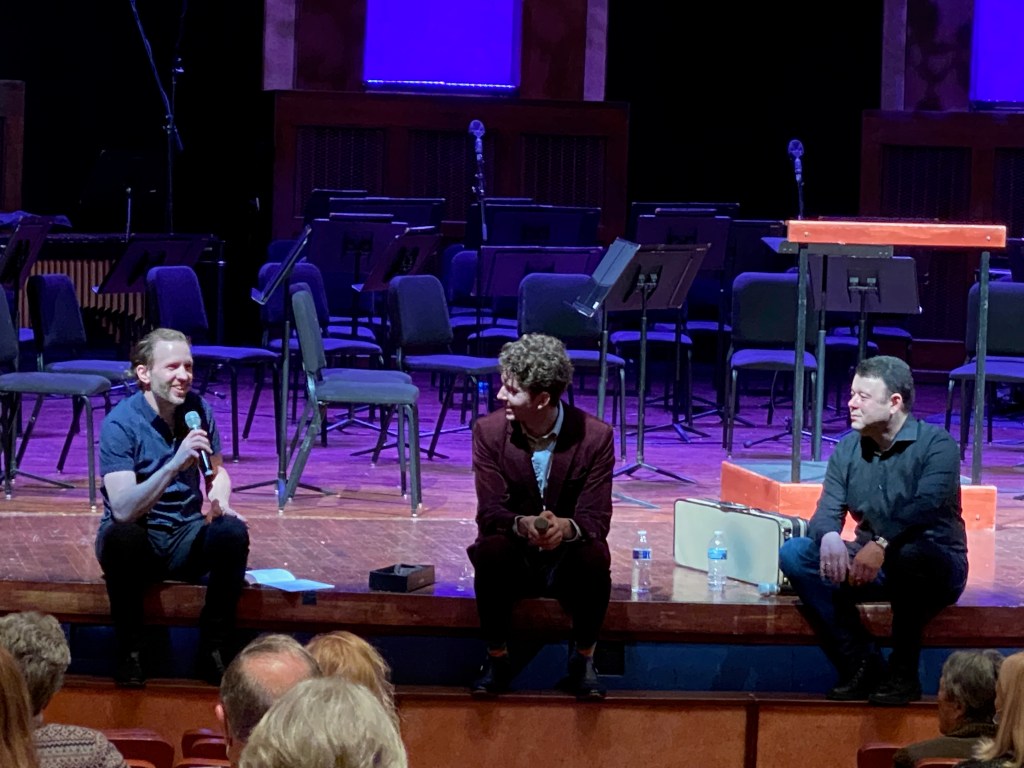
Post-concert Q&A with David Danzmayr, Joshua Roman, and Vadim Gluzman
Theofanidis: Valley of Detachment from Conference of the Birds Haydn: Allegro di molto from String Quartet in A major, Op. 20 No. 6, Hob. III:36 Haydn: Allegro from String Quartet in A major, Op. 20 No. 6, Hob. III:36 Bartók: Andante from String Quartet No. 5, Sz. 102 Wolf: Italian Serenade Tchaikovsky: Andante funebre from String Quartet No. 3 in E-flat minor, Op. 30 Mendelssohn: Andante espressivo from String Quartet No. 3 in D major, Op. 44 No. 1 Schulhoff: Alla Czeca from Five Pieces for String Quartet Schulhoff: Alla Tarantella from Five Pieces for String Quartet Randall Thompson: Alleluia, Amen (arr. Ying Quartet) Dvořák: Allegro ma non troppo from String Quartet No. 12 in F major, Op. 96, American
At Chamber Music Columbus, the Ying Quartet teamed up with PUSH Physical Theatre – both ensembles of which are based in Rochester, New York – to breathe fresh air into the vaunted sting quartet recital. A wide-ranging sampling of the string quartet literature was intriguingly presented in tandem with physical theater, with each group of selections centered on a particular theme to invoke a narrative arc. At the heart of this creative collision was the art of storytelling, which as violist Philip Yang noted in his spoken remarks, lies central to who we are as human beings.
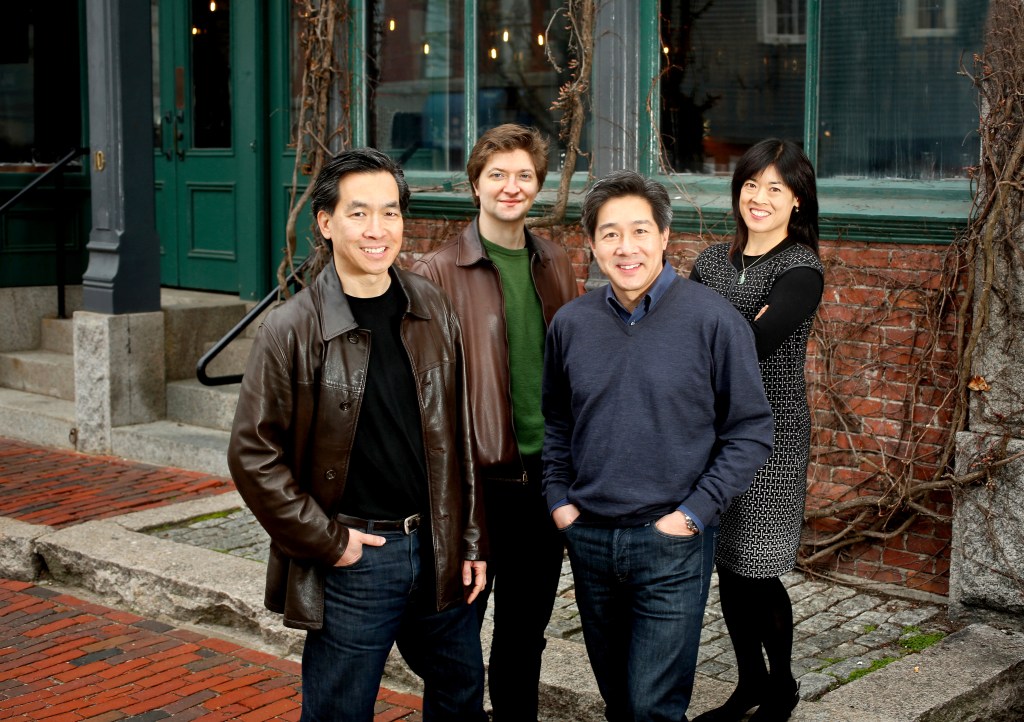
Ying Quartet, photo credit Tim Greenway
A movement from Christopher Theofanidis’ Conference of the Birds opened, with the gestures from the dance troupe mirroring the ebb and flow of the music. Two movements from Haydn followed; in this case, the elegance of the music was contrasted by the rather more risqué dance. The Andante from Bartók’s great Fifth Quartet took us into the realm of the surreal, a prime example of the Hungarian composer’s rarefied night music. Hugo Wolf’s lovely Italian Serenade was brought to life by a laugh-out-loud routine from PUSH, bringing humor and levity to what is usually a serious affair. At the opposite end of the spectrum was the doleful Andante funebre from Tchaikovsky’s Third Quartet – a tender wistfulness which served to depict the human cost of war.
Randall Thompson’s 1940 “Alleluia, Amen” – given in an arrangement by the Ying Quartet – served as a plaintive contrast to the gritty perpetuum mobile of the Schulhoff that preceded. The performance came to a close with the spacious opening movement of Dvořák’s American quartet. It’s a piece that resonates deeply with the Ying Quartet – just as the composer found solace and inspiration while spending a summer in the small town of Spillville, Iowa, the Ying Quartet found similar stimulus and connection during an extended residency in Jesup, Iowa in the 1990s. The performers gave Dvořák’s music with a natural fluency and affinity – lyrical, gracious, and generous. For this audience member, the highlight was certainly the quartet’s fine playing, but I applaud their efforts to push the boundaries of the way we experience chamber music, and seek connections from one artistic discipline to another.
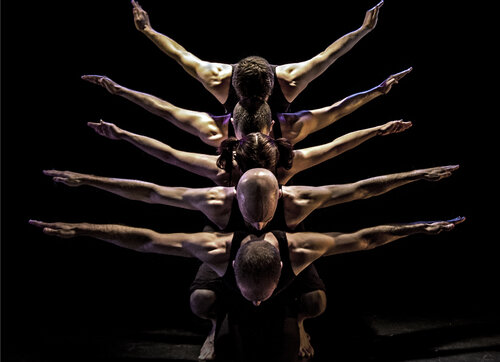
PUSH Physical Theatre, photo credit Avi Pryntz-Nadworny
Cleveland Orchestra
Nicholas McGegan, condcutor
Michael Sachs, trumpet
Severance Hall
Cleveland, OH
November 21, 2019
Schubert: Selections from Rosamunde, D797: Overture – Ballet Music No. 1 – Entr’acte No. 3 – Ballet Music No. 2
Hummel: Trumpet Concerto in E major
Haydn: Symphony No. 104 in D major, Hob. I:104, London
This marked the third consecutive November Nicholas McGegan has stood at The Cleveland Orchestra podium, and his charm and affable spirit without fail warms an otherwise chilly time of the year. The present program straddled the eighteenth and nineteenth centuries, with Hummel’s Trumpet Concerto the centerpiece, bringing into the spotlight Cleveland principal Michael Sachs. Proceeding in reverse chronological order, McGegan opened with selections from Schubert’s incidental music to Rosamunde.
Nicholas McGegan, photo credit Randy Beach
What is known as the overture to Rosamunde was in fact the repurposed overture to Schubert’s earlier (and unsuccessful) opera Der Zauberharfe. A bold sense of drama opened, but the remainder of the work bubbled with a graceful Schubertian charm. The first of the ballets was of a symphonic weight in its Sturm und Drang sensibility, but more mellow material offered contrast near the end, heightened by the clarinet of Afendi Yusuf. One of Schubert’s most cherished melodies, later reused in one of the impromptus for piano as well as the thirteenth string quartet, resounded through a choir of strings and winds in the Entr’acte. Another ballet rounded off McGegan’s suite, given with a rustic abandon.
Hummel’s Trumpet Concerto remained a forgotten quantity until it was rediscovered in the 1950s by trumpeter Armando Ghitalla. Originally cast in the key of E major, Ghitalla opted to publish the work transposed to E flat for ease of playability on the modern trumpet. It continues to be most often heard in the lower tonality today, including in Sachs’ two previous performances of the work with this orchestra. This time, however, Sachs stayed faithful to the composer’s intentions, easily surmounting the inherent technical hurdles. The martial opening was bright and brilliant with the soloist offering a limpid flexibility and climactic trills. The long-breathed tones of the central Andante, interjected by further trilling gestures, were pitted over an undulating accompaniment – a lyrical essay to be sure, but not without a certain grandeur. A jaunty rondo served as the finale, showcasing Sachs’ rapid-fire virtuosity and a never-waning vigor from both soloist and orchestra.
Haydn’s final entry of his long series of symphonies concluded the evening. The attention-grabbing opening made a sharp turn to the doleful minor before this introductory material gave way to the delectably appealing material firmly in the home key of D major. Here and throughout, McGegan drew out a playing in equal parts refined and joyous. The slow movement was a gentle affair, deftly balanced and crisply articulated. A rhythmic vitality served the minuet well, with Jeffrey Rathbun’s oboe of note in the trio. Energy was never at the expense of clarity in the effusive finale, the main subject of which was rooted in a Croatian folk song.
Cleveland Orchestra
Franz Welser-Möst, conductor
Paul Jacobs, organ
Severance Hall
Cleveland, OH
March 14, 2019
Haydn: Symphony No. 34 in D minor, Hob. I:34
Deutsch: Okeanos
Tchaikovsky: Symphony No. 5 in E minor, Op. 64
Prior to The Cleveland Orchestra’s impending and extensive tour of China, Franz Welser-Möst is back in town for a pair of programs, the first of which was centered on Cleveland’s introduction to the tenth Daniel R. Lewis Young Composer Fellow, Bernd Richard Deutsch. Also hailing from Welser-Möst’s native Austria, Deutsch is representative of what is sometimes referred to as the Third Viennese School, a loose amalgamation of composers whose music has been championed by the contemporary music ensemble Klangforum Wien.
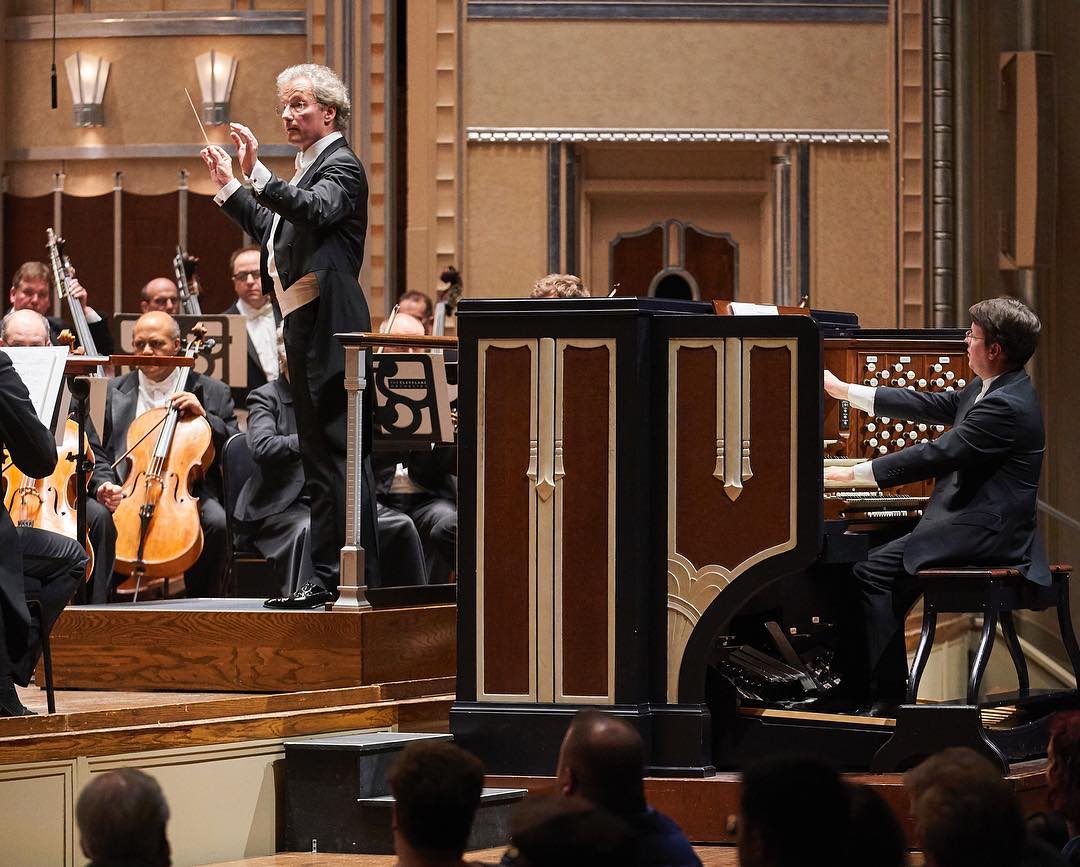
Franz Welser-Möst and Paul Jacobs in Okeanos. Photos credit Roger Mastroianni, Courtesy of The Cleveland Orchestra
The work Deutsch made his calling card was Okeanos, a nearly 30-minute canvas for organ and orchestra dating from 2014-15, and inspired by the titular Greek personification of the oceans. Prefacing the performance, Deutsch and organist Paul Jacobs were on hand for a fascinating preconcert discussion (although I did wish that moderator Caroline Oltmanns had been gracious enough to give the two more airtime). Okeanos is conceived in four movements, each representing the fundamental elements, respectively, water, air, earth, and fire. The work began almost indeterminately, with tremolos obscuring fragments of themes, and the organ so wrapped into the fabric of the orchestra as to be hardly discernible. The movement soon grew far more animated, building to a fluid gravitas, with the organ powerfully prominent in music of cosmic visceral impact – yet the movement ended in no more than a whisper.
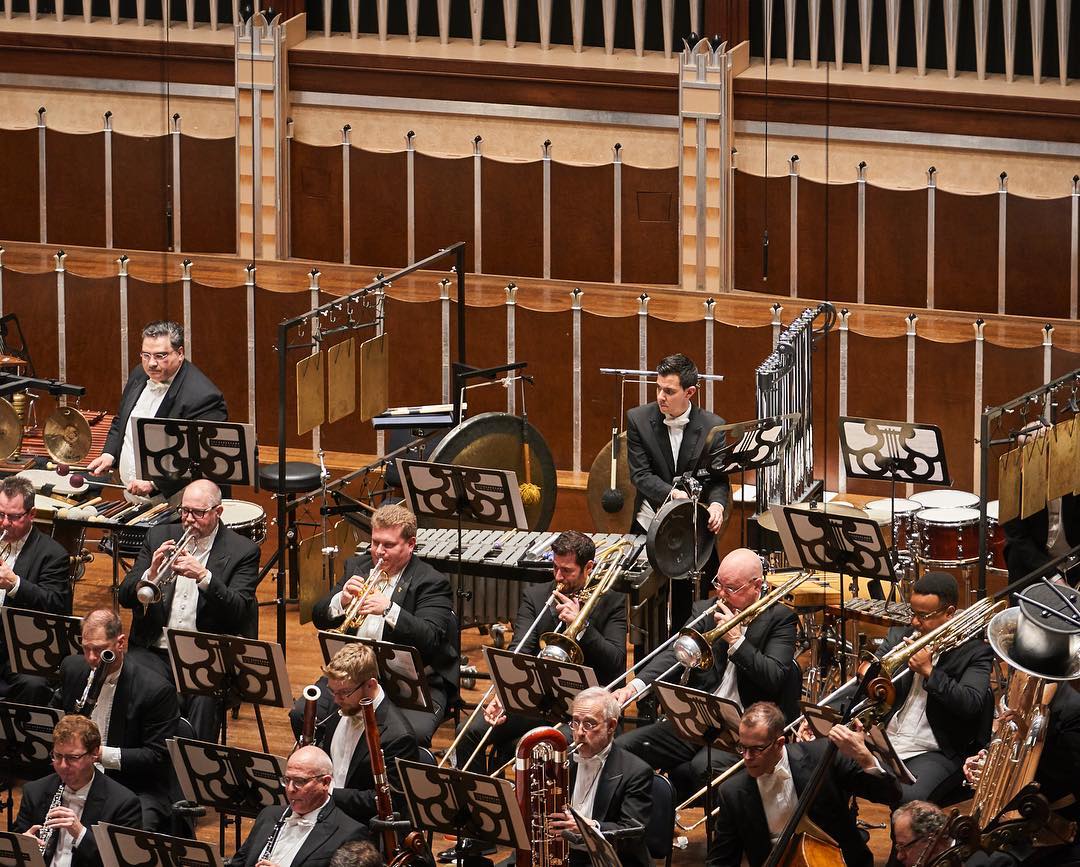
“Air” opened with rapid fluttering in the organ along with a wind machine used to obvious effect. Colorful glissandi on the organ were imitated by the harp and celesta. “Earth” was a more glacial affair, filled with otherworldly timbres usually emanating from the percussion battery, as vast and diverse as one could imagine. “Fire” was of rapid virtuosity and quite ferocious playing, emphasizing the rhythmic primacy of the percussion. Further striking effects were achieved through muted trombones; at movement’s end the texture dug down into the depths of the organ, ending on a sustained chord at quadruple forte – an imposing effect to be sure. Deutsch noted that the structure of the work was determined by the golden ratio – a thought-provoking compositional approach with antecedents in Debussy and elsewhere, though certainly not apparent on first hearing. As part of his fellowship, Deutsch has been commissioned to write a new work for the orchestra, to be performed at the end of next season (May 2020) – I look forward to music that lies ahead.
The evening began with the first Cleveland Orchestra performances of a lesser-known Haydn symphony, No. 34 in D minor. The first of the composer’s to be cast in the minor, it served as an incubator for the series of Sturm und Drang symphonies that would soon follow. Haydn quite surprisingly begins with the slow movement – what initially sounds like merely an introduction turns out to be a symphonic edifice nearly as long as the remaining movements combined. A lament in the strings was marked by the clarity of the inner voices in this statement of genuine expressive depth. After the weighty beginnings, the minor was all but forgotten and matters proceeded wholly unperturbed. The sudden high spirits of the second movement were further encouraged by the courtly minuet with lovely woodwind triplets during its trio. And as is often the case with Haydn’s whirlwind finales, one only wished it wasn’t so brief.
Tchaikovsky’s evergreen Fifth Symphony completed the program in lush Romanticism. A plaintive presentation of the fate motive in the clarinets opened the work to chilling effect, eventually coalescing as an energetic march, gathering great strength in the face of fate and brimming with endlessly flowing melody. Welser-Möst took matters at a startlingly brisk tempo – while I applaud his resolve to not sentimentalize, I would have preferred the music to breathe a bit more. Low strings of deep emotion marked the slow movement, a backdrop for the sumptuous horn solo, delicately interjected by Afendi Yusuf’s clarinet. While Welser-Möst might not have probed as deep as some, the result was nonetheless long, flowing lines of rapturous beauty. The tragic obsessions of the first two movements were left behind in the lilting Valse, decorated by mercurial strings. The fate motive resurfaced, suddenly benign, setting the stage for the finale wherein matters were miraculously morphed to the triumphant.
The Cleveland Orchestra performs Okeanos. Note the percussion battery and muted brass.
Cleveland Orchestra
Alan Gilbert, conductor
Garrick Ohlsson, piano
Men of the Cleveland Orchestra Chorus
Lisa Wong, director
Severance Hall
Cleveland, OH
February 7, 2019
Haydn: Symphony No. 100 in G major, Hob. I:100, Military
Busoni: Piano Concerto in C major, Op. 39
This weekend’s Cleveland Orchestra concerts were anything but routine and truly one for the books, featuring a rarely-heard epic: Ferruccio Busoni’s Piano Concerto, an Olympian creation spanning the continuum of over 70 minutes, cast in five movements with the last including a male chorus. At the podium was former assistant conductor Alan Gilbert in his only stateside appearances this season. Before plunging into the unforgiving waters of the Busoni, the orchestra offered a delectable amuse-bouche in Haydn’s “Military” symphony.
A graceful classicism imbued the quintessentially Haydnesque slow introduction, with deftly ornamented strings. The movement proper was given with joie de vivre, though Gilbert didn’t shy away from giving matters ample gravitas where necessary: while seemingly a trifle in the wake of the Busoni, it proved to be far more than a mere featherweight. The Allegretto began unassumingly with some particularly lovely playing in the winds, while a boisterous splash of color against the pearly white classicism was achieved through the sudden introduction of cymbals, triangle, and bass drum, earning this symphony its moniker. Thought of as “Turkish” sounds with the Austro-Turkish War being in recent memory, these instruments were used to similar effect by Mozart and Beethoven; the present work’s martial feeling was further enhanced by a series of bugle calls. By comparison, the ensuing minuet was decidedly Old World, with a trio of simple charm. The finale was of frenetic energy and included a brief return of the colorful percussion.
There’s some historical context necessary in appreciating the magnitude of the Busoni performance. An absolute marathon for the soloist, it makes superhuman technical demands virtually without respite, and thus only a handful of pianists have the stamina to approach such a work. The Cleveland Orchestra first traversed the concerto in 1966 with Italian pianist Pietro Scarpini and George Szell conducting (an archive recording can be heard here), and the Cleveland performances were followed by a tour date in New York. In the audience of the Carnegie Hall performance was an eighteen-year-old Garrick Ohlsson who later that year would win the Busoni International Piano Competition. Fast-forward to 1989, and Ohlsson was the soloist in TCO’s next encounter with the work, this time under the baton of Christoph von Dohnányi. A New York performance again took place (along with Boston), as well as a recording session, the fruits of which continue to serve as a benchmark. This weekend’s two performances thus commemorated a remarkable anniversary, with Ohlsson, now 70, returning to the keyboard almost 30 years to the day of the recording (February 4, 1989).
Cleveland Orchestra and Chorus. Garrick Ohlsson and Alan Gilbert, center.
The opening Prologo for orchestra alone initiated matters with lush, hyper-Romantic strings; though written in 1904 the work’s musical language was firmly rooted in the previous century, predating Busoni’s more astringent modernism. Winds and brass were introduced in stately fashion, with the piano’s entrance at the Introito being one of commanding chords thunderously traversing the keyboard. Rarely will one hear a Steinway played with such leonine power, with Ohlsson’s effusions sailing above the orchestra and through the depths of the hall – and impressively, he had the whole score committed to memory. While generally a movement of solemnity, there were occasional hints of the composer’s Italian heritage, of central importance in the work’s even-numbered movements. The following Pezzo giocoso was just that, beginning with rapid, fantastical material leading to a dizzying folk theme. It’s a movement that for me brings to mind the analogous one from Brahms’ second piano concerto, it too being a work of enormous weight, and like Brahms, Busoni’s piano writing is often subsumed into the dense texture of the orchestra when not front and center. Afendi Yusuf offered a languorous clarinet passage, and the folk theme appeared again in the piano atop rumbling tremolos in the bass. Boisterous as the movement was, it faded away in resolution.
The central Pezzo serioso is the heart of the work, its twenty minutes further divided into three sections with an introduction preceding. The low strings emanated a somber, looming darkness, as well as a contrapuntal severity that evidenced the specter of Bach, Busoni’s greatest idol. The piano floated above the strings, almost as a nocturne, and a solemn brass chorale also found an answer from the keyboard. Powerful rolling chords marked the Prima pars, while the extensive Altera pars erupted into a storm worthy of Mahler. Indeed, had Mahler written a piano concerto, this all-encompassing vision of Busoni leaves a clue to what perhaps could have been. The bright Italian sun broke through in the penultimate movement, All’Italiana, with bubbling winds further colored by tambourine. The wild tarantella was given with a joyous abandon, almost boiling over to a breaking point before the massive cadenza, with Ohlsson not flagging in intensity even an hour in.
The concluding Cantico brought forth the men’s chorus who rose to their feet at the cadenza’s conclusion (although it should be noted that Busoni desired for the chorus to not be visible to the audience). The notion of including a chorus within a piano concerto certainly contravenes convention, save for a few odd precedents – most notably, Beethoven’s Choral Fantasy, as well as all but forgotten examples from Daniel Steibelt and Henri Herz. In scoring for male voices, one also suspects Busoni looked towards the finale of Liszt’s Faust Symphony as a guiding light. A mystical atmosphere pervaded the movement’s beginnings to set the stage for the monastic entry of the chorus, at which point Ohlsson was afforded a well-earned relief, albeit brief. The six-part choral writing yielded some striking harmonies, in the service of a text by the Danish poet Adam Oehlenschläger rendered in German. Excerpted from the poet’s “Aladdin”, the text in question is a hymn to Allah, yet much like Mahler’s texts of religious inspiration, it transcends one particular ethos. Upon conclusion of the text, the piano and full orchestra were rallied once again for the coda, magnificent and triumphant. A remarkable achievement, not to be soon forgotten.
Cleveland Orchestra
Nicholas McGegan, conductor
Peter Otto, violin
Severance Hall
Cleveland, OH
November 23, 2018
Vivaldi: Le quattro stagioni
Mozart: Ballet Music for Idomeneo, K367 – Chaconne
Haydn: Symphony No. 94 in G major, Hob. I:94, Surprise
The Cleveland Orchestra’s Thanksgiving weekend concerts were an ample serving of comfort food, with the first half devoted to Vivaldi’s The Four Seasons – a follow up of sorts to last season’s traversal of another seasonal quadriptych, namely Haydn’s oratorio The Seasons. Initially published as part of the composer’s The Contest Between Harmony and Invention (Op. 8), The Four Seasons comprise the first four and certainly best known selections. These concerts were not without some controversy, however, as the violin soloist was originally slated to be the ousted William Preucil (whom I saw perform the work on this stage back in February 2007, coincidentally also under the baton of McGegan). First associate concertmaster Peter Otto was on hand to more than capably take the reins.
Peter Otto, all photos credit Roger Mastroianni, Courtesy of The Cleveland Orchestra
The immediately familiar strains of Spring featured Otto in some sprightly interplay with second violin chair Stephen Rose. Some minor intonation issues were apparent initially but soon resolved. The Largo was of long-bowed repose while the closing was a joyous dance filled with rapid passagework. A minor-key haze marked Summer, taking flight in due course in evidence of the orchestra’s tight chemistry under McGegan’s expert direction from the harpsichord. A remarkable expressiveness was achieved in the finale, while the fire returned in the breathless finale.
Autumn boasted the rustic charm of the harvest, given with an authentic rhythmic snap. An affecting melody played over undulating arpeggios in the harpsichord made the Adagio molto a standout, while the closing Allegro was – appropriately – a joyful Thanksgiving. Winter introduced dissonances that must have been shocking to audiences in Vivaldi’s day; the songful Largo, however, was enough to warm even the coldest of winter days.
The Viennese classicism of Haydn and Mozart rounded off the program. Mozart’s opera Idomeneo is thought of as his first fully mature operatic foray. The composer produced a fine suite of ballet music to accompany the work as per the French tradition, likely owing to the French origins of the original libretto. McGegan offered the opening chaconne; although satisfying I would have preferred inclusion of the modest remainder of the ballet score. Apparent from the declamatory opening onward was the immediate charm of a Mozart opera, here with the intimacy of communication fostered through the reduced-sized orchestra in playing of sparkling transparency and clarity.
Last on the menu was Haydn’s Symphony No. 94 in G major, known by its memorable moniker Surprise. A graceful and leisurely introduction set the stage for the vigor of the movement proper. Under McGegan, the orchestra operated as a single organism, achieving a wide range of expression in the development even within classical proportions. The Andante is what earned the work its nickname, full of tongue-in-cheek wit, and McGegan maximized the dynamic contrasts to further its irresistible appeal. A fine oboe solo from Jeffrey Rathbun counted as another highlight; the penultimate movement carried the swagger of an Old World minuet while the finale was a whirlwind of effervescence – one only wished it could have lasted longer.
Cleveland Orchestra
Jonathan Cohen, conductor
Kristian Bezuidenhout, piano
Severance Hall
Cleveland, OH
August 24, 2018
Handel: An Occasional Oratorio, HWV 62 – Overture
Haydn: Keyboard Concerto No. 11 in D major, Hob. XVIII/11
Mozart: Symphony No. 25 in G minor, K183
This summer’s concluding offering at Severance Hall from The Cleveland Orchestra culled three masterworks from the 18th-century, compressing the tried-and-true overture-concerto-symphony program format to just over an hour. Making his Cleveland Orchestra debut was conductor Jonathan Cohen, a specialist in this repertoire of particular note as artistic director of the early music ensemble Arcangelo.
Jonathan Cohen, photo credit Marco Borggreve
Kristian Bezuidenhout, photo credit Marco Borggreve
The earliest work was presented first, namely the overture to Handel’s Occasional Oratorio in its first Cleveland Orchestra performance. Cohen led the reduced, almost chamber-sized orchestra in tight direction from the harpsichord, with the overture opening bold and stately, contoured by the dotted rhythms as per the French style. The small brass section added a sheen of brightness, and following the introductory material, matters took off via the fleet strings. Cast in four sections, the penultimate featured a lovely long-breathed oboe solo from Frank Rosenwein, and the work concluded in a brief but jubilant march.
Haydn’s Keyboard Concerto No. 11 in D major served as a platform for another local debut, that of South African keyboardist Kristian Bezuidenhout. The opening movement was lithe and sprightly, encouraged by Bezuidenhout’s crisp playing, direct in expression and always of utmost economy. The cadenza demonstrated his fine technique, but not without moments of introspection. In the slow movement, the sweet lyricism offered repose if not quite achieving the rapt beauty one would find in a Mozart concerto, and Hungarian finale recalled the composer’s dutiful service to the Esterházy family. Bursting with a folksy joviality, a vigorous theme in concert with the horns was of particular delight.
Mozart’s first minor key symphony – No. 25 in G minor – concluded the evening (incidentally, a few months prior TCO traversed Mozart’s only other minor key symphony, also in G minor). Opening in energetic Sturm und Drang, a looming darkness was assuaged by a singing oboe line and the buoyancy of the dance-like secondary subject. The delicate gestures of the Andante counted as calm following the storm, while the main theme of the ensuing minuet was sharply punctuated, contrasted by the mellifluous winds and brass of the trio – though here and elsewhere regrettably plagued by intonation issues. A nervous energy began the finale, its potential soon becoming kinetic to guide the work with inevitability to its ominous conclusion.
Cleveland Orchestra Chorus
Lisa Wong, acting director
Severance Hall
Cleveland, OH
January 18, 2018
Haydn: Excerpts from Die Jahreszeiten, Hob. XXI:3
It is often joked that one can experience all four seasons during the course of a single day in Ohio, and this was certainly the case on Thursday with The Cleveland Orchestra and Chorus performing Haydn’s late oratorio The Seasons, a traversal through each of the titular quarters of the calendar year. This is also unfortunately the season for illness: a matter of hours before the performance, two of the three vocal soloists were forced to withdraw for health reasons (tenor Maximilian Schmitt and bass-baritone Christian Van Horn, who himself was to replace an indisposed Thomas Hampson).
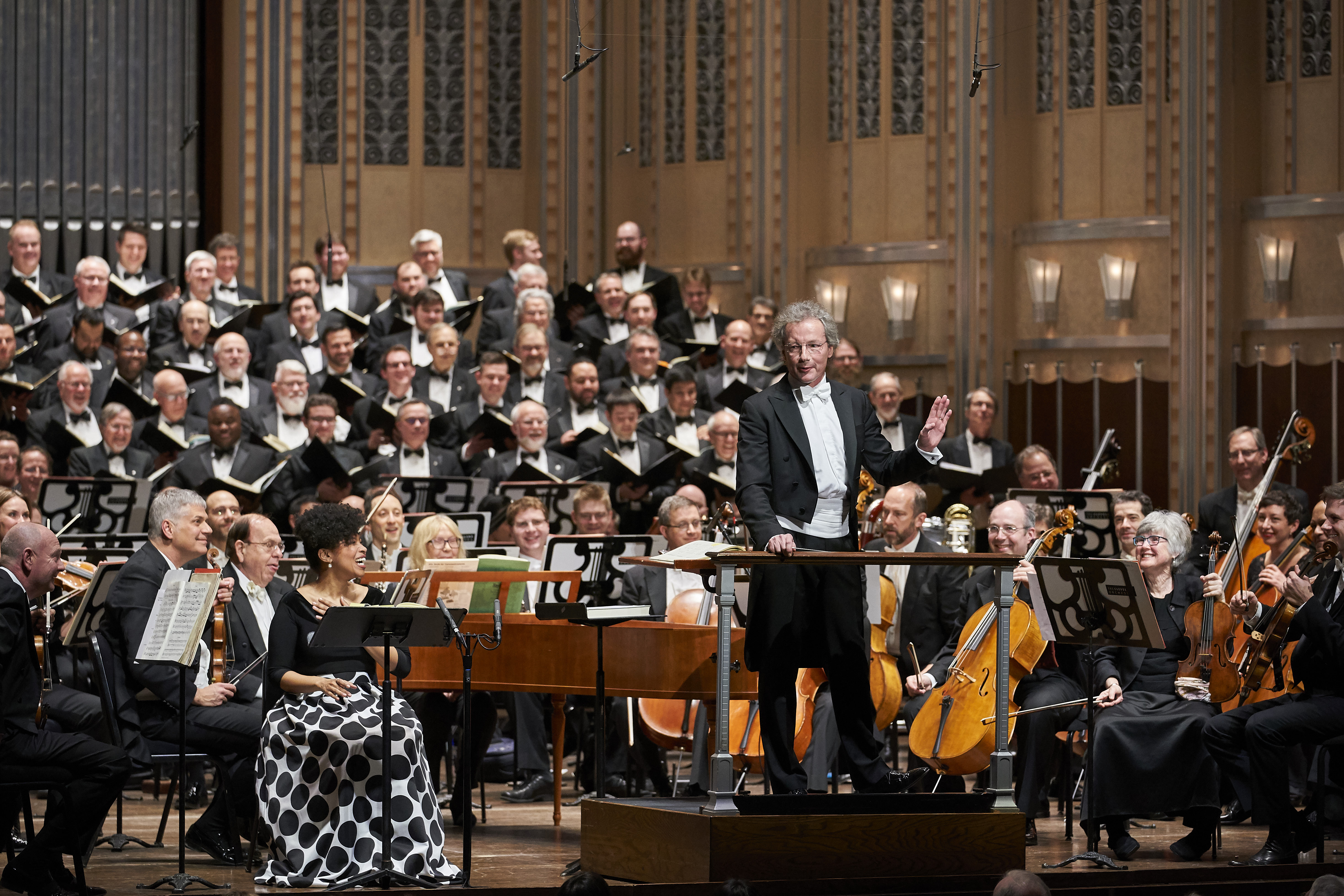
Without sufficient time to book substitutes, an abridged version of The Seasons was arranged, excising all parts for the male soloists. What was salvaged, however, was the not inconsiderable amount of material for orchestra, chorus, and soprano, all expertly prepared and certainly whetting one’s appetite for more. The many gaps were filled in with Welser-Möst’s user-friendly and often humorous commentary, a veritable Cliff’s Notes version of the whole work. As recompense for those hoping for a complete performance, complimentary tickets were offered for the Saturday performance, by which point Schmitt had adequately recovered and a substitute was found in Alexander Dobson, allowing Welser-Möst to close his brief winter residency on a festive note before taking the orchestra on tour to New York and Miami.
As with each section, an orchestral prelude began Spring, evidencing Haydn as master orchestrator, and here filled with pathos as the coldness of winter gradually subsided. For these performances, Welser-Möst opted for the German version of the text, although Haydn simultaneously prepared an English setting to appease his considerable following in London. The chorus sang of the sweetness of spring, given with a fittingly sweet tone, and a fugue brought matters to a resounding close – and the contrapuntal writing surely didn’t go unnoticed by Beethoven when writing his own major choral works.
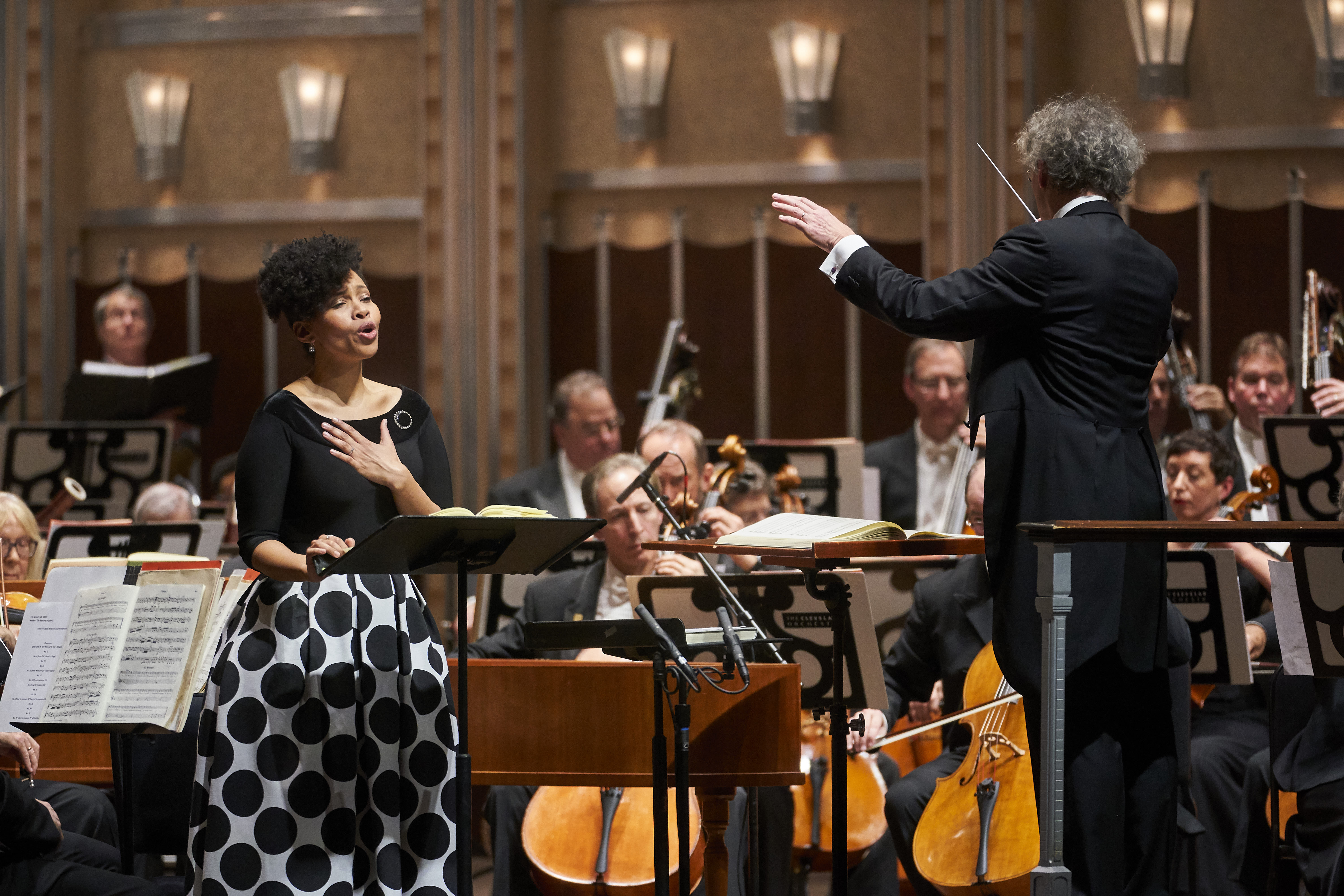
Soprano Golda Schultz had a lovely aria in Summer; when singing of a shepherd’s reed, she was in poignant duet with oboist Frank Rosenwein. While the soprano’s role is perhaps the smallest of the three soloists, without her male counterparts on Thursday Schultz shined as the star of the performance. A tempest filled with Sturm und Drang broke the haze of summer (again, an almost certain inspiration for Beethoven in his Pastoral symphony) before closing in a peaceful evening. Regrettable, though, that the imitations of frogs and other summer wildlife had to be cut. The scheduled intermission following was also jettisoned, and rightfully so as the excerpts totaled about 70 minutes, roughly half the length of the complete piece.
Franz Welser-Möst addressing the audience
A rustic and halcyon mood characterized Autumn, with a bevy of hunting horns serving as a rallying call and gestures in the orchestra that suggested barking dogs. The rousing chorus told of the joys and bounty of the harvest, replete with wine and bacchanalia. At one point, the orchestra imitated the folk sounds of bagpipes and the hurdy-gurdy. The prelude to Winter painted a barren landscape, but Schultz’s aria added warmth to the cold in displaying the full operatic potential of her instrument. Near the work’s end, one found a meditation on the cyclical nature of life as symbolized by the recurrent seasons (and I couldn’t help but being reminded of the similar themes conveyed in the concluding scene of The Cunning Little Vixen, with which this season began), and a final song of praise brought the oratorio to a resplendent close.
A tip of the hat to all involved in successfully pulling off a radically altered performance on exceptionally short notice. While it goes without saying that this cut-and-paste version was a bit disjointed, I wondered if it was altogether necessary to attempt to fill the gaps instead of letting the music speak for itself, abridged or otherwise. Nonetheless, Welser-Möst’s commentary was well-received and in dutiful service to the score. In his opening remarks, executive director André Gremillet described the evening’s performance as a “unique concert experience” – that it surely was, and in the best way possible.
Marc-André Hamelin, piano
Gartner Auditorium
Cleveland Museum of Art
Cleveland, OH
March 21, 2017
Haydn: Piano Sonata in C Major, Hob. XVI:48
Feinberg: Piano Sonata No. 1 in A major, Op. 1
Feinberg: Piano Sonata No. 2 in A minor, Op. 2
Beethoven: Piano Sonata No. 23 in F minor, Op. 57, Appassionata
Scriabin: Piano Sonata No. 7, Op. 64, Messe blanche
Chopin: Piano Sonata No. 2 in B flat minor, Op. 35
Encore:
Debussy: Reflets dans l’eau, No. 1 from Images, Book I
Marc-André Hamelin has built much of his reputation on fearless exploration of the byways of the piano repertoire, and his recital at the Cleveland Museum of Art – presented by the Cleveland International Piano Competition – was no exception, juxtaposing the familiar with the obscure. All the works on the program bore the title “piano sonata”, although none adhered very closely to the standard model of the form, a true testament to the medium’s protean potential. Hamelin delivered the program with his signature peerless technique, yet this was far from an evening of vapid virtuosity, but one of probing artistic discovery.
Marc-André Hamelin, photo credit Rachel PapoThe survey of piano sonatas appropriately began with Haydn, in the two movement C major sonata, Hob. XVI:48. Given Hamelin’s association with the fingerbusting works of the 19th– and 20th-century, Hamelin and Haydn might sound like an unnatural fit, but as he as shown in his extensive recordings of the composer’s sonatas for Hyperion, it’s an inspired coupling to be sure. From the onset, the performance was marked by deftly nuanced articulation and crisp ornamentation. There were sporadic moments when matters felt a bit heavy-handed which lesser pedaling perhaps could have ameliorated, but overall this was a study in precision, replete with minor key excursions that foreshadowed Beethoven, and the all too brief finale exuded joie de vivre.
Certified rarities followed, the first two piano sonatas of the Russian composer and pianist Samuil Feinberg. His cycle of twelve piano sonatas is a remarkable achievement, unjustly neglected, and Hamelin is rumored to be recording them. These two sonatas, in A major and minor respectively, were of a similar aesthetic, the consecutive opuses hardly demonstrating Feinberg’s eventual compositional developments (both dating from 1915; the final sonata dates from 1962), yet Hamelin presented them with a singular intensity and an unflinching commitment to this little-known music.
The First Sonata was of a brooding Romanticism, while the dense textures would have sounded murky in lesser hands, Hamelin achieved a lucid clarity of voices, and delineated a clear trajectory in spite of the composer’s tendency to meander. A touchingly lyrical melody characterized the Second Sonata, and a highpoint came in its dramatically cascading climax.
Beethoven’s mighty Appassionata is a recent addition to Hamelin’s concert repertoire; I’ve been eager to hear his take on this durable work, and he certainly didn’t disappoint. The opening movement built to massive climaxes that carefully avoided bombast. There was much-needed repose in the slow movement, enhanced by the adroitly voiced chordal melody, while the finale had an unrelenting nervous energy in its breathless race to the tragic end, given at a dangerously brisk tempo.
One of Hamelin’s first recordings of his long and fruitful association with Hyperion was of the complete Scriabin piano sonatas; the arresting Seventh Sonata is a work that has been in his fingers for a very long time. Explosive and mercurial, the sonata proceeded with inevitability towards the trilling, mystical ending, shrouded in enigma.
Chopin’s B-flat minor sonata concluded the program, and in the passionate first movement Hamelin drew out a fluid melody over an undulating accompaniment. He eschewed the repeat of the exposition, although in this case I would suggest the repeat is a wise interpretative choice given the movement’s proportions. There was a menacing determination in the scherzo, while its middle section was indulgent in sumptuous melody, quintessentially Chopinesque.
No empty sentimentality was to be had in the tragic heights of the famous funeral march, and Hamelin had a velvet touch in the contrasting lyrical section. His utter and absolute command of the keyboard was on full display in the moto perpetuum finale, yet phrases were keenly shaped to make the sonata’s revolutionary ending more than mere volleys of notes.
Hamelin obliged the modest but enthusiastic audience with an encore in Debussy’s Reflets dans l’eau, shimmering and liquescent.







 quasi-faust