Takács Quartet marks 50th anniversary in return to Cleveland Chamber Music Society

Takács Quartet
Cultural Arts Center
Disciples Church
Cleveland Heights, OH
November 11, 2025

Haydn: String Quartet in G minor, Op. 74, No. 3, Hob. III:74, Rider
Bartók: String Quartet No. 3
Dvořák:  String Quartet No. 13 in G major, Op. 106

Encore:
Debussy: String Quartet in G minor – 2nd mvt.

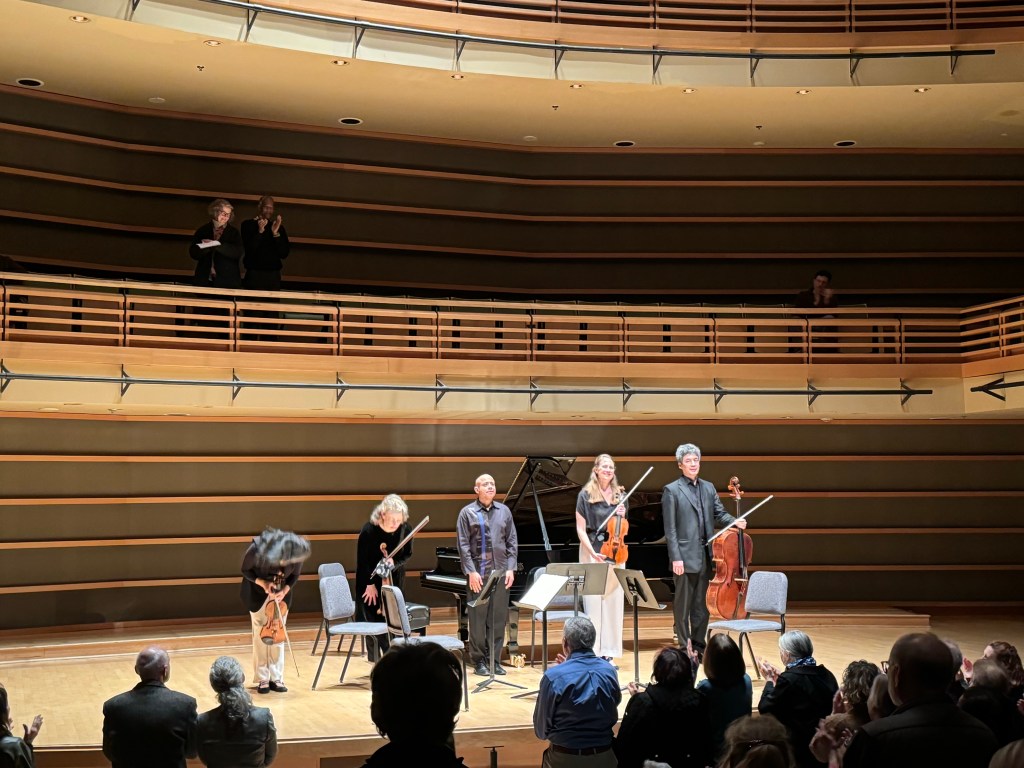
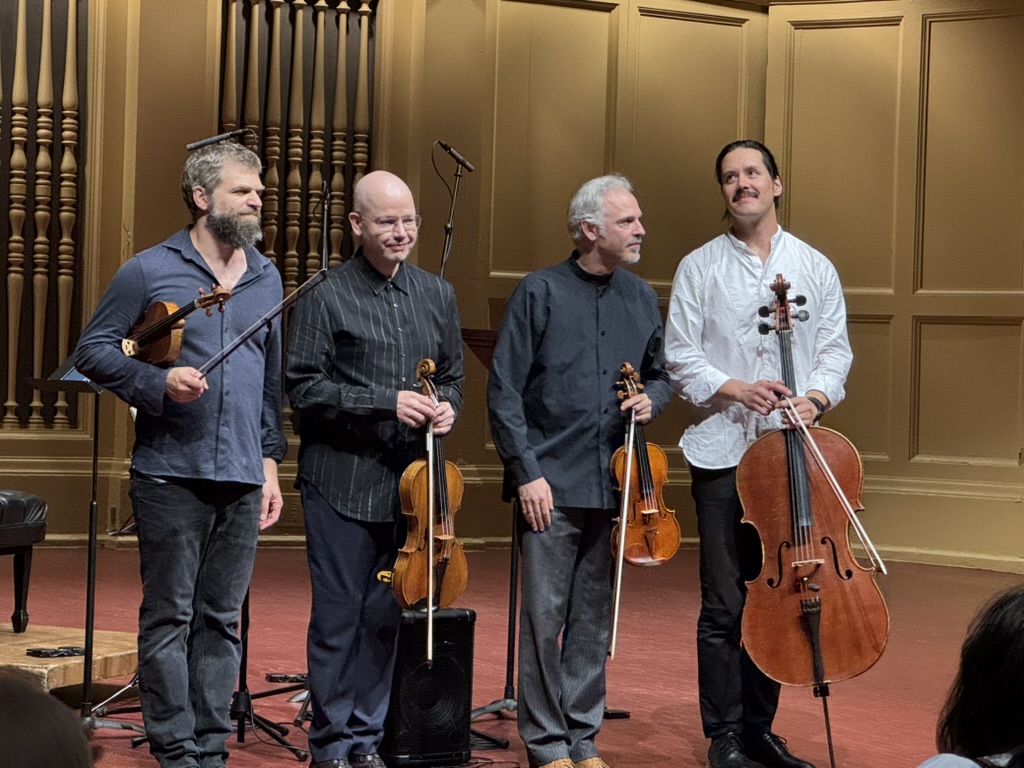
Founded in 1975 while students at the Liszt Academy in Budapest, half a century later the Takács Quartet continues to offer a gold standard of string quartet playing — and remarkably, still counts one original member in its ranks (cellist András Fejér). Tuesday night marked a welcome return to the Cleveland Chamber Music Society (which celebrated its own 75th anniversary last season) where they have long been regular guests — in recent years, performing with Marc-André Hamelin and in a memorable Grieg/Shostakovich program.
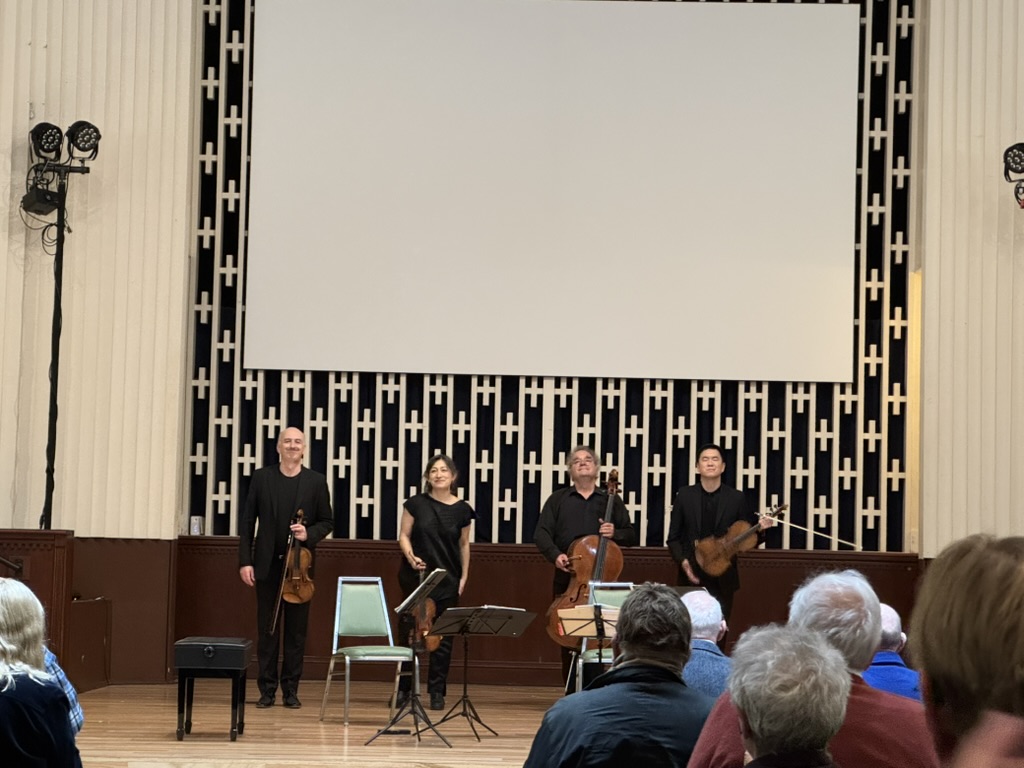
Takács Quartet at the Cleveland Chamber Music Society

The so-called father of the string quartet, Haydn is always a rewarding composer with which to begin a string quartet recital. Tuesday’s selection was the Rider quartet in its bristling G minor. It opened in quintessential Haydnesque fashion with its delicate ornamentations and sudden pauses. This genteel material was given with tight cohesion, carefully conveying its layered textures with clarity. Some striking modulations were heard in the slow movement before an elegant minuet countered by a rather stormy trio (usually it’s the trio that’s the calmer one). The fiery, galloping finale is what gave this work its epithet, and Haydn had the last laugh with its humorously deceptive close.

Of Bartók’s six iconoclastic quartets, the Third is the shortest but also the most concentrated. It’s quite unusual in form, too, with two contrasting parts subsequently repeated in a loose mirror of their initial presentation. Protean strands began, organically growing in weight and intensity — preconcert lecturer Kevin McLaughlin aptly compared this soundscape to Stravinsky’s Rite of Spring. A panoply of extended techniques were deployed, yielding an array of captivating sounds. Melodically, harmonically, and rhythmically intricate, the second part was blistering in its driving appropriation of folk song. The so-called Ricapitulazione of first part surfaced like a distant dream of the opening before the work’s uncompromising close.

It was lovely to hear Dvořák on a string quartet program in a piece that isn’t the justly famous American quartet. The Takács instead offered the Bohemian composer’s penultimate work in the genre: no. 13 in G major, Op. 106 (I was also reminded the Apollon Musagète Quartet presenting Dvořák’s final quartet on a CCMS program in February 2020, just ahead of the covid shutdown). In these last two works in the form, Dvořák sailed to new heights, only to then turn his attention away from chamber music and to opera and the tone poem.

Gentle gestures opened to set an intoxicatingly bucolic mood, only to grow in dramatic tension and orchestral heft. First violinist Edward Dusinberre had a soaring melodic line, and the broad first moment movement drew to particularly robust coda. Rich textures were layered on top of each in the angelic slow movement, somewhat reminiscent of Beethoven’s Heiliger Dankgesang. At its conclusion, some earthy pentatonicism reminded us this came from the same pen as the man wrote the New World symphony.

Even more quintessential Dvořák came in the following, wherein the composer proudly displayed his Czech origin in the shape of a spunky furiant. I was struck by the Takács intense physicality here, playing with their whole bodies. The bold, wide-ranging finale was given with unified direction for a powerful close.

As an encore, the quartet turned to the second movement of Debussy’s sole work in the medium in a show of their versatility, equally adept in the Frenchman’s impressionist enigma.
Brooklyn Rider opens Chamber Music Pittsburgh’s 65th season with thoughtful, politically-informed program

Brooklyn Rider
Carnegie Music Hall
Pittsburgh, PA
September 16, 2025

Haydn: String Quartet in F minor, Op. 20 No. 5, Hob. III:35
Byron: String Quartet No. 3
Hearne: We Are Working Tirelessly for a Ceasefire
Negrón: Our Children Speak English and Spanish
Dylan: The Times they are a-changin’ (arr. Colin Jacobsen)
Beethoven: String Quartet No. 9 in C Major, Op. 59 No. 3

Returning to its former home at the Carnegie Music Hall for the first after the extensive renovation, Chamber Music Pittsburgh began its 65th season with the enterprising string quartet Brooklyn Rider. A banner year for the quartet as well, with this being its 20th anniversary. BR has a gift for thought-provoking recital programs that often become the basis for recordings (see my review of a program which touched on their Healing Modes and Four Elements projects). Tuesday’s offering introduced their Citizenship Notes initiative, celebrating democratic ideals through the string quartet, itself a microcosm of a functioning democracy with its four generally equal voices.

Brooklyn Rider at Chamber Music Pittsburgh

The evening opened with Haydn, whose works bear the ideals of the Enlightenment. The String Quartet in F minor is marked by unusually rich writing from the generally economic classicist, given by BR with ample heft and a refined clarity and balance between the four parts. The slow movement featured some graceful playing in triple meter before the fugal writing of the finale, whisked off with crisp precision. The fugue is perhaps the greatest musical expression of democracy with its lively discourse and equality amongst parts, and the present performance made one wish it was a form Haydn explored more.

A quartet of new commissions followed, all centered around the democratic theme — and the composers engaged were given much latitude on how they wished to express that. Don Byron’s String Quartet No. 3 makes only veiled reference to the theme. Rapid runs in endless succession made for chaotic beginnings, and a colorful employ of pizzicato yielded shifting, contrasting textures. The only overt acknowledgment of the politically charged theme was in the central second movement — denoted “Russian March,” with obvious implications against of the backdrop of the war in Ukraine. An ostinato was used to ominous effect, and the strife was unabated in the finale.

Ted Hearne’s We Are Working Tirelessly for a Ceasefire refers the oft-repeated line from politicians in reference to the Gaza war that amounts to all talk and no action. Incessant repetitions in the music seemed to evoke this deluge of platitudes, and with rhythms out of sync, one perhaps felt the cacophony of a session of Congress. Our Children Speak English and Spanish by Puerto Rican composer Angélica Negrón looked to the children as the surest hope for a democratic future, with pre-recorded bits of children’s voices interwoven with the strings.

Brooklyn Rider violinist Colin Jacobsen offered his own transcription of Bob Dylan’s anthem The Times they are a-changin’, and it was a remarkable way to hear a classic afresh. Much more ambitious than a straightforward transcription, it took the Dylan tune in a multitude of directions as members of the quartet sang the familiar lyrics.

The third and final of Beethoven’s so-called Razumovsky quartets closed the program, neatly bookending the contemporary works with masters of the form. A prolonged and rather static introductory passage was quite striking before a gently cascading main theme took shape, resonating with the brightness of C major. The first two of the Razumovsky quartets explicitly contain a Russian theme — although no such designation is made in the third, the captivating theme of the slow movement is likely of Russian origin (perhaps a connection to the Byron work heard earlier). Winding and wistful, the melodic line was underpinned by pizzicato cello. Like the selected Haydn quartet, Beethoven too closed with a fugue — indeed, the most appropriate way to conclude this program. Blazing by in a whirlwind, it made for one of Beethoven’s most thrilling finales.

Pittsburgh Opera resident artists shine in Haydn’s Armida

Pittsburgh Opera
Antony Walker, conductor
Haley Stamats, director

Matthew Soibelman, Idreno
Lauryn Davis, Armida
Fran Daniel Laucerica, Rinaldo
Erik Nordstrom, Ubaldo
Audrey Welsh, Clotarca
Shannon Crowley, Zelmira

CAPA School Theater
Pittsburgh, PA
January 28, 2025

Haydn: Armida, Hob. XXVIII:12

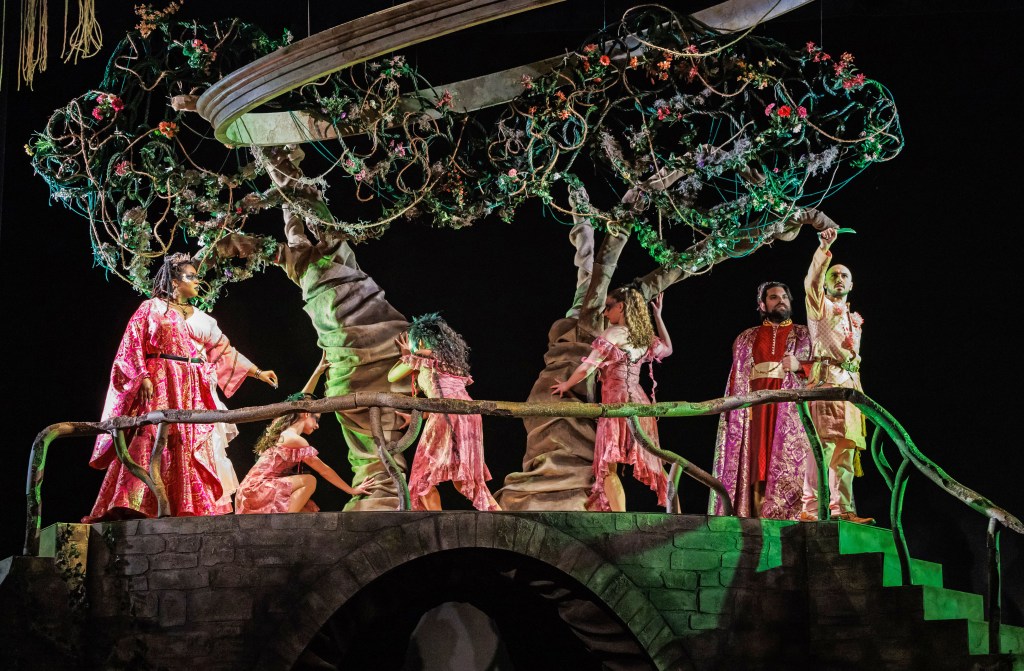
The overwhelming majority of the standard opera repertoire dates from the 19th and into the early 20th centuries. Hearing a work outside that admittedly fertile era is always a welcome opportunity, afforded locally in late January by Pittsburgh Opera’s presentation of Haydn’s 1784 dramma eroico, Armida. The subject matter deals with the First Crusade, and inspired a litany of music, including earlier operatic treatments by Handel (Rinaldo) and Lully (Armide).

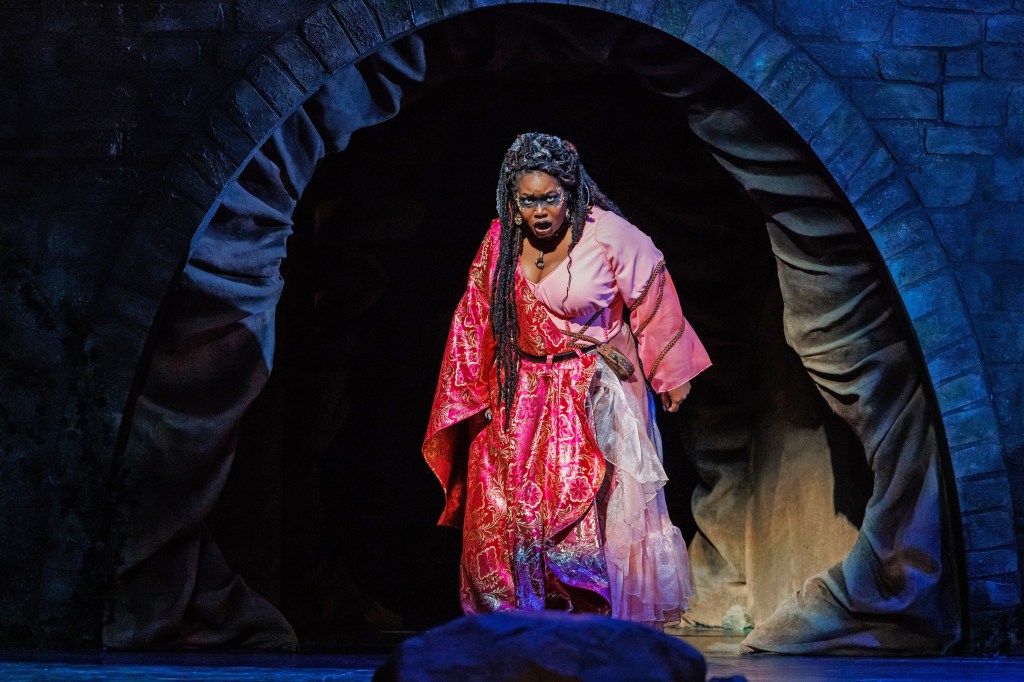
Armida (Lauryn Davis), photos credit David Bachman Photography for Pittsburgh Opera

The forces Armida required conveniently allowed all eight members of this year’s corps of resident artists a moment in the spotlight — six vocalists, along with pianist Maeve Berry and assistant stage director Dana Kinney. The Pittsburgh Opera Orchestra under the baton of Antony Walker opened crisp and articulate, just as adept in the late 18th-century style as they are in Puccini — though I did find the obvious electronic sound of the continuo a bit jarring. Bass Matthew Soibelman made the first vocal appearance in a declamatory recitative.

A troupe of dancers from Attack Theatre added a further expressive dimension to the performance, and provided narrative in the absence of text. I particularly enjoyed the various duets when the singers’ voices harmoniously blended — Audrey Welsh as Clotarca (originally, a tenor named Clotarco, but rescored and renamed here to fit the mezzo-soprano) with Shannon Crowley as Zelmira, and certainly the two leads: Fran Daniel Laucerica’s loving and longing take on Rinaldo, with Lauryn Davis as the imposing titular sorceress. With elements of the supernatural achieved through clever staging, the work ultimately drew to a dark and stormy end in this quintessential opera seria.

Armida (Lauryn Davis), nymphs (dancers courtesy of Attack Theatre), Idreno (Matthew Soibelman), Rinaldo (Fran Daniel Laucerica)

Early symphonies and a new violin concerto at Los Angeles Chamber Orchestra

Los Angeles Chamber Orchestra
Jaime Martín, conductor
Kelly Hall-Tompkins, violin
Alex Theatre
Glendale, CA
November 2, 2024

Haydn: Symphony No. 7 in C major, Hob. I:7, Le midi
Beal: Body in Motion
Beethoven: Overture to Egmont, Op. 84
Beethoven: Symphony No. 1 in C major, Op. 21

Held at the historic Alex Theatre in Glendale, the Los Angeles Chamber Orchestra presented an alluring program bookended by early forays into the symphony from Haydn and Beethoven. As a centerpiece was a recent violin concerto by Jeff Beal, receiving its West Coast premiere.

Jaime Martín, Jeff Beal, and Kelly Hall-Tompkins with LACO

Haydn’s Seventh Symphony is the middle of early trilogy, in which each entry represents a different time of day (the other two are also being performed by LACO this season). Le midi (Noon) was written for the composer’s inaugural concert for the Esterházy family, the beginnings of an enormously fruitful musical relationship. The introduction was marked by crisp dotted rhythms, and I was struck from the first bars by music director Jaime Martín’s graceful conducting — without a baton, he seemed to be acting out the music he intended to draw from the orchestra rather than merely beating time.

The work proceeded with delightful interplay amongst the musicians on stage, and evidenced Haydn’s blossoming compositional skill — though one scarcely could have imagined that nearly 100 more symphonies would follow. Solo passages from concertmaster and principal cello were further highlights. A recitative served as an introduction to the Adagio — an inventive device which the composer would rarely revisit. Genteel material was decorated by fluttering flutes, and a duet between violin and cello gave a certain chamber-like quality. An elegant minuet followed — with a striking double bass solo in the trio — rounded off a by a finale brisk and full of vitality.

Jeff Beal is a California native particularly known for his work in film and television, including scores for House of Cards and Monk. His violin concerto titled Body in Motion received its first hearing at the St. Louis Symphony this past January, and LACO also engaged dedicatee Kelly Hall-Tompkins as soloist. Each of the three movements depicts a certain physiological phenomenon, beginning with head above water. Rippling material in the orchestra opened, with the violin soloist entering on the crest of the wave. A long and lyrical melody contrasted the orchestra’s bubbling gestures. Matters were ramped up in vigor with rapid-fire playing from the soloist, and a colorful touch of percussion. A wide-ranging cadenza followed, and finally, the sea swells of the opening resurfaced.

Plaintive strings, barely present, opened the central breathing movement. Hall-Tompkins joined in to draw out a melodic line in this meditative, inward-facing moment. Coarsely pulsating material began the closing running, and Beal made clever, efficient use of the slimmer resources of a chamber-sized orchestra. The violin writing was quite demanding, traversing the range of her instrument to bring the work to a rousing close. An appealing listen even if not particularly profound.

The remainder of the program was devoted to Beethoven, beginning with the Egmont overture. Bold and bellicose, there was wound-up tension from the opening, further emphasized by LACO through stark dynamic contrasts. The payoff came in the heroic ending, full of brassy splendor. The First Symphony opened with strikingly dissonant chords, quickly resolved — a device which Martín charismatically demonstrated in his spoken remarks. Fleet and buoyant, there was particularly fine playing from the winds, capped off by a joyous finale in all its foot-tapping vigor.

Sara Davis Buechner joins Columbus Symphony in Viennese program

Columbus Symphony Orchestra
Rossen Milanov, conductor 
Sara Davis Buechner, piano
Ohio Theatre
Columbus, OH
April 5, 2024

Haydn: Symphony No. 82 in C major, Hob. I:82, The Bear
Mozart: Symphony No. 31 in D major, K297, Paris
Beethoven: Piano Concerto No. 1 in C major, Op. 15

Encore:
Gershwin: The Man I Love

This weekend’s Columbus Symphony program traversed Haydn, Mozart, and Beethoven, all of whom spent most of their professional life in Vienna, and crystallized and embodied what we now know as the Classical style. Though a Viennese evening, the first two selections were associated with Paris, beginning with Haydn’s Symphony No. 82. The first of the six so-called Paris symphonies, it and its successors were written on commission for performances in the French capital throughout 1786.

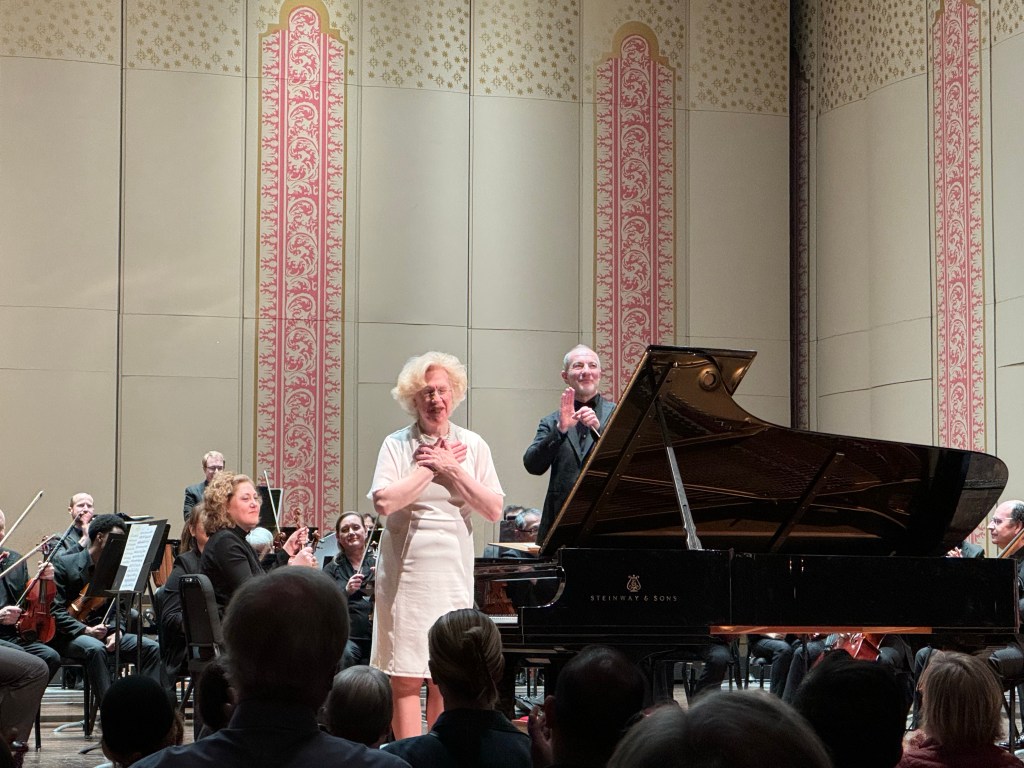
Sara Davis Buechner, Rossen Milanov, and the Columbus Symphony

Despite its numerical order, No. 82 was the last of the Paris symphonies to be composed. The rather heavy-handed opening lumbered forward, soon to be countered by a gentler theme in a back and forth with the more martial material. The development introduced some piquant dissonances that to my ears seemed to anticipate those in Beethoven’s Eroica. Haydn showed himself master of the double variation in the Allegretto. The finale was marked by a sustained drone, giving rise to the work’s ursine nickname, imitating the music used to accompany the barbaric practice of dancing bears, in any case, themes of folk inflection gave the symphony a spirited close.

Though the program was presented chronologically by composer, Mozart’s Paris symphony (no. 31) predates Haydn’s by almost a decade. A bold opening – and perhaps a bit overbearingly so Friday night – showcased the expanded orchestra (inclusive of clarinets, the first Mozart symphony to employ them), a quantity that must have dazzled Parisian audiences at the time. Delicately drawn-out melody made the central slow movement especially lyrical, and the finale was a pristine balance of both abandon and sophistication.

The first of Beethoven’s five genre-defining piano concertos brought forth Sara Davis Buechner as soloist. A gentle theme brimming with playful potential was heard from the orchestra, though the time-honored tradition of an orchestral introduction is a device the composer would jettison in his later works in the medium. Buechner’s entry was an elegant affair, deftly ornamented and replete with smooth runs across the keyboard, engaging in an energetic conversation with the orchestra. Though the work still very much bears the influence of Mozart, a lyrical flourish several minutes in unmistakably showed Beethoven’s individual stamp. Buechner’s snappy rhythmic punctuations and dynamic contrasts imbued the performance with excitement, and especially so in the wide-ranging cadenza of her own device (though perhaps not as wide-ranging as the one Alkan supplied for the Third Concerto!).

The Largo was gorgeous and serene, a mood sustained by the delicate cantilena in the piano. Quite a contrast to the Allegro scherzando finale which rivaled the mischievousness of his teacher Haydn – and moreover, in this case a nod to one Andreas Hofer – and Buechner offered a reading with flexibility and freedom. An enthusiastic reception brought her back for an encore which she introduced as “an unnecessary delay before my first martini” – a delay we’re grateful for, as it proved to be a lovely and sultry account of Gershwin’s The Man I Love.

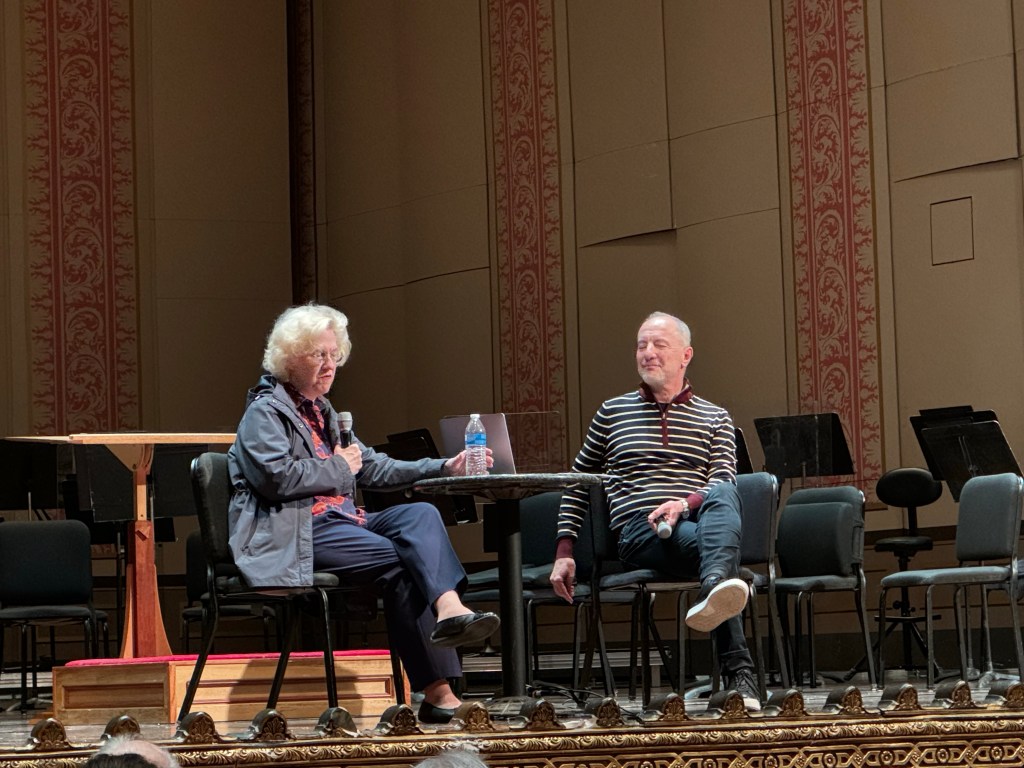
Buechner and Milanov during the preconcert conversation

Rosamunde Quartet anchors Linton Chamber Music program with sublime Beethoven

Rosamunde String Quartet
First Unitarian Church of Cincinnati
Cincinnati, OH
March 3, 2024

Haydn: String Quartet in C major, Op. 20 No. 2, Hob. III:32
Puts: Credo
Beethoven: String Quartet No. 15 in A minor, Op. 132

Something of a supergroup amongst string quartets, the Rosamunde is comprised of current or former members of the Berlin, New York, and Los Angeles philharmonics, affording these players an opportunity to supplement their orchestral responsibilities by indulging in their love of chamber music. Their Sunday afternoon program at Cincinnati’s Linton Chamber Music offered two major classical period quartets sandwiching a more recent expression in the medium.

Rosamunde String Quartet at Linton Chamber Music. L-R Nathan Vickery, Shanshan Yao, Teng Li, Noah Bendix-Balgley

Dubbed the “father of the sting quartet,” Haydn virtually invented the form – and it was the set of six that comprise the watershed opus 20 in particular that earned him the title. Collectively known as the Sun Quartets owing to an early edition’s cover illustration, the Rosamunde selected the second quartet, in the sunny key of C major. A rather mellow beginning was had with the first violin absent from the opening few bars, and there was a particularly robust part for cello – Haydn was at his most lyrical here. A slow movement was stern and solemn, perhaps a look back towards the Baroque stylistically, but the latter section was truly radiant – and fittingly timed with the late afternoon sunlight streaming through the church’s stained glass windows.

A minuet followed without pause, much more restrained than typical for the composer, and a trio contrasted in the minor. Though less of a hallmark of Haydn’s later quartets, half of opus 20 concludes with a fugue. The four-voice fugue that closed the present example evidenced the Rosamunde’s incisive clarity and taut communication.

A 2007 work by Kevin Puts took the string quartet to the present day. On commission from the Miró Quartet, Puts was tasked with writing a work to capture the “lighter side of America,” a requirement he found quite a challenge given the backdrop of wars in the Middle East and mass shootings back home. The resulting Credo painted short vignettes which inspired feelings of hope in some fashion.

The Violin Guru of Kantonah brought to life an instrument maker in the titular New York town. Improvisatory in character, it seemed to gingerly experiment with the different possibilities of the instruments, and a cross-section of excerpts from the violin repertoire surfaced in the first violin. Infrastructure was inspired by the bridges and highways the composer passed taking the path along the Monongahela River in Pittsburgh. Guttural and motoric, it depicted the marvels of industry with vigor.

Intermezzo: Learning to Dance recollected when Puts observed a mother teaching her daughter how to dance, its nostalgic lyricism capturing a sweet moment. The Pittsburgh tableau was reprised with the vigor turned up one more notch before the closing Credo, the heart of the piece. Puts purveyed a resonant lyricism, grappling and questioning for answers, ultimately finding a peaceful if inconclusive resolution.

Beethoven’s monumental opus 132 completed the program. Somewhat in the manner of where the Puts left off, Beethoven’s penultimate quartet began searching and musing, with the opening movement finding its footing in material that the Rosamunde gave with a rich sonority, a wide-ranging essay that culminated in a blistering coda. The crux of the work came in the central Heiliger Dankgesang, unfolding as a deeply-felt hymn. In his spoken remarks, violinist Noah Bendix-Balgley suggested a connective thread between the Puts and Beethoven in that both find hope in difficult times (in Beethoven’s case, in the wake of recovering from serious illness). At times the mood was simply ecstatic, an expression of joy all too uncommon for the tragic composer. The brief march that followed was rather quotidian by comparison, bringing matters back down to the earthly, and providing a moment of levity before the pathos-laden finale.

Stewart Goodyear joins forces with the Daedalus Quartet at Philadelphia Chamber Music Society

Daedalus Quartet
Stewart Goodyear, piano
Perelman Theater
Kimmel Center for the Performing Arts
Philadelphia, PA
February 11, 2024

Haydn: String Quartet in D Major, Op. 1 No. 3, Hob. III:3
Goodyear: Piano Quintet, Hommage a Beethoven
Brahms: Piano Quintet in F Minor, Op. 34

Sunday afternoon at the Perelman Theater saw the Philadelphia Chamber Music Society present the Daedalus Quartet. Their program began with an early entry of Haydn’s vast series of sixty-eight string quartets. Cast in five movements, the D major quartet from opus 1 is in some ways more akin structurally to the Baroque suite with its alternating tempos than the form the composer would later crystallize. The opening Adagio was given with transparency and balance. A stylish triple meter marked the pair of minuets. The central and final movements bore a Presto tempo indication; rapid, buoyant energy made them spirited if brief affairs.

Stewart Goodyear and Daedalus Quartet at the Perelman Theater

String quartet subsequently blossomed to piano quintet with the addition of Stewart Goodyear, donning the dual mantle of pianist-composer. In its Philadelphia premiere, Goodyear’s own Piano Quintet filled the balance of the first half. Subtitled Hommage a Beethoven, the work is filled with a panoply of allusions to the earlier composer. The opening Passacaglia was built around a theme from the Ninth Symphony. Tremolos punctuated the bass line on which the variations were built, and matters were skillfully textured such that the bold piano didn’t outsize the string players.

Mercurial fragments coalesced in the Scherzo, alluding to the Bagatelle, Op. 126 No. 4. A central Air was cast for strings alone – something of a lamentation, it was rather un-Beethovenian in its long-bowed melody, but looked back to the composer’s Baroque inspirations. This was followed by a Minuet, coloristic and chromatic, an almost impressionistic deconstruction of the venerable dance form. A wide-ranging and kinetic Toccata closed the work. Eclectic in inspiration, I caught nods to the Moonlight and Appassionata sonatas among others, varied by some unusual timbres inclusive of tapping the cello body, col legno strings, and plucking the piano.

One of the exemplary works in the form closed the recital, namely Brahms’ Piano Quintet in F minor, Op. 34. A broad theme grew in impassioned urgency, with the ensemble yielding a quasi-orchestral sonority. Almost Schubertian in its spaciousness, the movement pointed towards a forceful coda. All was suddenly at peace in the slow movement, with the richly lyrical piano decorated by the strings.

The Scherzo saw hypnotically repeated figures building to searing intensity, contrasted by its songful trio. Brahms extensively makes use of syncopation here, and my thoughts turned to the recently-departed Peter Schickele: in a memorable episode of his inimitable radio program Schickele Mix, he colorfully illustrated how this movement can be seen as a precursor to American ragtime. Soul-searching introductory material opened the finale. Its primary theme first surfaced sumptuously in the cello, proceeding sprightly but lyrical at heart, and the bold, uncompromising close evidenced Goodyear and the Daedalus as polished collaborators.

Classical symphonies bookend wunderkind violinist at ProMusica

ProMusica Chamber Orchestra
David Danzmayr, conductor
Fiona Khuong-Huu, violin
Southern Theatre
Columbus, OH
January 28, 2024

Prokofiev: Symphony No. 1 in D major, Op. 25, Classical
Saint-Saëns: Introduction et Rondo capriccioso, Op. 28
Ravel: Tzigane
Haydn: Symphony No. 104 in D major, Hob. I:104, London

Last weekend’s ProMusica performances introduced Columbus audiences to the remarkable – and remarkably young – violinist Fiona Khuong-Huu. Just 16 years old, she has already scored a New York Philharmonic debut and is currently a student in Juilliard’s pre-college division. Additionally, she is recipient of the Fomin Scholarship Fund from the Chicago-area North Shore Chamber Festival, an organization helmed by ProMusica’s creative partner Vadim Gluzman.

Fiona Khuong-Huu, David Danzmayr, and ProMusica, photos credit ProMusica

Khuong-Huu offered two 10-minute or so virtuoso showpieces, beginning with Saint-Saëns’ Introduction and Rondo capriccioso. A long-bowed melody marked the introductory material, and the violinist played with a rich tone and a maturity beyond her years. The Rondo was elegantly ornamented, with Khuong-Huu self-assured across the range of her instrument. In a particularly striking moment, the soloist played a series of rapid, wide-ranging arpeggios as the theme surfaced in the winds.

Ravel’s Tzigane opened with a monologue for violin alone, replete with modal inflections in invocation of Romani music. It’s a work that made substantial technical demands, surmounted by the soloist with seeming effortlessness. It’s also a piece filled with novel timbres, from the rapid pizzicato passages to a substantial part for harp (Jeanne Norton). Khuong-Huu certainly has a bright future ahead of her, and a career I look forward to watching.

The evening began and ended with “classical” symphonies of various flavors – Prokofiev’s First, which consciously sought to emulate and imitate his symphonic forbears, and Haydn’s last, a veritable archetype of the form. The fizzy opening of the Prokofiev was further buttressed by a buoyant contrasting theme, almost weightless, though vigor was amassed as much was made from efficient use of the chamber-sized orchestra. The delicate inner voices were intricately brought out in the Larghetto, and the piquant dissonances of the haughty gavotte were given a stylish reading. The effervescence of the whirlwind finale was a worthy rival to Haydn himself.

A broad-stroked introduction began Haydn’s London symphony at the other end of the program, pointing towards an essay in equal parts energetic and elegant, epitomizing classical symmetry and balance. The irregularly dispersed accents and pauses of the minuet were of charming effect, as was the finale, derived from a Croatian folk song that sounded almost indistinguishable from a bona fide Haydn theme.

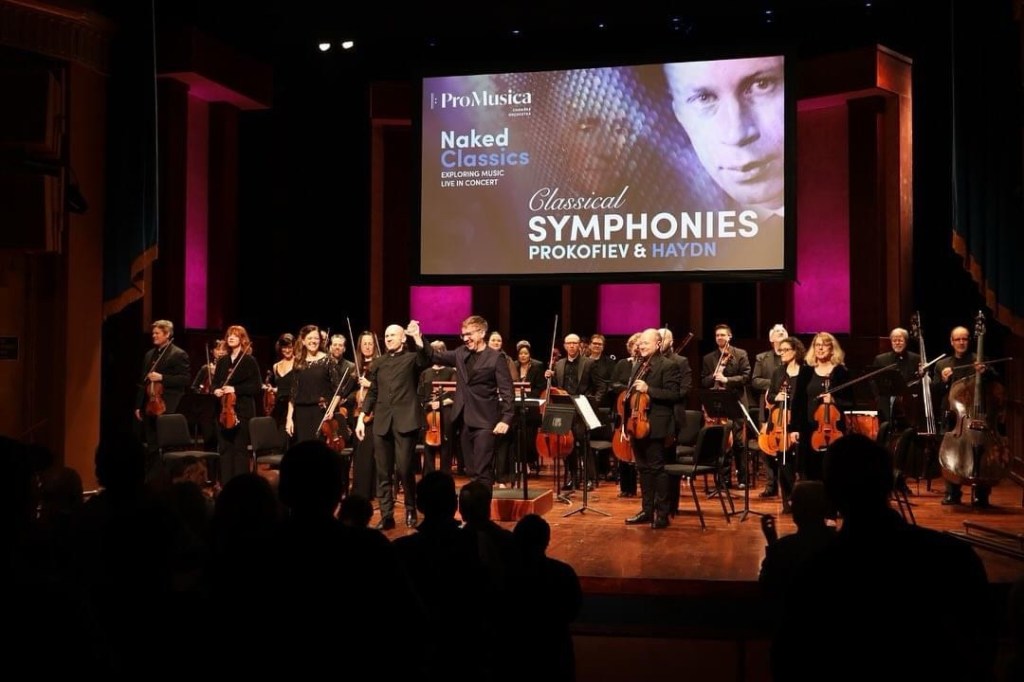
The preceding Friday night saw a further installment of Naked Classics, hosted by the ebullient and informed Paul Rissmann. Parallels and contrasts between the Haydn and Prokofiev symphonies were illuminated, culminating in a performance of both works. Here, the two symphonies were intertwined, with a movement of Prokofiev alternating with a movement of Haydn, an approach which may have helped illustrate comparisons but ultimately made for a disjointed listen.

Paul Rissmann with David Danzmayr and ProMusica

Callisto Quartet pairs new and old at Chamber Music Columbus

Callisto Quartet
Southern Theatre
Columbus, OH
February 18, 2023

Haydn: String Quartet in F major, Op. 77 No. 2, Hob. III:82
Fujiwara: Sunsets, Like Childhood
Hu: As Hope Builds
Debussy: String Quartet in G minor, Op. 10

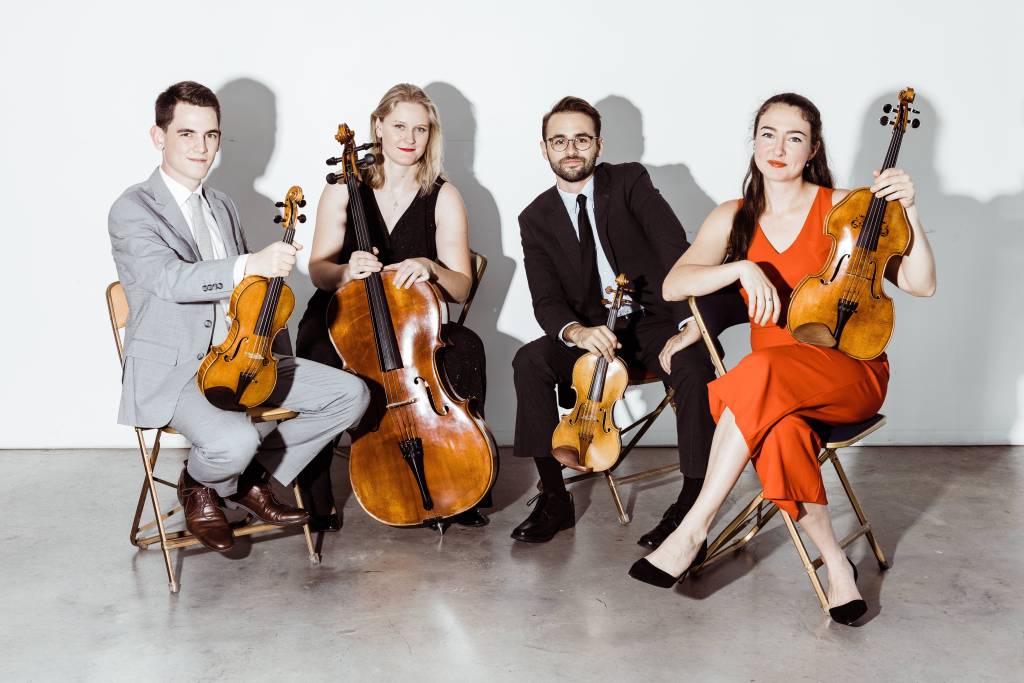
February’s Chamber Music Columbus concert was originally slated to feature the St. Lawrence String Quartet; following the very sad passing of their first violinist Geoff Nuttall, a substitute was booked in the Callisto Quartet – an ensemble currently serving as quartet in residence at the Yale School of Music. Kudos to Callisto for presenting a very fine, polished program on short notice that included two world premieres along with two cornerstones of the quartet repertoire.

Callisto Quartet, photo credit callistoquartet.com

The program opened with Haydn’s final completed quartet (Op. 77 No. 2) from his vast output in the form (a projected sixty-eighth string quartet would follow as Op. 103, but was left incomplete). The opening Allegro moderato was elegant and deftly balanced. Bucking the tradition the composer himself largely established, a Menuetto was placed ahead of the slow movement. Sprightly and harmonically adventurous, it was almost more akin to something of Beethoven. The theme and variations Andante was given with careful attention to detail, bringing out its rhythmic intricacies. Despite being the composer’s final quartet, there was certainly nothing valedictory about the finale, spirited and vivacious, with some particularly energetic playing from first violinist Cameron Daly.

As the 75th anniversary celebrations continue, the next featured composer was Korine Fujiwara. Though now based in the Pacific Northwest, she is someone with strong local connections (describing Columbus as her “emotional home” during her spoken remarks): violinist in the Columbus Symphony for many years, composer of a new work for Opera Columbus, and founding member of the Carpe Diem String Quartet. Sunsets, Like Childhood alludes to a quote from author Richard Paul Evans, and seeks to capture the energy of a sunset, and childlike sense of wonder many of us continue to have for this daily occurrence.

A short cello line opened, soon joined by the rest of the ensemble in lush harmony. Rapid tremolos and arpeggios conveyed a sense of evanescence like the fleeting sunset. The piece was simply full of life – celebratory, almost exuberant, yet still wistful and reflective with a particularly lovely theme surfacing about halfway through before the work peacefully drifted away into the night.

Ching-chu Hu’s next “puzzle piece” of the 75th anniversary fanfare opened the second half, entitled As Hope Builds. A self-described “eternal optimist,” that mindset was very much reflected in the work’s theme and character, amassing strength and vigor through the titular hope.

The recital closed with Debussy’s sole entry in the string quartet medium, and a fine one at that. A rich sound opened, with the quartet communicating as a seasoned ensemble as the conversation on stage naturally shifted to Debussy’s impressionist language. Striking pizzicato sonorities marked the scherzo, and not without a certain wit one doesn’t always associate with the Frenchman. The Andantino was the heart of the work, gorgeous and serene with the quartet purveying a singing tone throughout, an essay of repose before cleanly negotiating the thorny textures of the finale.

Columbus Symphony delights in Viennese triumvirate

Rossen Milanov, conductor
Columbus Symphony Orchestra
Ohio Theatre
Columbus, OH
January 20, 2023

Beethoven: Leonore Overture, Op. 72b
Mozart: Symphony No. 36 in C major, K425, Linz
Haydn: Symphony No. 100 in G major, Hob. I:100, Military

Haydn, Mozart, and Beethoven are all but synonymous with the classical style, and this weekend’s Columbus Symphony program offered one sterling example from each of these Viennese masters (and although indelibly associated with the Austrian capital, none were in fact natives). Beethoven produced no less than four overtures for his sole opera Fidelio; the third, bearing the opera’s original title Leonore, opened the program. Ripe with operatic drama, it functions well as a standalone concert piece – and in the opera house, it has become a long-standing tradition to inject this version between scenes in the second act.

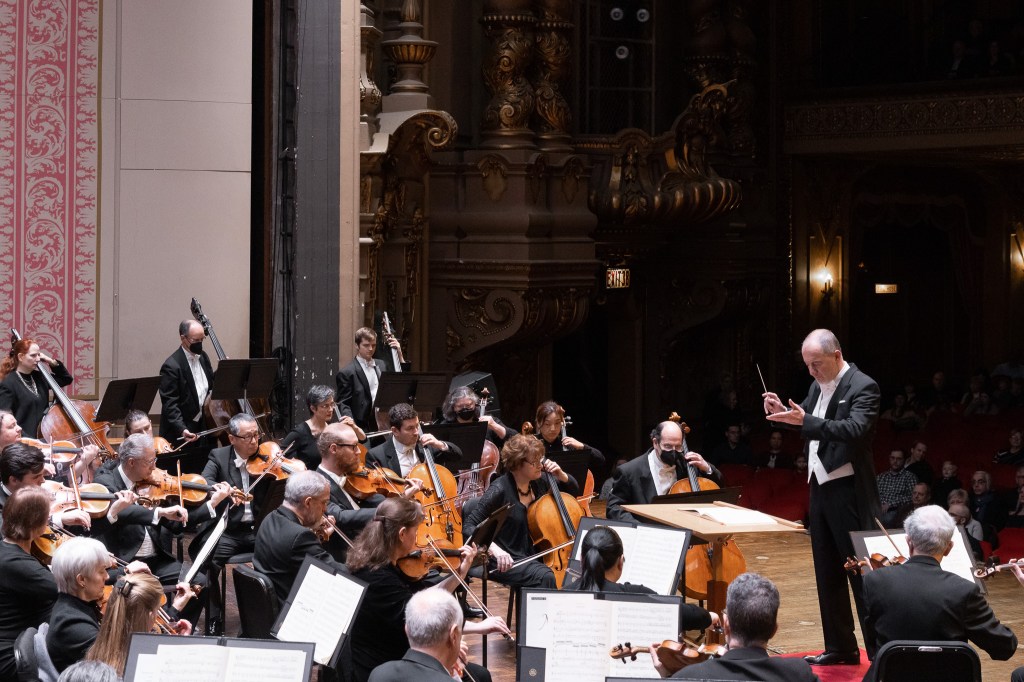
 Rossen Milanov and the Columbus Symphony, photo credit Corinne Mares

Somber beginnings gave rise to dramatic tension, thoughtfully paced by Milanov. Offstage trumpets sounded as a fanfare, suggesting narrative details of the source material, and the work ended in brassy splendor. Slow introductions were par for the course in Haydn’s symphonies, but rather rare for Mozart’s output. He employed such a device for the first time in the Linz symphony (No. 36), a technique he would only revisit twice (nos. 38 and 39). It made for a stately opening, setting up the effervescent main subject of the movement proper, given with airy clarity.

The Andante made for a gentle interlude, though punctuated by insistent brass and timpani. A most elegant of minuets followed, with Milanov’s baton bringing emphasis to the sprightly triple meter. The finale was lithe, lean, and joyous – one of Mozart’s most untroubled creations.

The introduction to Haydn’s Military symphony was given with clarity and careful articulation; the main theme was established with the unusual scoring for flute and oboe, and matters proceeded with a refined charm. Over two centuries later, the Allegretto which gives this symphony its moniker is still so striking and wonderfully surprising with its ceremonial percussion and brass fanfare. Such a movement is a hard act to follow, but the minuet was full of wit and charisma, with playing from the well-rehearsed CSO boasting the requisite transparency demanded by this repertoire. A vigorous return of the percussion made the finale an especially exciting affair.