Marc-André Hamelin offers probing virtuosity at Akron’s Tuesday Musical

Marc-André Hamelin, piano
EJ Thomas Hall
Akron, OH
October 21, 2025

Beethoven: Piano Sonata No. 29 in B-flat major, Op. 106, Hammerklavier
Schumann: Waldszenen, Op. 82
Ravel: Gaspard de la nuit

Encore:
Debussy: Reflets dans l’eau (No. 1 from Images, Book 1)

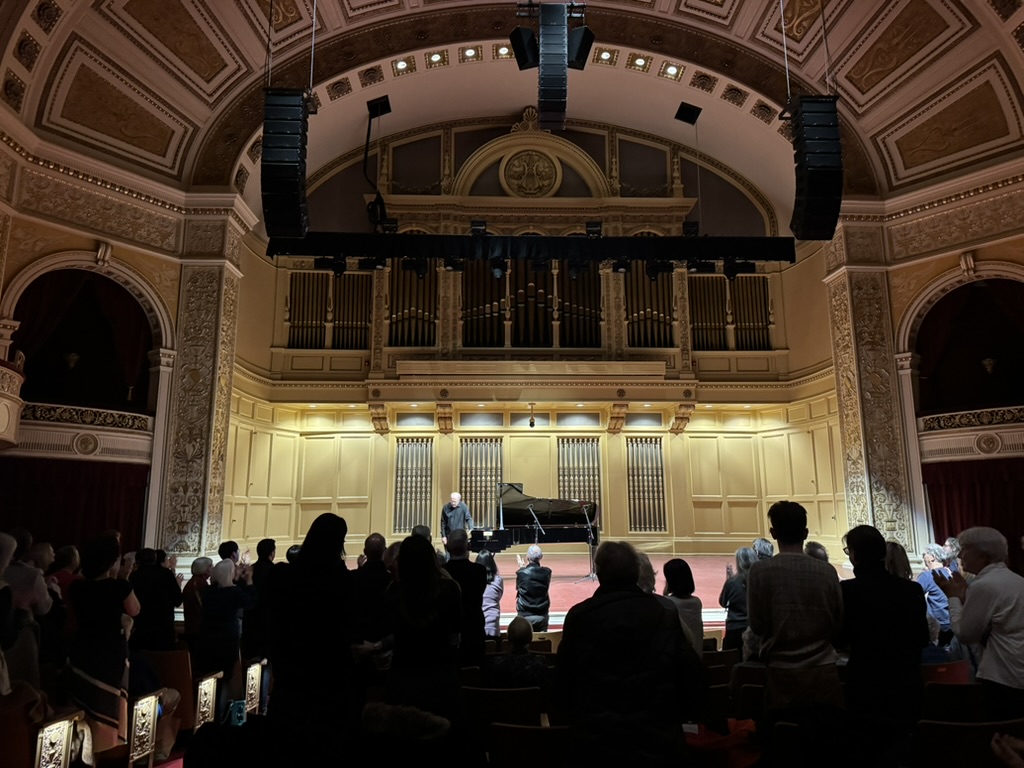
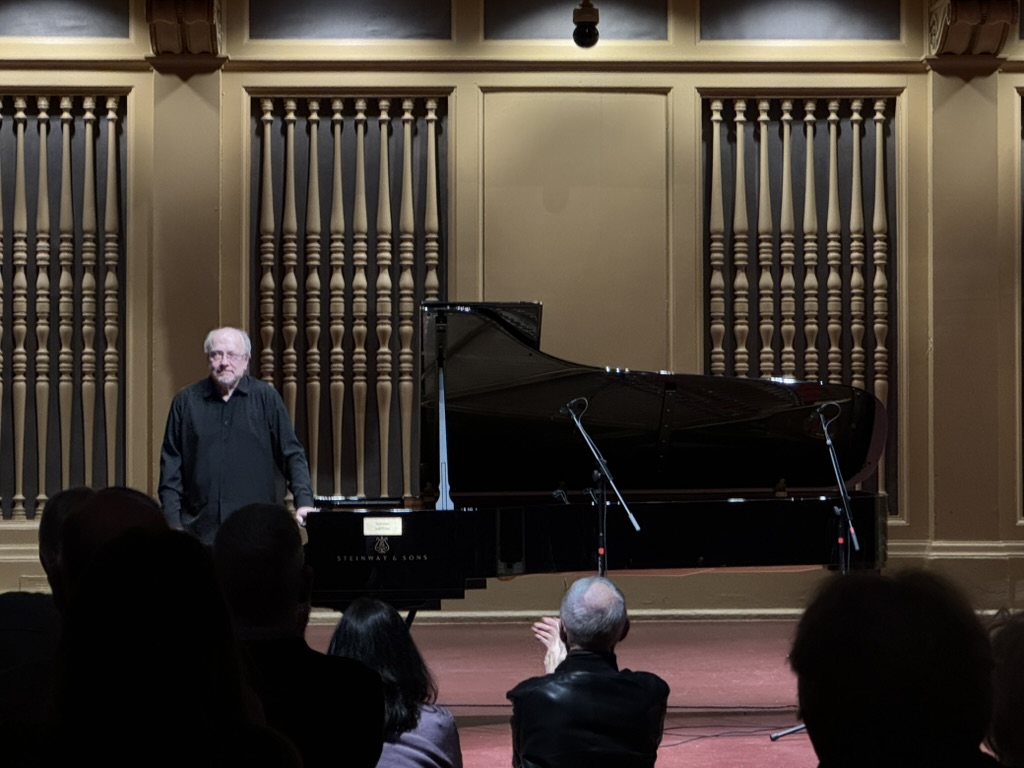
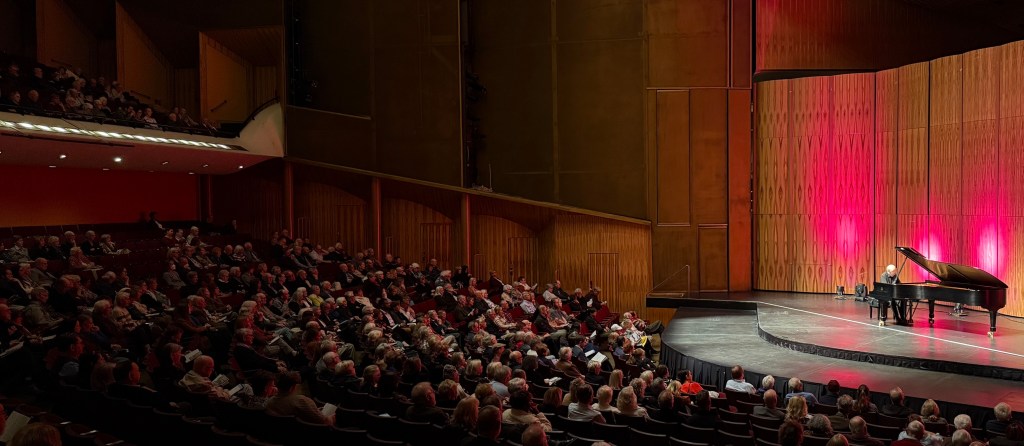
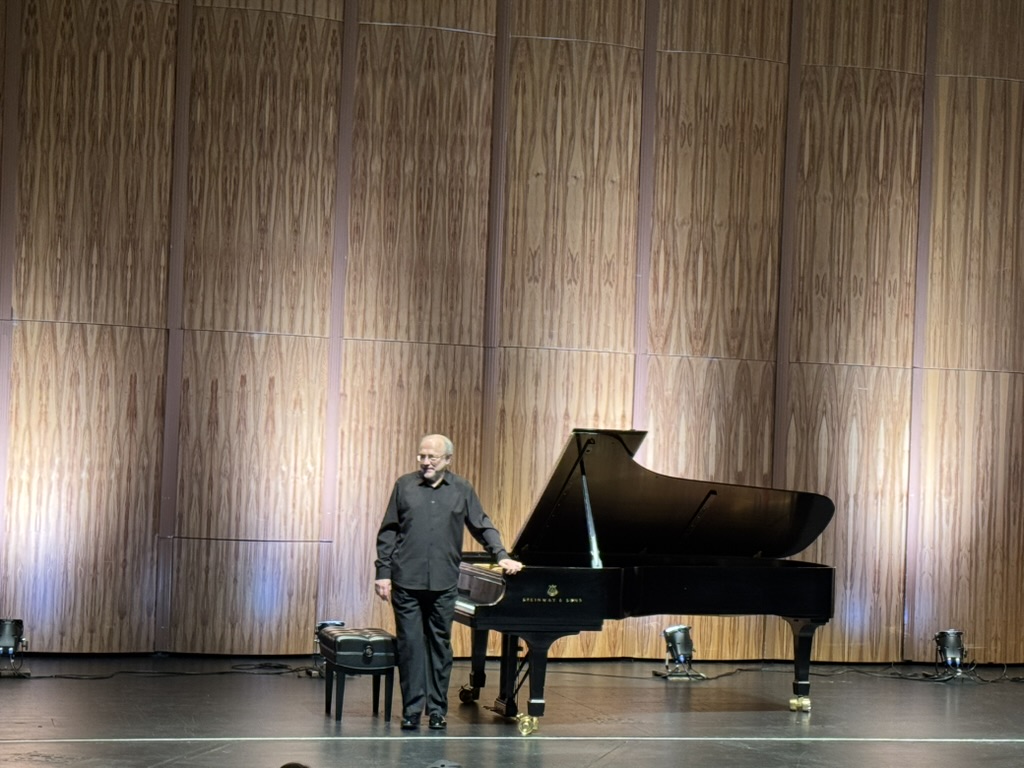
No part of Marc-André Hamelin’s recital at Akron’s Tuesday Musical was for the faint of heart. The repertoire spanned a mammoth Beethoven sonata, the rewarding Romanticism of Schumann, and Ravel at his most mercurial and ferocious. Opening night of Tuesday Musical’s 138th(!) season, Hamelin served as the annual Margaret Baxtresser Pianist, in which capacity he led a masterclass at Kent State the following day. Additionally, the evening performance began with a rippling account of Liszt’s La leggierezza by local high school student Saya Uejima.

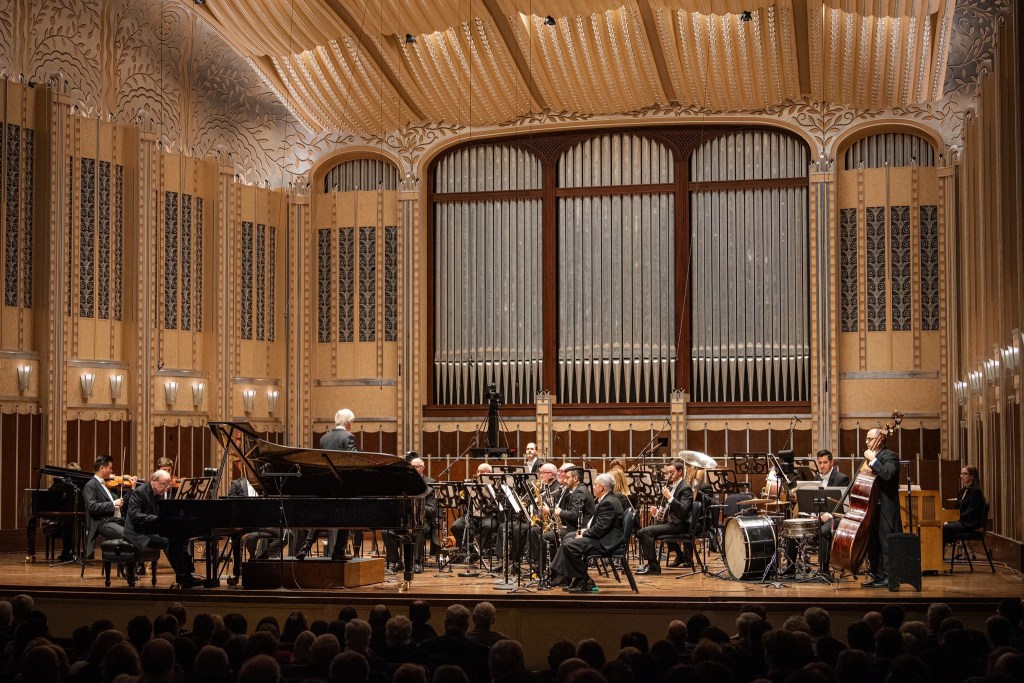
Marc-André Hamelin at EJ Thomas Hall, photo credit Tuesday Musical

Along with the Diabelli Variations, the Hammerklavier is Beethoven’s largest and most demanding work for solo piano. A granite monument of the piano literature, Hamelin has recently recorded it to acclaim. As if totally unfazed by its technical demands, it comprised merely the first half of Tuesday’s recital. The bold Allegro movement made for a commanding beginning. Hamelin opted to strike the opening bass note with the right hand rather than the left for added power. Textures were crisp and brisk, with deft voicing of its intricacies, balancing the exuberant with more graceful material. The development saw some spiky contrapuntal passages, a preview of sorts for what was to come, before the movement’s blistering, uncompromising coda.

Though short in length, the scherzo that followed was hardly a trifle. Hamelin conjured a tempest, though an impulse towards restraint here kept the otherwise tumultuous writing in check. What followed was the work’s magnificent slow movement. Drawing on deep reserves of emotion, Hamelin sustained a spellbinding atmosphere over its nearly twenty-minute duration. Worlds apart from the robustness of the outer movements, here Hamelin purveyed a velvety touch to striking effect, landing on the profound sequence of chords that closed, beautifully voiced. With meditative, improvisatory beginnings, the massive fugue that concluded the sonata saw Hamelin at his best — a dazzling technique used in service of the music.

Schumann’s Waldszenen (Forest Scenes) made for a genial opening to the second half. Eintritt (Arrival) extended a warm and gracious entry into the forest, played with rippling lyricism. Hunting songs came second and second-to-last in this nine-part suite, in both cases given with vigorous flexibility. I was touched by the delicate nostalgia of Einsame Blumen (Lonely Flowers) and the uber-Romantic lushness of Herberge (Wayside Inn). The closing Abschied (Farewell) bid adieu with the same warmth with which it began.

The evening concluded with another work famous for its extraordinary technical demands in Ravel’s Gaspard de la nuit. Though a mainstay of Hamelin’s recital programs for years, it’s the only work of the present selection he has not yet recorded. The work brings to life in musical terms poems by Aloysious Bertrand, all of which deal with fantastical, rather demonic figures — a seasonally appropriate selection for late October! Ondine positively shimmered in this remarkable soundworld of the titular water nymph, building to an ecstatic climax. Le Gibet was a striking contrast in its funereal stasis ahead of Scarbo, closing with a spattering of iridescent colors and ferocious virtuosity.

Hamelin offered just a single encore in Debussy’s Reflets dans l’eau, which like Ondine, paints a mesmerizingly impressionist aquatic scene. A clip of Hamelin discussing the work can be viewed here.

Two years ago, I saw Hamelin play a very similar program in Cleveland with another massive piano sonata — Charles Ives’ Concord — in place of the Hammerklavier. See review here. Lastly, Hamelin was on hand ahead of his Akron recital for a brief but affable interview with WCLV’s Jacqueline Gerber, available for listening here.

Hamelin a star soloist in Cleveland Orchestra’s feast of American music

Cleveland Orchestra
David Robertson, conductor
Marc-André Hamelin, piano
Mandel Concert Hall
Severance Music Center
Cleveland, OH
November 29, 2024

Copland: Suite from Appalachian Spring (1945 orchestration)
Gershwin: Rhapsody in Blue (arr. Grofé)
Ellington: New World A-Comin’
Copland: Suite from The Tender Land

Over the Thanksgiving weekend, The Cleveland Orchestra and guest conductor David Roberston served up a rich course of American orchestral music. As the centerpiece was a pair of works for piano and orchestra with virtuoso Marc-André Hamelin, both of which artfully brought jazz and popular traditions into the concert hall.

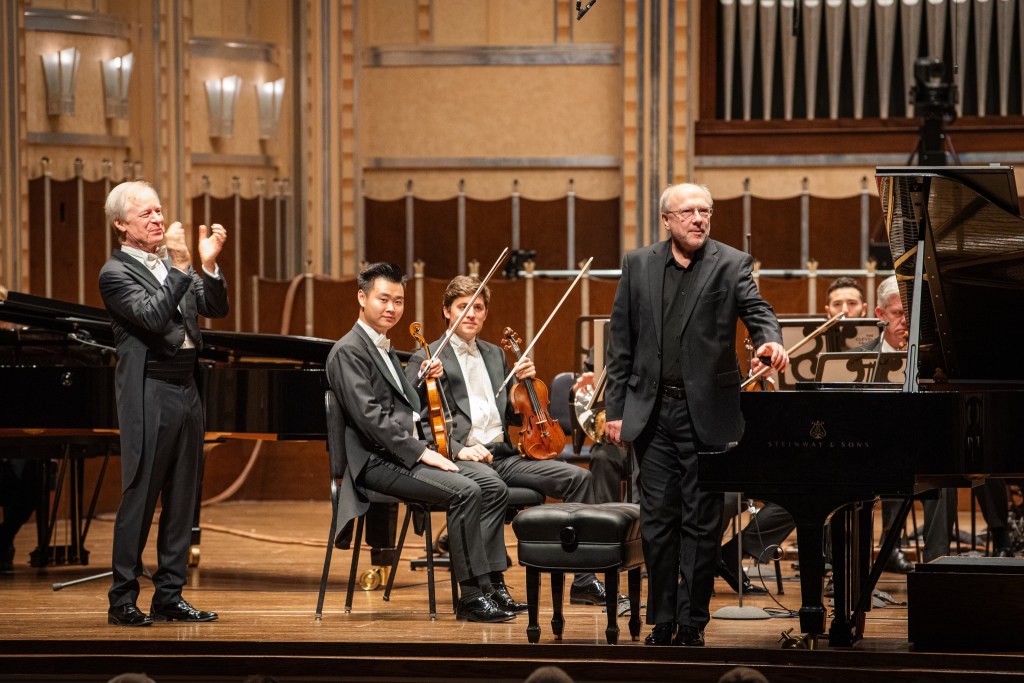
Marc-André Hamelin, David Robertson, and The Cleveland Orchestra perform Rhapsody in Blue. Photos credit Extraordinaire Photos

This year marks the centennial of Gershwin’s epochal Rhapsody in Blue, and the evening’s performers offered an energetic and joyous performance fitting for such an anniversary. The work was presented in its original jazz band orchestration arranged by Ferde Grofé, as it would have been heard in its 1924 premiere at Carnegie Hall — and The Cleveland Orchestra morphed into a bona fide dance hall band.

The iconic wail of the clarinet opened the work, stylishly played by Daniel McKelway. A muted trumpet responded in its striking timbre, setting the stage for Hamelin’s commanding pianism, given with flair and virtuosity. In this amalgamation of the classical and the vernacular, the two resided not in opposition, but as a unified whole. A downtempo section was a sultry affair, while a passage of repeated notes conveyed the mechanistic fury of the Industrial Age, not unlike what one finds in Prokofiev at the same time. All cares were left aside though in the abandon of the foot-tapping finale.

Duke Ellington’s 1943 work New World A-Comin’ premiered under similar circumstances as the Gershwin: a Carnegie Hall performance that endeavored to break the confines of the traditional classical repertoire. Unlike Rhapsody in Blue, Ellington’s work was not initially well-received. Credit, then to Hamelin et al. for offering a compelling performance. A lushly-scored opening in the orchestra gave way to a quasi-improvisatory passage for piano, with silky filigree and silvery runs, colored by jazz-inflected harmonies. A drum kit onstage added to the rhythmic pulse. Comprised of alternating sections for orchestra and piano, it lacked the cohesion of the Gershwin, but proved an attractive discovery nonetheless. On the subject of jazz-influenced classical works, Hamelin’s 2008 album In a state of jazz is warmly recommended.

Bookending the concertante works was music of Aaron Copland, in both cases orchestral suites extracted from stage works. Appalachian Spring made for a lovely opening to the evening. Earthy harmonies began, brimming with hope and possibility. Robertson and the orchestra gently breathed life into this soft-spoken material, starkly different from the bustling Manhattan streetscape conveyed in Gershwin’s Rhapsody. More angular material was enhanced by the sheen of the brass, and rhythmic inflections conveyed a dance-like quality — this was, after all, originally a ballet. A magical moment saw the first appearance of the Simple gifts hymn, first in the winds and then blooming to its magnificent orchestration. The loveliest of epilogues concluded, wholly at peace.

Less well-known was the three movement suite from Copland’s opera The Tender Land, dating about a decade after Appalachian Spring. Strident, brassy beginnings retreated inward for a gentle love song. A specialist of the American repertoire, Robertson served as a keen guide in this deeply lyrical writing. A boisterous, raucous “Party Scene” took matters in a rather different direction, splashed by piquant touches from the xylophone. The closing “Promise of the Living” was a peaceful paean with a fine English horn solo, and a touching, topical close for the Thanksgiving program.

And for those who couldn’t make it to Severance Hall in person, Sunday’s performance was live-streamed and subsequently available on demand through Adella and Stage+.

David Robertson applauds Marc-André Hamelin

Andsnes and Hamelin dazzling in two piano recital

Leif Ove Andsnes, piano
Marc-André Hamelin, piano
Symphony Center
Chicago, IL
April 30, 2017

Mozart: Larghetto and Allegro in E-flat Major for Two Pianos
Stravinsky: Concerto for Two Pianos
Debussy: En blanc et noir
Stravinsky: The Rite of Spring

Encores:
Stravinsky: Madrid for Two Pianos from Four Studies for Orchestra (transc. Soulima Stravinsky)
Stravinsky: Circus Polka for Two Pianos (transc. Babin)
Stravinsky: Tango for Two Pianos (transc. Babin)

It is a rare opportunity indeed to see not one, but two of the world’s leading concert pianists on stage together.  This was fortunately the case Sunday afternoon, when Marc-André Hamelin and Leif Ove Andsnes stopped at Symphony Center as part of a 13-city tour of a bracing program that explored music for two pianos.  Their partnership goes back a decade when they performed the two piano version of The Rite of Spring at the Risør Chamber Music Festival, where Andsnes served as artistic director.  Not three weeks prior to the Chicago performance, the pair finally recorded the piece for Hyperion along with additional works of Stravinsky for the same medium also featured in the recital, and one is grateful this inspired collaboration has been preserved on disc given the pair’s absolutely electric chemistry.

01ANDSNES-superJumbo
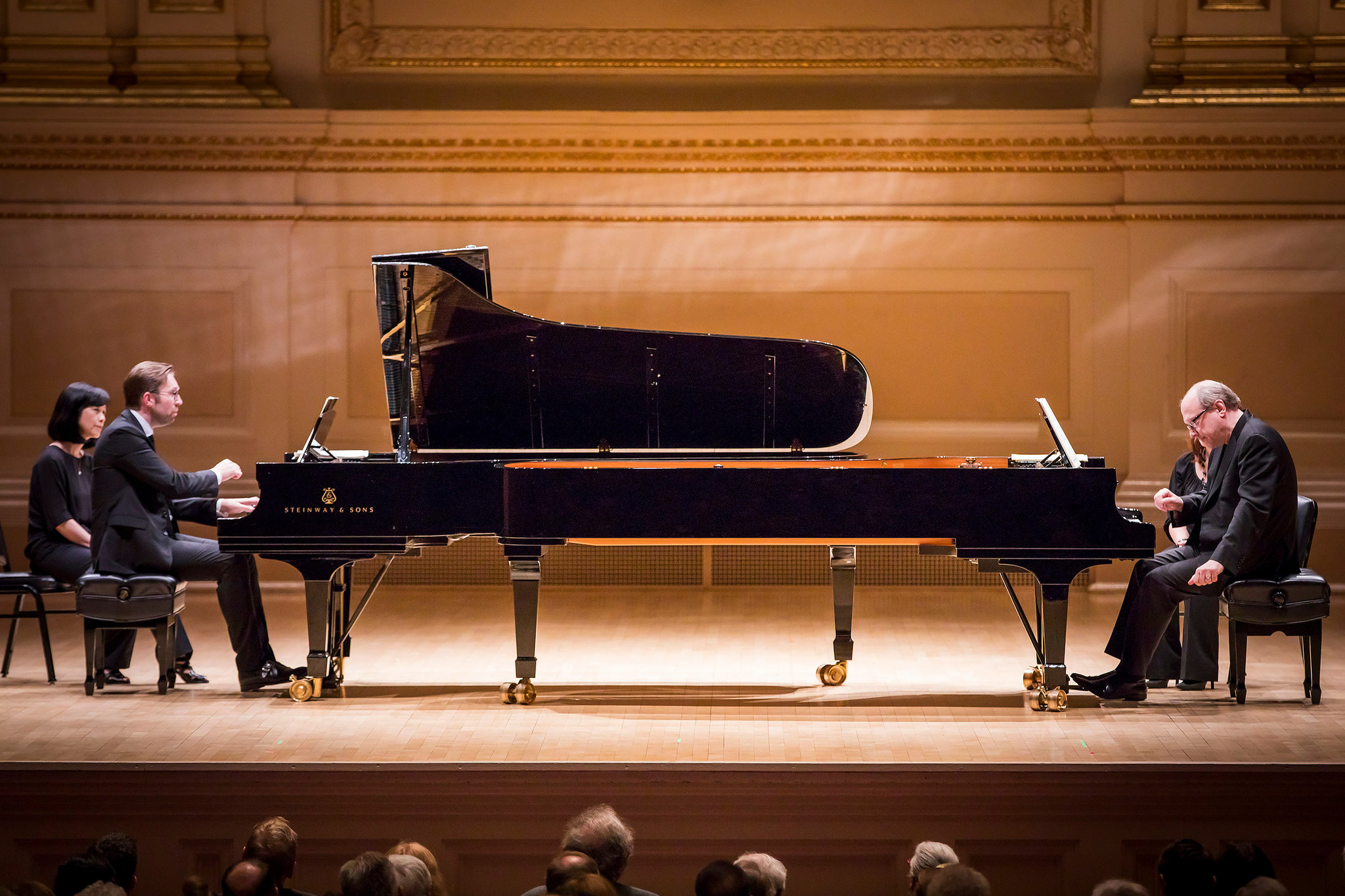
Andsnes and Hamelin presenting the same program at Carnegie Hall, two days prior to their Symphony Center appearance, photo credit Chris Lee
The program opened unassumingly with Mozart’s Larghetto and Allegro in E flat major, with Andsnes taking the primo part in the whole of the first half.  The Larghetto was graceful but not without shades of melancholy, as in the best of the Mozart’s slow movements.  Cast in sonata form, the Allegro remained unfinished at the time of the composer’s death, and was presented in a completed version by Paul Badura-Skoda.  The sprightly main theme evidenced the duo’s rapport from the start, in what was an energetic warmup for all that was to follow.

Stravinsky’s Concerto for Two Pianos is a substantial if neglected work from his neoclassical period, written for him and his son Soulima to play together, and one couldn’t have asked for better advocates in Andsnes and Hamelin.  The first movement was of bold, sweeping gestures, delivered with a knife-edged acerbity.  The delicate ornamentation in the ensuing “Notturno” gave it a mysterious charm, while contrasting sections were more march-like.  Spiky dissonances characterized much of the “Quattro variazioni”, while the finale opened with a brief but declamatory prelude to set up an intricate fugue.  The theme of the preceding variations was not heard until it was presented as the subject of the fugue – the composer had originally intended for the last two movements to be in reverse, but settled on the present ordering to give the work a more forceful ending.  And a forceful ending it certainly had!

Written in 1915, Debussy’s En blanc et noir is very much a product of the First World War.  The angular themes of the opening movement made for a striking visual effect with Andsnes and Hamelin perfectly in sync as a mirror image of each other.  The somberness of wartime was particularly apparent in the central movement, which made dissonant allusions to the Lutheran chorale “Ein’ feste Burg ist unser Gott” to depict the German enemy.  The final movement – which, perhaps significantly, was dedicated to Stravinsky – was fleet and mercurial, a stark departure in its apparent playfulness.

Stravinsky’s Rite of Spring has been heard on the same stage innumerable times from the Chicago Symphony, but hearing it on two pianos was a refreshing and altogether different experience.  It was in this version that the seminal work was first heard – an early performance involved the composer with Debussy: what a sight that must have been.  The work is actually carefully written such that it can be performed on one piano, four hands, but the decision to split it across two pianos was a wise one, not just for obvious logistical concerns, but the resonance of two instruments along with two separate sets of pedals allowed for a much greater range of orchestral effect.

Hamelin commanded the primo from here to the end of the program, opening with the famous bassoon line.  In spite of Hamelin’s attention to nuance, what’s striking in the bassoon sounded admittedly pedestrian on the piano.  This was quickly allayed, however, as “The Augers of Spring” built to electrifying orchestral sonority and power.  Despite the orchestral score not calling for piano (as Petrushka does, and quite prominently), the work sounded very natural pianistically.  The memorable performance was by and large a steel-fingered assault with hurricane-like intensity, continuing unmitigated through the final, crashing flourish.

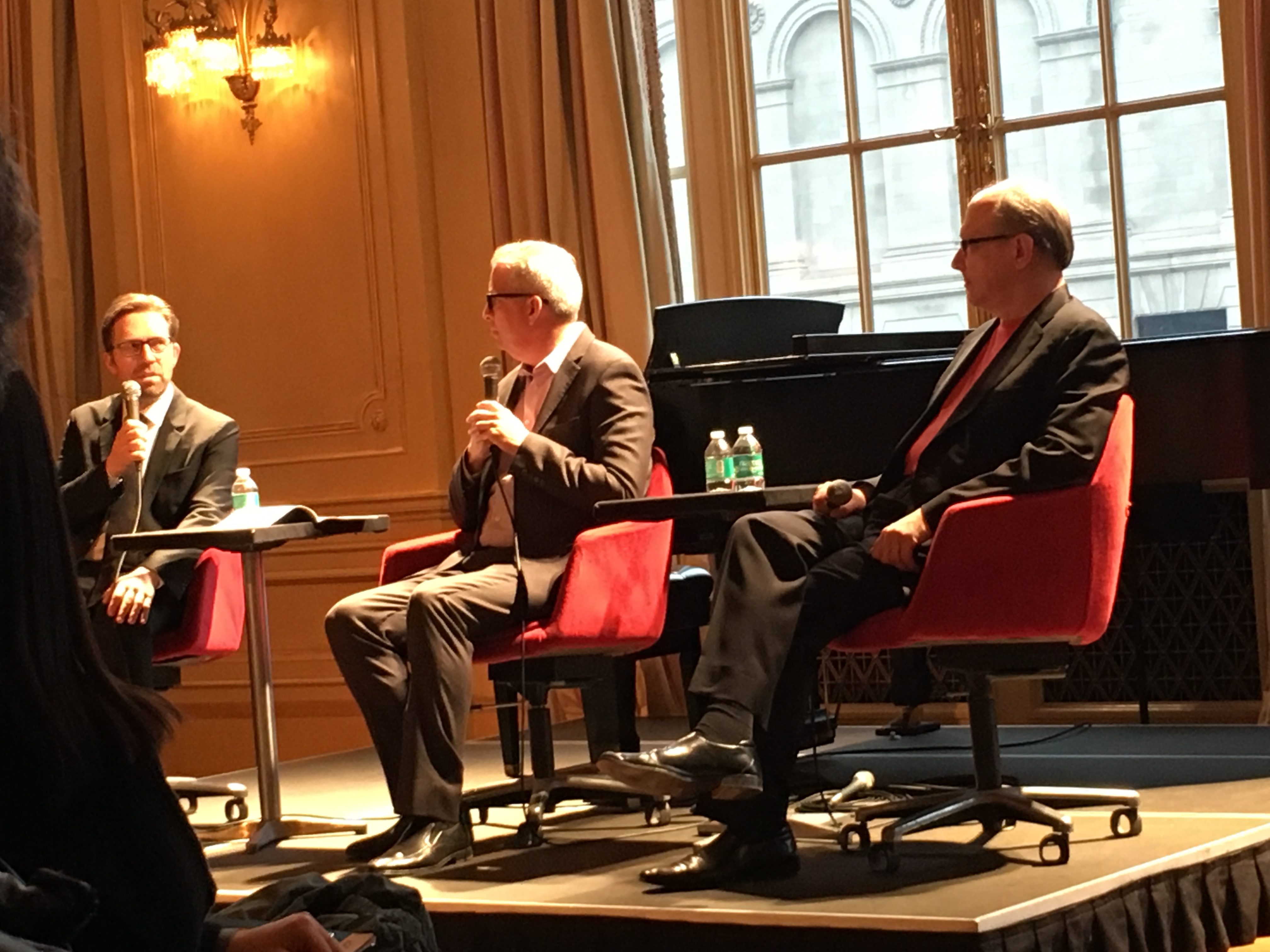
A rousing, well-deserved ovation brought the pair back for three encores, all by Stravinsky.  “Madrid” appropriately had an irresistible Spanish tinge, with a hint of the jota.  The “Circus Polka” (“we’ve prepared all these lovely things for you”, noted Hamelin in his introduction to the delight of the audience) was Stravinsky at his wittiest, replete with bitonalities (and perhaps an inspiration for Hamelin’s own “Circus Galop”).  Lastly, the “Tango” was sultry, yet not without the composer’s unmistakable stamp.  Thanks are due to both for being on hand for an engaging Q&A session following the concert, and their chemistry there was just as palpable as it was on stage.

Hamelin Andsnes
Leif Ove Andsnes, James Fahey (Director of Programming, Symphony Center Presents), and Marc-André Hamelin during the post-concert Q&A

Hamelin explores the piano sonata in commanding Cleveland recital

Marc-André Hamelin, piano
Gartner Auditorium
Cleveland Museum of Art
Cleveland, OH
March 21, 2017

Haydn: Piano Sonata in C Major, Hob. XVI:48
Feinberg: Piano Sonata No. 1 in A major, Op. 1
Feinberg: Piano Sonata No. 2 in A minor, Op. 2
Beethoven: Piano Sonata No. 23 in F minor, Op. 57, Appassionata
Scriabin: Piano Sonata No. 7, Op. 64, Messe blanche
Chopin: Piano Sonata No. 2 in B flat minor, Op. 35

Encore:
Debussy: Reflets dans l’eau, No. 1 from Images, Book I

Marc-André Hamelin has built much of his reputation on fearless exploration of the byways of the piano repertoire, and his recital at the Cleveland Museum of Art – presented by the Cleveland International Piano Competition – was no exception, juxtaposing the familiar with the obscure.  All the works on the program bore the title “piano sonata”, although none adhered very closely to the standard model of the form, a true testament to the medium’s protean potential.  Hamelin delivered the program with his signature peerless technique, yet this was far from an evening of vapid virtuosity, but one of probing artistic discovery.

hame.lrg
Marc-André Hamelin, photo credit Rachel Papo
The survey of piano sonatas appropriately began with Haydn, in the two movement C major sonata, Hob. XVI:48.  Given Hamelin’s association with the fingerbusting works of the 19th– and 20th-century, Hamelin and Haydn might sound like an unnatural fit, but as he as shown in his extensive recordings of the composer’s sonatas for Hyperion, it’s an inspired coupling to be sure.  From the onset, the performance was marked by deftly nuanced articulation and crisp ornamentation.  There were sporadic moments when matters felt a bit heavy-handed which lesser pedaling perhaps could have ameliorated, but overall this was a study in precision, replete with minor key excursions that foreshadowed Beethoven, and the all too brief finale exuded joie de vivre.

Certified rarities followed, the first two piano sonatas of the Russian composer and pianist Samuil Feinberg.  His cycle of twelve piano sonatas is a remarkable achievement, unjustly neglected, and Hamelin is rumored to be recording them.  These two sonatas, in A major and minor respectively, were of a similar aesthetic, the consecutive opuses hardly demonstrating Feinberg’s eventual compositional developments (both dating from 1915; the final sonata dates from 1962), yet Hamelin presented them with a singular intensity and an unflinching commitment to this little-known music.

The First Sonata was of a brooding Romanticism, while the dense textures would have sounded murky in lesser hands, Hamelin achieved a lucid clarity of voices, and delineated a clear trajectory in spite of the composer’s tendency to meander.  A touchingly lyrical melody characterized the Second Sonata, and a highpoint came in its dramatically cascading climax.

Beethoven’s mighty Appassionata is a recent addition to Hamelin’s concert repertoire; I’ve been eager to hear his take on this durable work, and he certainly didn’t disappoint.  The opening movement built to massive climaxes that carefully avoided bombast.  There was much-needed repose in the slow movement, enhanced by the adroitly voiced chordal melody, while the finale had an unrelenting nervous energy in its breathless race to the tragic end, given at a dangerously brisk tempo.

One of Hamelin’s first recordings of his long and fruitful association with Hyperion was of the complete Scriabin piano sonatas; the arresting Seventh Sonata is a work that has been in his fingers for a very long time.  Explosive and mercurial, the sonata proceeded with inevitability towards the trilling, mystical ending, shrouded in enigma.

Chopin’s B-flat minor sonata concluded the program, and in the passionate first movement Hamelin drew out a fluid melody over an undulating accompaniment.  He eschewed the repeat of the exposition, although in this case I would suggest the repeat is a wise interpretative choice given the movement’s proportions.  There was a menacing determination in the scherzo, while its middle section was indulgent in sumptuous melody, quintessentially Chopinesque.

No empty sentimentality was to be had in the tragic heights of the famous funeral march, and Hamelin had a velvet touch in the contrasting lyrical section.  His utter and absolute command of the keyboard was on full display in the moto perpetuum finale, yet phrases were keenly shaped to make the sonata’s revolutionary ending more than mere volleys of notes.

Hamelin obliged the modest but enthusiastic audience with an encore in Debussy’s Reflets dans l’eau, shimmering and liquescent.