ProMusica celebrates a decade of artistic partnership to close season

ProMusica Chamber Orchestra
David Danzmayr, conductor
Vadim Gluzman, violin
Southern Theatre
Columbus, OH
May 11, 2024

Silvestrov: Hymn – 2001
Tchaikovsky: Violin Concerto in D major, Op. 35
 Encore:
 Bach: Sarabande from Violin Partita No. 2 in D minor, BWV 1004
Brahms: Symphony No. 2 in D major, Op. 73

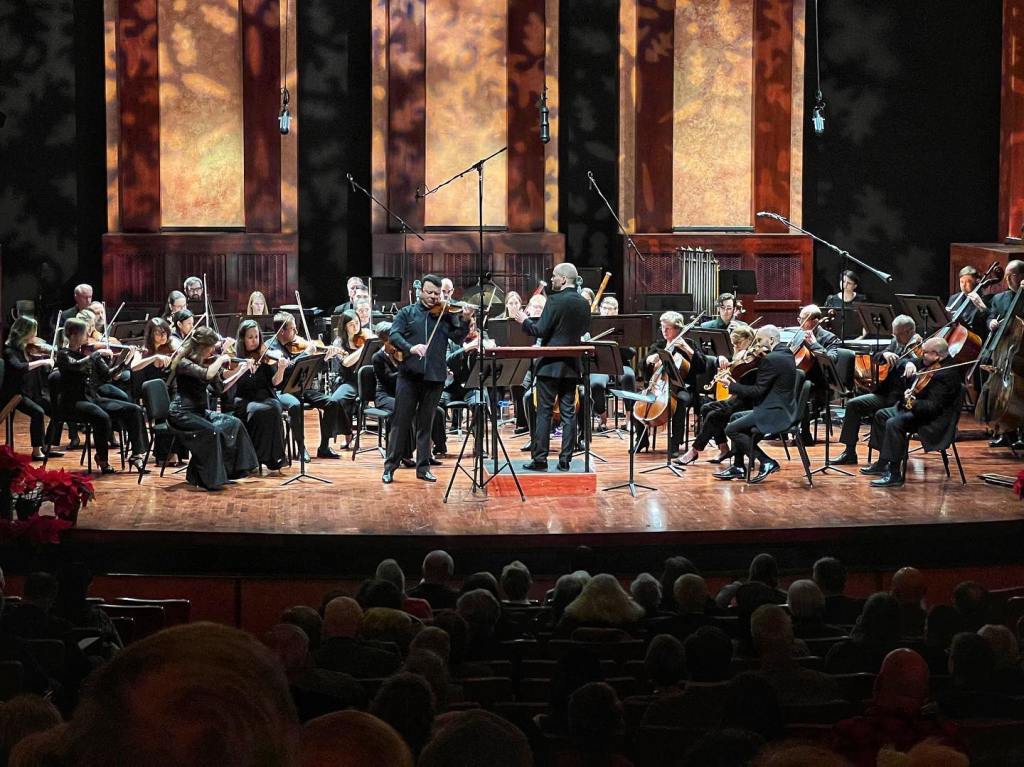
There was a celebratory air to ProMusica’s closing performances of their 45th season in marking a decade of having both David Danzmayr and Vadim Gluzman in the fold as music director and creative partner respectively. As has become tradition, the final weekend was opened with a short performance by students from the Play Us Forward program – this year, an excerpt from Vivaldi’s Autumn – celebrating ProMusica’s impact in the greater Columbus community.

Vadim Gluzman performs with David Danzmayr and ProMusica, photo credit ProMusica

Valentin Silvestrov’s Hymn – 2001 began ProMusica’s program with a lush essay for string orchestra. There were fine solo passages from concertmaster Katherine McLin and principal second violin Jennifer Ross. Meaning was also drawn from punctuated moments of silence, with the Ukrainian composer acknowledging Cage’s 4’33” as an inspiration for this lyrical paean.

Tchaikovsky’s evergreen Violin Concerto served as the evening’s centerpiece, and put on full display the collaborative spark between Danzmayr and Gluzman. It’s a particular pleasure to see Gluzman play this work as he performs on a violin once owned by Leopold Auer, the concerto’s original dedicatee – in other words, the very violin this concerto was written for. I have fond memories of Gluzman performing this work with The Cleveland Orchestra and the late Michail Jurowski a few years ago – a privilege to hear this instrument in this work again.

Matters began with graceful charm, and the violinist filled the Southern with a resonantly lyrical tone. Gluzman gave an impassioned performance, and I was often simply in awe of the sound he drew from his storied instrument (Tchaikovsky must have liked it too!). Fleet fingers pulled off the more rapid passegework, further encouraged by a taut communication with Danzmayr, the product of a fruitful decade.

A choir of winds opened the central slow movement, and Gluzman answered with a long-bowed, somber melody, an articulate dialogue between soloist and orchestra. The finale was of rapid fire excitement, though a downtempo section of distinctly Slavic inflection contrasted before the blistering finish. An enthusiastic ovation brought the violinist back for an encore by Bach, a lovely pendant to the concerto, with Gluzman noting it an apropos choice given Silvestrov’s affinity for Bach.

Last season closed with a Brahms symphony, a feat reprised this past weekend with attention turned to the sunny Second. Once again, ProMusica, buttressed by an expanded string section, proved that the Brahms symphonies can be convincingly performed by a chamber-sized orchestra. A dip in the strings opened, warmly answered by horns and winds, with a particularly rich theme in the cellos to follow. Danzmayr opted out of the long repeat of the exposition, delving right into the energetic development. The slow movement proceeded as a beautifully lyrical paragraph, though seemingly all cares were left behind for the Allegretto grazioso, given with an abandon that was only a warmup for the jubilant finale.
Vadim Gluzman returns to ProMusica to lead neighborhood series

ProMusica Chamber Orchestra
Vadim Gluzman, violin & leader
Donna Conaty, oboe
Nadine Hur, flute
Aya Hamada, harpsichord

St Mary Catholic Church
Columbus, OH
February 25, 2024

Bach: Concerto for Oboe and Violin in C minor, BWV 1060
Silvestrov: Excerpts from Silent Music
Bach: Brandenburg Concerto No. 5 in D major, BWV 1050
Mendelssohn: String Symphony No. 10 in B minor

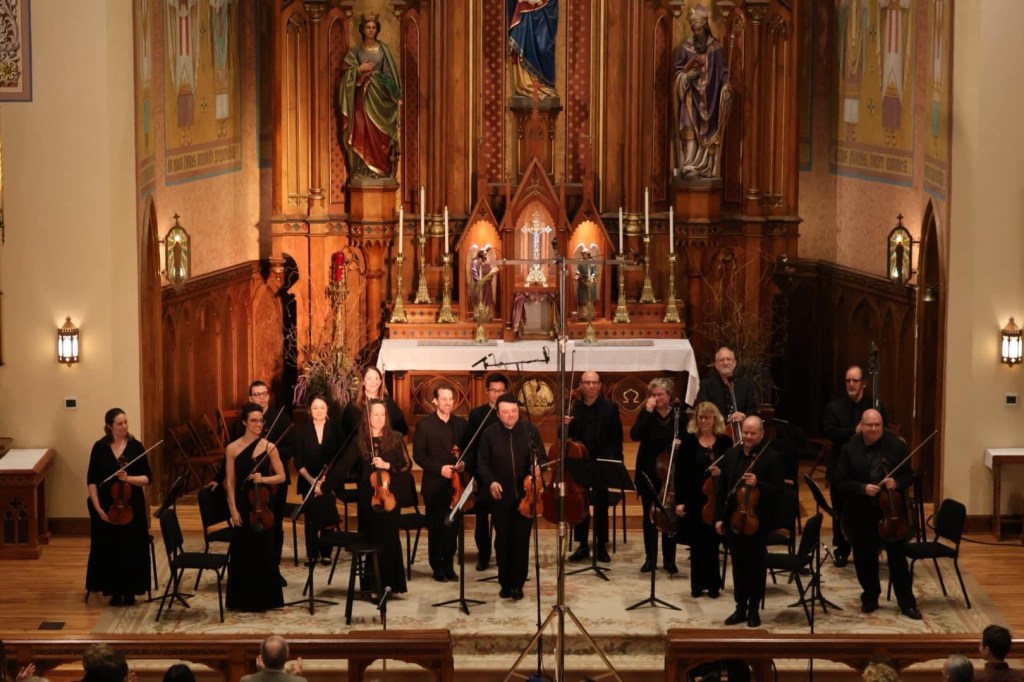
In his first appearance of the current concert season, ProMusica’s creative partner Vadim Gluzman led the ensemble in the Neighborhood Series, an event that sees the group perform outside the confines of their usual home in the Southern Theatre. Sunday’s afternoon performance in German Village drew a capacity crowd for a program that featured ProMusica players as soloists in Bach concertos, interspersed with works scored for string orchestra.

ProMusica at St Mary, photos credit ProMusica

Bach’s Double Concerto for Oboe and Violin brought forth Gluzman along with oboist Donna Conaty. Gluzman served dual role as a dynamic leader and charismatic soloist, sparking a fine chemistry with Conaty. The pair gave the piece an energetic workout, though perhaps most touching was the slow movement’s singing line in the oboe deftly answered by the violin.

This weekend marked the two year anniversary of the Russian invasion of Ukraine, and meaningfully, a work from Gluzman’s Ukrainian compatriot Valentin Silvestrov followed, as the conductor-violinist put it, “in hope of a better tomorrow.” The deeply reflective Silent Music dates from 2002, and is cast in three movements – though ProMusica opted to play only the first two. Solemn strings opened the Waltz of the Moment, and a wistful waltz gesture eloquently took shape. Evening Serenade occupied a similar space, marked by a melody gently cascading.

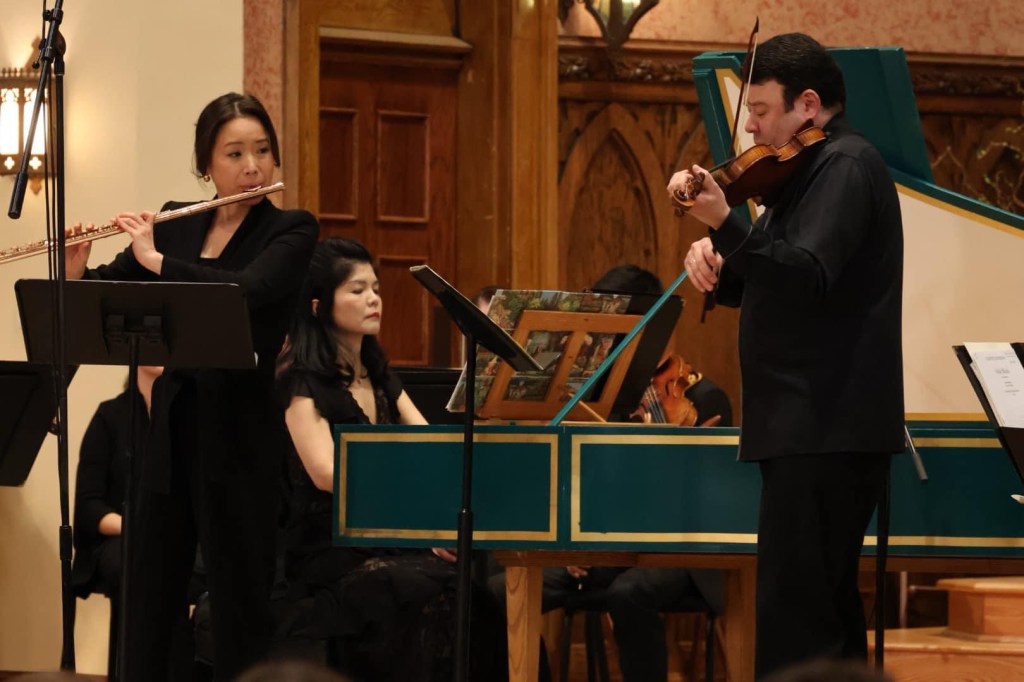
Bach’s Brandenburg Concerto No. 5 was quite a contrast, being in the highest of spirits. It boasted substantial solo parts for flute (Nadine Hur) and harpsichord (Aya Hamada). The flute offered a lyrical presence throughout, and the sparkling, bright effect of the harpsichord captured one’s attention, above all, in the cadenza. One of the single most impressive moments in all of Bach’s keyboard writing (which is saying a lot!), Hamada purveyed a self-assured virtuosity.

Between the ages of twelve and fourteen, the astonishingly precocious Mendelssohn wrote a set of twelve string symphonies. No. 10 closed the afternoon’s program, a single movement conception that opened in the lushness of the strings. More animated material took flight, providing glimmers of the gossamer textures that would come to define the very word Mendelssohnian.

Nadine Hur, Aya Hamada, and Vadim Gluzman perform Bach

ProMusica closes the year with lush Brahms and Mendelssohn

ProMusica Chamber Orchestra
David Danzmayr, conductor
Vadim Gluzman, violin
Southern Theatre
Columbus, OH
December 10, 2022

Chin: subito con forza
Brahms: Violin Concerto in D major, Op. 77
 Encore:
 Gluck: “Dance of the Blessed Spirits” from Orfeo ed Euridice (trans. Kreisler)
MacMillan: One
Mendelssohn: Symphony No. 5 in D major, Op. 107, Reformation

The final ProMusica program of the year presented two major scores from the 19th century (both in D major!), each prefaced by a brief but fitting contemporary work. Unusk Chin’s 2020 work subito con forza certainly made for an energetic opening. An homage of sorts to Beethoven, the opening gesture invoked the Coriolan overture before veering in a different direction, and powerful writing for the piano hinted at the Emperor piano concerto.

Vadim Gluzman, David Danzymar, and ProMusica, photo credit ProMusica

In her opening remarks, ProMusica CEO Janet Chen noted that this marks ten years since David Danzmayr and Vadim Gluzman assumed their current roles of music director and creative partner respectively. What followed was a veritable celebration of this now decade-long collaboration in Brahms’ Violin Concerto. The orchestral introduction was marked by an arching lyricism, and a fiery contrasting theme provided set up for the violin’s entrance. More lyrical material saw Gluzman sailing into the upper range of his instrument with a tone limber and flexible. The partnership between conductor, soloist, and orchestra certainly paid its dividends in convincingly conveying the large-scale architecture of the expansive opening movement.

A choir of winds opened the plangent Adagio, and Gluzman responded with a songful lyricism of his own. The Hungarian-inflected finale was a jocular affair, given with authentic flair. Gluzman returned with an encore in Gluck’s “Dance of the Blessed Spirits” from the opera Orfeo ed Euridice – presented in Kreisler’s transcription for violin with a touch of orchestral accompaniment. Its gorgeous, long-bowed melody was a lovely pendant to the Brahms.

As the title suggests, James MacMillan’s 2012 essay One explores single-line melodies, monastic in its starkness and somewhat suggestive of Gregorian chant. The religious orientation was apropos as it led without pause to Mendelssohn’s Reformation symphony – a fitting follow up to last season’s performances of the Scottish and Italian symphonies (perhaps a future ProMusica season could offer the rarely heard First and Second symphonies?). The slow introduction saw a rich invocation in the strings of the divine Dresden amen; the movement proper took shape with vigor in the stormier minor, delivered with momentum and precision.

The Allegro vivace was playful, lighter fare by contrast, and the gentle Andante was noted for its languid melody in the strings. The finale introduced the Lutheran hymn Ein feste Burg ist unser Gott in the flute (Nadine Hur) with matters building to a climax of both contrapuntal intricacy and festive exuberance.

Gluzman and Roman terrific soloists with ProMusica

ProMusica Chamber Orchestra
David Danzmayr, conductor
Vadim Gluzman, violin
Joshua Roman, cello
Southern Theatre
Columbus, OH
April 2, 2022

Golijov: Last Round
Mendelssohn: Violin Concerto in E Minor, Op. 64
 Encore:
 Silvestrov: Serenade
Roman: Confluence
Haydn: Symphony No. 94 in G major, Hob. I:94, Surprise

April’s ProMusica program began in the always intriguing world of contemporary Argentine composer Osvaldo Golijov, namely with the 1996 string orchestra work Last Round. It was a lively, high-octane opener, marked by rhythmic drive and astringent harmonies. The more languid, tango-inflected latter section contrasted in its impassioned lyricism.

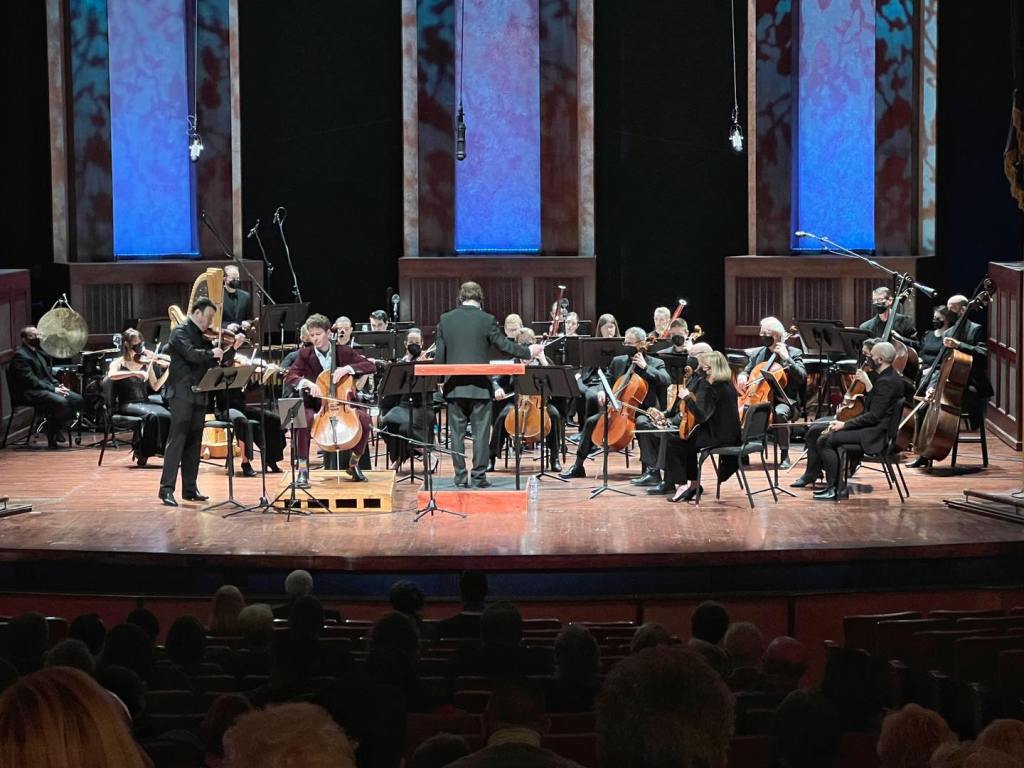
Vadim Gluzman, Joshua Roman, David Danzmayr, and ProMusica Chamber Orchestra, photo credit ProMusica

Mendelssohn’s evergreen Violin Concerto followed with ProMusica’s Creative Partner and Principal Guest Artist Vadim Gluzman as soloist. The haunting opening melody was clear-toned as it seared and soared, and Gluzman projected well atop the vigorous and supportive orchestral accompaniment. The cadenza displayed his virtuosity and control over whole range of the violin’s register, with the work clearly ingrained deep in his fingers. The Andante proceeded as a gentle song without words, and the finale was fleet and featherlight. As an encore, Gluzman turned towards music of his Ukrainian home country in Valentin Silvestorv’s deeply poignant Serenade. In contending with a heartbreaking global situation, Gluzman reminded us of the importance of art, referencing the Soviet quote “when the cannons are heard, the muses are silent. When the cannons are silent, the muses are heard.”

The latter half saw saw the latest entry in ProMusica’s enterprising Composer/Performer Project, an endeavor which features musicians distinguished in both disciplines – and has resulted in now 68 commissions. Joshua Roman’s Confluence was at last brought to life almost exactly two years to the day of the originally scheduled premiere, owing to covid cancellations. Roman was appointed principal cellist of the Seattle Symphony at age 22 – the youngest principal player in that ensemble’s history – but left after just a few years to pursue a solo career, and this marked the fourth work of his featured on a ProMusica program.

Confluence is a fifteen-minute work that hearkens back to the double concerto, featuring both cello and violin as soloists. A pulsating marimba made for a striking opening, and Gluzman’s rapid violin blended well with Roman’s lyrical cello. Roman did much to capitalize on his instrument’s resonant bass register, and true to the title, the work was marked by a confluence of harmonious, lyrical voices. A glass harp (wine glasses) added to the colorful soundscape, and a tender ending felt at peace with the world – in a way, at odds with the uncertain backdrop in which the piece was written.

The program closed with Haydn’s Surprise symphony, and Austrian conductor David Danzmayr showed a natural affinity for music of his compatriot. An effervescent joie de vivre made matters all the more delightful, and the musicians were clearly having fun in emphasizing the dynamic contrasts of the Andante which earned this symphony its moniker.

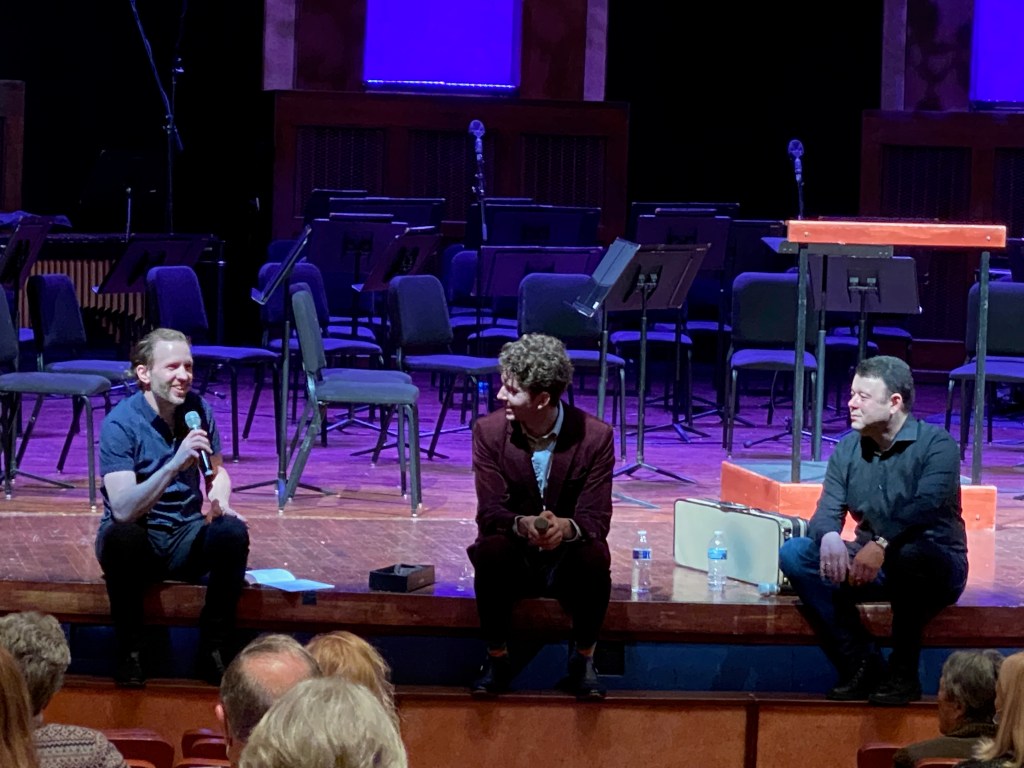
Post-concert Q&A with David Danzmayr, Joshua Roman, and Vadim Gluzman

Michail Jurowski makes belated US debut in blistering Shostakovich, Tchaikovsky

Cleveland Orchestra
Michail Jurowski, conductor
Vadim Gluzman, violin
Severance Hall
Cleveland, OH
May 5, 2019

Tchaikovsky: Violin Concerto in D major, Op. 35
 Encore:
 Bach: Violin Partita No. 2 in D minor, BWV 1004 – Sarabande
Shostakovich: Symphony No. 11 in G minor, Op. 103, The Year 1905

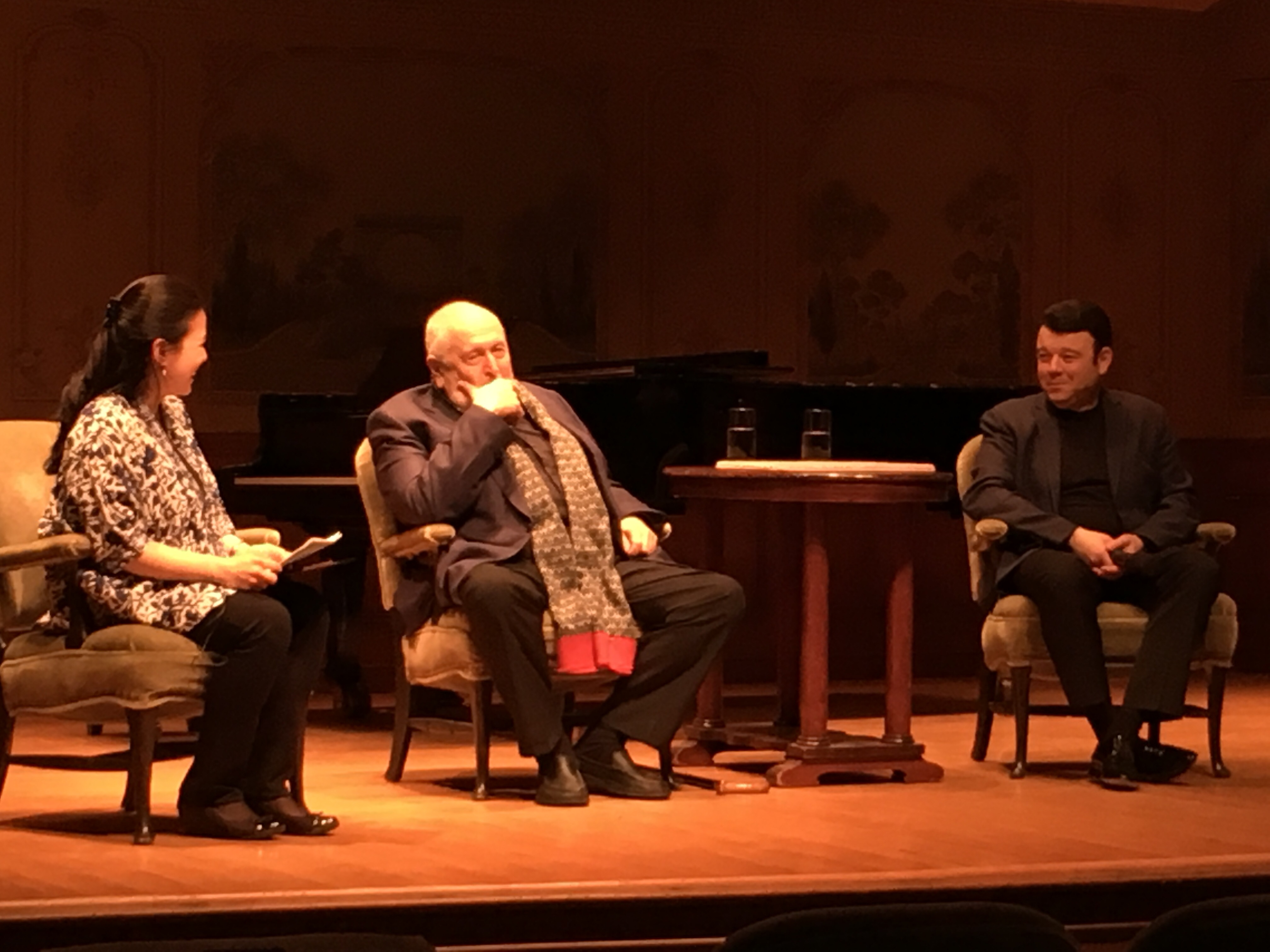
Last weekend’s Cleveland Orchestra concerts marked not only Michail Jurowski’s local debut, but – astonishingly for a 75-year-old with a long and distinguished career – his US debut. Good things come to those who wait, and given the level of playing, one could have easily mistook conductor and orchestra as seasoned collaborators. Adding to the occasion was Jurowski’s participation in a pre-concert interview along with violin soloist Vadim Gluzman, both offering fascinating insights. Gluzman spoke of his cherished instrument, a 1690 Stradivarius formerly played by Leopold Auer, the original dedicatee of Tchaikovsky’s Violin Concerto – this is to say, this is the instrument for which the composer envisioned his now ubiquitous concerto. In deference to the violin’s provenance, Gluzman remarked on his preference for Auer’s edition of the work. Jurowski fondly recalled his first exposure to The Cleveland Orchestra while the latter was on tour to Moscow in 1965 under Szell. This performance he called one of the “most powerful feelings from live music” he’d ever experienced, and was thus particularly keen to stand in front of them as conductor. He further reminisced about his personal friendship with Shostakovich, with whom he played piano duets!

Pre-concert interview, left to right: moderator Cicilia Yudha, Michail Jurowski, Vadim Gluzman

The Tchaikovsky Violin Concerto is certainly a well-known quantity, yet violinist and conductor managed to forge a fresh interpretation. A gentle, untroubled lyricism opened the work, so much at odds with the composer’s tormented life. Gluzman’s instrument was particularly rich in the low register, something Tchaikovsky took advantage of when writing the work, emanating a songful, burnished tone in this music of endless, organic development, with one theme flowing out of the next. The orchestral climax was given with vigor and swagger, and in the cadenza, one was struck by Gluzman’s crystal clear intonation of the stratospherically high notes and thorough command of his storied instrument – joined by flutist Joshua Smith in a particularly affecting moment. A choir of winds – a notch too loud to my ears – opened the central Canzonetta, and the violin sang with an ineffable melancholy, quite a contrast from the breakneck dance of the finale. Gluzman encored with the sarabande from Bach’s Second Partita, given with stately introspection.

Shostakovich’s Eleventh Symphony is patently programmatic, recounting the horrific events of Bloody Sunday in graphic detail. The events – occurring one year before the composer’s birth and witnessed firsthand by his father – entailed the mass murder of peaceful demonstrators by the tsarist regime on a fateful Sunday in January 1905. The symphony was completed in 1957, and Jurowski suggested it was inspired by the Hungarian Revolution of the year prior which had some clear parallels – in other words, ever the subversive, Shostakovich was using historical events to comment upon the present. The work opened with the eerie and chilling motionlessness of a St. Petersburg January, a calm before the storm, aspiring to the monumental stasis of a Bruckner symphony. A plethora of folk songs in support of the revolutionary program was integral to the fabric of the work, first appearing in the brilliant trumpet of Michael Sachs.

A jarring contrast was had in the following movement, structurally serving as a scherzo but miles removed from a light-hearted affair. Matters seemed to crest to apparent triumph, only to devolve into music of shattering, shocking violence, with the snare depicting gunshots in gruesome recount, leading to a grinding fugue in the low strings of blistering contrapuntal ferocity. What followed was music of a broken world, never the same, this being the beginning of the end for the tsarists, and ghostly sounds of the celesta and muted trumpet finally brought matters to an inconclusive close. The third movement, titled “Eternal Memory”, was mourning of deepest lamentation. The strings initiated, followed ominously by the low brass. Matters burgeoned to an impassioned outcry, but in due course retreated to the somber beginnings. The closing “Tocsin” (“Alarm” – fittingly at this point a siren was heard from a passing emergency vehicle outside) jolted matters out of the shadows, startling in intensity. A march of relentless vigor proceeded, toppling over into a reminiscence of the quietude of the work’s distant opening, heightened by a plaintive English horn solo from Robert Walters. The coda added bells to the texture, material as impressive and blood rushing as anything Shostakovich wrote, yet after such bombast, Jurowski held the audience suspended in shocking silence.