ProMusica closes the year with lush Brahms and Mendelssohn

ProMusica Chamber Orchestra
David Danzmayr, conductor
Vadim Gluzman, violin
Southern Theatre
Columbus, OH
December 10, 2022

Chin: subito con forza
Brahms: Violin Concerto in D major, Op. 77
 Encore:
 Gluck: “Dance of the Blessed Spirits” from Orfeo ed Euridice (trans. Kreisler)
MacMillan: One
Mendelssohn: Symphony No. 5 in D major, Op. 107, Reformation

The final ProMusica program of the year presented two major scores from the 19th century (both in D major!), each prefaced by a brief but fitting contemporary work. Unusk Chin’s 2020 work subito con forza certainly made for an energetic opening. An homage of sorts to Beethoven, the opening gesture invoked the Coriolan overture before veering in a different direction, and powerful writing for the piano hinted at the Emperor piano concerto.
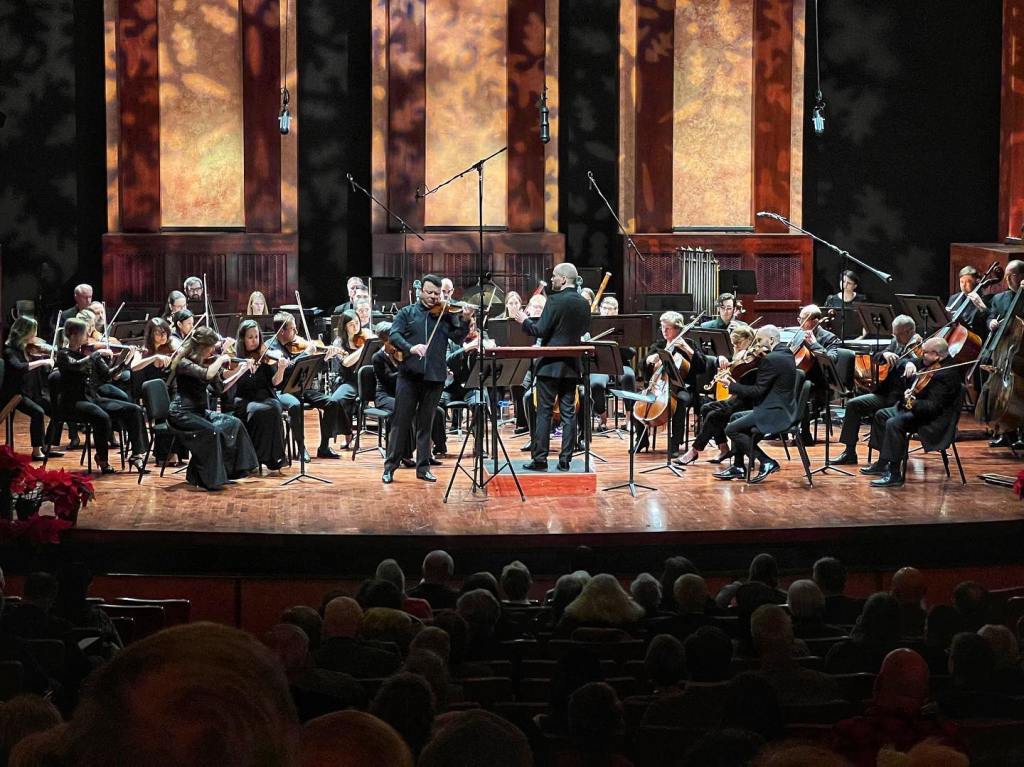
Vadim Gluzman, David Danzymar, and ProMusica, photo credit ProMusica

In her opening remarks, ProMusica CEO Janet Chen noted that this marks ten years since David Danzmayr and Vadim Gluzman assumed their current roles of music director and creative partner respectively. What followed was a veritable celebration of this now decade-long collaboration in Brahms’ Violin Concerto. The orchestral introduction was marked by an arching lyricism, and a fiery contrasting theme provided set up for the violin’s entrance. More lyrical material saw Gluzman sailing into the upper range of his instrument with a tone limber and flexible. The partnership between conductor, soloist, and orchestra certainly paid its dividends in convincingly conveying the large-scale architecture of the expansive opening movement.

A choir of winds opened the plangent Adagio, and Gluzman responded with a songful lyricism of his own. The Hungarian-inflected finale was a jocular affair, given with authentic flair. Gluzman returned with an encore in Gluck’s “Dance of the Blessed Spirits” from the opera Orfeo ed Euridice – presented in Kreisler’s transcription for violin with a touch of orchestral accompaniment. Its gorgeous, long-bowed melody was a lovely pendant to the Brahms.

As the title suggests, James MacMillan’s 2012 essay One explores single-line melodies, monastic in its starkness and somewhat suggestive of Gregorian chant. The religious orientation was apropos as it led without pause to Mendelssohn’s Reformation symphony – a fitting follow up to last season’s performances of the Scottish and Italian symphonies (perhaps a future ProMusica season could offer the rarely heard First and Second symphonies?). The slow introduction saw a rich invocation in the strings of the divine Dresden amen; the movement proper took shape with vigor in the stormier minor, delivered with momentum and precision.

The Allegro vivace was playful, lighter fare by contrast, and the gentle Andante was noted for its languid melody in the strings. The finale introduced the Lutheran hymn Ein feste Burg ist unser Gott in the flute (Nadine Hur) with matters building to a climax of both contrapuntal intricacy and festive exuberance.


Viotti makes memorable Cleveland debut in Russo-French program

Cleveland Orchestra
Lorenzo Viotti, conductor
Yuja Wang, piano
Severance Hall
Cleveland, OH
November 29, 2019

Prokofiev: Suite from The Love for Three Oranges, Op. 33bis
Rachmaninov: Piano Concerto No. 4 in G minor, Op. 40
 Encore:
 Gluck-Sgambati: “Dance of the Blessed Spirits” from Orfeo ed Euridice
Poulenc: Sinfonietta, FP 141
Ravel: La valse

Over the Thanksgiving weekend, The Cleveland Orchestra dependably serves a musical feast, and this year was hardly an exception. Friday (coincidentally, the 150th birthday of the orchestra’s founder, Adella Prentiss Hughes) marked the local debut of 29-year-old conductor Lorenzo Viotti. Currently principal conductor of Portugal’s Gulbenkian Orchestra, and dubbed to assume the same role with the Netherlands Philharmonic Orchestra next season, Viotti is a conductor who Cleveland music director Franz Welser-Möst singled out as being especially promising during an interview previewing the current season. Viotti’s colorfully appealing program was bifurcated by nationality with a Russian first half preceding a French second.

900 Lorenzo-liggend (1)
Lorenzo Viotti, photo credit Desiré van den Berg

Prokofiev’s six-movement suite from The Love for Three Oranges opened with the composer’s characteristically vigorous orchestrations, bringing to life the opera’s colorful cast of characters with gentler, dancing winds contrasting. The following “Infernal Scene” was darkly surreal in its unusual timbres, while the “Marche” – the opera’s most indelible quantity – was given a crisply rhythmic and foot-tapping workout. “The Prince and the Princess” made for a lyrical interlude, the deeply touching language anticipating Romeo and Juliet. Viotti roused the requisite virtuosity for the roiling “Flight” that closed.

As central to repertoire as Rachmaninov’s works for piano and orchestra are, the Fourth Concerto has been relegated to periphery, not having been performed by this orchestra since 1996. An arsenal of energy opened, quickly paving the way for the full-bodied entry of the incomparable Yuja Wang. The fiendishly difficult piano writing was easily surmounted by her fleet fingerwork, and about two thirds of the way through the movement, matters burgeoned to a climax as grand and lush as anything Rachmaninov wrote. The solo introduction of the Largo was of deep melancholy, revealing Wang’s lyrical gifts, and in due course aided by burnished strings.

Textures grew impassioned and stormier, leading to the jarring transition to the closing Allegro vivace. Wang’s sleight-of-hand pianism negotiated the jazz-inflected rhythmic complexities, and chains of double octaves were effortlessly delivered with fire and panache. The orchestra supported Wang with a colorful accompaniment – Jeffrey Rathbun’s oboe a standout – culminating in a muscular conclusion. While ultimately perhaps not as memorable as the composer’s other works in the medium, it certainly merits hearings at more regular intervals! Although not indulging the Severance Hall audience in one of her encore marathons, Wang nonetheless responded to the hearty ovation with the wistful lyricism of a transcription from Gluck’s Orfeo ed Euridice.

The Cleveland Orchestra gave the US premiere of Poulenc’s Sinfonietta under George Szell in 1949, but remarkably hasn’t touched it since. Kudos then to Viotti for resurrecting this vintage gem, which despite its obscurity, local audiences had the chance to hear as recently as this past March on a CityMusic program. The opening movement brimmed with melodies of immediate appeal, piquant and bright, a sort of synthesis of 20th-century sensibilities within a classical economy, invoking comparison to Prokofiev’s Classical symphony. The inner movements were respectively joyfully light-hearted and sweetly songful, the latter with noteworthy solo passages from the trumpet and clarinet. Perhaps an expression of post-war bliss, the finale was utterly untroubled, and delectably so.

Continuing with French appropriations Germanic forms, matters turned to waltz in Ravel’s iconic La valse. Originally conceived for solo piano (heard just the previous weekend in Soyeon Kate Lee’s recital at the Cleveland Museum of Art), the orchestral version shows in no uncertain terms the composer’s stunning mastery of instrumentation. Beginning with barely audible rumbles, a sultry waltz theme took shape, with sumptuous harps adding to the dizzyingly rich tapestry: a glitteringly cataclysmic dissolution of the once venerable waltz.

Yuja-Wang-by-Norbert-Kniat-DG-11
Yuja Wang, photo credit Norbert Kniat