Simone Dinnerstein calms the storm in tender meditation at the Gilmore Festival

Simone Dinnerstein, piano
Stetson Chapel
Kalamazoo College
Kalamazoo, MI
May 7, 2024

Couperin: Les barricades mystérieuses, from Pièces de clavecin
Schumann: Arabeske, Op. 18
Satie: Gnossienne No. 3
Glass: Mad Rush
Schumann: Kreisleriana, Op. 16

Encore:
Couperin: Les barricades mystérieuses, from Pièces de clavecin

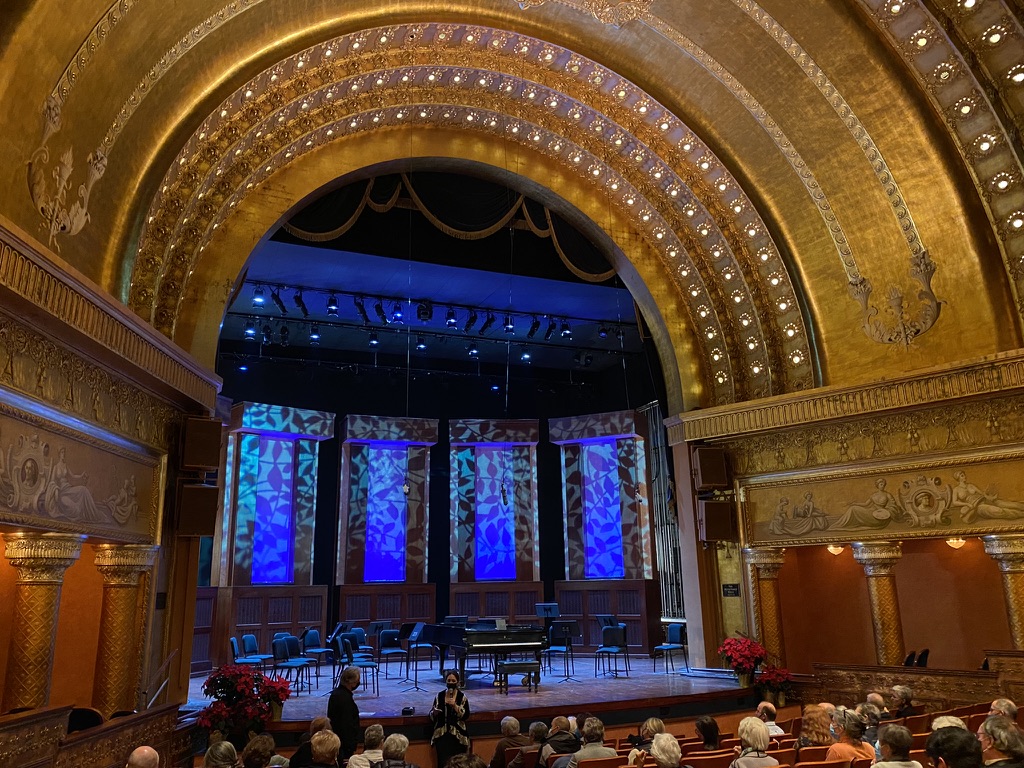
There’s a first time for everything, and I can safely say that Tuesday evening at the Gilmore Festival was the first concert I’ve attended in which the audience was asked to shelter in the venue’s basement for 45 minutes due to uncomfortably close tornados raging nearby. A hearty crowd of committed pianophiles stuck it out, however, and were amply rewarded with an artfully crafted recital from Simone Dinnerstein.
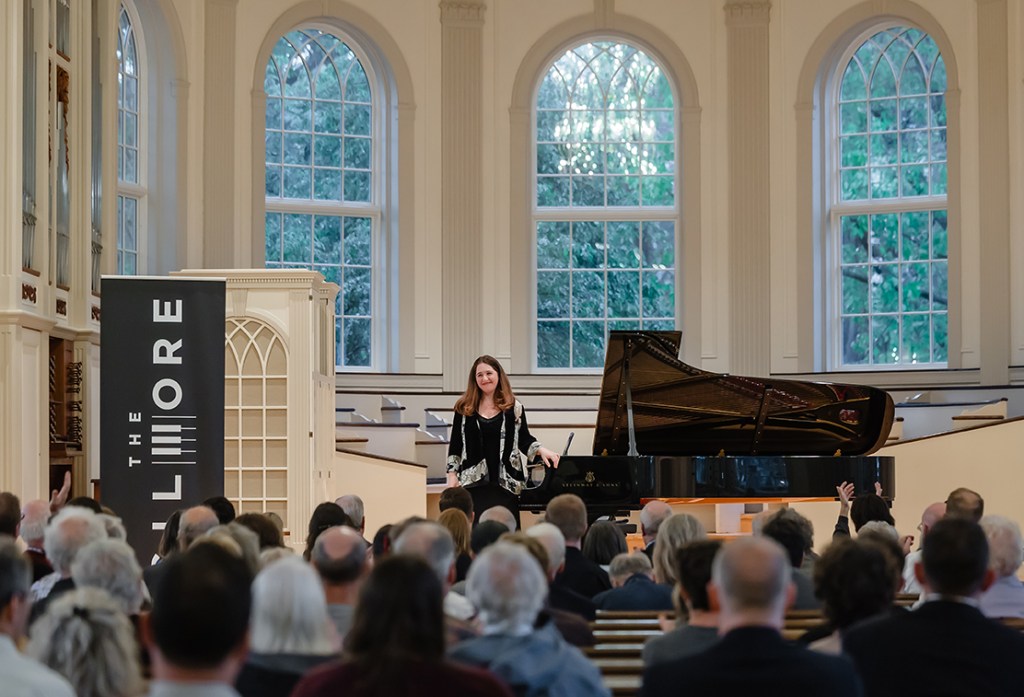
Simone Dinnerstein at Stetson Chapel, photos © Chris McGuire Photography, courtesy of The Gilmore

This was essentially a live performance of her Undersong album, the last of a trilogy of projects she recorded during the pandemic. The title, an archaic word for chorus or refrain, refers to the idea of return, revisiting places after the passage of time. All of the diverse body of music programmed engaged with the theme in a different way, but in each case, a melody presented resurfaced in some context later on. The delayed evening began with Couperin’s gem of a piece Les barricades mystérieuses, quite literally the calm after the storm. Elegantly ornamented, Dinnerstein drew from the piano a rich, reflective tone.

Schumann’s Arabeske saw the composer at his most Schubertian with its lyrical, rippling figures, arriving at a point of return following some contrasting episodes, and its gentle coda amounts to one of Schumann’s loveliest inspirations. Philip Glass’ Mad Rush continued the theme into the late 20th-century. Undulating figures changed subtly, almost imperceptibly, growing in intensity as Dinnerstein filled the Stetson Chapel with waves of sound. She has a close affinity for the music of Glass, with the composer having written his Third Piano Concerto with her in mind.

The third of Satie’s Gnossiennes evoked the French composer’s rarefied, idiosyncratic language, distilled of any excess and expressive in its barrenness. Recurrence is a key element of the eight vignettes that comprise Schumann’s Kreisleriana. Fleet and mercurial, the opening was given an impassioned workout. The most extended selection of the suite followed, with contrasting themes bound together by its common thread. Nearly manic, the penultimate episode introduced contrapuntal textures in homage to Bach, played with incisive clarity, and the final piece was stately and sensitive, the culmination of a long trajectory.

Dinnerstein’s lone encore embodied the undersong theme in returning to the Couperin with which the recital began. What a lovely gesture it was to close the program full-circle.

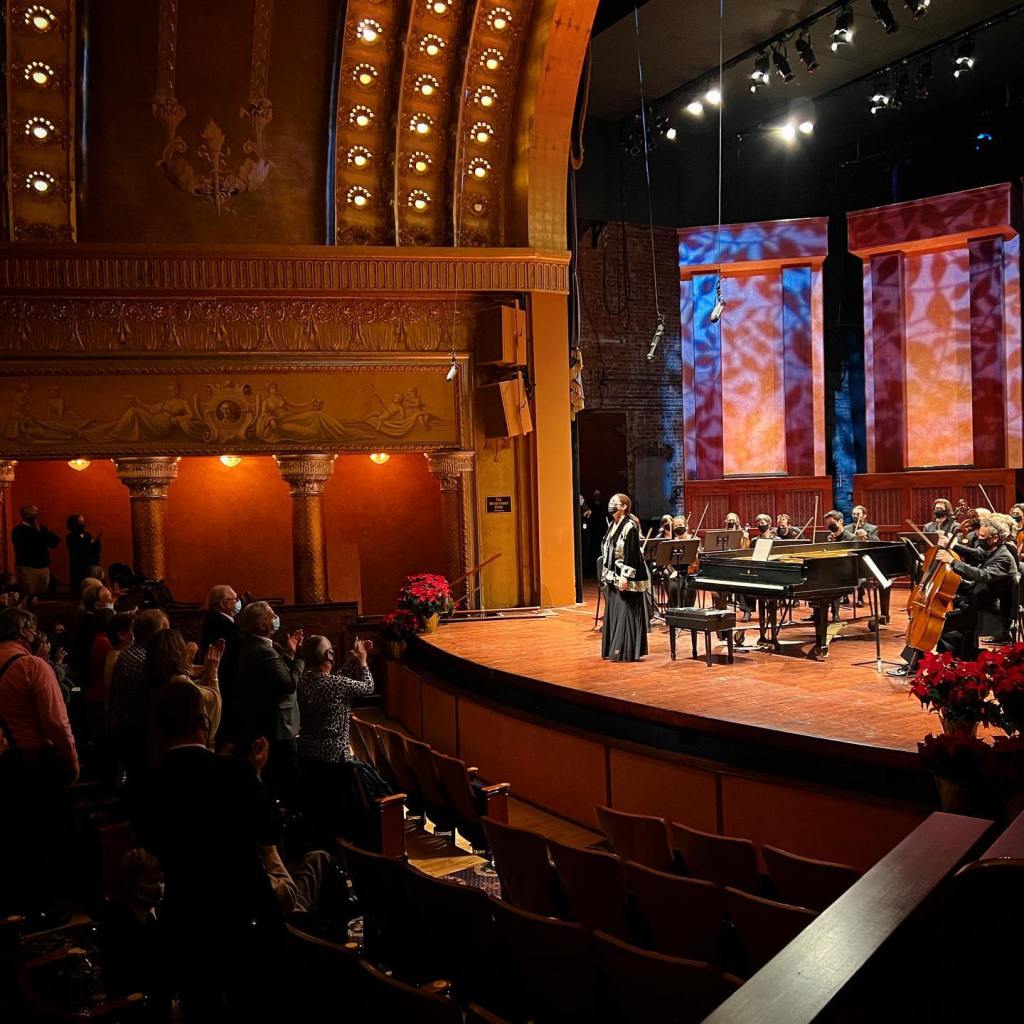
5/7/24 – Kalamazoo, Michigan: Simone Dinnerstein, Gilmore Piano Festival. © Chris McGuire Photography.

Dinnerstein shines as both pianist and conductor with ProMusica

ProMusica Chamber Orchestra
Simone Dinnerstein, piano and leader
Southern Theatre
Columbus, OH
December 11, 2021

Bach: Keyboard Concerto No. 7 in G minor, BWV 1058
Bach: Erbarm’ dich mein, o Herre Gott, BWV 721 (arr. Lasser)
Bach: Orchestral Suite No. 2 in B minor, BWV 1067
Glass: Piano Concerto No. 3

Encore:
Glass: Etude No. 6

The spotlight shone on Simone Dinnerstein during this weekend’s ProMusica performances in which she served dual role as pianist and conductor. This was an event that was originally on the calendar a year ago, inevitably cancelled due to the pandemic – during which time Dinnerstein was involved in bringing to life Richard Danielpour’s monumental tribute to the heroes of the pandemic (see my interview with her on that project). Ever keen to draw out thoughtful connections between composers, Dinnerstein curated a poignant program comprised of Bach and Glass. It’s an inspired coupling, to be sure: Dinnerstein noted that Glass was intensely immersed in Bach during his studies with Nadia Boulanger, and moreover, one can draw parallels in the two composers’ musical languages, for instance, in their extensive use of motivic repetition.

Simone Dinnerstein with ProMusica Chamber Orchestra, photo credit ProMusica

Bach’s Keyboard Concerto No. 7 in G minor is a reworking of his Violin Concerto in A minor, transposed down a tone to better suit the harpsichord used at the time. Dinnerstein purveyed a seamless, flowing playing, leading the orchestra – just as the composer would have done – as if an extension of herself. The vigor of the opening movement offered little respite until the central Andante, a lovely moment, delicate and carefully judged. A crisp contrapuntal vigor opened the finale, and Dinnerstein’s stylish playing, punctuated by rippling chains of sixteenth notes, made full use of the resources of the modern concert grand.

The chorale prelude Erbarm’ dich mein, o Herre Gott was presented in a transcription for piano and strings, an arrangement made for Dinnerstein by Philip Lasser – a composer with whom she has had numerous collaborations. Much was said in the work’s brief duration. The resonant reserves of the piano were tastefully aided and abetted by the strings, yielding a touching gravitas, and matters built to a stentorian climax.

The Orchestral Suite No. 2 in B minor followed without break, allowing the previous work to function quite literally as a prelude. It’s a well-known quantity, but Dinnerstein heightened one’s interest by imbuing the work with her own individual stamp and making subtle alterations to the score, for instance, adding some pizzicatos and playing an octave higher in certain places. The overture opened in stately fashion, with its dotted rhythms sharply delineated. Dinnerstein offered a lively and incisive continuo (along with cellist Marc Moskovitz) while adeptly directing her orchestral colleagues – and it was quite striking hearing a modern piano rather than harpsichord play the role. A contrasting series of dances ensued, among them, a languid sarabande, a lively bourée, and a regal polonaise. The suite culminated in the much-loved badinerie, bringing principal flute Nadine Hur front and center. Her rapid-fire playing made for an exhilarating close.

Philip Glass dedicated his 2017 Piano Concerto No. 3 to Dinnerstein – indeed, half the works on the program were written with Dinnerstein in mind. He intended the work to be paired with the Bach concerto that opened the program (as it also is on her recording of the work). The work opened with a meditative solo statement from the pianist, instantly recognizable as coming from Glass’ pen. This was music deeply lyrical and affecting, showing minimalism not as just a cold experiment but an aesthetic that can have a real heart to it. The last movement made perhaps the strongest impression. Written for fellow minimalist Arvo Pärt (though both composers have resisted such labeling), it opened with a monastic done in the bass, alluding to the Estonian’s idiosyncratic use of bell-like textures. This gesture was repeated incessantly yet purposefully, eventually fading away into the ether. As an encore, Dinnerstein offered Glass’ Etude No. 6, a fitting pendant to the concerto, and her reading was as dramatic as it was mesmerizing.

Post-concert Q&A with Dinnerstein and WOSU’s Boyce Lancaster

Kronos Quartet celebrates contemporary music at Carnegie Hall

Kronos Quartet
Zankel Hall
Carnegie Hall
New York, NY
January 25, 2020

Gordon: Clouded Yellow
Glass: Quartet Satz
Mazzoli: Enthusiasm Strategies
Mochizuki: Boids
Riley: “The Electron Cyclotron Frequency Parlour” and “One Earth, One People, One Love” from Sun Rings
Dessner: Le Bois
Reich: Different Trains

Encore:
Man: “Silk and Bamboo” from Two Chinese Paintings

The Kronos Quartet’s sold out Saturday night performance at Carnegie’s Zankel Hall was an enthusiastic celebration of music by living, thriving composers, three of whom were present in the audience: Michael Gordon, Missy Mazzoli, and Philip Glass. About half the selections performed were products of Kronos’ ambitious and ingenious initiative Fifty for the Future, wherein 50 new works – 25 by men, 25 by women – are being commissioned over a five year period, with the score along with a recording by Kronos available for free online. A remarkable way to disseminate new repertoire for the venerable string quartet, and one had that project to thank for the works heard on Saturday by Glass, Mazzoli, Mochizuki, and Dessner.

1_small3-600x0
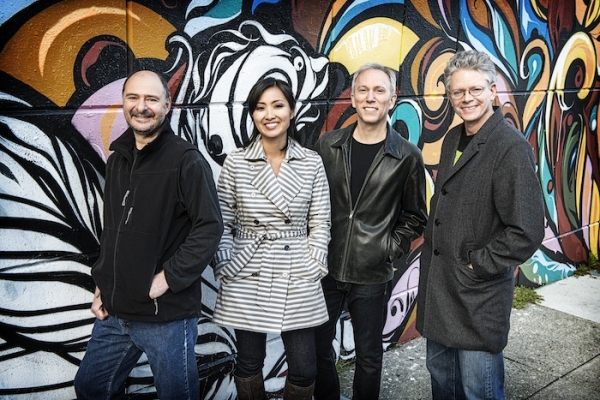
Kronos Quartet (not pictured, cellist Paul Wiancko), photo credit Jay Blakesberg

The quartet performed against a backdrop of lighting effects, adding a visual dimension to the already rich aural soundscape. Michael Gordon’s Clouded Yellow opened the evening, evoking its namesake species of butterfly with a striking harmonic palette, mutating over a cello ostinato – one of many fine contributions from cellist Paul Wiancko, substituting for Sunny Yang while she is on maternity leave. A more rhythmically driven section offered a propulsive drive, with matters eventually dissipating to mesmerizing effect. Glass’ Quartet Satz showed the composer at his most lyrical, glacially paced but not without quintessentially Glassian modulations. The New York premiere of Mazzoli’s Enthusiasm Strategies followed, an expression of joy marked by ethereal textures in the strings’ upper registers. Misato Mochizuki’s Boids refers to the flocking behavior of fish, as such, the music was filled with sudden, sharp turns, depicting the entropy found in nature.

A pair of movements from Terry Riley’s extensive suite Sun Rings rounded off the first half. With the NASA Art Program one of the work’s commissioners, Riley drew upon a literal music of the spheres, weaving in recordings of solar winds and other phenomenon: in “The Electron Cyclotron Frequency Parlour”, acoustic textures danced with cosmic electronica. In his informative commentary between selections, first violinist David Harrington noted that the concluding “One Earth, One People, One Love” has become something of an anthem for Kronos. 9/11 fell during the genesis of Sun Rings, forcing the work to take a different direction in the wake of new reality. Riley employed a recording of Alice Walker speaking the eponymous mantra, and projections of the Earth from space put the events on the surface in the context of a vast cosmos. An extended passage for solo cello was particularly moving.

Two larger works filled the second half, beginning with the world premiere of Bryce Dessner’s Le Bois. Drawing on a work by Pérotin and inspired by the modern day destruction by fire of the Notre Dame Cathedral, it began with a monastic drone, which upon taking a myriad of guises, pointed towards a contemplative ending. While I look forward to hearing more from Dessner, this work ultimately didn’t make the strongest impression. Closing the printed program was Reich’s iconic Different Trains, written expressly for Kronos in 1988. Harrington noted this marked turning point for them in which the quartet effectively became a quintet given the newfound need for a full-time sound engineer. Vigorous material opened, brimming with American idealism and optimism as encapsulated by the transcontinental railroad, only for matters to be starkly contrasted by depiction of the trains on the other side of the Atlantic that contemporaneously transported victims to the concentration camps. A definitive performance of this masterpiece.

By way of an encore, the quartet offered Wu Man’s “Silk and Bamboo”, another product of Fifty for the Future. The piece included a substantial percussion part on Chinese gong and woodblocks, expertly handled by violist Hank Dutt. A topical choice given the coincidence of the Lunar New Year, and a wonderfully festive end to the evening.

img_1777
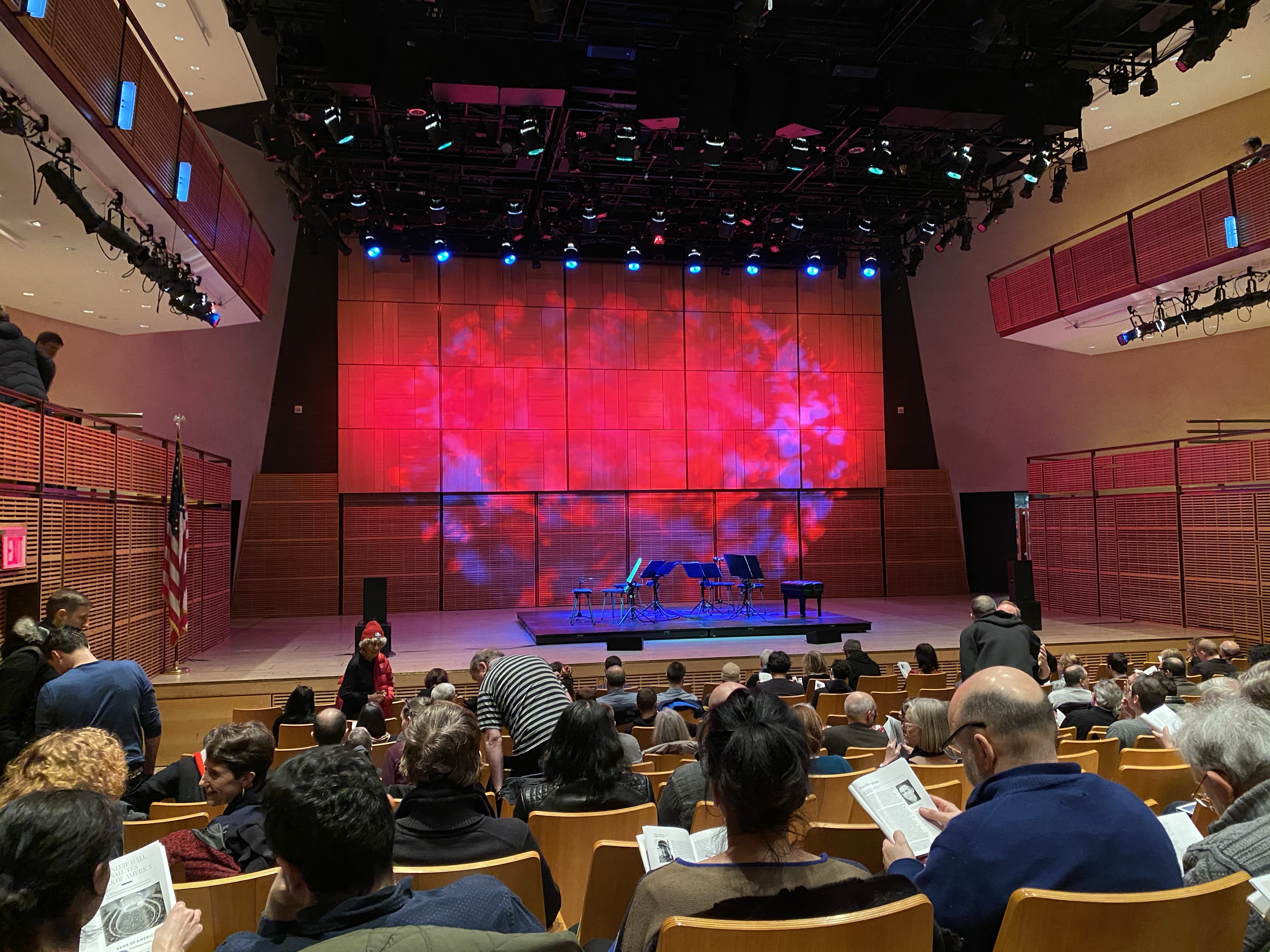
Zankel Hall before the Kronos Quartet’s performance