Hamelin a star soloist in Cleveland Orchestra’s feast of American music

Cleveland Orchestra
David Robertson, conductor
Marc-André Hamelin, piano
Mandel Concert Hall
Severance Music Center
Cleveland, OH
November 29, 2024

Copland: Suite from Appalachian Spring (1945 orchestration)
Gershwin: Rhapsody in Blue (arr. Grofé)
Ellington: New World A-Comin’
Copland: Suite from The Tender Land

Over the Thanksgiving weekend, The Cleveland Orchestra and guest conductor David Roberston served up a rich course of American orchestral music. As the centerpiece was a pair of works for piano and orchestra with virtuoso Marc-André Hamelin, both of which artfully brought jazz and popular traditions into the concert hall.
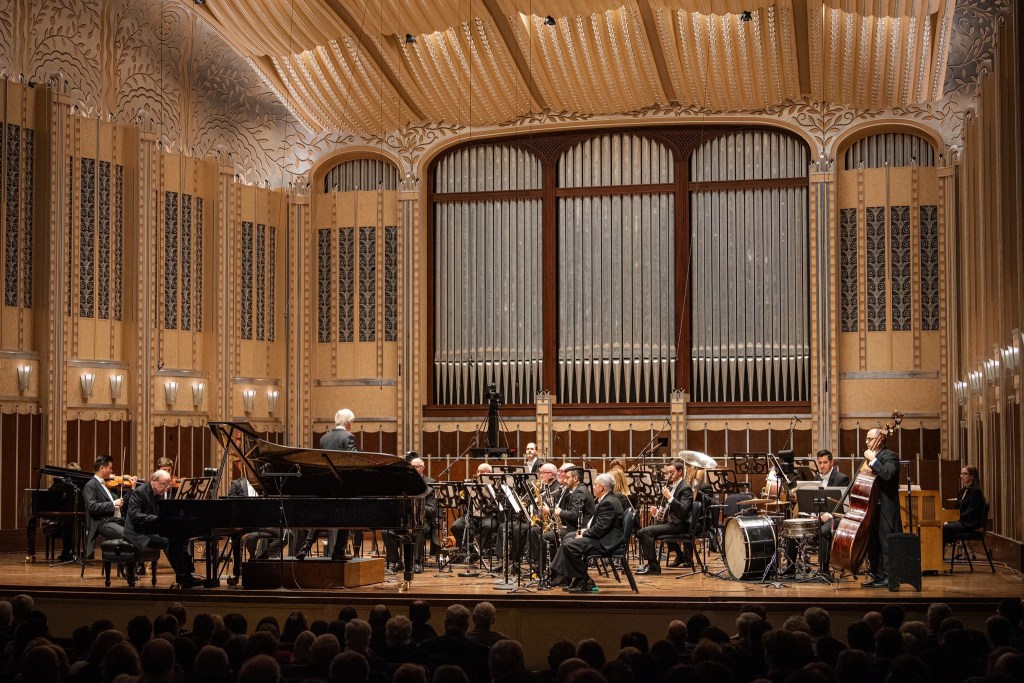
Marc-André Hamelin, David Robertson, and The Cleveland Orchestra perform Rhapsody in Blue. Photos credit Extraordinaire Photos

This year marks the centennial of Gershwin’s epochal Rhapsody in Blue, and the evening’s performers offered an energetic and joyous performance fitting for such an anniversary. The work was presented in its original jazz band orchestration arranged by Ferde Grofé, as it would have been heard in its 1924 premiere at Carnegie Hall — and The Cleveland Orchestra morphed into a bona fide dance hall band.

The iconic wail of the clarinet opened the work, stylishly played by Daniel McKelway. A muted trumpet responded in its striking timbre, setting the stage for Hamelin’s commanding pianism, given with flair and virtuosity. In this amalgamation of the classical and the vernacular, the two resided not in opposition, but as a unified whole. A downtempo section was a sultry affair, while a passage of repeated notes conveyed the mechanistic fury of the Industrial Age, not unlike what one finds in Prokofiev at the same time. All cares were left aside though in the abandon of the foot-tapping finale.

Duke Ellington’s 1943 work New World A-Comin’ premiered under similar circumstances as the Gershwin: a Carnegie Hall performance that endeavored to break the confines of the traditional classical repertoire. Unlike Rhapsody in Blue, Ellington’s work was not initially well-received. Credit, then to Hamelin et al. for offering a compelling performance. A lushly-scored opening in the orchestra gave way to a quasi-improvisatory passage for piano, with silky filigree and silvery runs, colored by jazz-inflected harmonies. A drum kit onstage added to the rhythmic pulse. Comprised of alternating sections for orchestra and piano, it lacked the cohesion of the Gershwin, but proved an attractive discovery nonetheless. On the subject of jazz-influenced classical works, Hamelin’s 2008 album In a state of jazz is warmly recommended.

Bookending the concertante works was music of Aaron Copland, in both cases orchestral suites extracted from stage works. Appalachian Spring made for a lovely opening to the evening. Earthy harmonies began, brimming with hope and possibility. Robertson and the orchestra gently breathed life into this soft-spoken material, starkly different from the bustling Manhattan streetscape conveyed in Gershwin’s Rhapsody. More angular material was enhanced by the sheen of the brass, and rhythmic inflections conveyed a dance-like quality — this was, after all, originally a ballet. A magical moment saw the first appearance of the Simple gifts hymn, first in the winds and then blooming to its magnificent orchestration. The loveliest of epilogues concluded, wholly at peace.

Less well-known was the three movement suite from Copland’s opera The Tender Land, dating about a decade after Appalachian Spring. Strident, brassy beginnings retreated inward for a gentle love song. A specialist of the American repertoire, Robertson served as a keen guide in this deeply lyrical writing. A boisterous, raucous “Party Scene” took matters in a rather different direction, splashed by piquant touches from the xylophone. The closing “Promise of the Living” was a peaceful paean with a fine English horn solo, and a touching, topical close for the Thanksgiving program.

And for those who couldn’t make it to Severance Hall in person, Sunday’s performance was live-streamed and subsequently available on demand through Adella and Stage+.
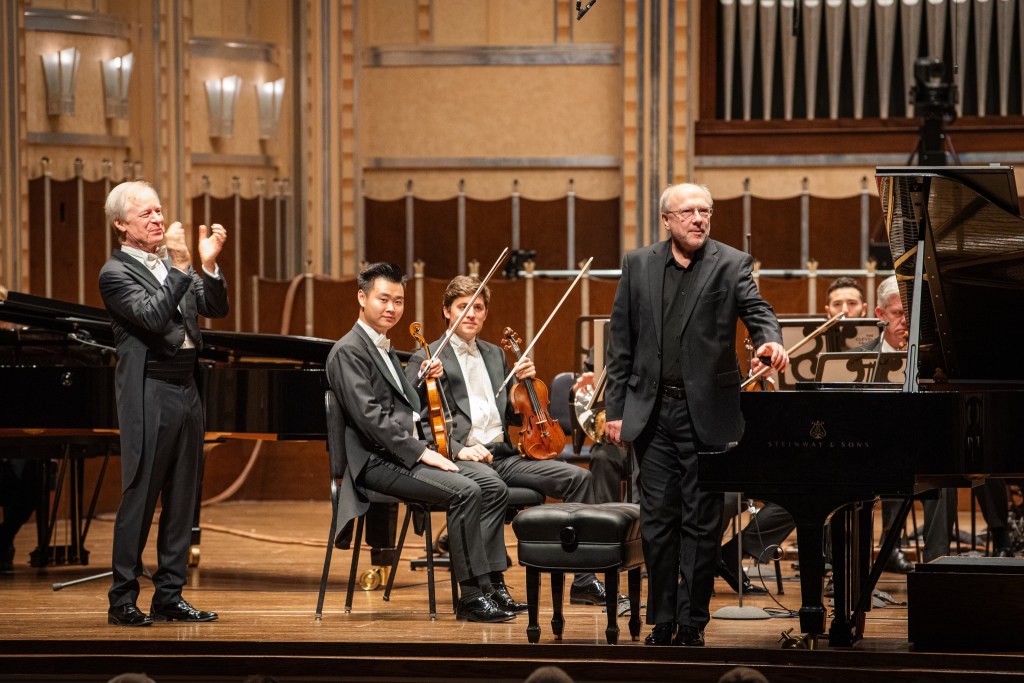
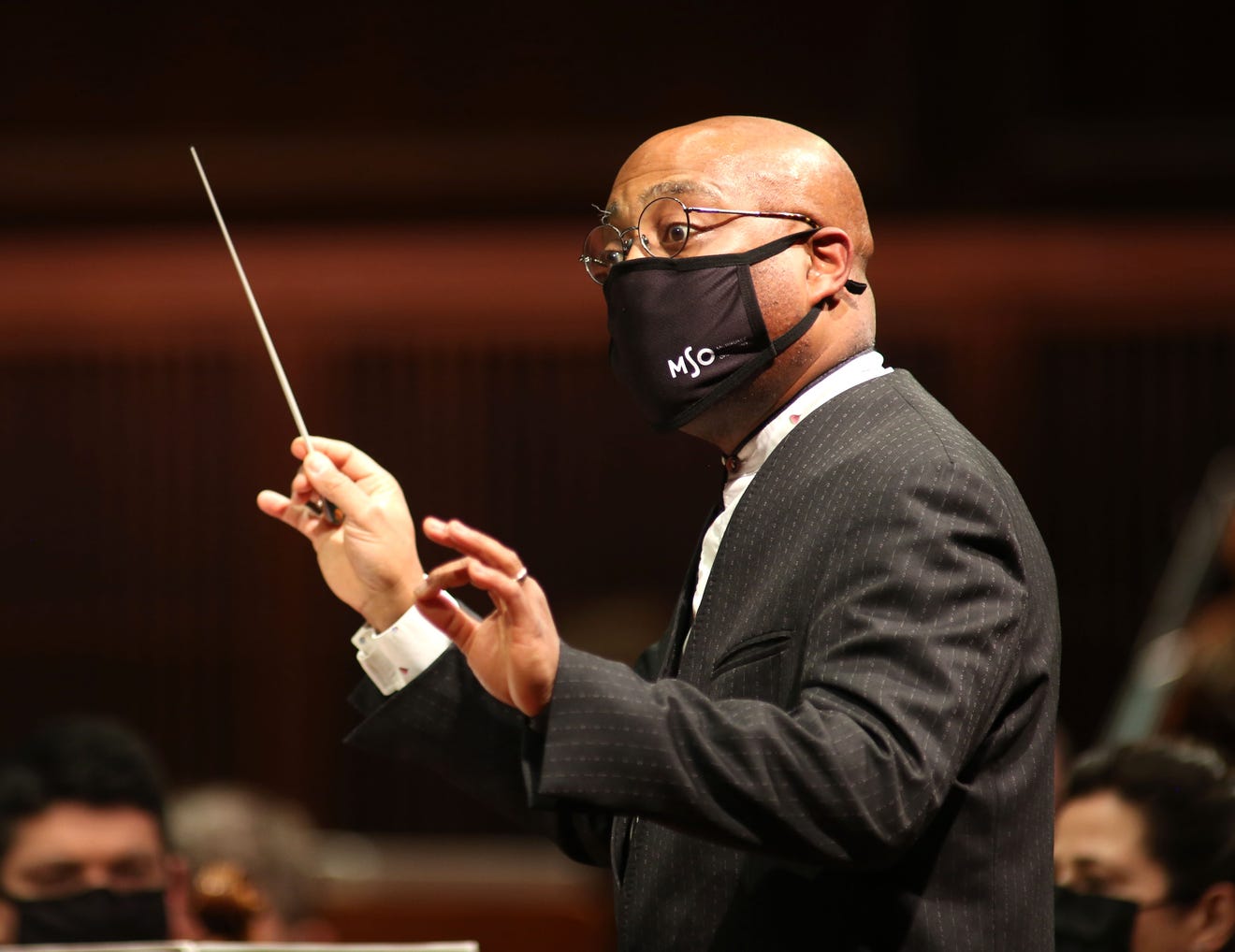
David Robertson applauds Marc-André Hamelin

Sara Davis Buechner joins Columbus Symphony in Viennese program

Columbus Symphony Orchestra
Rossen Milanov, conductor 
Sara Davis Buechner, piano
Ohio Theatre
Columbus, OH
April 5, 2024

Haydn: Symphony No. 82 in C major, Hob. I:82, The Bear
Mozart: Symphony No. 31 in D major, K297, Paris
Beethoven: Piano Concerto No. 1 in C major, Op. 15

Encore:
Gershwin: The Man I Love

This weekend’s Columbus Symphony program traversed Haydn, Mozart, and Beethoven, all of whom spent most of their professional life in Vienna, and crystallized and embodied what we now know as the Classical style. Though a Viennese evening, the first two selections were associated with Paris, beginning with Haydn’s Symphony No. 82. The first of the six so-called Paris symphonies, it and its successors were written on commission for performances in the French capital throughout 1786.

Sara Davis Buechner, Rossen Milanov, and the Columbus Symphony

Despite its numerical order, No. 82 was the last of the Paris symphonies to be composed. The rather heavy-handed opening lumbered forward, soon to be countered by a gentler theme in a back and forth with the more martial material. The development introduced some piquant dissonances that to my ears seemed to anticipate those in Beethoven’s Eroica. Haydn showed himself master of the double variation in the Allegretto. The finale was marked by a sustained drone, giving rise to the work’s ursine nickname, imitating the music used to accompany the barbaric practice of dancing bears, in any case, themes of folk inflection gave the symphony a spirited close.

Though the program was presented chronologically by composer, Mozart’s Paris symphony (no. 31) predates Haydn’s by almost a decade. A bold opening – and perhaps a bit overbearingly so Friday night – showcased the expanded orchestra (inclusive of clarinets, the first Mozart symphony to employ them), a quantity that must have dazzled Parisian audiences at the time. Delicately drawn-out melody made the central slow movement especially lyrical, and the finale was a pristine balance of both abandon and sophistication.

The first of Beethoven’s five genre-defining piano concertos brought forth Sara Davis Buechner as soloist. A gentle theme brimming with playful potential was heard from the orchestra, though the time-honored tradition of an orchestral introduction is a device the composer would jettison in his later works in the medium. Buechner’s entry was an elegant affair, deftly ornamented and replete with smooth runs across the keyboard, engaging in an energetic conversation with the orchestra. Though the work still very much bears the influence of Mozart, a lyrical flourish several minutes in unmistakably showed Beethoven’s individual stamp. Buechner’s snappy rhythmic punctuations and dynamic contrasts imbued the performance with excitement, and especially so in the wide-ranging cadenza of her own device (though perhaps not as wide-ranging as the one Alkan supplied for the Third Concerto!).

The Largo was gorgeous and serene, a mood sustained by the delicate cantilena in the piano. Quite a contrast to the Allegro scherzando finale which rivaled the mischievousness of his teacher Haydn – and moreover, in this case a nod to one Andreas Hofer – and Buechner offered a reading with flexibility and freedom. An enthusiastic reception brought her back for an encore which she introduced as “an unnecessary delay before my first martini” – a delay we’re grateful for, as it proved to be a lovely and sultry account of Gershwin’s The Man I Love.

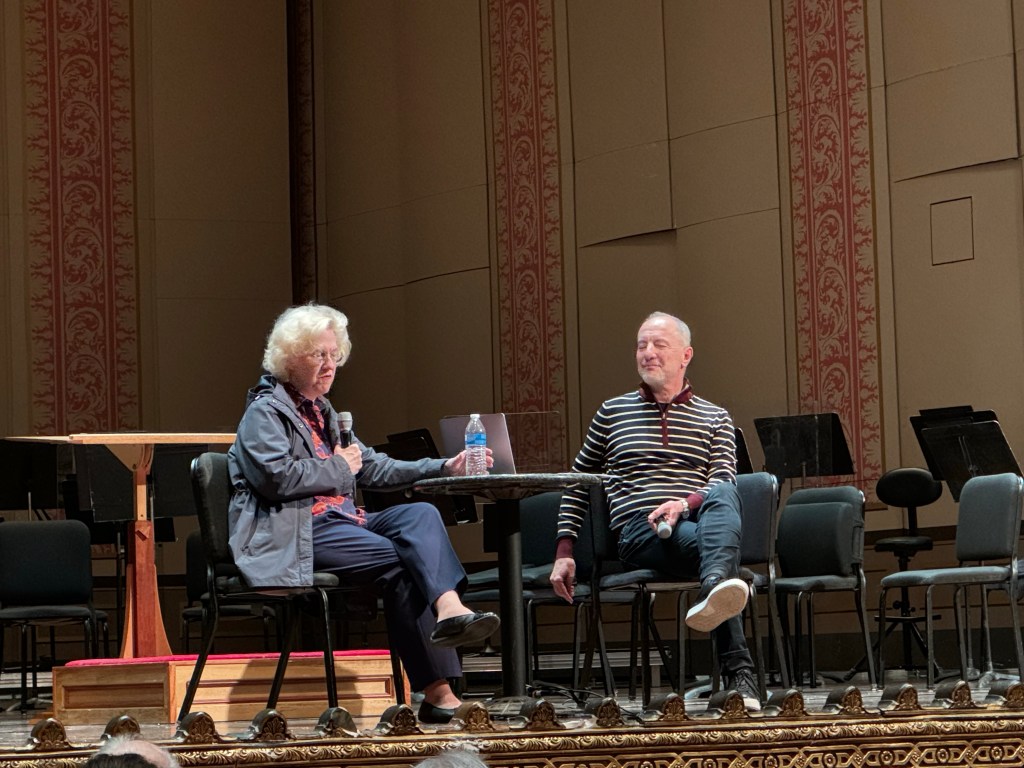
Buechner and Milanov during the preconcert conversation

Pianist Claire Huangci returns to Columbus Symphony with Tchaikovsky

Columbus Symphony Orchestra
Carl St. Clair, conductor
Claire Huangci, piano
Ohio Theatre
Columbus, OH
February 23, 2024

Wineglass: Alone Together
Tchaikovsky: Piano Concerto No. 1 in B-flat minor, Op. 23
 Encore:
 Gershwin/Wild: Embraceable You
Brahms: Symphony No. 4 in E minor, Op. 98

Last weekend’s Columbus Symphony concerts brought forth guest conductor Carl St. Clair, currently – and remarkably – in his 34th season as music director of the Irvine, California-based Pacific Symphony. Headlining the performance was pianist Claire Huangci, returning to the Ohio Theatre following a memorable debut two seasons ago. Prefacing the pianistic centerpiece was a local premiere by John Wineglass, perhaps best known for his work in television scoring – most notably for All My Children, garnering him six Emmy nominations.

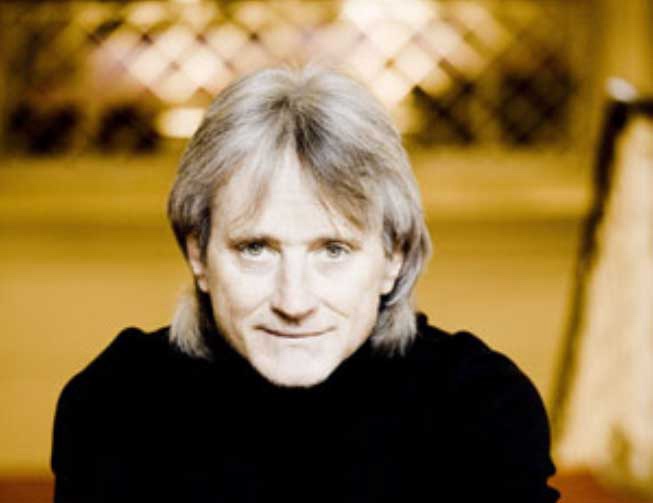
Carl St. Clair, photo credit pacificsymphony.com

Alone Together dates from 2021, in the throes of the pandemic, and was premiered virtually by St. Clair and his California ensemble on the first anniversary of the murder of George Floyd. Scored for strings, harp, and percussion, it documents a challenging time in recent history (a recording may be heard here). The opening “Strange Pandemic Times” was marked by unsettling harmonics, though generally lushly tonal and reflective. A pulsating drum ominously sounded, taking a darker turn before the closing “A Ray of Hope.” The harp had a calming effect and introduced an appealing melody, but ultimately felt to this listener more akin to “feel-good” music than a work that fully captured the depth of the subject matter.

Tchaikovsky’s evergreen First Piano Concerto was a fitting platform for Huangci’s virtuosity. A bold, brassy opening pointed to the thunderous chords in the piano, but I found the pianist’s approach perplexing at best. She was wont to rapidly release her hands from the keyboard, almost as if the keys were hot to the touch. Not only did this make for an odd visual, but the tone yielded was rarely more than surface-level, inadequate to project over the large orchestra and throughout the cavernous theater – especially apparent in the rapid double octaves which came off rather feeble. Still, I found her technique impressive and effective in the elegant cadenza.

The Andantino semplice opened with pizzicato strings and a lovely flute solo. The pianist seemed at her finest in these more lyrical and restrained moments, including a touching bit of dialogue with cellist Luis Biava. The fiery finale was at heart a lively folk dance, likely of Ukrainian origin. As an encore, Huangci offered the great Earl Wild’s transcription of Gershwin’s Embraceable You – impressive fingerwork colored by sweet, jazz-inflected harmonies.

Brahms’ Fourth Symphony concluded the program. The work’s long journey embarked with a gentle dip in the strings. St. Clair had a keen sense of structure and pacing, though there was something to be desired with regard to balance, given that the brass were often too much in the foreground. The slow movement boasted some lovely string playing, contrasting the stentorian brass, while the scherzo saw jubilation amidst the work’s severity. Eight powerful chords made the spine of the closing passacaglia, its variations unfolding with dignified purpose.

Columbus Symphony explores the confluence of classical and jazz

Columbus Symphony Orchestra
Rossen Milanov, conductor
Aaron Diehl, piano
Ohio Theatre
Columbus, OH
March 17, 2023

Perry: Study for Orchestra
Gershwin: Concerto in F
Tchaikovsky: Suite from The Nutcracker, Op. 71a
Ellington/Strayhorn: The Nutcracker Suite

The Columbus Symphony’s program served as a colorful depiction of elements of jazz seeping into the classical tradition – and vice-versa. Matters began on a different note, however, with an example of the considerable body of work from the often forgotten 20th century American composer Julia Perry. A native of Lexington, Kentucky who spent her final years in Akron, Ohio, her reputation was tragically stifled by the establishment’s prejudices towards an African-American woman.

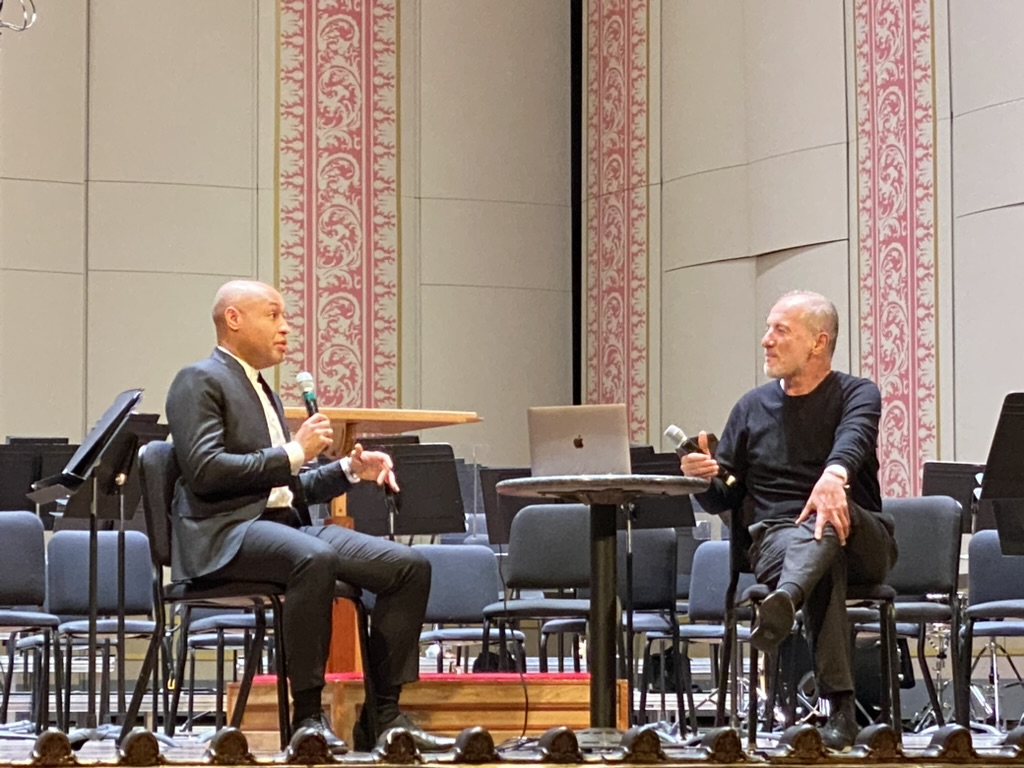
Aaron Diehl in conversation with Rossen Milanov

Nonetheless, she produced a substantial output – including more than ten symphonies – and the 1952 Study for Orchestra, included on the present program, was performed by the New York Philharmonic in 1965, certainly a major milestone. Bracing, strident beginnings gave way to more lyrical interludes. Albeit brief, it was a work of adroit craftsmanship, and certainly piqued my interest in discovering more of her music.

Gershwin’s great Concerto in F filled the balance of the first half, and was fitting platform for the belated CSO debut of Aaron Diehl – a Columbus native, Juilliard-trained, and equally at home in classical and jazz. A thunderous opening in the timpani pointed towards a lively Charleston rhythm. The pianist’s entry was graceful and elegant, with the virtuosity and vigor quickly ramping up. An impassioned lyrical melody served as the first movement’s climax, as lush as anything Rachmaninov wrote.

The brass with which the slow movement opened evidenced Gershwin’s skill at orchestration, much improved from the earlier Rhapsody in Blue for which he had the enlist the assistance of Ferde Grofé. The gently cascading piano was quite lovely, and the cadenza afforded Diehl the opportunity to improvise – and the orchestra musicians seemed to be watching him in awe. A motoric toccata-like movement closed the work with a big-boned finish. Diehl offered an encore (perhaps of his own composition?) that filled the theater with ethereal jazz harmonies.

In 1960, Duke Ellington released an album re-imagining Tchaikovsky’s Nutcracker as a jazz piece. Conductor Rossen Milanov cleverly devised a suite in which Tchaikovsky’s originals were interwoven with Ellington’s take, and it was quite fascinating to hear them juxtaposed. Delicate musical tinsel marked the opening Overture; in the ensuing Ellington version, the orchestra seamlessly morphed into a bona fide jazz band. Ellington’s adaptation of the Marche was styled as the “Peanut Brittle Brigade”; it expanded the rhythm and harmonies while the source material remained recognizable. In the “Dance of the Sugar Plum Fairy” the celesta sparkled; Ellington’s “Sugar Rum Cherry” retooled it for sax and brass. Tchaikovsky was given the final word, however, with a lush and lilting “Waltz of the Flowers.”

Eddins shows his mettle as both conductor and pianist with the Columbus Symphony

Columbus Symphony Orchestra
William Eddins, conductor and piano
Ohio Theatre
Columbus, OH
February 20, 2022

Perkinson: Sinfonietta No. 1
Gershwin: Rhapsody in Blue (1926 orchestration, Grofé)
Beethoven: Symphony No. 5 in C minor, Op. 67

Guest conductor Williams Eddins led the Columbus Symphony last weekend in a decidedly populist program, though matters nonetheless opened with an unfamiliar work by an unfamiliar composer. The quantity in question was the Sinfonietta No. 1 by African-American composer Coleridge-Taylor Perkinson, named after Samuel Coleridge-Taylor who perhaps served as a guiding inspiration to the younger composer. A compact three-movement work dating from 1954, the work opened with angular gestures though generally lyrical at heart, colored by piquant harmonies. A mournful slow movement seemed to echo Barber’s Adagio for Strings (this work too was scored for strings alone), while the vigorous finale purveyed textures akin to a Baroque concerto grosso. A finely crafted product of midcentury America given with compelling advocacy from Eddins and the Columbus strings.

William Eddins, photo credit Jonathan Kim

Eddins served double duty as pianist and conductor in Gershwin’s Rhapsody in Blue, but first took several minutes to introduce the work – as historically-informed as it was entertaining. Principal clarinet David Thomas delivered the iconic opening in a sultry solo. The work was presented in its 1926 pit orchestra scoring for an authentic feel of the roaring twenties, and it was certainly fitting for the performance to take place in a venue that was a product of the same decade. Eddins proved equally adept at both roles, and guided the ensemble in a charismatic, high-octane performance.

It’s a challenge for conductors to make such a well-worn piece as Beethoven’s Fifth Symphony sound fresh. I wasn’t convinced Eddins managed to say anything novel, but the performance nonetheless served as an always welcome encounter with an old friend. The opening Allegro con brio benefitted from Eddins’ energetic conducting, an intensity countered by the warm lyricism of the strings in the slow movement – though I found the brass to be a bit overzealous. The scherzo started out as a whisper, employing the ubiquitous rhythmic gesture that binds the work, and gradually grew in urgency. Matters were held in suspense until the brassy C major finale broke through the clouds. Still, the journey is far from over – Beethoven has gift for profligate finales! – and the energy on stage seemed to flag for a somewhat anticlimactic ending.