
Mao Fujita, piano
Mandel Concert Hall
Severance Music Center
Cleveland, OH
February 17, 2026
Beethoven: Piano Sonata No. 1 in F minor, Op. 2 No. 1
Wagner: In das Album Fürstin Metternich
Berg: Twelve Variations on an Original Theme
Mendelssohn: Variations sérieuses, Op. 54
Brahms: Piano Sonata No. 1 in C major, Op. 1
Liszt: Isoldes Liebestod, S447
Encore:
Rachmaninoff: Piano Sonata No. 1 in D minor, Op. 28 – Lento
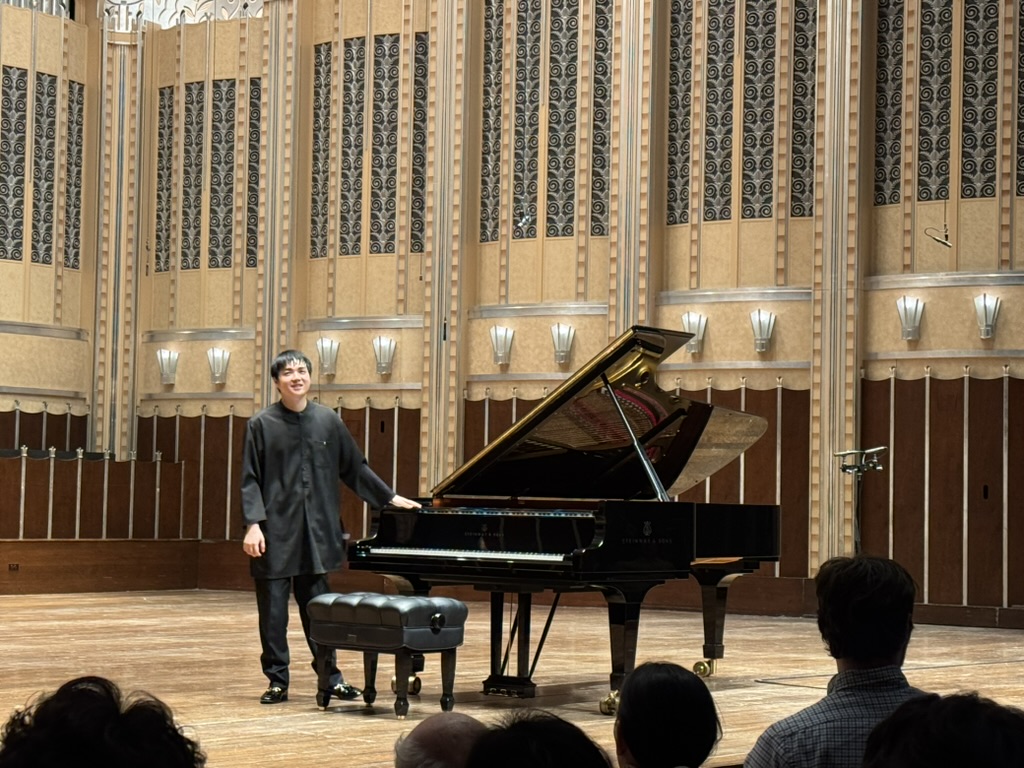
In another memorable entry of The Cleveland Orchestra’s recital series, Japanese pianist Mao Fujita delivered a wind-ranging, thoughtfully-curated program at Severance Hall. This counted as his debut in the hall, having previously performed with TCO at Blossom in 2023. I recall viewing a live-streamed recital he gave in Berlin during the pandemic; even watching from my computer during those lonely days of lockdown, his playing was utterly enthralling, so an opportunity to see him in the flesh in Cleveland was unmissable.
The program was quite interesting, mapping the development of Romanticism from Beethoven’s First Piano Sonata to perhaps the greatest culmination of it, Wagner’s Tristan und Isolde. For the first essay in a genre he would redefine with his incomparable cycle of 32 piano sonatas, Beethoven chose the key of F minor, one that would later be associated with some of Romanticism’s most impassioned works (think of Beethoven’s own Appassionata, Chopin’s Fourth Ballade or Fantasy, Liszt’s Transcendental Etude No. 10).
Though a stormy piece, at this point one never felt classical elegance was left far behind. I was struck by Fujita’s delicate, detailed playing, with a refined balance that deftly brought out the left hand. The finale of the four-movement sonata had a wide dynamic range, and here more than anywhere it seemed the seeds of Romanticism were firmly unleashed.
A pair of rarities followed, the first which was a miniature from someone usually rather maximalist — Richard Wagner. Ein Albumlatt is a gem of a piece, saying much in little by way of its wistful, longing melodic line. Alban Berg’s Twelve Variations on an Original Theme was quite a striking discovery, showing Berg as a late Romantic. It sounds almost nothing like atonal works we associate with him, and could very well be mistaken for a work by Brahms. The sprightly fourth variation was captivating in its leaps and bounds; subsequent variations in the form of canons were given with clarity ahead of the impassioned conclusion.
Rounding out the first half was another but much better-known set of variations in Mendelssohn’s Variations sérieuses. Deft voicings in the brooding theme drew out the melody. The variations oscillated between intense drama and lyrical sensitivity, with Fujita a thoughtful interpreter across the spectrum. The work’s close was one of majestic power.
The largest work on the program was the First Piano Sonata of Brahms. Brahms’ three works in the medium were written in rapid succession at the very beginning of his career. While the Third is an undisputed masterpiece, the first two remain compelling listens in their own right. A commanding opening showed a fountain of inspiration pouring from the composer’s youthful pen. A rapturously lyrical secondary theme offered contrast, while the development thundered with intensity.
The brief slow movement was of quiet resonance, upended by the scherzo bursting forth with explosive energy, an energy that in no way flagged for the jubilant finale. No matter how pianistically awkward the writing was, Fujita sailed through its technical demands and made an arresting case for this early work. Capping off the recital was the Liebestod from Wagner’s Tristan und Isolde in a magnificent piano transcription by Franz Liszt. Its divine melody and webs of chromaticism made for a deeply affecting close, as if the previous repertoire was mere warmup for this profoundly touching statement.
For a lone encore, Fujita turned to another First Piano Sonata, that of Rachmaninoff. Offering its slow movement, the pianist concluded the thought-provoking recital in music of languorous melancholy.
 quasi-faust