Ébène and Belcea quartets combine forces at Chamber Music Pittsburgh

Ébène Quartet
Belcea Quartet
Carnegie Music Hall
Pittsburgh, PA
November 12, 2024

Mendelssohn: String Octet in E-flat major, Op. 20
Enescu: String Octet in C major, Op. 7

Encore:
Fauré: In paradisum from Requiem, Op. 48

In a special presentation from Chamber Music Pittsburgh, two major string quartets – the Ébène and the Belcea – joined together for an evening of octets. Far and above the most recognizable work of the string octet literature is Mendelssohn’s sterling example, a quantity which was paired with a less familiar octet by George Enescu. Remarkably, this was an evening of music composed by teenagers – Mendelssohn was a prodigious 16-year-old when writing his; Enescu was hardly far behind at 19. 
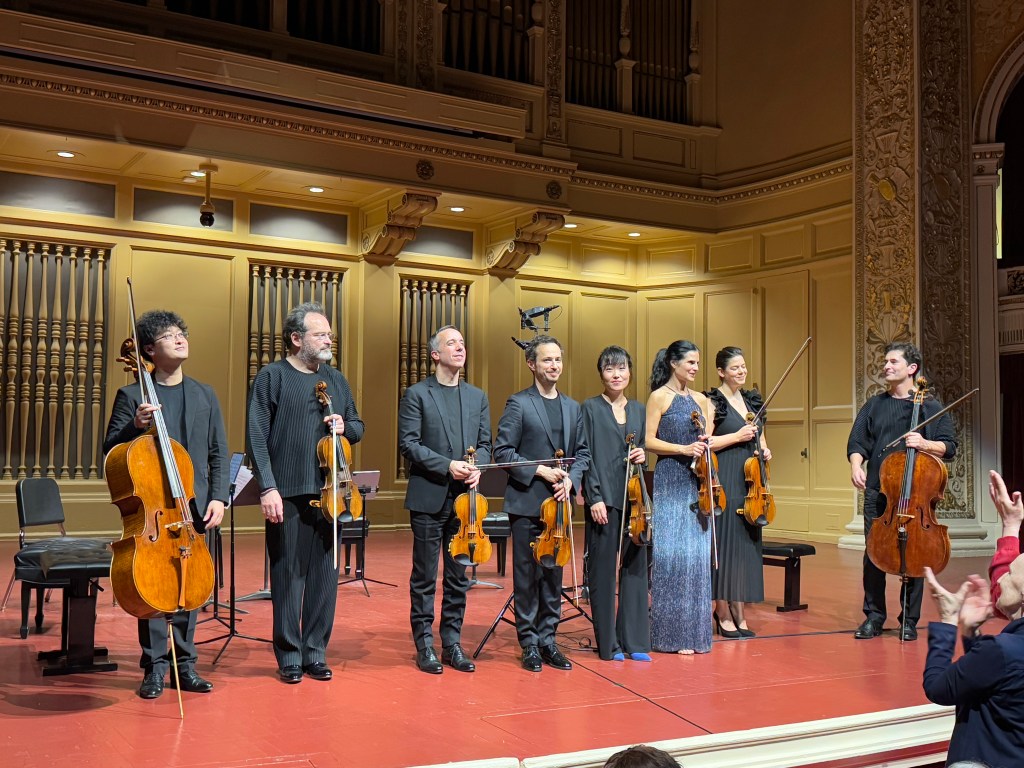
Ébène and Belcea quartets at Chamber Music Pittsburgh

The Mendelssohn opened the program warm and gracious, with a lushly flowing melody from the violin. The eight players on the Carnegie Music Hall stage collectively drew a rich orchestral heft, sounding not as eight soloists or two quartets, but a single, unified organism. A more playful contrasting theme danced in its delicate interplay.

The Andante movement was plaintive and pensive. Just few minutes in duration, the scherzo defined and crystallized the very term Mendelssohnian: fleet and gossamer, it was given with a featherlight touch, the musicians perfectly in sync. Furious gestures from the cello opened the finale, with the others joining in succession in a wide-ranging fugato. A movement of great drama, given here with exacting clarity and attention to detail. 

Enescu almost certainly looked to Mendelssohn for inspiration when writing his own octet, but it’s a work that nonetheless bears his individual voice. Some changes were made to the seating arrangement on stage, alternating which players commanded the primo parts. A full-bodied tone and textural richness made for a bracing beginning. The melodic line had some striking harmonic inflections, perhaps a nod to the folk music of the composer’s native Romania. The performers illuminated the opening movement’s complex form, and the work proved an intriguing discovery (though admittedly, anything can seem a letdown after the Mendelssohn – perhaps the Enescu would have been better positioned being programmed first?). 

A sudden contrast was had in the following movement, marked with the French Très fougueux (“very fiery”). Spiky, angular material was given with impassioned – and yes, fiery – playing, and a beguiling chord progression served as a transition to the slow movement. Calm and stillness pervaded before the coruscating and bold finale, capping off this ambitious work in grand form. 

As an encore, the ensemble offered a transcription for octet of the closing In paradisum from Fauré’s Requiem – which also served to whet one’s appetite for the Pittsburgh Symphony’s upcoming performance of the work. With some particularly lovely pizzicato material given to the viola, it served as a gorgeously beautiful close to the evening. 

VIVO closes festival in style with French repertoire, Choi premiere

Alicia Hui, violin †
Siwoo Kim, violin †‡
Henry Kramer, piano *‡
Jeffrey Myers, violin *
John Stulz, viola *†
Alice Yoo, cello *
Matthew Zalkind, cello †‡
Gabriel Campos Zamora, clarinet †

* Fauré / † Choi / ‡ Ravel

Southern Theatre
Columbus, OH
September 4, 2022

Fauré: Piano Quartet No. 1 in C minor, Op. 15
Choi: With Winds III
Ravel: Piano Trio

VIVO Music Festival closed the eighth edition of its annual chamber music celebration Sunday afternoon at the Southern Theatre, an event which also served to unofficially open Chamber Music Columbus’ banner 75th season. As with all of the elder organization’s upcoming concerts, Sunday’s included a newly commissioned work, as well as poem from the season’s poet laureate, Jennifer Hambrick – known to listeners of WOSU, as well as the host of VIVO’s “Beer & Beethoven” held a few nights prior. Hambrick’s entry “Stones to join the mountain with the rock” fit the spirit of the occasion, the joining of forces of two very fine chamber music organizations.

L-R: Jaehyuck Choi, Jeffrey Myers, John Stulz, Gabriel Campos Zamora, Alicia Hui, Alice Yoo, Siwoo Kim, Henry Kramer, Matthew Zalkind. Photo credit VIVO Music Festival

Fauré’s Piano Quartet No. 1 boasted dark-hued, dramatic beginnings, rather Brahmsian in persuasion, with the virtuosic piano writing and its tumultuous octaves (Henry Kramer) a standout. The scherzo was markedly more Gallic and of irresistible charm, while the Adagio was a gorgeous respite, with a particularly affecting and resonant cello line (Alice Yoo). The finale recalled the virtuosity of the beginning to bring the opening selection to an enthusiastic close.

South Korean composer Jaehyuck Choi was present to introduce his clarinet quintet With Winds III, the first of Chamber Music Columbus’ seven commissions to come to life. A taste of Choi’s work was sampled at the aforementioned Beer & Beethoven event in which violinist Alicia Hui performed his Self in Mind I. In addition to VIVO, violist John Stulz also counts himself a member of the Paris-based new music group Ensemble intercontemporain, and it was there he first became acquainted with Choi. Choi’s commission served as a tribute to CMC’s founder James N. Cain, and moreover, the clarinet quintet medium was apropos as one of the organization’s first performances featured the Walden Quartet with clarinetist Donald McGinnis. Choi spoke of finding influence from contrasting works of visual arts, a thread he discussed at length during my interview with him a few months prior.

Terse, rapid gestures in the strings opened, punctuated by a long-breathed tone in the clarinet (Gabriel Campos Zamora), emblematic of the work’s near obsession with pointed contrasts. The work’s dense textures made substantial use of extended techniques, pushing the capabilities of both the musicians and their instruments alike. A passage cast in the violin’s highest possible range was otherworldly in effect, while a mute in the clarinet provided yet another striking sonority in work’s final segment before matters evaporated into silence.

The afternoon closed with Ravel’s remarkable Piano Trio. The opening Modéré was dreamy and evocative, with the performers adroitly negotiating the 8/8 meter – suggestive of the Basque zortziko – complexities that felt all but effortless in this musical conversation amongst friends. What followed was a rare scherzo from Ravel, its gossamer textures almost like a work of Saint-Saëns. The Passacaille easily serves as the heart of the work, searching probing depths. A solemn statement, it was a juxtaposition of the austere and the deeply felt. Decorative filigree was abundant in the finale, given with meticulous attention to detail, and the self-assured piano in particular pointed towards a big-boned finish.