
Pittsburgh Symphony Orchestra
Vasily Petrenko, conductor
Benjamin Grosvenor, piano
Heinz Hall
Pittsburgh, PA
June 2, 2024
Dukas: The Sorcerer’s Apprentice
Liszt: Piano Concerto No. 1 in E-flat major, S124
Encore:
Sousa/Horowitz: The Stars and Stripes Forever
Tchaikovsky: Manfred Symphony, Op. 58
Under the baton of guest conductor Vasily Petrenko, the Pittsburgh Symphony presented a colorful selection of three contrasting works spanning the Romantic era. Matters began with the inimitably familiar Sorcerer’s Apprentice of Paul Dukas, a familiarity in no small part cemented by its appropriation in Disney’s watershed Fantasia. The tone poem began in suspenseful mystery, decorated with silvery, gossamer texturing. Haughty bassoons introduced the main theme, given with swagger and bringing to life Goethe’s titular poem. The work burgeoned to an overflowing urgency, made the all the more affecting by way of its iridescent orchestration.
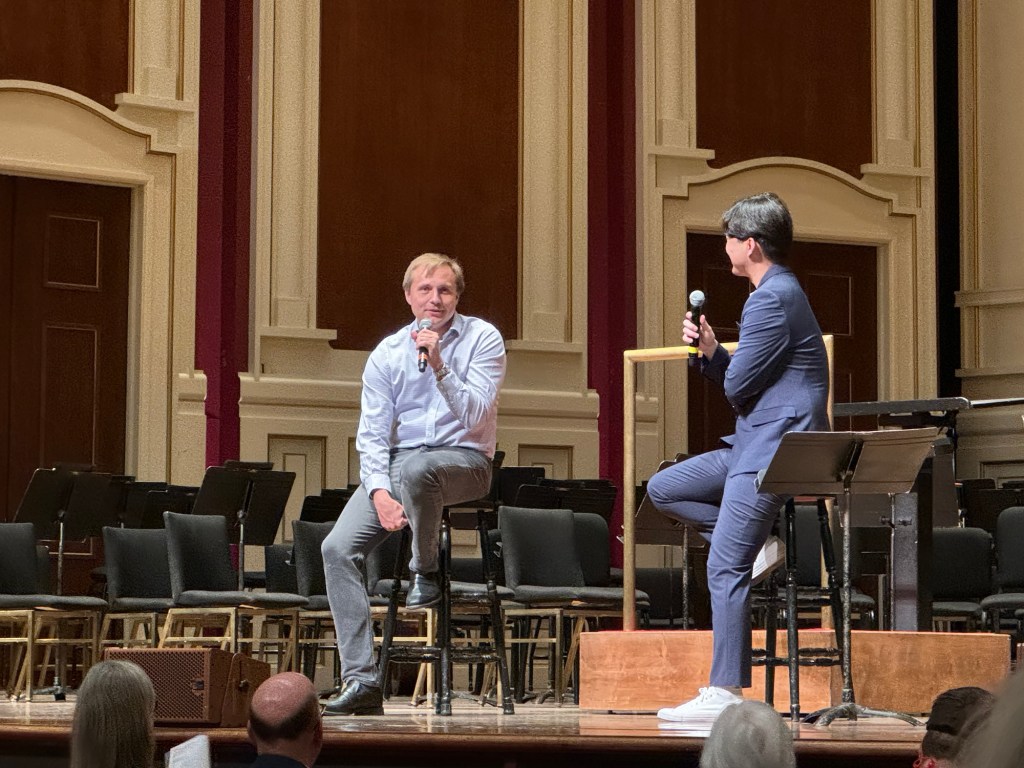
Liszt’s Piano Concerto No. 1 introduced British pianist Benjamin Grosvenor. Bellicose beginnings were furthered encouraged by the pianist’s steely-toned octaves, but the work wasn’t all fireworks and bombast, being interspersed with lyrical episodes often in dialogue with an orchestra member. The tone produced from the Steinway was bit too bright for my taste, though I’m not sure whether to point fingers at the pianist or the piano.
The ringing of the triangle marked the scherzo section, answered by Grosvenor’s stylish playing. The octaves returned at breakneck speed, pointing the way towards the concerto’s blistering end. An enthusiastic reception brought Grosvenor back for an encore in Horowitz’s transcription of Sousa’s Stars and Stripes Forever. Thunderous bass octaves and intricate filigree in the upper register made for a fun close to the first half – and perhaps a suitable welcome to summer.
Though he didn’t include it amongst his numbered symphonies, Tchaikovsky’s Manfred is one of his most significant orchestral works, chronologically falling between the Fourth and Fifth symphonies. Like the Dukas that opened, it too draws programmatic inspiration from poetry, in this case, Lord Byron. Nearly an hour long, it can be abstruse work to interpret, but Petrenko (who has recorded the work with the Royal Liverpool Philharmonic) made a clear and compelling case for it. I would perhaps suggest a parallel with Liszt’s Dante Symphony heard earlier this season, hyper-Romantic, literary works scored for large orchestra, both perhaps a bit bloated but which nonetheless have much to say when given an incisive interpretation.
Lugubrious, tragic beginnings were had in the expansive opening movement, outlining a brooding main theme that swelled to great passions, depicting our Romantic hero. The Vivace con spirito that followed was lighter fare by comparison, with a central section lush and lyrical. Mercurial filigree in the high strings surfaced near the movement’s end to striking effect. The Andante con moto featured a songful oboe solo, a moment of peace amidst the tumult. The finale amounted to long, arduous journey in of itself. At the very end, the organ filled Heinz Hall for a remarkable moment of lavish orchestration, and the closing hymn led to a peaceful if somber resolution in evocation of Manfred’s death. While the Manfred Symphony might not be a masterpiece on par with the composer’s final three numbered symphonies, a performance like this nonetheless compels one to give it ample attention.
 quasi-faust