Cleveland Orchestra’s stellar Mozart and Dvořák bookends Deutsch premiere

Cleveland Orchestra
Franz Welser-Möst, conductor
Mandel Concert Hall
Severance Music Center
Cleveland, OH
January 15, 2022

Mozart: Symphony No. 36 in C major, K425, Linz
Deutsch: Intensity
Dvořák: Symphony No. 8 in G major, Op. 88

Under the baton of music director Franz Welser-Möst, The Cleveland Orchestra offered familiar and appealing symphonies of Mozart and Dvořák as bookends to a compelling premiere from its current composer in residence. Mozart’s Linz symphony made for a pearly opener. The dotted rhythms which opened the slow introduction were punctuated with heft while the ensuing Allegro spiritoso was a fittingly lighter affair, given with such energy as to mirror the frenetic pace at which it was composed. The Andante was delicate and intricately refined by way of Welser-Möst’s exacting attention to articulation and dynamics. In the Menuetto, one was struck by the rhythmic swagger, and the bold, big sound of the modern orchestra which the conductor cultivated – something of a foil to Nicholas McGegan’s airier and comparatively more historically-informed performance of the work a few seasons ago. Contrast was further sharpened by the rather more genial trio, and the finale was given with crystalline clarity even at breakneck tempo.
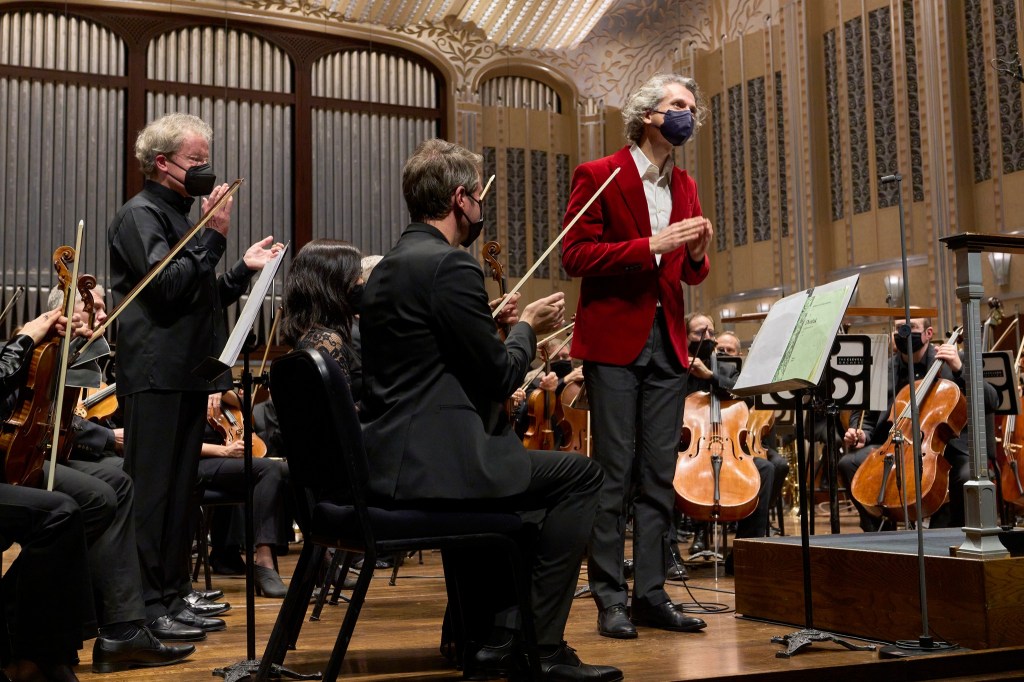
Bernd Richard Deutsch and The Cleveland Orchestra, photo credit Roger Mastroianni, courtesy of The Cleveland Orchestra

Bernd Richard Deutsch’s Okeanos made a strong impression on this listener when performed by the orchestra in March 2019 (and captured on the excellent A New Century). As the current Daniel R. Lewis Young Composer Fellow, Deutsch was commissioned to write a new work for TCO, originally slated for a May 2020 performance but inevitably postponed until this weekend. The product of this residency was Intensity, an aptly titled twenty-minute fantasy scored for massive orchestral forces – including a particularly extensive percussion battery. A sense of wound-up energy, pregnant with potential permeated the opening bars, and the colorful timbres of the percussion were utilized from the opening notes. Lyrical interludes at various interludes offered an anchor in otherwise stormy waters. The middle of the work’s three sections was spectral and dissipated, achieved through the striking aural palette of high strings, muted brass, percussion, and celesta. The namesake intensity ramped up again in the final section, encouraged by the boisterous percussion and finally culminating in a blast in the brass. A fitting tribute to the virtuosity and technical prowess of the The Cleveland Orchestra, and I hope a recording is released in the near future.

Dvořák’s Symphony No. 8 is certainly one of the most popular in the repertoire, but this performance was refreshingly far above the routine and pedestrian. Passionate beginnings, as coaxed from the resonant cellos, persisted for only a moment before the work’s sunny disposition shone through. Joshua Smith’s solo flute passages were a highlight, and Welser-Möst opted for a brisk tempo, keenly avoiding over-sentimentalizing. The Adagio showed Dvořák at his most lyrical, although a brilliant brass section added bold contrast. The Allegretto grazioso positively sparkled in its lilting textures, while clarion trumpets heralded the finale wherein the conductor guided the orchestra with conviction through the myriad of guises of this rousing theme and variations.
US premiere of Deutsch’s Okeanos makes strong impression

Cleveland Orchestra
Franz Welser-Möst, conductor
Paul Jacobs, organ
Severance Hall
Cleveland, OH
March 14, 2019

Haydn: Symphony No. 34 in D minor, Hob. I:34
Deutsch: Okeanos
Tchaikovsky: Symphony No. 5 in E minor, Op. 64

Prior to The Cleveland Orchestra’s impending and extensive tour of China, Franz Welser-Möst is back in town for a pair of programs, the first of which was centered on Cleveland’s introduction to the tenth Daniel R. Lewis Young Composer Fellow, Bernd Richard Deutsch. Also hailing from Welser-Möst’s native Austria, Deutsch is representative of what is sometimes referred to as the Third Viennese School, a loose amalgamation of composers whose music has been championed by the contemporary music ensemble Klangforum Wien.

54800325_2019833998310847_5346184265367133856_n
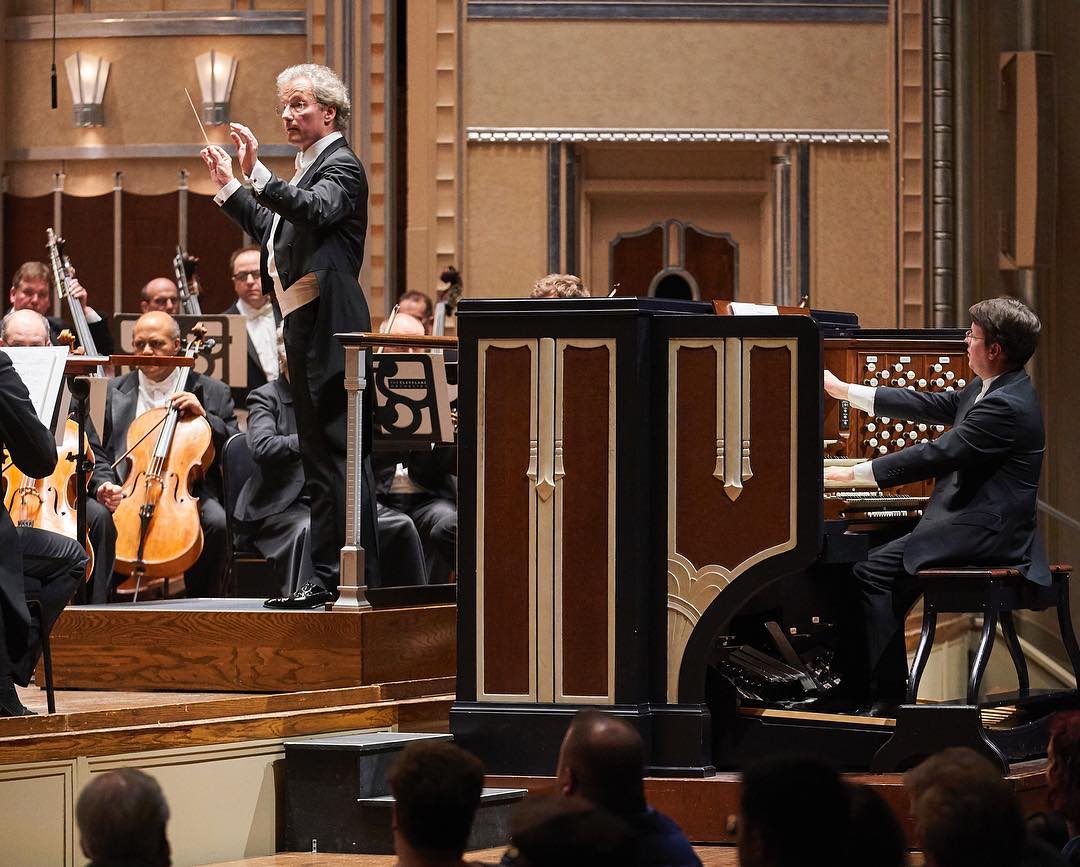
Franz Welser-Möst and Paul Jacobs in Okeanos. Photos credit Roger Mastroianni, Courtesy of The Cleveland Orchestra

The work Deutsch made his calling card was Okeanos, a nearly 30-minute canvas for organ and orchestra dating from 2014-15, and inspired by the titular Greek personification of the oceans. Prefacing the performance, Deutsch and organist Paul Jacobs were on hand for a fascinating preconcert discussion (although I did wish that moderator Caroline Oltmanns had been gracious enough to give the two more airtime). Okeanos is conceived in four movements, each representing the fundamental elements, respectively, water, air, earth, and fire. The work began almost indeterminately, with tremolos obscuring fragments of themes, and the organ so wrapped into the fabric of the orchestra as to be hardly discernible. The movement soon grew far more animated, building to a fluid gravitas, with the organ powerfully prominent in music of cosmic visceral impact – yet the movement ended in no more than a whisper.

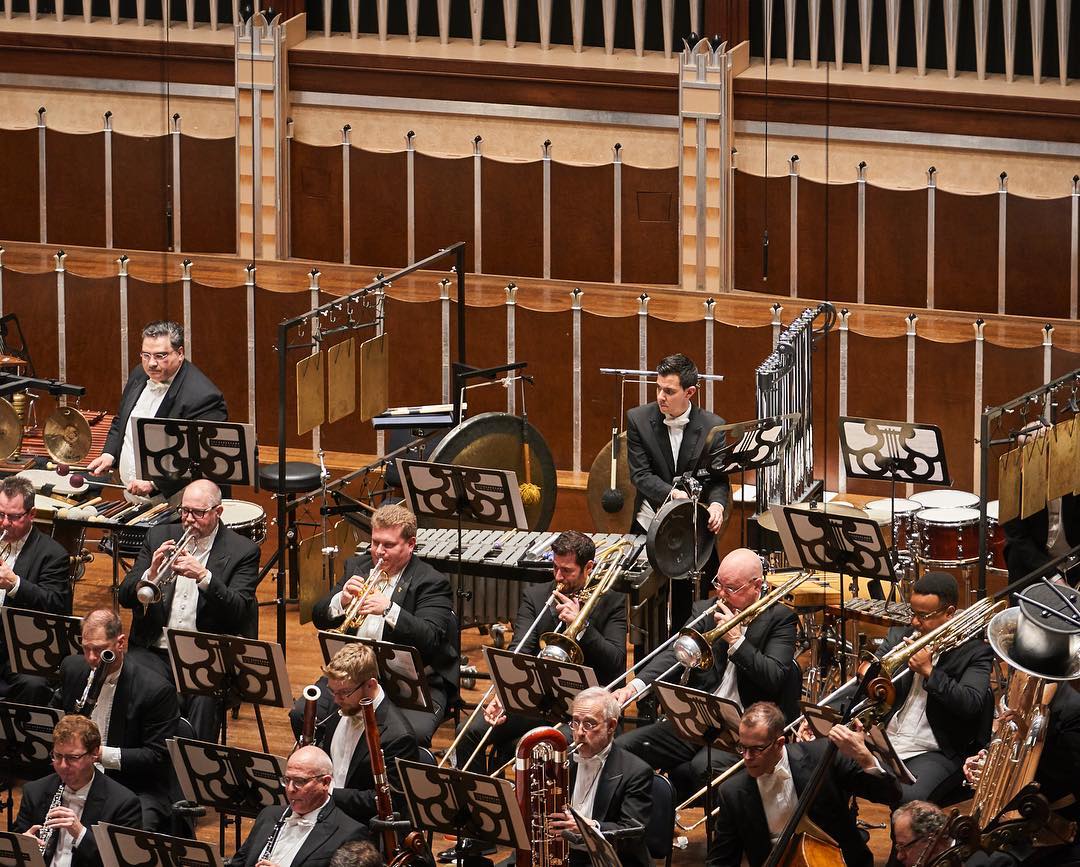
“Air” opened with rapid fluttering in the organ along with a wind machine used to obvious effect. Colorful glissandi on the organ were imitated by the harp and celesta. “Earth” was a more glacial affair, filled with otherworldly timbres usually emanating from the percussion battery, as vast and diverse as one could imagine. “Fire” was of rapid virtuosity and quite ferocious playing, emphasizing the rhythmic primacy of the percussion. Further striking effects were achieved through muted trombones; at movement’s end the texture dug down into the depths of the organ, ending on a sustained chord at quadruple forte – an imposing effect to be sure. Deutsch noted that the structure of the work was determined by the golden ratio – a thought-provoking compositional approach with antecedents in Debussy and elsewhere, though certainly not apparent on first hearing. As part of his fellowship, Deutsch has been commissioned to write a new work for the orchestra, to be performed at the end of next season (May 2020) – I look forward to music that lies ahead.

The evening began with the first Cleveland Orchestra performances of a lesser-known Haydn symphony, No. 34 in D minor. The first of the composer’s to be cast in the minor, it served as an incubator for the series of Sturm und Drang symphonies that would soon follow. Haydn quite surprisingly begins with the slow movement – what initially sounds like merely an introduction turns out to be a symphonic edifice nearly as long as the remaining movements combined. A lament in the strings was marked by the clarity of the inner voices in this statement of genuine expressive depth. After the weighty beginnings, the minor was all but forgotten and matters proceeded wholly unperturbed. The sudden high spirits of the second movement were further encouraged by the courtly minuet with lovely woodwind triplets during its trio. And as is often the case with Haydn’s whirlwind finales, one only wished it wasn’t so brief.

Tchaikovsky’s evergreen Fifth Symphony completed the program in lush Romanticism. A plaintive presentation of the fate motive in the clarinets opened the work to chilling effect, eventually coalescing as an energetic march, gathering great strength in the face of fate and brimming with endlessly flowing melody. Welser-Möst took matters at a startlingly brisk tempo – while I applaud his resolve to not sentimentalize, I would have preferred the music to breathe a bit more. Low strings of deep emotion marked the slow movement, a backdrop for the sumptuous horn solo, delicately interjected by Afendi Yusuf’s clarinet. While Welser-Möst might not have probed as deep as some, the result was nonetheless long, flowing lines of rapturous beauty. The tragic obsessions of the first two movements were left behind in the lilting Valse, decorated by mercurial strings. The fate motive resurfaced, suddenly benign, setting the stage for the finale wherein matters were miraculously morphed to the triumphant.

53614295_414978859268690_2808613123078089845_n
The Cleveland Orchestra performs Okeanos. Note the percussion battery and muted brass.