Takács Quartet marks 50th anniversary in return to Cleveland Chamber Music Society

Takács Quartet
Cultural Arts Center
Disciples Church
Cleveland Heights, OH
November 11, 2025

Haydn: String Quartet in G minor, Op. 74, No. 3, Hob. III:74, Rider
Bartók: String Quartet No. 3
Dvořák:  String Quartet No. 13 in G major, Op. 106

Encore:
Debussy: String Quartet in G minor – 2nd mvt.

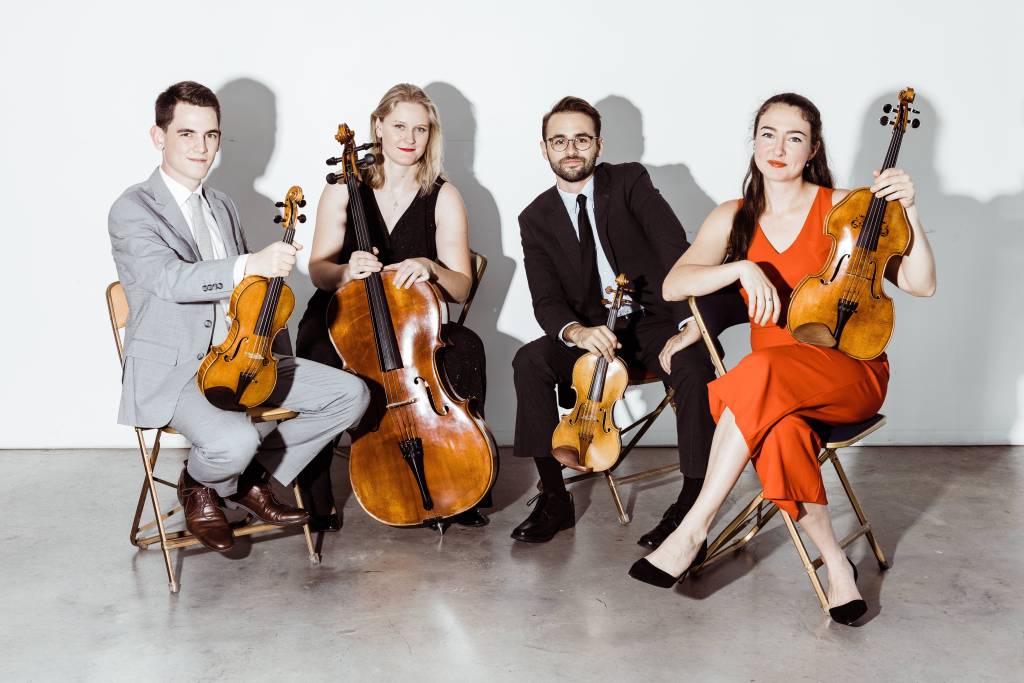
Founded in 1975 while students at the Liszt Academy in Budapest, half a century later the Takács Quartet continues to offer a gold standard of string quartet playing — and remarkably, still counts one original member in its ranks (cellist András Fejér). Tuesday night marked a welcome return to the Cleveland Chamber Music Society (which celebrated its own 75th anniversary last season) where they have long been regular guests — in recent years, performing with Marc-André Hamelin and in a memorable Grieg/Shostakovich program.
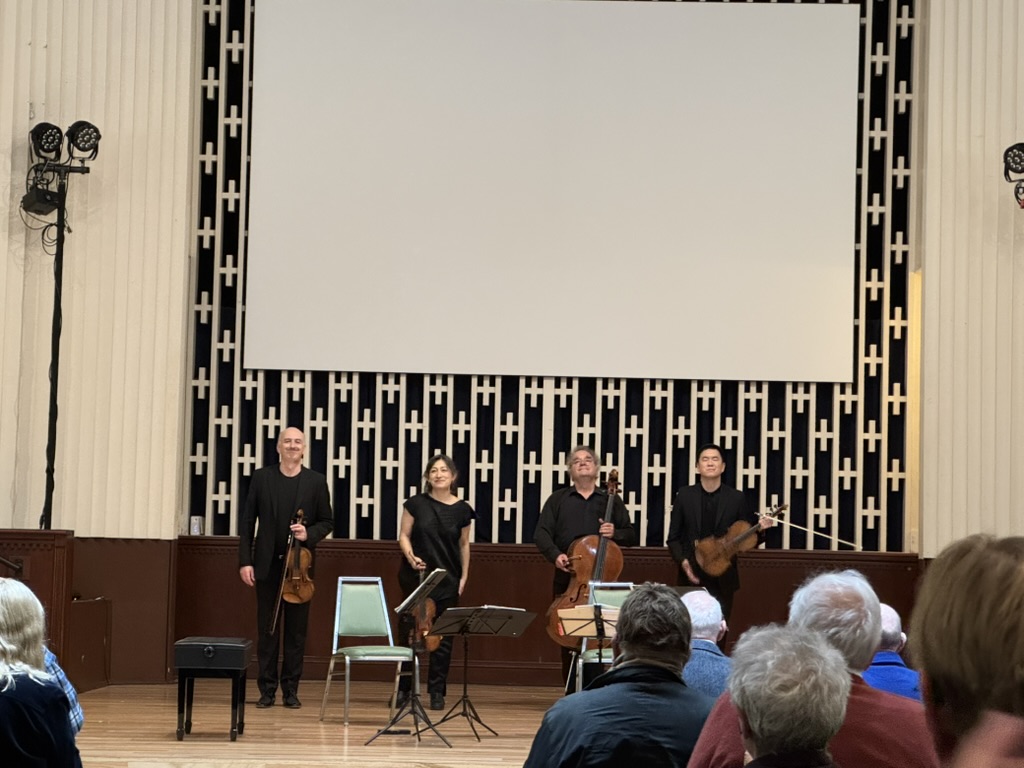
Takács Quartet at the Cleveland Chamber Music Society

The so-called father of the string quartet, Haydn is always a rewarding composer with which to begin a string quartet recital. Tuesday’s selection was the Rider quartet in its bristling G minor. It opened in quintessential Haydnesque fashion with its delicate ornamentations and sudden pauses. This genteel material was given with tight cohesion, carefully conveying its layered textures with clarity. Some striking modulations were heard in the slow movement before an elegant minuet countered by a rather stormy trio (usually it’s the trio that’s the calmer one). The fiery, galloping finale is what gave this work its epithet, and Haydn had the last laugh with its humorously deceptive close.

Of Bartók’s six iconoclastic quartets, the Third is the shortest but also the most concentrated. It’s quite unusual in form, too, with two contrasting parts subsequently repeated in a loose mirror of their initial presentation. Protean strands began, organically growing in weight and intensity — preconcert lecturer Kevin McLaughlin aptly compared this soundscape to Stravinsky’s Rite of Spring. A panoply of extended techniques were deployed, yielding an array of captivating sounds. Melodically, harmonically, and rhythmically intricate, the second part was blistering in its driving appropriation of folk song. The so-called Ricapitulazione of first part surfaced like a distant dream of the opening before the work’s uncompromising close.

It was lovely to hear Dvořák on a string quartet program in a piece that isn’t the justly famous American quartet. The Takács instead offered the Bohemian composer’s penultimate work in the genre: no. 13 in G major, Op. 106 (I was also reminded the Apollon Musagète Quartet presenting Dvořák’s final quartet on a CCMS program in February 2020, just ahead of the covid shutdown). In these last two works in the form, Dvořák sailed to new heights, only to then turn his attention away from chamber music and to opera and the tone poem.

Gentle gestures opened to set an intoxicatingly bucolic mood, only to grow in dramatic tension and orchestral heft. First violinist Edward Dusinberre had a soaring melodic line, and the broad first moment movement drew to particularly robust coda. Rich textures were layered on top of each in the angelic slow movement, somewhat reminiscent of Beethoven’s Heiliger Dankgesang. At its conclusion, some earthy pentatonicism reminded us this came from the same pen as the man wrote the New World symphony.

Even more quintessential Dvořák came in the following, wherein the composer proudly displayed his Czech origin in the shape of a spunky furiant. I was struck by the Takács intense physicality here, playing with their whole bodies. The bold, wide-ranging finale was given with unified direction for a powerful close.

As an encore, the quartet turned to the second movement of Debussy’s sole work in the medium in a show of their versatility, equally adept in the Frenchman’s impressionist enigma.
Marc-André Hamelin offers probing virtuosity at Akron’s Tuesday Musical

Marc-André Hamelin, piano
EJ Thomas Hall
Akron, OH
October 21, 2025

Beethoven: Piano Sonata No. 29 in B-flat major, Op. 106, Hammerklavier
Schumann: Waldszenen, Op. 82
Ravel: Gaspard de la nuit

Encore:
Debussy: Reflets dans l’eau (No. 1 from Images, Book 1)

No part of Marc-André Hamelin’s recital at Akron’s Tuesday Musical was for the faint of heart. The repertoire spanned a mammoth Beethoven sonata, the rewarding Romanticism of Schumann, and Ravel at his most mercurial and ferocious. Opening night of Tuesday Musical’s 138th(!) season, Hamelin served as the annual Margaret Baxtresser Pianist, in which capacity he led a masterclass at Kent State the following day. Additionally, the evening performance began with a rippling account of Liszt’s La leggierezza by local high school student Saya Uejima.

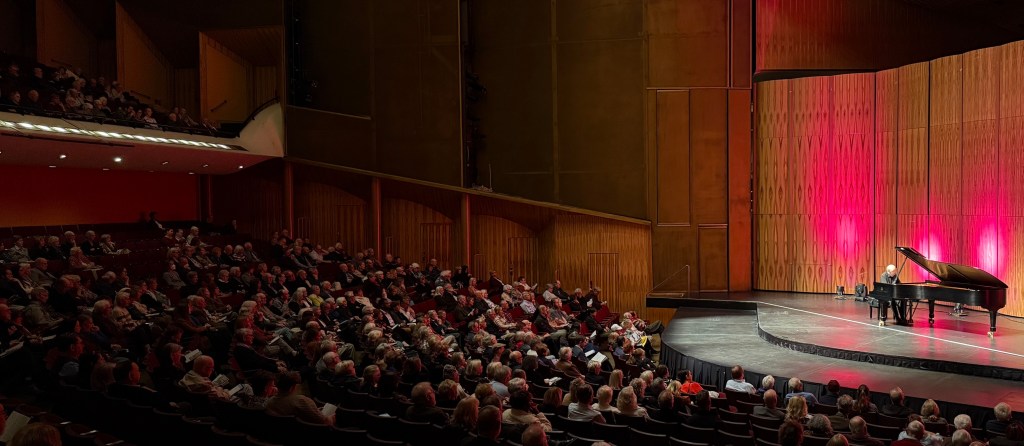
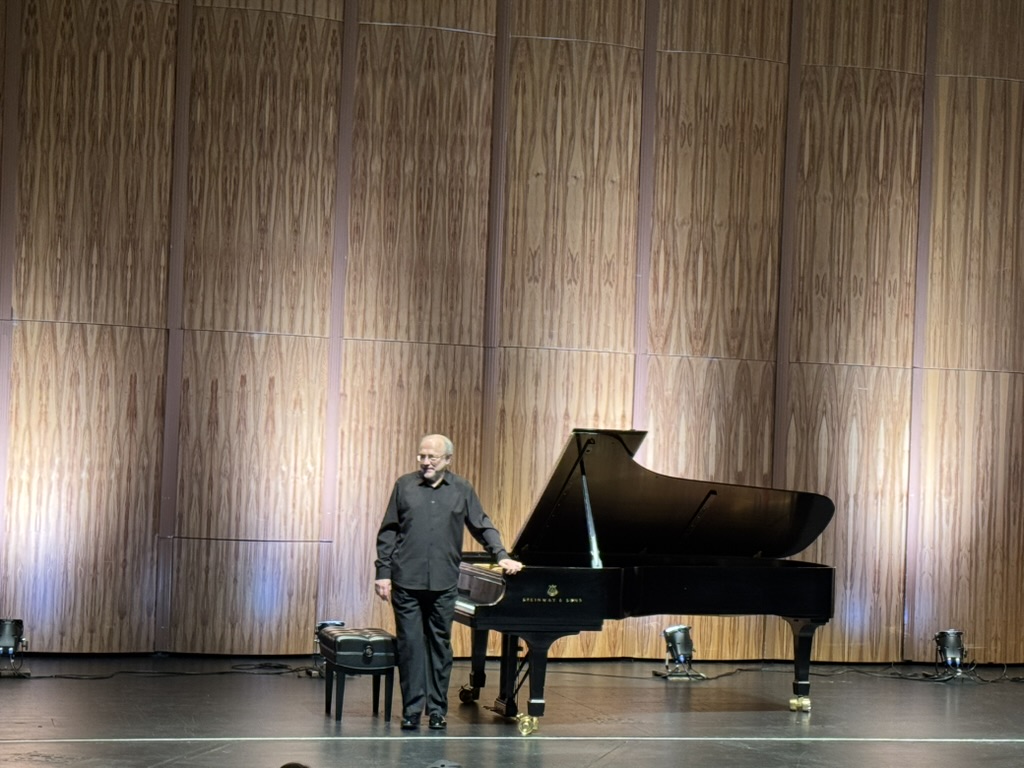
Marc-André Hamelin at EJ Thomas Hall, photo credit Tuesday Musical

Along with the Diabelli Variations, the Hammerklavier is Beethoven’s largest and most demanding work for solo piano. A granite monument of the piano literature, Hamelin has recently recorded it to acclaim. As if totally unfazed by its technical demands, it comprised merely the first half of Tuesday’s recital. The bold Allegro movement made for a commanding beginning. Hamelin opted to strike the opening bass note with the right hand rather than the left for added power. Textures were crisp and brisk, with deft voicing of its intricacies, balancing the exuberant with more graceful material. The development saw some spiky contrapuntal passages, a preview of sorts for what was to come, before the movement’s blistering, uncompromising coda.

Though short in length, the scherzo that followed was hardly a trifle. Hamelin conjured a tempest, though an impulse towards restraint here kept the otherwise tumultuous writing in check. What followed was the work’s magnificent slow movement. Drawing on deep reserves of emotion, Hamelin sustained a spellbinding atmosphere over its nearly twenty-minute duration. Worlds apart from the robustness of the outer movements, here Hamelin purveyed a velvety touch to striking effect, landing on the profound sequence of chords that closed, beautifully voiced. With meditative, improvisatory beginnings, the massive fugue that concluded the sonata saw Hamelin at his best — a dazzling technique used in service of the music.

Schumann’s Waldszenen (Forest Scenes) made for a genial opening to the second half. Eintritt (Arrival) extended a warm and gracious entry into the forest, played with rippling lyricism. Hunting songs came second and second-to-last in this nine-part suite, in both cases given with vigorous flexibility. I was touched by the delicate nostalgia of Einsame Blumen (Lonely Flowers) and the uber-Romantic lushness of Herberge (Wayside Inn). The closing Abschied (Farewell) bid adieu with the same warmth with which it began.

The evening concluded with another work famous for its extraordinary technical demands in Ravel’s Gaspard de la nuit. Though a mainstay of Hamelin’s recital programs for years, it’s the only work of the present selection he has not yet recorded. The work brings to life in musical terms poems by Aloysious Bertrand, all of which deal with fantastical, rather demonic figures — a seasonally appropriate selection for late October! Ondine positively shimmered in this remarkable soundworld of the titular water nymph, building to an ecstatic climax. Le Gibet was a striking contrast in its funereal stasis ahead of Scarbo, closing with a spattering of iridescent colors and ferocious virtuosity.

Hamelin offered just a single encore in Debussy’s Reflets dans l’eau, which like Ondine, paints a mesmerizingly impressionist aquatic scene. A clip of Hamelin discussing the work can be viewed here.

Two years ago, I saw Hamelin play a very similar program in Cleveland with another massive piano sonata — Charles Ives’ Concord — in place of the Hammerklavier. See review here. Lastly, Hamelin was on hand ahead of his Akron recital for a brief but affable interview with WCLV’s Jacqueline Gerber, available for listening here.

Leif Ove Andsnes contrasts Chopin with Norwegian piano sonatas in Cleveland recital

Leif Ove Andsnes, piano
Mandel Concert Hall
Severance Music Center
Cleveland, OH
March 27, 2025

Grieg: Piano Sonata in E minor, Op. 7
Tveitt: Piano Sonata No. 29, Op. 129, Sonata etere
Chopin: Preludes, Op. 28

Encore:
Debussy: La cathédrale engloutie, from Préludes Book I

The first half of Leif Ove Andsnes’ Thursday night piano recital in Cleveland plunged into wholly unfamiliar territory in an exploration of the Norwegian piano sonata. The pianist proved to be an incisive guide to the music of his home country, beginning with the Piano Sonata in E minor from the pen of a 22-year-old Edvard Grieg.

Leif Ove Andsnes at Severance Hall

Brimming with youthful energy, the piece balanced both the lyrical and the dramatic. A slow movement was delicate in its simplicity, though it built in density and traversed some striking harmonic modulations. The sonata very much bore the influence of Schumann above all, but the brief third movement was quite original, showing the composer finding his individual voice. The finale capped off this attractive work with a bravura march.

The real rarity came in the Piano Sonata No. 29 of Geirr Tveitt. Like Grieg, Tveitt studied in Leipzig, but returned to Norway where he developed his unique style. He settled in an isolated area in Norway’s Hardanger region, though tragedy would strike when a fire in 1970 would destroy nearly 300 of his unpublished manuscripts, the majority of his body of work. The Sonata etere (“Ethereal Sonata”) is the only surviving piano sonata — astonishingly, number 29 out of an unknown quantity lost to the flames.

A startlingly original work, there are perhaps nods to Prokofiev or Bartók in its percussive gestures or the French impressionists in its coloristic writing, but one imagines the composer writing in isolation, free from outside influences. A large-scale, 35-minute conception, the first movement (titled In cerca di — “In search of”) was propelled forward with driving energy — and I found Andsnes even more compelling than the composer’s own recording.

The central Tono Etereo in Variazoni consisted of 19 variations, most strikingly featuring a cluster of notes depressed with the pianist’s entire left arm, an ethereal resonance that would recur throughout. Overtop this were spiky jabs in the right hand the drew out the skeleton of a theme on which the variations were based. The variations were largely lyrical, and with subtle yet captivating effects. The closing Tempo di Pulsazione was virtuosic and bracing, though not purely percussive with its lyrical interludes, in due course fading away into the ether.

Chopin’s magnificent set of 24 preludes comprised the second half. Andsnes gave each one of these gems loving attention to detail, bringing out their unique personalities and sharpening contrasts across the set. I was struck by the majestic take on #9 and the ferocious energy given to #12, only outdone by the chillingly dramatic closing prelude. I loved the way he deftly voiced the chords in #20, and the warmly poetic readings he gave to #13 and #17 were deeply rewarding.

Andsnes offered a single encore from another great cycle of preludes in Debussy’s Sunken Cathedral, painting a wondrous soundscape.

While several artists have justly announced boycotts of the US in response to the current political climate, upon his arrival in this country, Andsnes thoughtfully mused on the potential music has to bring people together. A further post saw him marveling at the beauty of the Severance Hall stage. The pianist certainly proved that a captivating performance in a gorgeous venue can offer much-needed solace.

Tommy Mesa and Michelle Cann warm a cold evening with colorful recital

Tommy Mesa, cello
Michelle Cann, piano
PNC Theatre
Pittsburgh Playhouse
Pittsburgh, PA
January 20, 2025

Nadia Boulanger: Three Pieces for Cello and Piano
Debussy: Cello Sonata in D minor, L135
Kevin Day: Sonata for Cello and Piano
Casarrubios: Mensajes del agua
Shostakovich: Cello Sonata in D minor, Op. 40

Encore:
Rachmaninoff: Andante from Cello Sonata in G minor, Op. 19

If one longed for an escape from the presidential inauguration and the bitter cold temperatures, Chamber Music Pittsburgh offered a perfect solution the night of January 20 by way of a cello and piano recital. Cuban-American cellist Tommy Mesa was joined by Michelle Cann, and the duo offered a wide-ranging, diverse program, ripe with musical discovery.

Michelle Cann and Tommy Mesa at the PNC Theater, photo credit Chamber Music Pittsburgh

Better known as a pedagogue of enormous influence, Nadia Boulanger was also an accomplished composer in her own right (as was her far too short-lived sister, Lili). The first of her Three Pieces for Cello and Piano boasted an expressive cello melody, underpinned by rippling gestures in the piano’s upper register. The middle piece served as a gentle interlude before the fiery close which saw extrovert playing from both parties to round off these finely crafted gems.

Near the end of his life, Debussy embarked on a set of six sonatas for various instrumental combinations. Sadly, only three were completed, the first being a brief but impactful cello sonata. Introductory material in the piano evidenced a unique soundscape, even for Debussy. Rich tone in the cello and dramatic playing in the piano made for a captivating effect, and yielded a language markedly different from the German tradition (this sonata is worlds apart from the Brahms cello sonatas, for instance). The central Sérénade showed Debussy as the master of effect, with ample use of pizzicato, glissando, and most strikingly, flautando – bowing in such a way as to create a flute-like sound. An interlude that brought to mind the charm of Children’s Corner, ahead of a playful finale that brimmed with Gallic elegance.

A 2016 cello sonata from West Virginia composer Kevin Day closed the first half. Though Day’s first work for the medium, its skillful writing grabbed one in from the beginning with its piquant harmonies and energetic syncopations. The central Lento was especially lovely with a long melody high in the cello’s range, with the piano gently pulsing. The sonata reached a satisfying close with a vigorous, driving finale. Mesa and Cann included this work on their warmly recommended album Our Stories, featuring works by Black and Latinx composers.

Andrea Casarrubios is another composer included on the album, represented in the present program by her work Mensajes del agua (“Messages from water”). Meant to depict the perfection of frozen water, it was meditative in its glacial stillness, and though textures were sparse, it purveyed a deep lyricism. Nikolai Kapustin’s Elegy was originally slotted on the program but jettisoned Monday evening, for which Mesa offered apologies to the Kapustin fans in the audience — a population to which I emphatically identify!

Any disappointment was easily allayed by the masterful performance of Shostakovich’s great cello sonata which closed. The first movement saw pointed articulation and a directness of expression, with Mesa’s burnished tone well-suited to the work. Despite its seeming simplicity, subtleties beneath the surface abounded for both instruments, with Shostakovich ever the subversive. A Largo section was marked by ominous pizzicato figures.

The brief Allegro second movement was perhaps the most remarkable, filled with colorful, sardonic writing. There was somber tragedy in the slow movement, with the cello nearly matching the human voice, and Mesa’s ample vibrato yielded a pained lyricism. A finale was in equal parts playful and gritty, drawing comparison to the composer’s First Piano Concerto from the previous year.

As an encore, the duo offered the slow movement from another great Russian cello sonata: Rachmaninoff’s G minor work. A sumptuously gorgeous close to the evening.

Pires gifts sublimely poetic Schubert and Debussy in Cleveland recital

Maria João Pires, piano
Mandel Concert Hall
Severance Music Center
Cleveland, OH
May 3, 2023

Schubert: Piano Sonata No. 13 in A major, D664
Debussy: Suite bergamasque, L75
Schubert: Piano Sonata No. 21 in B-flat major, D960

Encore:
Debussy: No.1 from Deux arabesques, L66

The Cleveland Orchestra’s inaugural recital series came to a divinely inspired close Wednesday evening, with Maria João Pires showing herself a true poet of the piano in works of Schubert and Debussy. Pires officially retired from the concert stage in 2017 – I sorely regretted missing her Cleveland appearance the previous year upon hearing that news – making the present recital all the more wonderful of an occasion, evidenced by the sizable and enthusiastic audience.

Maria João Pires at Severance Hall

Pires began with Schubert’s Piano Sonata No. 13 – middle period Schubert, still very much in the classical style insofar as it predated the sublime late sonatas, but not without the composer’s individual hallmark markedly apparent. Matters opened gracious and gentle, but colored by passing shadows in quintessentially Schubertian effect. Pires deftly shaped the phrasing and melody; stormier material in the development offered contrast but only for a fleeting moment before we returned to sunny A major. The Andante showed the pianist’s detailed voicing and nuance; the finale’s sprightly fingerwork playfully contrasted.

Debussy’s Suite bergamasque followed. The opening Prélude was given confident, self-assured beginnings, but not without an essential lyricism. Distinctive dance rhythms marked the Menuet, burgeoning to more impassioned material. Though Clair de lune is often presented as a standalone piece, it was quite intriguing hearing it in the context of the whole suite. Familiar a work as it may be, Pires’ lovely reading was anything but routine. A foil to its shimmering stasis came in the Passepied, an essay of near perpetual motion.

Schubert’s transcendent final piano sonata occupied the second half, and it truly was nothing short of a spiritual experience. An elegantly sculpted melodic line wondrously took shape, punctuated by profound silence after its first statement. Pires was particularly remarkable in the way she varied bringing out the inner voices, never content to merely repeat a phrase in the same way twice, and her keen attention to balance and coloring kept one in rapturous attention. The pianist took the long repeat of the first movement exposition, offering its dramatic first ending that would otherwise have been jettisoned. Distant keys were explored in the development before the movement’s serene close.

Pires opted for minimal pedaling in the Andante sostenuto, allowing the dotted rhythmic gesture to be strikingly detached, seemingly making the sumptuously gorgeous central section resound all the more lyrical. The scintillating scherzo was wonderfully charming, and the myriad guises in which the main theme recurred in the closing rondo oscillated between the insouciant and the dramatic.

For a lone encore, Pires returned to Debussy in the first of the Arabesques, an account limpid and lithe. Certainly a high bar on which to conclude the recital series, and kudos to the Cleveland Orchestra administration for such a successful endeavor. Next season’s offerings provide much to look forward to with solo recitals or chamber collaborations from Marc-André Hamelin, Emanuel Ax, Yefim Bronfman, and Evgeny Kissin.

Callisto Quartet pairs new and old at Chamber Music Columbus

Callisto Quartet
Southern Theatre
Columbus, OH
February 18, 2023

Haydn: String Quartet in F major, Op. 77 No. 2, Hob. III:82
Fujiwara: Sunsets, Like Childhood
Hu: As Hope Builds
Debussy: String Quartet in G minor, Op. 10

February’s Chamber Music Columbus concert was originally slated to feature the St. Lawrence String Quartet; following the very sad passing of their first violinist Geoff Nuttall, a substitute was booked in the Callisto Quartet – an ensemble currently serving as quartet in residence at the Yale School of Music. Kudos to Callisto for presenting a very fine, polished program on short notice that included two world premieres along with two cornerstones of the quartet repertoire.

Callisto Quartet, photo credit callistoquartet.com

The program opened with Haydn’s final completed quartet (Op. 77 No. 2) from his vast output in the form (a projected sixty-eighth string quartet would follow as Op. 103, but was left incomplete). The opening Allegro moderato was elegant and deftly balanced. Bucking the tradition the composer himself largely established, a Menuetto was placed ahead of the slow movement. Sprightly and harmonically adventurous, it was almost more akin to something of Beethoven. The theme and variations Andante was given with careful attention to detail, bringing out its rhythmic intricacies. Despite being the composer’s final quartet, there was certainly nothing valedictory about the finale, spirited and vivacious, with some particularly energetic playing from first violinist Cameron Daly.

As the 75th anniversary celebrations continue, the next featured composer was Korine Fujiwara. Though now based in the Pacific Northwest, she is someone with strong local connections (describing Columbus as her “emotional home” during her spoken remarks): violinist in the Columbus Symphony for many years, composer of a new work for Opera Columbus, and founding member of the Carpe Diem String Quartet. Sunsets, Like Childhood alludes to a quote from author Richard Paul Evans, and seeks to capture the energy of a sunset, and childlike sense of wonder many of us continue to have for this daily occurrence.

A short cello line opened, soon joined by the rest of the ensemble in lush harmony. Rapid tremolos and arpeggios conveyed a sense of evanescence like the fleeting sunset. The piece was simply full of life – celebratory, almost exuberant, yet still wistful and reflective with a particularly lovely theme surfacing about halfway through before the work peacefully drifted away into the night.

Ching-chu Hu’s next “puzzle piece” of the 75th anniversary fanfare opened the second half, entitled As Hope Builds. A self-described “eternal optimist,” that mindset was very much reflected in the work’s theme and character, amassing strength and vigor through the titular hope.

The recital closed with Debussy’s sole entry in the string quartet medium, and a fine one at that. A rich sound opened, with the quartet communicating as a seasoned ensemble as the conversation on stage naturally shifted to Debussy’s impressionist language. Striking pizzicato sonorities marked the scherzo, and not without a certain wit one doesn’t always associate with the Frenchman. The Andantino was the heart of the work, gorgeous and serene with the quartet purveying a singing tone throughout, an essay of repose before cleanly negotiating the thorny textures of the finale.

Roth makes Cleveland Orchestra debut in brilliant Parisian program

Cleveland Orchestra
François-Xavier Roth, conductor
Javier Perianes, piano
Severance Hall
Cleveland, OH
February 28, 2019

Debussy: Rêve, from Première Suite d’Orchestre (orch. Manoury)
Ravel: Piano Concerto in G major
 Encore:
 Falla: Danza ritual del fuego, from El amor brujo
Stravinsky: Petrushka (1947 version)

An unexpected artist cancellation had the ancillary effect of morphing François-Xavier Roth’ Cleveland Orchestra debut program into a decidedly Parisian affair. Due to illness, violinist Patricia Kopatchinskaja was obliged to cancel her scheduled performance of Peter Eötvös’ Seven, a violin concerto written in memoriam the astronauts aboard the Space Shuttle Columbia – hopefully a work which can be programmed again in a future season. Spanish pianist Javier Perianes was on hand for the Ravel piano concerto instead, neatly complemented by works of Debussy and Stravinsky. The program change did little to derail Roth’s auspicious debut, a colorful portrait of Parisian musical life as the 19th-century gave way to the twentieth, and something of a pendant to Ingo Metzmacher’s program earlier in the season comprised of works of the same time period from Vienna.

FXR-c-HolgerTalinski3
François-Xavier Roth, photo credit Holger Talinski

Debussy catalogues had long indicated the existence of a Première Suite d’Orchestre dating from his student days, but it was assumed to be lost until as recently as 2008 when the score surfaced in New York’s Pierpont Morgan Library. Two extant versions of the four-movement suite were unearthed: a version for two pianos and a full orchestral score. The latter, however, was missing the third movement (Rêve) which was in due course orchestrated from the piano version by Philippe Manoury. While one might have wished for the entire suite to be performed, Rêve made for a fine opening selection as a standalone work. String tremolos and bubbling winds showed the present piece to be a clear precursor to La mer despite its youthful ambitions, with a lyrical theme (especially prominent in the oboe) taking its cue from the Romanticism of Debussy’s predecessors. An attractive piece – and a US premiere – with orchestration remarkably faithful to Debussy’s palette.

Credit is due to the orchestra administration to booking a first-class substitute in Perianes at short notice. Ravel’s Piano Concerto in G major was a vehicle well-suited to the pianist and a welcome addition to the evening (and parenthetically, Ravel’s other piano concerto, for left hand alone, was performed here almost exactly a year ago). Its striking whip crack opening was answered by a prominent piccolo, glittering glissandi on the keyboard, and ebullient trumpet, giving way to a bluesy, quasi-improvisatory theme in the piano. A wondrous texture from the harp led to the cadenza, bringing Perianes’ formidable technique in the spotlight. The Adagio assai opened sans orchestra, a heart-wrenchingly beautiful nocturne somewhat reminiscent of Satie’s Gymnopédies, made all the more affecting by the pianist’s lyrical phrasing and touch. A lovely flute passage ushered in the rest of the orchestra. Matters grew more impassioned, only to recede to delicate filigree in the piano in dialogue with the English horn. The finale was a wild toccata of bright colors and bursts of jazz, inevitably leading to demands for an encore. Perianes obliged in a solo transcription of Falla’s Ritual Fire Dance, with a slithery main theme growing to staggering virtuosity.

14_PERIANES ©IGOR STUDIO
Javier Perianes, photo credit Igor Studio

Stravinsky’s Petrushka, written for the Paris-based Ballets Russes in 1911, was presented in its 1947 revision which refined and clarified the orchestration. “The Shrovetide Fair” was awash with color, immediately pulling the audience in to a bustling street scene, with busy fragments of themes quickly shifting focus from one character to the next. The vigorous “Russian Dance” was a further highpoint, later reoccurring prominently in the piano. Piquant bitonalities, first appearing in the clarinets, displayed in no uncertain terms the conflicted duality of the titular puppet, while a fine trumpet solo from Michael Sachs offered some impish, folksy charm. The final scene returned to the opening fair at evening with textures even denser than as before. Shrill clarinets added to the dizzying array of colors, ominously predicting the puppet’s eventual death with the bitonal theme having the last word – now distant and disembodied, as if the post-mortem puppet was in ghostly dialogue with himself.

Altinoglu leads Cleveland Orchestra in Ravel, Debussy, and Pintscher

Alain Altinoglu, conductor
Joshua Smith, flute
Cleveland Orchestra
Severance Hall
Cleveland, OH
November 8, 2018

Debussy: Suite from Pelléas et Mélisande (arr. Altinoglu)
Pintscher: Transir
Ravel: Rapsodie espagnole
Ravel: Pavane pour une infante défunte
Ravel: Boléro

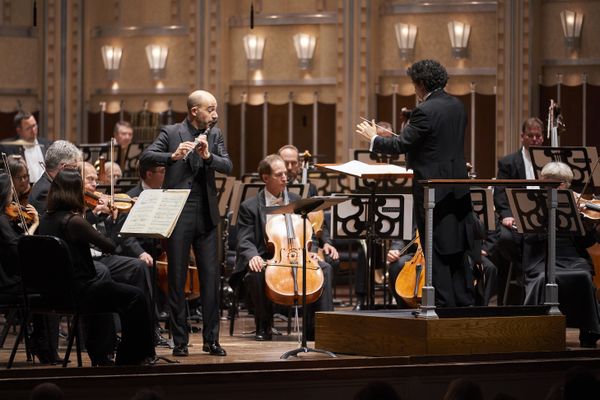
Following last week’s podium appearance from Matthias Pintscher, this week’s Cleveland Orchestra programs afforded the opportunity to hear from Pintscher as composer albeit under the capable baton of Alain Altinoglu. The work in question was Transir, a 2006 composition for flute and chamber orchestra, originally conceived for Emmanuel Pahud, principal flute of the Berlin Philharmonic. Last month, principal cello was Mark Kosower was afforded a concerto appearance; the present program passed the reins to another distinguished principal, namely Joshua Smith who has served as principal flute since 1990, when he was appointed at a mere twenty years old.

6G5MGMMWPJARTLF5WA7TZ77OGI
Joshua Smith, Alain Altinoglu, and The Cleveland Orchestra, photo credit Roger Mastroianni, Courtesy of The Cleveland Orchestra

Thursday’s performance counted as the American premiere of Transir. The French title suggests a state of paralysis due to cold, and it’s a work that certainly occupies a rarefied soundworld and atmosphere. In the spirit of the Debussy that preceded it, Pintscher favored a language that gave primacy to suggestion over directness. Unfamiliar – and quite unsettling – timbres were present without respite from the opening, and the score required Smith to engage in extended techniques to the extreme, including breathy sounds in the high register scarcely recognizable as emanating from a flute. Smith was supported by a chamber-sized orchestra which in spite of its modest dimensions included a substantial percussion section, offering garish contrasts. Sustained soprano notes in the violins were another important part of the fabric, in a sense presenting the melody one would think the flute should be doing in a more traditional piece. While I applaud The Cleveland Orchestra’s commitment to programming contemporary works – and Smith’s far-reaching virtuosity – I found the present work unconvincing, a bizarre though intriguing study in extended technique, novel timbres, and intense concentration.

Opening the evening was a twenty-minute suite drawn by Altinoglu himself from Debussy’s opera Pelléas et Mélisande – a fitting follow-up to TCO’s reading of Schoenberg’s work on the same subject a few weeks prior. The aura was immediately enigmatic with the orchestra offering a warm tone yet never fully disclosing. Altinoglu’s suite was chiefly comprised of the opera’s orchestral interludes, preserving much fine music while necessarily omitting much more. A solo from the concertmaster was of deep yearning, and flourishes in the harps were painted with impressionistic watercolors. The music grew in urgency only to ultimately shy away to a serene ending, tragic yet obfuscated.

Following the somewhat uneven first half was a generous sampling of Ravel, bringing to mind last season’s all-Ravel evening (which while not including a work by Pintscher, was conducted by Pintscher) – although the playing on Thursday, alluring as it was, rather fell short of the inspired level witnessed then. A descending four-note motif opened Rapsodie espagnole, serving as a binding element for the work as a whole. The hazy mystery of the night gave way to the comparatively livelier Malagueña, picking up energy but still generally subdued, and heightened by an extended English horn solo from Robert Walters. Initially written well before the rest of the work, the Habanera that followed was dreamy and sultry before daybreak came suddenly in the brilliant Feria. Fluid playing in the winds set the stage for the conclusion of brassy and percussive exuberance.

The Pavane pour une infante défunte served as a calming interlude of sumptuous orchestration. The gorgeous main theme appeared in various instrumental combinations, beginning in the horns – mellow yet not quite the liquid gold one might hope for – and most touchingly in the strings and harp. Boléro made for an ebullient close (not to mention an endurance test for the snare drum), giving virtually all the instruments a chance in the spotlight, beginning with the silvery flute – a fine test for the freshly appointed Jessica Sindell. An exercise in repetition as refracted through an orchestral kaleidoscope, the perpetual crescendo never fails to excite.

Hough and Imani Winds a sheer delight in Mostly Mozart’s A Little Night Music

Stephen Hough, piano
Imani Winds
Stanley H. Kaplan Penthouse
Lincoln Center
New York, NY
August 10, 2018

Debussy: Clair de lune from Suite bergamasque
Mozart: Quintet in E-flat major for Piano and Winds, K452
Poulenc: Sextet for Piano and Wind Quintet, FP 100

Encore:
Poulenc, arr. Hough: No. 1 from Trois mouvements perpétuels, FP 14

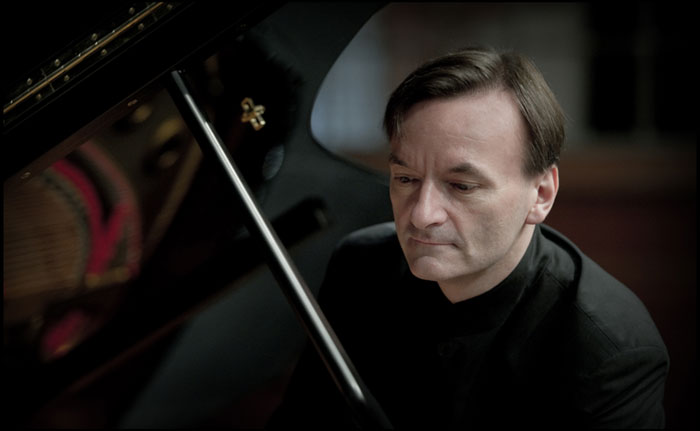
Right on the heels of the Mostly Mozart Festival Orchestra’s concluding performance of the summer season, one had a late-night opportunity to see pianist Stephen Hough in a much more intimate setting: a remarkable chamber music performance with the Imani Winds at the Stanley H. Kaplan Penthouse, part of the festival’s A Little Night Music series. Hough opened the program sans winds in a luminous, shimmering account of Debussy’s Clair de lune. Debussy is a composer to whom Hough has recently turned ample attention, releasing a very fine all-Debussy album at the beginning of the year (although one would need to look to his French Album for a recording of the present work). The acoustics in the Penthouse were a bit dry, but the striking setting of flickering candlelight and the Manhattan skyline made it a small price to pay, an atmospheric complement to the rapturous beauty of Hough’s pianism.

hough_pic46_large
Stephen Hough, photo credit Sim Canetty-Clarke

The remainder of the brief program was devoted to sterling examples of chamber works for piano and winds by Mozart and Poulenc. Hough noted that these disparate composers had little in common musically save for their wry sense of humor. A stately introduction opened the former’s Quintet (K452), giving way to a jaunty primary theme which beautifully melded Hough’s elegant keyboard playing with the graceful winds – a harmonious blend of diverse timbres. The Larghetto was sweet and dulcet in its delicate trills and ornaments, and an almost sinfully sumptuous melody was passed through the winds. The finale was a jovial affair yet in no apparent hurry with a lyrical subject at its core.

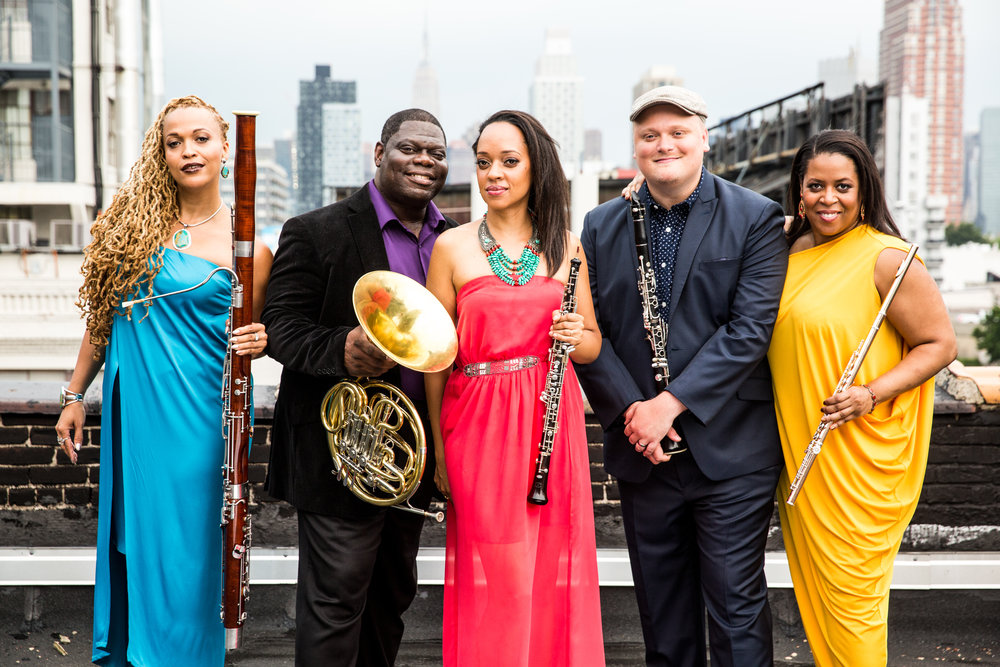
Poulenc’s Sextet, dating from the early 1930s, added the flute to the forces onstage. The commanding opening brought to life a scene bustling with coloristic contrasts and manic syncopations evoking American ragtime. A searching monologue in the bassoon (Monica Ellis) and impressionistic writing from the piano offered some introspection, only for the movement to conclude in a dramatic flourish. An underlying melancholy – perhaps another parallel to Mozart – was palpable in the central divertissement with some especially fine playing from oboist Toyin Spellman-Diaz. More frenzied contrast was manifest in due course, with a rambunctious and perky finale leading inexorably to a bright and brilliant end.

A lone encore continued the ensemble’s exploration of Poulenc, namely Hough’s own transcription for the sextet of the first of the Mouvements perpétuels (originally a work for solo piano). Hough was certainly apt in remarking it had “not a bit of angst”, and the seamless performance closed the evening in pure delight.

IMANI_WINDS_7_25_16_1022
Imani Winds, photo credit Matt Murphy

Andsnes and Hamelin dazzling in two piano recital

Leif Ove Andsnes, piano
Marc-André Hamelin, piano
Symphony Center
Chicago, IL
April 30, 2017

Mozart: Larghetto and Allegro in E-flat Major for Two Pianos
Stravinsky: Concerto for Two Pianos
Debussy: En blanc et noir
Stravinsky: The Rite of Spring

Encores:
Stravinsky: Madrid for Two Pianos from Four Studies for Orchestra (transc. Soulima Stravinsky)
Stravinsky: Circus Polka for Two Pianos (transc. Babin)
Stravinsky: Tango for Two Pianos (transc. Babin)

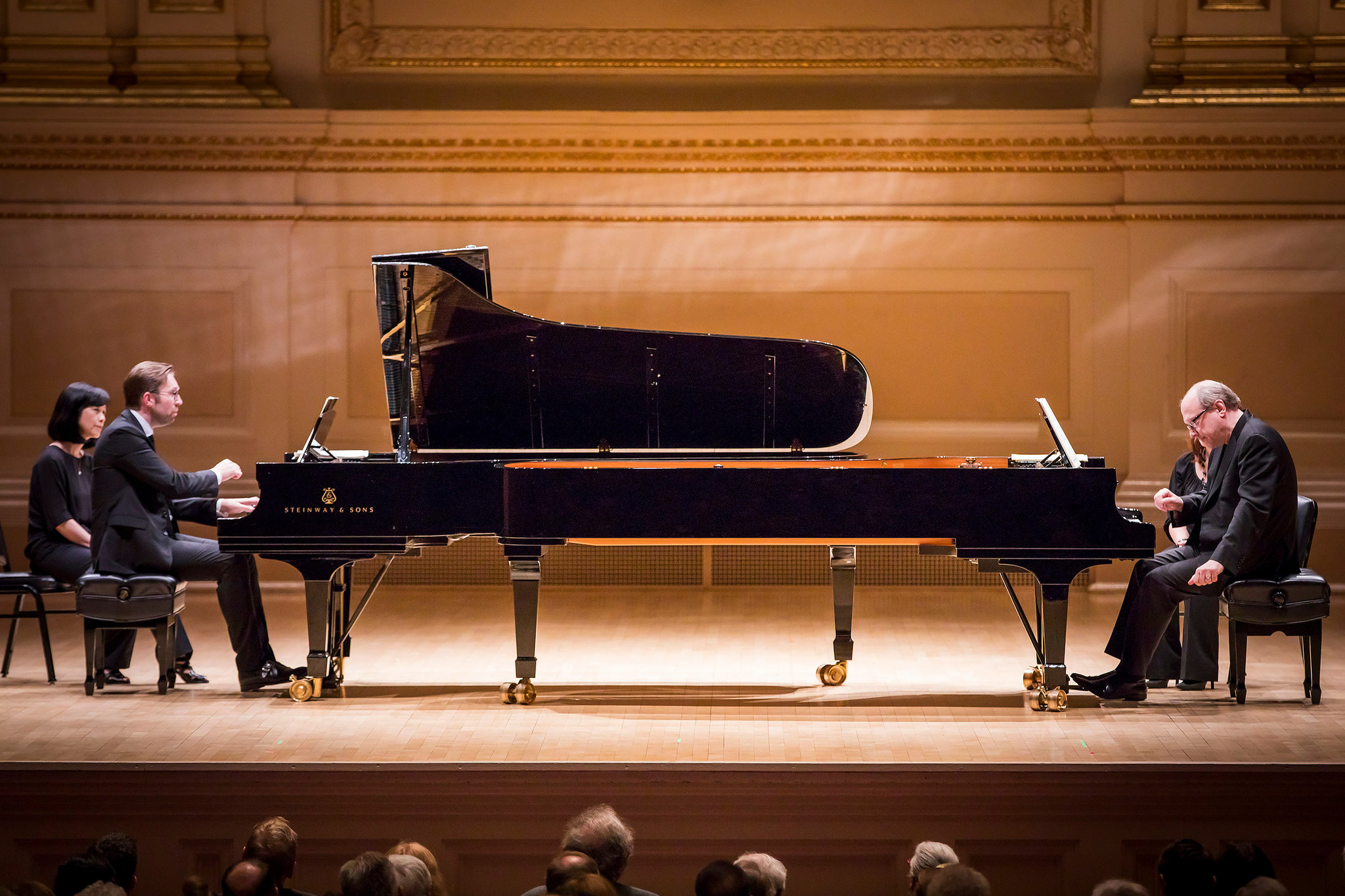
It is a rare opportunity indeed to see not one, but two of the world’s leading concert pianists on stage together.  This was fortunately the case Sunday afternoon, when Marc-André Hamelin and Leif Ove Andsnes stopped at Symphony Center as part of a 13-city tour of a bracing program that explored music for two pianos.  Their partnership goes back a decade when they performed the two piano version of The Rite of Spring at the Risør Chamber Music Festival, where Andsnes served as artistic director.  Not three weeks prior to the Chicago performance, the pair finally recorded the piece for Hyperion along with additional works of Stravinsky for the same medium also featured in the recital, and one is grateful this inspired collaboration has been preserved on disc given the pair’s absolutely electric chemistry.

01ANDSNES-superJumbo
Andsnes and Hamelin presenting the same program at Carnegie Hall, two days prior to their Symphony Center appearance, photo credit Chris Lee
The program opened unassumingly with Mozart’s Larghetto and Allegro in E flat major, with Andsnes taking the primo part in the whole of the first half.  The Larghetto was graceful but not without shades of melancholy, as in the best of the Mozart’s slow movements.  Cast in sonata form, the Allegro remained unfinished at the time of the composer’s death, and was presented in a completed version by Paul Badura-Skoda.  The sprightly main theme evidenced the duo’s rapport from the start, in what was an energetic warmup for all that was to follow.

Stravinsky’s Concerto for Two Pianos is a substantial if neglected work from his neoclassical period, written for him and his son Soulima to play together, and one couldn’t have asked for better advocates in Andsnes and Hamelin.  The first movement was of bold, sweeping gestures, delivered with a knife-edged acerbity.  The delicate ornamentation in the ensuing “Notturno” gave it a mysterious charm, while contrasting sections were more march-like.  Spiky dissonances characterized much of the “Quattro variazioni”, while the finale opened with a brief but declamatory prelude to set up an intricate fugue.  The theme of the preceding variations was not heard until it was presented as the subject of the fugue – the composer had originally intended for the last two movements to be in reverse, but settled on the present ordering to give the work a more forceful ending.  And a forceful ending it certainly had!

Written in 1915, Debussy’s En blanc et noir is very much a product of the First World War.  The angular themes of the opening movement made for a striking visual effect with Andsnes and Hamelin perfectly in sync as a mirror image of each other.  The somberness of wartime was particularly apparent in the central movement, which made dissonant allusions to the Lutheran chorale “Ein’ feste Burg ist unser Gott” to depict the German enemy.  The final movement – which, perhaps significantly, was dedicated to Stravinsky – was fleet and mercurial, a stark departure in its apparent playfulness.

Stravinsky’s Rite of Spring has been heard on the same stage innumerable times from the Chicago Symphony, but hearing it on two pianos was a refreshing and altogether different experience.  It was in this version that the seminal work was first heard – an early performance involved the composer with Debussy: what a sight that must have been.  The work is actually carefully written such that it can be performed on one piano, four hands, but the decision to split it across two pianos was a wise one, not just for obvious logistical concerns, but the resonance of two instruments along with two separate sets of pedals allowed for a much greater range of orchestral effect.

Hamelin commanded the primo from here to the end of the program, opening with the famous bassoon line.  In spite of Hamelin’s attention to nuance, what’s striking in the bassoon sounded admittedly pedestrian on the piano.  This was quickly allayed, however, as “The Augers of Spring” built to electrifying orchestral sonority and power.  Despite the orchestral score not calling for piano (as Petrushka does, and quite prominently), the work sounded very natural pianistically.  The memorable performance was by and large a steel-fingered assault with hurricane-like intensity, continuing unmitigated through the final, crashing flourish.

A rousing, well-deserved ovation brought the pair back for three encores, all by Stravinsky.  “Madrid” appropriately had an irresistible Spanish tinge, with a hint of the jota.  The “Circus Polka” (“we’ve prepared all these lovely things for you”, noted Hamelin in his introduction to the delight of the audience) was Stravinsky at his wittiest, replete with bitonalities (and perhaps an inspiration for Hamelin’s own “Circus Galop”).  Lastly, the “Tango” was sultry, yet not without the composer’s unmistakable stamp.  Thanks are due to both for being on hand for an engaging Q&A session following the concert, and their chemistry there was just as palpable as it was on stage.

Hamelin Andsnes
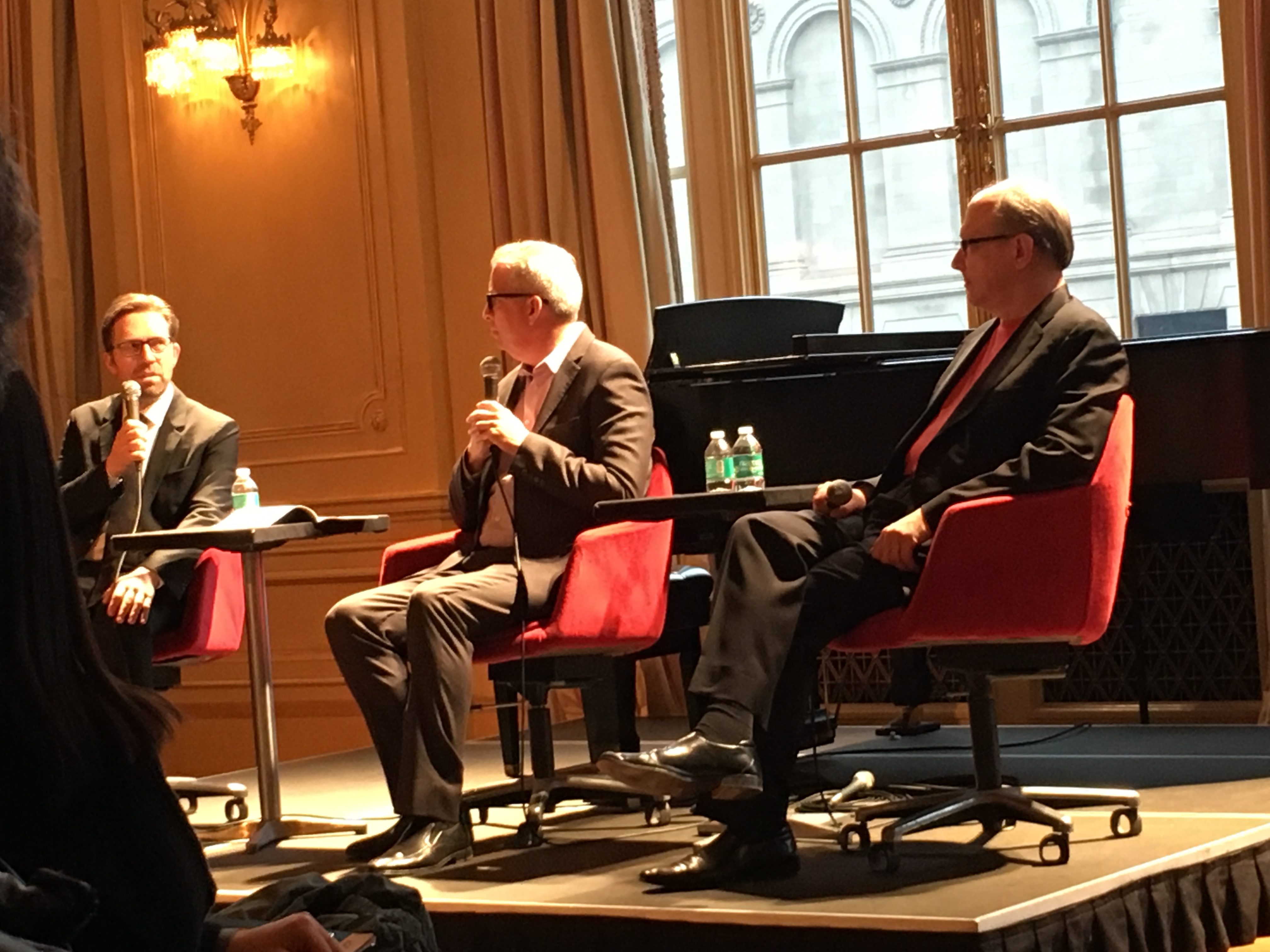
Leif Ove Andsnes, James Fahey (Director of Programming, Symphony Center Presents), and Marc-André Hamelin during the post-concert Q&A