
Pittsburgh Symphony Orchestra
Manfred Honeck, conductor
Bruce Liu, piano
Lilit Davtyan, soprano
Heinz Hall
Pittsburgh, PA
June 6, 2025
Vali: The Camel Bell
Beethoven: Piano Concerto No. 3 in C minor, Op. 37
Encore:
Chopin: Fantasie-Impromptu in C-sharp minor, Op. 66
Mahler: Symphony No. 4 in G major
Both of the Pittsburgh Symphony’s final two subscription programs of the season are scheduled to open with a world premiere, the first of which saw Reza Vali’s The Camel Bell come into being. Born in Iran, Vali is a composer with strong connections to Pittsburgh, having completed his PhD in composition at Pitt and subsequently teaching for many years at Carnegie Mellon. Additionally, this counts as his fourth PSO commission — the first three of which have been recorded on a recent Naxos release.
In his prefatory remarks, Vali likened the work to a “dialogue between great musical civilizations,” specifically noting it weaves together European, American, and Persian influences. A burst of energy began, and work explored the sounds of quarter tones – somewhat jarring to the Western ear, but a striking effect. Inflections even of jazz surfaced in this kaleidoscopic confluence of musical cultures, and I enjoyed the dueling solos between violinists David McCarroll and Jeremy Black. A tour de force closed one of the most impressive new pieces the PSO has introduced this season.
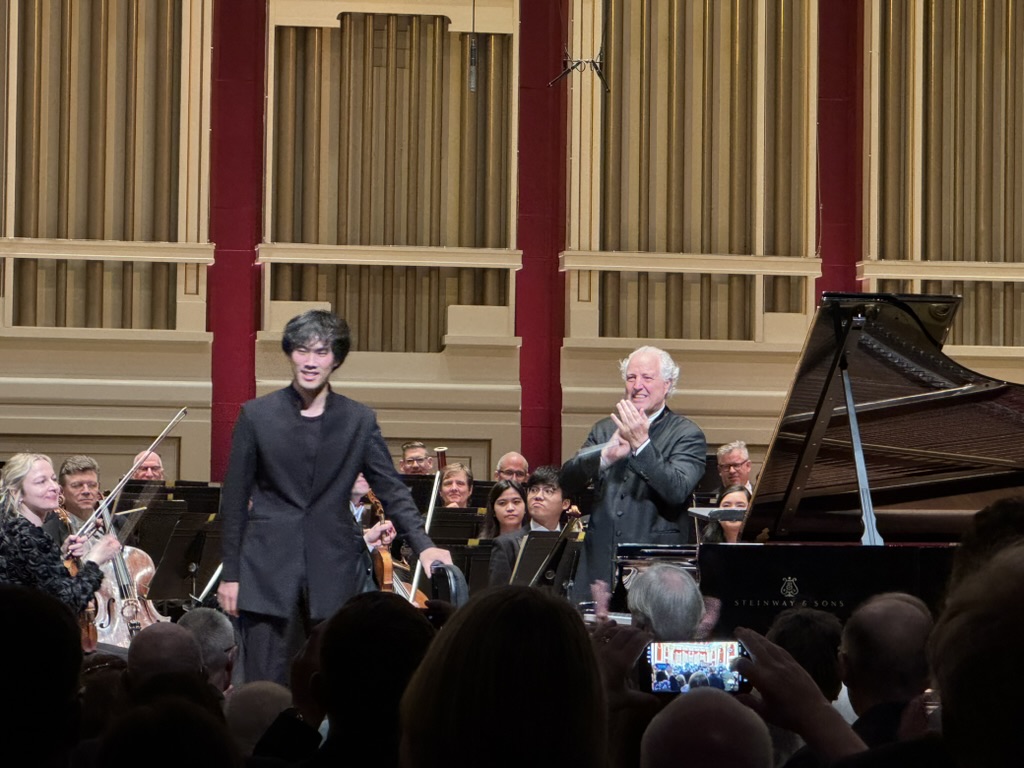
Pianist Alice Sara Ott was regrettably obliged to bow out of this weekend’s appearances due to acute tendinitis — much admiration to Bruce Liu for stepping in on short notice (as well as for the PSO360 recital situated between the two performances of this program). Liu has come to prominence after capturing first prize in the 2021 International Chopin Piano Competition, so a PSO debut from him was a welcome surprise.
Crisply articulated, the orchestral introduction to Beethoven’s Piano Concerto No. 3 introduced the C minor tonality, replete with requisite tension. Liu entered the fold by way of a fiery flourish on the keyboard, while nonetheless purveying a tone elegant and rippling, and the cadenza was given with dramatic flair. The unaccompanied piano opened the central Largo, prayer-like, and probing its great expressive potential. I was struck by Liu’s limber, flexible fingerwork in the stylishly elegant finale, ending in the brightness of C major. As an encore, Liu offered a marvelous account of Chopin’s impassioned Fantasie-Impromptu.
Mahler’s Fourth Symphony is a different animal than the composer’s other symphonies, slimmer and rather classically proportioned, yet still unmistakably Mahlerian. Music director Manfred Honeck drew the orchestral fabric with clarity and transparency, and a classical economy that brought out its details and nuances — and not without an infectious lilt. In the second movement, concertmaster McCarroll played a de-tuned violin, purveying a coarse, rustic quality further enhanced by a shrill clarinet.
In the sprawling Ruhevoll we were given the first glimpse of heaven, plaintive and serene, seemingly at peace — but still not without a certain strife with which to contend. The finale began with an innocent purity, free from world-weary concerns. Soprano Lilit Davtyan perhaps could have benefitted from clearer diction, but I was mostly taken by the angelic quality of her voice, and the way the orchestra deftly matched it.
 quasi-faust