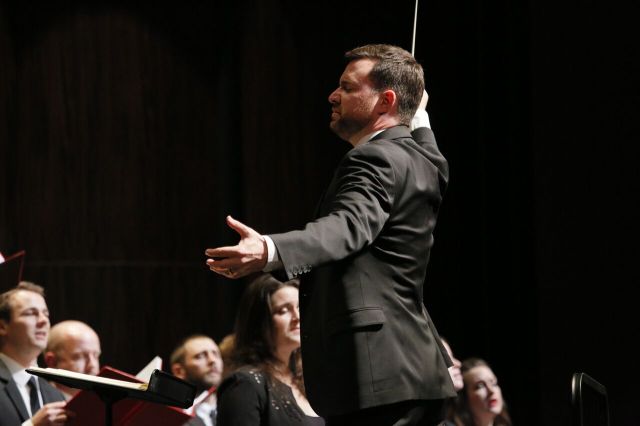
Tilson Thomas shines as both composer and conductor with The Cleveland Orchestra

Cleveland Orchestra
Michael Tilson Thomas, conductor
Sasha Cooke, mezzo-soprano
Dashon Burton, bass
Severance Hall
Cleveland, OH
February 20, 2020

Tilson Thomas: Meditations on Rilke
Berlioz: Symphonie fantastique, Op. 14

Now in his twenty-fifth and final season as music director of the San Francisco Symphony, Michael Tilson Thomas has increasingly devoted his time to composition, following in the footsteps of the composer-conductor luminaries with whom he closely worked – Stravinsky, Copland, and Bernstein amongst them. His freshly-minted song cycle Meditations on Rilke was given its second set of performances last weekend, following the San Francisco world premiere in January. It’s a work, however, which has been gestating in the back of Tilson Thomas’ mind for some time: in a recent interview, he referred to it as a “pages of [his] musical diary.” Structurally, the piece immediately brings to mind Mahler’s Das Lied von der Erde in its scoring for large orchestra with mezzo-soprano and bass soloists alternating between the six Rilke poems. While not on as large a scale as the Mahler, it’s still quite substantial, clocking in at just under forty minutes – the program was originally slated to open with Berlioz’s Roman Carnival Overture, a quantity which was excised when the MTT work burgeoned to its current dimensions.
164968-clo-022020-270c-roger-mastroianni--courtesy-of-the-cleveland-orchestra
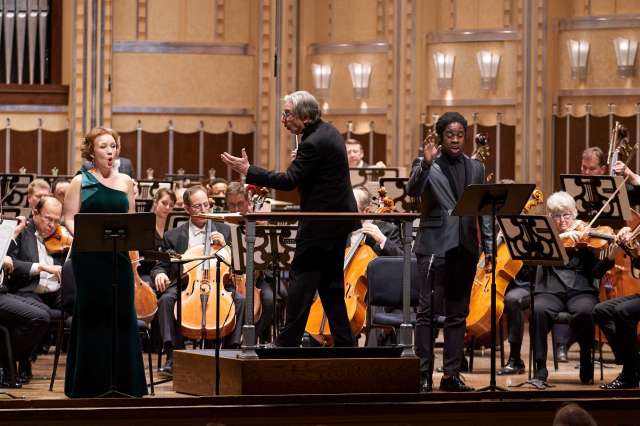
Sasha Cooke, Michael Tilson Thomas, and Dashon Burton with The Cleveland Orchestra, photos credit Roger Mastroianni, courtesy of The Cleveland Orchestra

A deliberately out-of-tune, honky-tonk sounding upright piano had the first word in the opening “Herbsttag,” setting the scene in a small-town dive bar where the pianist introduces influences from the classical repertoire in addition to the standard pub fare, setting in motion the present set of stream-of-consciousness reflections. The texture grew from the solo piano to an orchestral landscape of colorful effects, remaining resolutely tonal and approachable. Dashon Burton offered a deep and powerful tone, yet was often touchingly pensive, and the spirit of Mahler was never far away – hardly a surprise in a work from such a distinguished Mahlerian as MTT. “Ich lebe mein Leben” was given a lushly gorgeous setting, sweetly sung by Sasha Cooke, and an oboe passage from Frank Rosenwein served as a further highlight. “Das Lied des Trinkers” again brought to mind Das Lied von der Erde in its apparent affinity for drinking songs. A rather more rambunctious counterpart to the preceding song, matters began plaintively but soon crested to the thorny and dissonant.

“Immer wieder” featured a glowing brass chorale, and as elsewhere, extensive paragraphs for orchestra alone. Cooke had a natural feel for MTT’s language in this gem of the cycle, which the composer colorfully likened to a “Schubert cowboy song” – Morricone came to my mind as well. The crack of a whip epitomized the vigor given to “Imaginärer Lebenslauf” which called upon both singers, often quite ingeniously blended. The concluding “Herbst” opened with a long flute solo very finely given by Joshua Smith. The harp and pizzicato strings gave matters an ineffably autumnal quality, and the cycle closed with Burton’s repeated incantation of “fallen”, serving a similar function as “ewig” in the work’s Maherlian predecessor.

MTT has a long history of not only conducting the Berlioz Symphonie fantastique, but conducting it in Cleveland, having first performed it with this orchestra in 1977. It made for a choice pairing with the Rilke songs with both works deeply autobiographical and evidencing their respective conductors’ acute ear for orchestral color. The dreamy “Rêveries” that opened was meditative yet never shying away from building to hypnotic passions. The first presentation of the ubiquitous idée fixe was refined, hardly hinting at the grotesque mutations to come, and the pious solemnity of the coda was another highpoint of this first movement. “Un bal” began as lilting waltz, emanating a Gallic elegance, only to dissolve in making way for the idée fixe. There was sharp clarity even given the sprawling orchestra, paying dividends in the blazing conclusion.

The “Scène aux champs” was given with ample breathing room, a capacious portrait of the quietude of the countryside. The dialogue between English horn Robert Walters and offstage oboe Jeffrey Rathbun was expertly articulated – and at the long movement’s end, Walters was answered not by Rathbun, but by the rumbling timpani, signaling the impending storm. “Marche au supplice” was tautly concentrated, erupting with brilliant brass anchored by a backbone of bassoons (four of them, no less). Daniel McKelway’s shrill interjections on the E-flat clarinet made for arresting effect in the closing “Songe d’une nuit du sabbat”, perhaps only outdone by the tolling cathedral bells and goosebumps-inducing low brass.
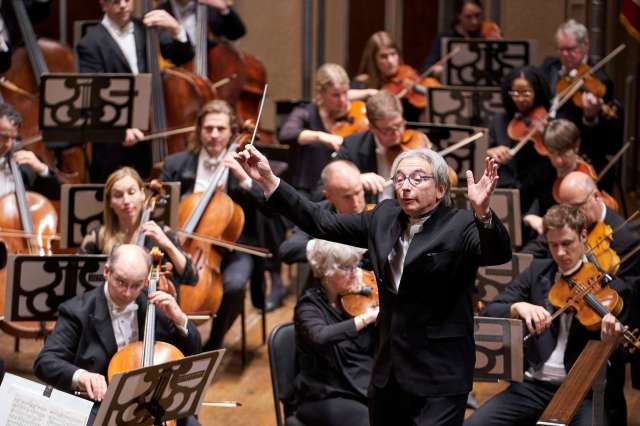
164966-clo-022020-473c-roger-mastroianni--courtesy-of-the-cleveland-orchestra
Tilson Thomas and The Cleveland Orchestra

Cleveland Orchestra’s 100th season closes in the magnificence of Beethoven’s Ninth

Cleveland Orchestra
Franz Welser-Möst, conductor

Erin Wall, soprano
Jennifer Johnston, mezzo-soprano
Norbert Ernst, tenor
Dashon Burton, bass-baritone

Cleveland Orchestra Chorus
Lisa Wong, director

Severance Hall
Cleveland, OH
May 17, 2018

Beethoven: Große Fuge, Op. 133 (version for string orchestra)
Beethoven: Symphony No. 9 in D minor, Op. 125, Choral

Note: for comments on the May 10 performance, inclusive of Symphony Nos. 1 & 3 and the Overture to The Creatures of Prometheus, please see here. For the performances from May 11-13 of Symphony Nos. 2 and 4-8 along with the Egmont, Coriolan, and Leonore overtures, please see here.

The Cleveland Orchestra’s watershed centennial season, as well as the ambitious Prometheus Project has reached a glorious conclusion with a pair of Beethoven’s monumental masterpieces. While the biggest draw was certainly the exultant Ninth Symphony, the inclusion of the Große Fuge made the final entry in the series much more than a traversal of that well-known symphony, but a probing survey of the apex of Beethoven’s late style. Originally the concluding movement of the Op. 130 string quartet, the daunting Große Fuge functioned remarkably well independently; presented in transcription for string orchestra, it has appeared with frequency on a Welser-Möst program in spite of (or perhaps because of) its rigor.

Cleveland Orchestra, Beethoven
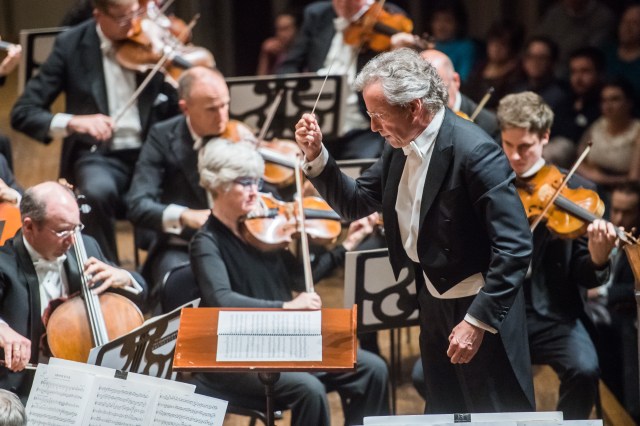
Welser-Möst conducting the Große Fuge, all photos credit Ken Blaze, Courtesy of The Cleveland Orchestra

The string quartet’s orchestral potential was in full bloom here, immediately apparent from richness of the strings in the jarring opening and spiky dissonances. Calmer interludes only occasionally mitigated the bracing severity of the work, and it was quite a sight to so many bows in perfect synchronization, even in the most dizzyingly complex passages wherein Beethoven fully realized his contrapuntal potential hinted at in the Ninth Symphony.

That symphony, of unprecedented length during its time, generously filled the balance of the lavish program. Opening with protean, elemental germs of themes, it explored the most fundamental of intervals before coalescing into a rigorous sonata allegro, given with the precision and drive of a well-oiled machine. The scherzo of the Ninth is no lightweight trifle, but a creation just as weighty as the opening movement which the orchestra played with a relentless vigor, at times proceeding with a march-like swagger, elsewhere, as if in ghostly imitation of itself. Rustic warmth from the horns and the songfulness of the strings made for a trio that occupied a world apart. A choir of winds introduced the slow movement, giving way to a theme in the strings of absolute serenity, a moment where such a stormy figure as Beethoven was truly at peace with the world – in line with the love transcendent expressed unambiguously through Schiller’s text in the finale.

Even after two centuries, the vast closing movement stands in a class of its own in its ingenious melding of orchestra, choir, and soloists, as well the way it manages to encapsulate the entire symphony as a unified whole. A striking bitonality functioned as a call to arms, the climax of the tension between D minor and B flat major established early on. The main theme of each preceding movement was presented sequentially, a reminiscence as refracted through a newfound vantage point and punctuated by instrumental recitatives. The “Ode to Joy” first surfaced in the low strings, seemingly innocuous but blossoming to the full orchestra in due course.

Bass-baritone Dashon Burton had a commanding recitative in the work’s first vocal appearance, delivering text written by the composer himself as a prologue to Schiller’s poem. There was a satisfying sense of coming full circle in engaging Burton for the season finale as he had last appeared on this stage during the performance of The Cunning Little Vixen with which this season began. The quartet of vocal soloists was remarkably well-balanced and of a natural chemistry; tenor Norbert Ernst had a notable moment during the movement’s “Turkish” episode while Erin Wall and Jennifer Johnston filled out the upper registers. Most impressive, however, was the stunning power of the chorus, particularly in the dazzling fugato, expertly prepared under the direction of Lisa Wong (who was officially promoted to chorus director just the day before). In taut cohesion with their orchestral counterparts, they led the symphony to a close of magnificent splendor, a memorable end to a memorable season.

This slideshow requires JavaScript.

Mozart’s Requiem a rousing close to Summers@Severance

Cleveland Orchestra
Patrick Dupré Quigley, conductor

Lauren Snouffer, soprano
Emily Fons, mezzo-soprano
Steven Soph, tenor
Dashon Burton, bass-baritone

Blossom Festival Chorus
Robert Porco, director

Severance Hall
Cleveland, OH
August 18, 2017

Mozart: Requiem, K626

In a thrilling close to this season’s triptych of Summers@Severance offerings, the Cleveland Orchestra joined forces with the Blossom Festival Chorus and a quartet of vocal soloists in Mozart’s enigmatic final work, the incomparable Requiem (presented in the familiar completion by Franz Xaver Süssmayr).  Making his podium debut was Patrick Dupré Quigley, founder and artistic director of the South Florida based choral ensemble Seraphic Fire, who collaborated with the Orchestra in last March’s memorable performance of Stravinsky’s Threni.  Not one to be restrained by the conventions of historical performance practice, Quigley opted for an orchestra and chorus expansive in number, what it may have lacked in authenticity it more than made up for in a rich tapestry of sound.

PDQ Pub Conducting
Patrick Dupré Quigley

From the opening bars of the Introit, one was struck by the gripping intensity and seriousness of purpose, and the resonant tones of the pair of basset horns offered an early instrumental highlight, while Joela Jones’ organ gave matters an almost monastic quality. With graceful gestures, Quigley adroitly held all the moving parts in tight alignment, and soprano Lauren Snouffer provided and heaven-reaching solo passage.  The brief Kyrie was marked by an intricate fugato, with all voices deftly balanced and clearly delineated.

Ample fire and passion filled the Dies irae to open the extensive Sequence, and rapid execution was to be found in this technical tour de force.  The Tuba mirum constituted a further highpoint, with the heft of bass-baritone Dashon Burton in dialogue with the trombone, and the more strained quality of Steven Soph’s tenor offered effective contrast.  The full force of the chorus was rallied in the ensuing Rex tremendae, coming together in especially striking fashion on the word “majestatis”, a majestic moment indeed.  All four soloists had their due in the Recordare; in spite of the relatively youthful age of the quartet, they attained a balance and chemistry one would expect from a much more seasoned group.

A menacing vigor drove the Confutatis, with particular grit in the strings, only to be countered by the angelic voices of the female choir.  A resounding major closed the famous Lacrymosa, a glorious moment which could hardly have been anticipated by the innocent sighs with which it began.  The polish of the Blossom Festival Chorus (incidentally, a volunteer group) truly shone in the Offertory, and further in negotiating the counterpoint of “Osanna in excelsis” which concluded both the Sanctus and Benedictus.

Melancholy returned in the august Agnus Dei (this is, after all, a requiem), and the wistful introspection of the opening was invoked in the concluding Lux aeterna, surely the most inspired moment of Süssmayr’s completion.  Snouffer was effective in her final solo, and the weight of the chorus built to one last fugue.  A dramatic pause kept the audience spellbound before delivery of the concluding line, a memorable finish to a very successful summer season at Severance Hall.