
Simone Dinnerstein, piano
Stetson Chapel
Kalamazoo College
Kalamazoo, MI
May 7, 2024
Couperin: Les barricades mystérieuses, from Pièces de clavecin
Schumann: Arabeske, Op. 18
Satie: Gnossienne No. 3
Glass: Mad Rush
Schumann: Kreisleriana, Op. 16
Encore:
Couperin: Les barricades mystérieuses, from Pièces de clavecin
There’s a first time for everything, and I can safely say that Tuesday evening at the Gilmore Festival was the first concert I’ve attended in which the audience was asked to shelter in the venue’s basement for 45 minutes due to uncomfortably close tornados raging nearby. A hearty crowd of committed pianophiles stuck it out, however, and were amply rewarded with an artfully crafted recital from Simone Dinnerstein.
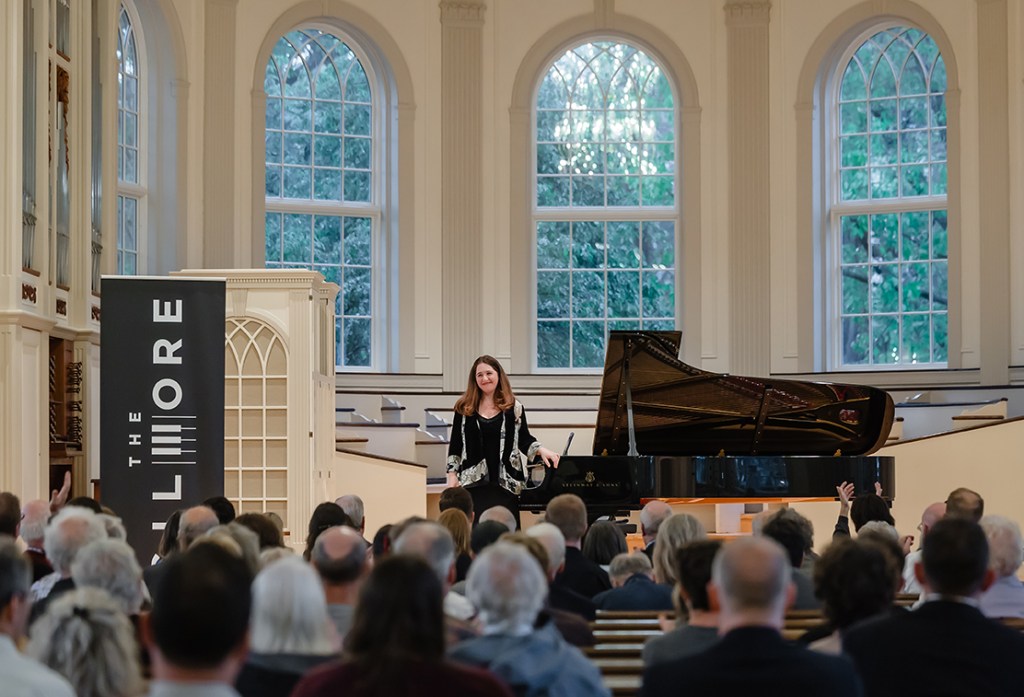
This was essentially a live performance of her Undersong album, the last of a trilogy of projects she recorded during the pandemic. The title, an archaic word for chorus or refrain, refers to the idea of return, revisiting places after the passage of time. All of the diverse body of music programmed engaged with the theme in a different way, but in each case, a melody presented resurfaced in some context later on. The delayed evening began with Couperin’s gem of a piece Les barricades mystérieuses, quite literally the calm after the storm. Elegantly ornamented, Dinnerstein drew from the piano a rich, reflective tone.
Schumann’s Arabeske saw the composer at his most Schubertian with its lyrical, rippling figures, arriving at a point of return following some contrasting episodes, and its gentle coda amounts to one of Schumann’s loveliest inspirations. Philip Glass’ Mad Rush continued the theme into the late 20th-century. Undulating figures changed subtly, almost imperceptibly, growing in intensity as Dinnerstein filled the Stetson Chapel with waves of sound. She has a close affinity for the music of Glass, with the composer having written his Third Piano Concerto with her in mind.
The third of Satie’s Gnossiennes evoked the French composer’s rarefied, idiosyncratic language, distilled of any excess and expressive in its barrenness. Recurrence is a key element of the eight vignettes that comprise Schumann’s Kreisleriana. Fleet and mercurial, the opening was given an impassioned workout. The most extended selection of the suite followed, with contrasting themes bound together by its common thread. Nearly manic, the penultimate episode introduced contrapuntal textures in homage to Bach, played with incisive clarity, and the final piece was stately and sensitive, the culmination of a long trajectory.
Dinnerstein’s lone encore embodied the undersong theme in returning to the Couperin with which the recital began. What a lovely gesture it was to close the program full-circle.

 quasi-faust